
Sonographic Assessment of Fetal Biometric Parameters and Maternal Height Ratio for Prediction of Cesarean Delivery due to Labor Dystocia
DOI:
https://doi.org/10.33192/smj.v77i6.273115Keywords:
Labor dystocia, fetal biometric parameters, maternal height, cesarean deliveryAbstract
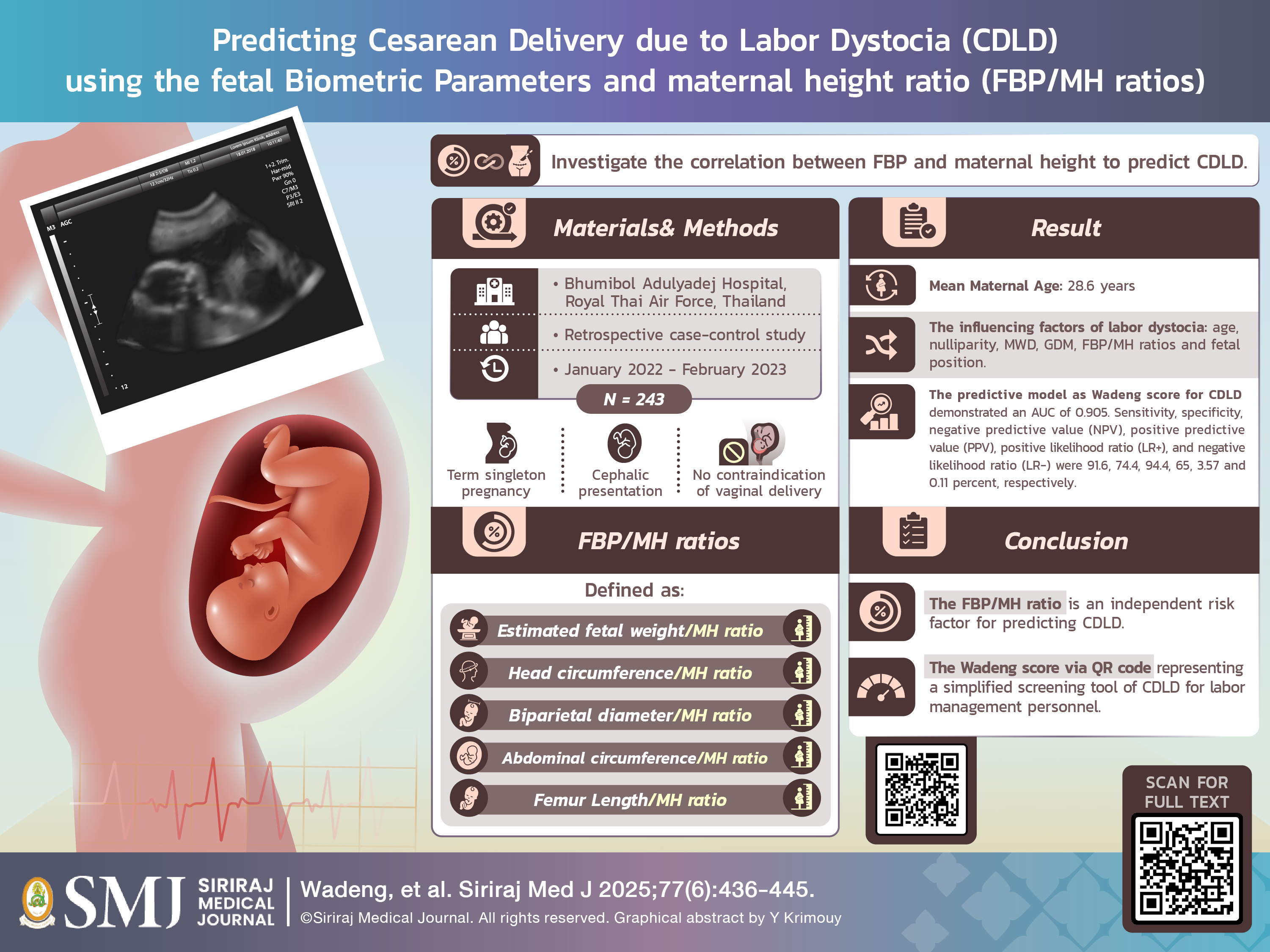
Objective: To investigate the correlation of fetal biometric parameters (FBP; estimated fetal weight (EFW), head circumference (HC), biparietal diameter (BPD), abdominal circumference (AC) and femur length (FL) and maternal height (MH) ratio to predict cesarean delivery (CD) due to labor dystocia (LD).
Materials and Methods: This retrospective case-control study was conducted at the Department of Obstetrics and Gynecology, Bhumibol Adulyadej Hospital, Bangkok, Thailand, between January 2022 and December 2023. Inclusion criteria were pregnant women with singleton, cephalic presentation, termed and without contraindication of vaginal delivery.
Results: A total of 243 parturients were included in the study,with a mean age of 28.6 years. The cesarean delivery rate was 34.1% (83/243). The predictive model was developed incorporating variables including parity, maternal age, gestational diabetes mellitus (GDM), weight, and the FBP/MH ratio. The predictive model for CD due to LD demonstrated an AUC of 0.905, indicating excellent performance. Sensitivity, specificity, negative predictive value (NPV), positive predictive value (PPV), positive likelihood ratio (LR+), and negative likelihood ratio (LR-) were 91.6, 74.4, 94.4, 65, 3.57 and 0.11 percent, respectively.
Conclusion: The FBP/MH ratio is an independent risk factor for predicting CD due to LD. The predictive model of CD due to LD gave sensitivity, specificity, NPV and PPV at percentages of 91.6, 74.4, 65 and 94.4 respectively. This model might be a simple screening tool for labor attending personnel.
References
Cunningham FG, Lenovo JK. Physiology of Labor. In: Cunningham FG, Lenovo JK, editors. Williams Obstetrics. 26th ed. New York: McGraw Hill Education; 2022.p.27-30, 398-443.
Titapant V, Phtithakwatchara N. Trends in Modes of Delivery in Siriraj Hospital. Siriraj Med J. 2007;59:271-3.
Lerkovit S, Camann WR. Effective Epidural Analgesia during Labor: A Feasible Method to Decrease Unnecessary Cesarean Deliveries in Thailand. Siriraj Med J. 2024;76:541-9.
Di Pasquo E, Morganelli G, Volpe N, Labadini C, Ramirez Zegarra R, Abou-Dakn M, et al. The sonographic measurement of the ratio between the fetal head circumference and the obstetrical conjugate is accurate in predicting the risk of labor arrest: results from a multicenter prospective study. Am J Obstet Gynecol MFM. 2022;4(6):100710.
Molaei B, Ghafoori S, Manteghi G, Tofighi Sh. Fetal Weight and Head Circumference Estimated by Ultrasound for Predicting Cervical Dilatation Progression Rate and Mode of Delivery. J Midwifery Reprod Health. 2022;10(4):3516-22.
Lipschuetz M, Cohen SM, Israel A, Baron J, Porat S, Valsky DV, et al. Sonographic large fetal head circumference and risk of cesarean delivery. Am J Obstet Gynecol. 2018;218(3):339.e1-7.
Verhoeven CJ, Rückert ME, Opmeer BC, Pajkrt E, Mol BW. Ultrasonographic fetal head position to predict mode of delivery: a systematic review and bivariate meta-analysis. Ultrasound Obstet Gynecol. 2012;40(1):9-13.
Dall'Asta A, Ramirez Zegarra R, Corno E, Mappa I, Lu JLA, Di Pasquo E, et al. Role of fetal head-circumference-to-maternal-height ratio in predicting Cesarean section for labor dystocia: prospective multicenter study. Ultrasound Obstet Gynecol. 2023;61(1):93-8.
Caughey AB, Cahill AG, Guise J-M, Rouse DJ. Safe prevention of the primary cesarean delivery. Am J Obstet Gynecol. 2014;210:179-93.
Zhang J, Landy HJ, Ware Branch D, Burkman R, Habermann S, Gregory KD, et al. Consortium on Safe Labor. Contemporary patterns of spontaneous labor with normal neonatal outcome. Obstet Gynecol. 2010;116(6):1281-7.
Boatin AA, Ngonzi J, Ganyaglo G, Mbaye M, Wylie BJ, Diouf K. Cesarean delivery in low- and middle-income countries: A review of quality of care metrics and targets for improvement. Semin Fetal Neonatal Med. 2021;26(1):101199.
Betran AP, Ye J, Moller AB, Souza JP, Zhang J. Trends and projections of caesarean section rates. global and regional estimates. BMJ Glob Health. 2021;6(6):e005671.
Sunsaneevitayakul P, Sompagdee N, Asad-Dehghan M, Talungchit P. Effect of Gestational Weight Gain on Overweight and Obese Pregnant Women. Siriraj Med J. 2022;74:364-70.
Yang Y. An intrapartum calculator for predicting cesarean birth due to dystocia: Preliminary findings from a single-center study in Korea. Birth. 2022;49(4):628-36.
Liu Y, Gong Q, Yuan Y, Shi Q. Prediction model for labour dystocia occurring in the active phase. J Obstet Gynaecol. 2023;43(1):2174837.
Published
How to Cite
License
Copyright (c) 2025 Siriraj Medical Journal

This work is licensed under a Creative Commons Attribution-NonCommercial-NoDerivatives 4.0 International License.
Authors who publish with this journal agree to the following conditions:
Copyright Transfer
In submitting a manuscript, the authors acknowledge that the work will become the copyrighted property of Siriraj Medical Journal upon publication.
License
Articles are licensed under a Creative Commons Attribution-NonCommercial-NoDerivatives 4.0 International License (CC BY-NC-ND 4.0). This license allows for the sharing of the work for non-commercial purposes with proper attribution to the authors and the journal. However, it does not permit modifications or the creation of derivative works.
Sharing and Access
Authors are encouraged to share their article on their personal or institutional websites and through other non-commercial platforms. Doing so can increase readership and citations.