
Association between Internet Gaming Disorder and Associated Parental and Peer Attachment: A Crosssectional Study among Thai Adolescents
DOI:
https://doi.org/10.33192/smj.v77i8.273394Keywords:
Internet Gaming Disorder, Prevalence, Parental Attachment, Peer Attachment, AdolescentsAbstract
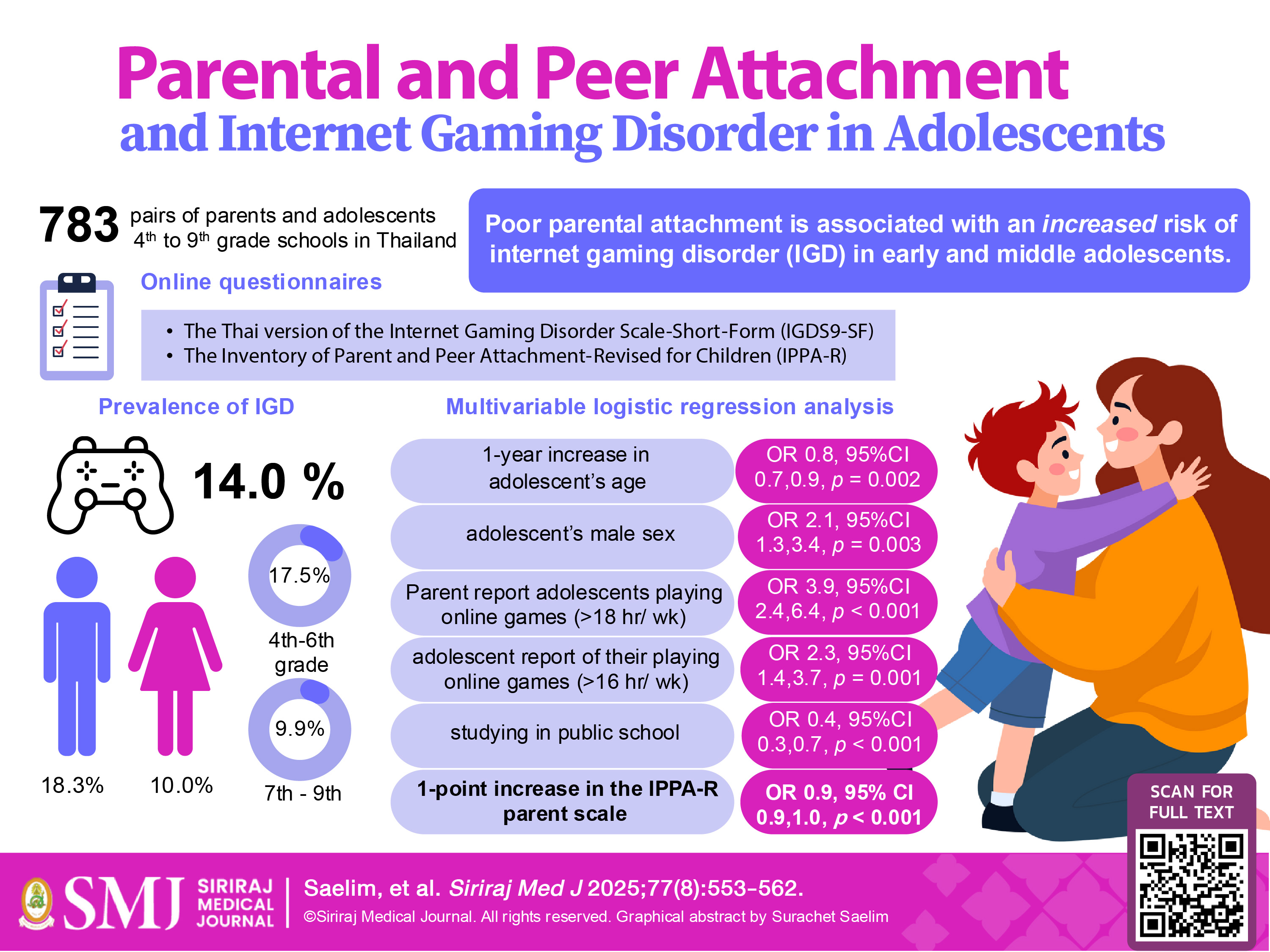
Objective: This study examined the prevalence of Internet Gaming Disorder (IGD) and its association with parental and peer attachment among Thai adolescents, accounting for gender and developmental stages.
Materials and Methods: A cross-sectional design involved 783 parent-adolescent pairs (4th-9th grade, Thailand). Online questionnaires, including the Thai version of the Internet Gaming Disorder Scale-Short-Form (IGDS9-SF) and the Inventory of Parent and Peer Attachment-Revised for Children (IPPA-R), were used. Multivariable logistic regression analyzed the data.
Results: The overall IGD prevalence was 14.0%, higher in males (18.3%) and 4th-6th graders (17.5%). Multivariable logistic regression analysis showed that a 1-year increase in adolescent age (OR 0.8, p=0.002), male sex (OR 2.1, p=0.003), parental report of adolescents playing online games (>18 hours/week) (OR 3.9, p<0.001), adolescent report of their playing online games (>16 hours/week) (OR 2.3, p=0.001), and studying in public school (OR 0.4, p<0.001), and a 1-point increase in the IPPA-R parent scale (OR 0.9, p<0.001) were significantly associated with IGD. No significant interaction terms for gender and developmental stages were identified.
Conclusion: Early male adolescents are at higher IGD risk. Poor parental attachment is associated with increased IGD likelihood. Preventive strategies focusing on strengthening parental attachment may help mitigate IGD in this population.
References
Global games market report 2022 [Internet]. Newzoo; 2022 [cited 2025 Jan 20]. Available from: http://www.daelab.cn/wp-content/uploads/2023/09/2022_Newzoo_Free _Global_Games_Market_Report.pdf
Paulus FW, Ohmann S, von Gontard A, Popow C. Internet gaming disorder in children and adolescents: a systematic review. Dev Med Child Neurol. 2018;60(7):645-59.
American Psychiatric Association. Diagnostic and statistical manual of mental disorders. 5th ed. Arlington (VA): APA; 2013.
Fam JY. Prevalence of internet gaming disorder in adolescents: a meta-analysis across three decades. Scand J Psychol. 2018;59(5):524–31.
Stevens MW, Dorstyn D, Delfabbro PH, King DL. Global prevalence of gaming disorder: A systematic review and meta-analysis. Aust N Z J Psychiatry. 2021;55(6):553-68.
Han TS, Cho H, Sung D, Park MH. A systematic review of the impact of COVID-19 on the game addiction of children and adolescents. Front Psychiatry. 2022;13:976601.
Alhamoud MA, Alkhalifah AA, Althunyan AK, Mustafa T, Alqahtani HA, Awad FAA. Internet gaming disorder: Its prevalence and associated gaming behavior, anxiety, and depression among high school male students, Dammam, Saudi Arabia. J Family Community Med. 2022;29(2):93-101.
Alghamdi MH, Alghamdi MM. Prevalence of Internet Gaming Disorder Among Intermediate and High School Students in Albaha, Saudi Arabia: A Cross-Sectional Study. Cureus. 2023;15(4):e37115.
Kolkijkovin V, Wisitpongaree C, Techakasem P, Pornnoppadol C, Supawattanabodee B. Computer game addiction: risk and protective factors in students in Dusit district, Bangkok. Vajira Med J. 2015;59(3):1-13.
Apisitwasana N, Perngparn U, Cottler LB. Gaming addiction situation among elementary school students in Bangkok, Thailand. Indian J Public Health Res Dev. 2017;8(2):8-13
Taechoyotin P, Tongrod P, Thaweerungruangkul T, Towattananon N, Teekapakvisit P, Aksornpusitpong C, et al. Prevalence and associated factors of internet gaming disorder among secondary school students in rural community, Thailand: a cross-sectional study. BMC Res Notes. 2020;13(1):11.
Mihara S, Higuchi S. Cross-sectional and longitudinal epidemiological studies of Internet gaming disorder: A systematic review of the literature. Psychiatry Clin Neurosci. 2017;71(7):425-44.
Sugaya N, Shirasaka T, Takahashi K, Kanda H. Bio-psychosocial factors of children and adolescents with internet gaming disorder: a systematic review. Biopsychosoc Med. 2019;13:3.
Hosiri T, Chukiatiwongul M, Sumalrot T, Auampradit N, Punyapas S, Phattharayuttawat S. Emotion Regulation Mediates Functional Impairment in Thai Children with Attention-deficit/ hyperactivity Disorder: A Cross-Sectional Study. Siriraj Med J. 2024;76(5):272-81.
Bowlby J. Attachment and loss: Volume I: Attachment. New York: Basic Books; 1969.
Ainsworth MDS. Patterns of attachment: a psychological study of the strange situation. Classic ed. New York: Psychology Press; 2015.
Delgado E, Serna C, Martinez I, Cruise E. Parental attachment and peer relationships in adolescence: a systematic review. Int J Environ Res Public Health. 2022;19(3):1064.
Armsden GC, Greenberg MT. The inventory of parent and peer attachment: individual differences and their relationship to psychological well-being in adolescence. J Youth Adolesc. 1987;16(5):427-54.
Gullone E, Robinson K. The inventory of parent and peer attachment—revised (IPPA-R) for children: a psychometric investigation. Clin Psychol Psychother. 2005;12(1):67-79..
Estévez A, Jáuregui P, Sánchez-Marcos I, López-González H, Griffiths MD. Attachment and emotion regulation in substance addictions and behavioral addictions. J Behav Addict. 2017;6(4):534-44.
Kim K, Kim K. Internet game addiction, parental attachment, and parenting of adolescents in South Korea. J Child Adolesc Subst Abuse. 2015;24(6):366-71.
Salmela-Aro K. Stages of adolescence. In: Brown BB, Prinstein MJ, editors. Encyclopedia of adolescence. 2nd ed. London: Academic Press; 2011. p. 360-8.
Pontes HM, Griffiths MD. Measuring DSM-5 internet gaming disorder: development and validation of a short psychometric scale. Comput Human Behav. 2015;45:137-43.
Pornnoppadol C, Hataiyusuk S, Kiatrungrit K, Thongchoi K, Thanoriyapaisan P, Chanphen S. Healthy gamer prevention model: research report. Nakhon Pathom: Mahidol University; 2022.
Lucktong A, Salisbury TT, Chamratrithirong A. The impact of parental, peer, and school attachment on the psychological well-being of early adolescents in Thailand. Int J Adolesc Youth. 2017;23(2):235-49.
She R, Wong K, Lin J, Leung K, Zhang Y, Yang X. How COVID-19 stress related to schooling and online learning affects adolescent depression and Internet gaming disorder: testing conservation of resources theory with sex difference. J Behav Addict. 2021;10(4):953-66.
Chen CY, Chen IH, Pakpour AH, Lin CY, Griffiths MD. Internet-related behaviors and psychological distress among schoolchildren during the COVID-19 school hiatus. Cyberpsychol Behav Soc Netw. 2021;24(10):654-63.
Elsayed W. Covid-19 pandemic and its impact on increasing the risks of children's addiction to electronic games from a social work perspective. Heliyon. 2021;7(12):e08503.
Donati MA, Guido CA, De Meo G, Spalice A, Sanson F, et al. Gaming among children and adolescents during the COVID-19 Lockdown: the role of parents in time spent on video games and gaming disorder symptoms. Int J Environ Res Public Health. 2021;18(12):6642.
Broman N, Prever F, di Giacomo E, Jimenez-Murcia S, Szczegielniak A, Hansson H, et al. Gambling, gaming, and internet behavior in a sexual minority perspective: a cross-sectional study in seven European countries. Front Psychol. 2021;12:707645.
Casey BJ, Jones RM, Hare TA. The adolescent brain. Ann N Y Acad Sci. 2008;1124:111-26.
Paulus FW, Sinzig J, Mayer H, Weber M, von Gontard A. Computer gaming disorder and ADHD in young children—a population-based study. Int J Ment Health Addict. 2017;16(5):1193-207.
Nickerson AB, Nagle RJ. Parent and peer attachment in late childhood and early adolescence. J Early Adolesc. 2005;25(2):223-49.
Schneider LA, King DL, Delfabbro PH. Family factors in adolescent problematic internet gaming: a systematic review. J Behav Addict. 2017;6(3):321-33.
Choo H, Sim BW, Liau AK, Gentile DA, Khoo A. Parental influences on pathological symptoms of video gaming among children and adolescents: a prospective study. J Child Fam Stud. 2015;24:1429-41.
Estévez A, Jáuregui P, López-González H. Attachment and behavioral addictions in adolescents: The mediating and moderating role of coping strategies. Scand J Psychol. 2019;60(4):348-60.
King DL, Delfabbro PH. Features of parent-child relationships in adolescents with internet gaming disorder. Int J Ment Health Addict. 2017;15(6):1270-83.
Malik A, Nanda AP, Kumra R. Children in the digital world: exploring the role of parental–child attachment features in excessive online gaming. Young Consum. 2020;21(3):335-50.
Lee C, Kim O. Predictors of online game addiction among Korean adolescents. Addict Res Theory. 2017;25(1):58-66.
Gorrese A, Ruggieri R. Peer attachment: a meta-analytic review of gender and age differences and associations with parent attachment. J Youth Adolesc. 2012;41(5):650-72.
Kim S, Chun J. The impact of parental and peer attachment on gaming addiction among out-of-school adolescents in South Korea: the mediating role of social stigma. Int J Environ Res Public Health. 2022;20(1):72.
Teng Z, Griffiths MD, Nie Q, Xiang G, Guo C. Parent-adolescent attachment and peer attachment associated with Internet Gaming Disorder: A longitudinal study of first-year undergraduate students. J Behav Addict. 2020;9(1):116-28.
Reiner I, Tibubos AN, Hardt J, Müller K, Wölfling K, Beutel ME. Peer attachment, specific patterns of internet use, and problematic internet use in male and female adolescents. Eur Child Adolesc Psychiatry. 2017;26(10):1257-68.
Khalid M, Mir ZK, Khalid M. Gamers revealed: peer attachment and family bonds as predictors of adolescent online video gaming addiction in district Sialkot, Pakistan. Pak J Soc Educ Lang. 2023;10(1):358-69.
Erikson EH. Childhood and society. 2nd ed. New York: Norton; 1963.
Biddle BJ, Bank BJ, Marlin MM. Parental and peer influence on adolescents. Soc Forces. 1980;58(4):1057-79.
Published
How to Cite
License
Copyright (c) 2025 Siriraj Medical Journal

This work is licensed under a Creative Commons Attribution-NonCommercial-NoDerivatives 4.0 International License.
Authors who publish with this journal agree to the following conditions:
Copyright Transfer
In submitting a manuscript, the authors acknowledge that the work will become the copyrighted property of Siriraj Medical Journal upon publication.
License
Articles are licensed under a Creative Commons Attribution-NonCommercial-NoDerivatives 4.0 International License (CC BY-NC-ND 4.0). This license allows for the sharing of the work for non-commercial purposes with proper attribution to the authors and the journal. However, it does not permit modifications or the creation of derivative works.
Sharing and Access
Authors are encouraged to share their article on their personal or institutional websites and through other non-commercial platforms. Doing so can increase readership and citations.