
Colorectal Neoplasms in Young Vietnamese Individuals with First-degree Relatives Diagnosed with Colorectal Cancer
DOI:
https://doi.org/10.33192/smj.v77i9.274210Keywords:
Colorectal cancer, advanced colorectal neoplasms, first-degree relatives, delayed screeningAbstract
Objective: Colorectal cancer (CRC) is increasingly prevalent, particularly among individuals with first-degree relatives (FDRs) diagnosed with CRC. Delayed colonoscopy beyond the recommended age increases the risk of advanced neoplasia and late-stage CRC. This study aims to characterize colorectal neoplasms in adults under 50 years of age with an FDR history of CRC.
Materials and Methods: A cross-sectional study was conducted on outpatients aged 18–49 years with an FDR history of CRC who presented with lower gastrointestinal symptoms and underwent colonoscopy at a tertiary hospital in Vietnam. All endoscopic lesions suspected of colorectal neoplasia were removed and subsequently reviewed for histopathological examination.
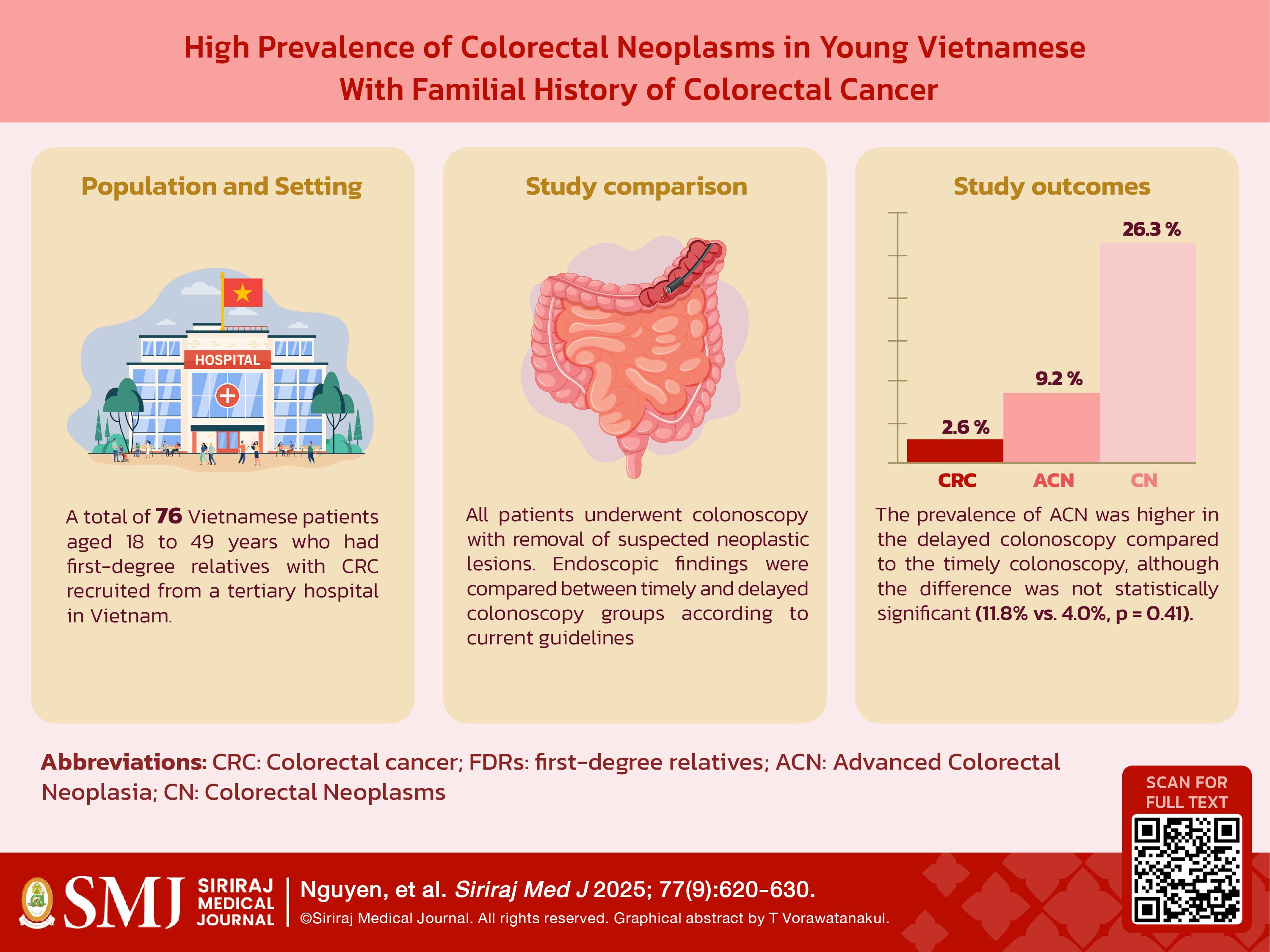
Results: Among 76 patients with FDRs diagnosed with CRC, the mean age was 40.2 ± 6.5 years, with a male-tofemale ratio of 1:1.3. A total of 27 neoplastic lesions were identified in 20 patients, including 22 adenomas (81.5%), 3 sessile serrated lesions (11.1%), and 2 adenocarcinomas (7.4%). Overall, colorectal neoplasms were detected in 26.3% (20/76) of patients, with advanced colorectal neoplasia accounting for 9.2% (7/76), including 2.6% (2/76) adenocarcinomas. The incidence of advanced colorectal neoplasms was higher but not significantly different in the delayed colonoscopy group than in the screening group in terms of adherence to the guidelines (11.8% vs. 4%, p = 0.41).
Conclusion: The prevalence of colorectal neoplasms in young Vietnamese individuals with an FDR history of CRC is significantly high.
References
Sung H, Ferlay J, Siegel RL, Laversanne M, Soerjomataram I, Jemal A, et al. Global cancer statistics 2020: GLOBOCAN estimates of incidence and mortality worldwide for 36 cancers in 185 countries. CA Cancer J Clin. 2021;71(3):209-49.
Siegel RL, Wagle NS, Cercek A, Smith RA, Jemal A. Colorectal cancer statistics, 2023. CA Cancer J Clin. 2023;73(3):233-54.
Huang J, Lucero-Prisno DE, 3rd, Zhang L, Xu W, Wong SH, Ng SC, et al. Updated epidemiology of gastrointestinal cancers in East Asia. Nat Rev Gastroenterol Hepatol. 2023;20(5):271-87.
Quach DT, Nguyen OT. Clinical, endoscopic and pathogical characteristics of early-onset colorectal cancer in Vietnamese. Asian Pac J Cancer Prev. 2012;13(5):1767-70.
Pearlman R, Frankel WL, Swanson B, Zhao W, Yilmaz A, Miller K, et al. Prevalence and Spectrum of Germline Cancer Susceptibility Gene Mutations Among Patients With Early-Onset Colorectal Cancer. JAMA Oncol. 2017;3(4):464-71.
Silla IO, Rueda D, Rodríguez Y, García JL, de la Cruz Vigo F, Perea J. Early-onset colorectal cancer: a separate subset of colorectal cancer. World J Gastroenterol. 2014;20(46):17288-96.
Stigliano V, Sanchez-Mete L, Martayan A, Anti M. Early-onset colorectal cancer: a sporadic or inherited disease? World J Gastroenterol. 2014;20(35):12420-30.
Jung YS, Song H, Tran MTX, Park B, Moon CM. Association between A Family History of Colorectal Cancer and the Risk of Colorectal Cancer: A Nationwide Population-Based Study. J Pers Med. 2022;12(10):1566.
Ng SC, Lau JY, Chan FK, Suen BY, Leung WK, Tse YK, et al. Increased risk of advanced neoplasms among asymptomatic siblings of patients with colorectal cancer. Gastroenterology. 2013;144(3):544-50.
Wong MC, Ching JY, Chiu HM, Wu KC, Rerknimitr R, Li J, et al. Risk of Colorectal Neoplasia in Individuals With Self-Reported Family History: A Prospective Colonoscopy Study from 16 Asia-Pacific Regions. Am J Gastroenterol. 2016;111(11):1621-9.
Quintero E, Carrillo M, Leoz ML, Cubiella J, Gargallo C, Lanas A, et al. Risk of Advanced Neoplasia in First-Degree Relatives with Colorectal Cancer: A Large Multicenter Cross-Sectional Study. PLoS Med. 2016;13(5):e1002008.
Lee YH, Kung PT, Wang YH, Kuo WY, Kao SL, Tsai WC. Effect of length of time from diagnosis to treatment on colorectal cancer survival: A population-based study. PloS One. 2019;14(1):e0210465.
Castelo M, Sue-Chue-Lam C, Paszat L, Scheer AS, Hansen BE, Kishibe T, et al. Clinical Delays and Comparative Outcomes in Younger and Older Adults with Colorectal Cancer: A Systematic Review. Curr Oncol. 2022;29(11):8609-25.
Rutter CM, Inadomi JM, Maerzluft CE. The impact of cumulative colorectal cancer screening delays: A simulation study. J Med Screen. 2022;29(2):92-8.
Consultation WE. Appropriate body-mass index for Asian populations and its implications for policy and intervention strategies. Lancet. 2004;363(9403):157-63.
Knott CS, Coombs N, Stamatakis E, Biddulph JP. All cause mortality and the case for age specific alcohol consumption guidelines: pooled analyses of up to 10 population based cohorts. BMJ. 2015;350:h384.
Luan Minh Dang, Nhan Quang Le, Huy Minh Le, Diem Thi-Ngoc Vo, Nguyen Lam Vuong, Minh Cuong Duong, et al. Risk of Advanced Adenomas in Siblings Aged ≤ 50 Years of Patients with Early-Onset Colorectal Advanced Adenomas. Dig Dis Sci. 2025.
Group. ECR. Update on the paris classification of superficial neoplastic lesions in the digestive tract. Endoscopy. 2005;37(6):570-8.
Rectum JSfCotCa. Japanese Classification of Colorectal, Appendiceal, and Anal Carcinoma: the 3d English Edition [Secondary Publication]. J Anus Rectum Colon. 2019;3(4):175-95.
Sano Y, Tanaka S, Kudo SE, Saito S, Matsuda T, Wada Y, et al. Narrow-band imaging (NBI) magnifying endoscopic classification of colorectal tumors proposed by the Japan NBI Expert Team. Dig Endosc. 2016;28(5):526-33.
Shaukat A, Kahi CJ, Burke CA, Rabeneck L, Sauer BG, Rex DK. ACG Clinical Guidelines: Colorectal Cancer Screening 2021. Am J Gastroenterol. 2021;116(3):458-79.
Rex DK, Boland CR, Dominitz JA, Giardiello FM, Johnson DA, Kaltenbach T, et al. Colorectal Cancer Screening: Recommendations for Physicians and Patients from the U.S. Multi-Society Task Force on Colorectal Cancer. Am J Gastroenterol. 2017;112(7):1016-30.
Nagtegaal ID, Odze RD, Klimstra D, Paradis V, Rugge M, Schirmacher P, et al. The 2019 WHO classification of tumours of the digestive system. Histopathology. 2020;76(2):182-8.
Siripongpreeda B, Mahidol C, Dusitanond N, Sriprayoon T, Muyphuag B, Sricharunrat T, et al. High prevalence of advanced colorectal neoplasia in the Thai population: a prospective screening colonoscopy of 1,404 cases. BMC Gastroenterol. 2016;16(1):101.
Wong S, Lidums I, Rosty C, Ruszkiewicz A, Parry S, Win AK, et al. Findings in young adults at colonoscopy from a hospital service database audit. BMC Gastroenterol. 2017;17(1):56.
Jeong SJ, Lee J, Kim E, Hwang JS, Lee J, Choi JH, et al. Prevalence and risk of colorectal polyps among the Korean population under 50 years. Medicine. 2022;101(27):e29493.
Thongdeebut T, Danaidutsadeekul S, Phligbua W, Lohsiriwat V. Impact of Social Determinants of Health on Postoperative Health-Related Quality of Life Among Patients Undergoing Colorectal Cancer Surgery. Siriraj Med J. 2025;77(5):331-41.
Mongkhonsupphawan A, Sethalao N, Riansuwan W. Long-term Oncologic Outcomes After Curative Surgery in Stage I–III Thai Colorectal Cancer Patients. Siriraj Med J. 2022;74(11):739-46.
Lee J, Xiao YY, Sun YY, Balderacchi J, Clark B, Desani J, et al. Prevalence and characteristics of hereditary non-polyposis colorectal cancer (HNPCC) syndrome in immigrant Asian colorectal cancer patients. BMC Cancer. 2017;17(1):843.
Weiss JM, Gupta S, Burke CA, Axell L, Chen LM, Chung DC, et al. NCCN Guidelines® Insights: Genetic/Familial High-Risk Assessment: Colorectal, Version 1.2021. J Natl Compr Cancer Netw. 2021;19(10):1122-32.
Stjepanovic N, Moreira L, Carneiro F, Balaguer F, Cervantes A, Balmaña J, et al. Hereditary gastrointestinal cancers: ESMO Clinical Practice Guidelines for diagnosis, treatment and follow-up†. Ann Oncol. 2019;30(10):1558-71.
Published
How to Cite
License
Copyright (c) 2025 Siriraj Medical Journal

This work is licensed under a Creative Commons Attribution-NonCommercial-NoDerivatives 4.0 International License.
Authors who publish with this journal agree to the following conditions:
Copyright Transfer
In submitting a manuscript, the authors acknowledge that the work will become the copyrighted property of Siriraj Medical Journal upon publication.
License
Articles are licensed under a Creative Commons Attribution-NonCommercial-NoDerivatives 4.0 International License (CC BY-NC-ND 4.0). This license allows for the sharing of the work for non-commercial purposes with proper attribution to the authors and the journal. However, it does not permit modifications or the creation of derivative works.
Sharing and Access
Authors are encouraged to share their article on their personal or institutional websites and through other non-commercial platforms. Doing so can increase readership and citations.