
Incidence, Risk Factors, and Clinical Outcomes of Postoperative Reintubation after Planned Extubation in Adults Undergoing General Anesthesia: A Single-center Experience
DOI:
https://doi.org/10.33192/smj.v77i10.274468Keywords:
Anesthesia complication, extubation, mortality, postoperative complication, postoperative reintubation, risk factorsAbstract
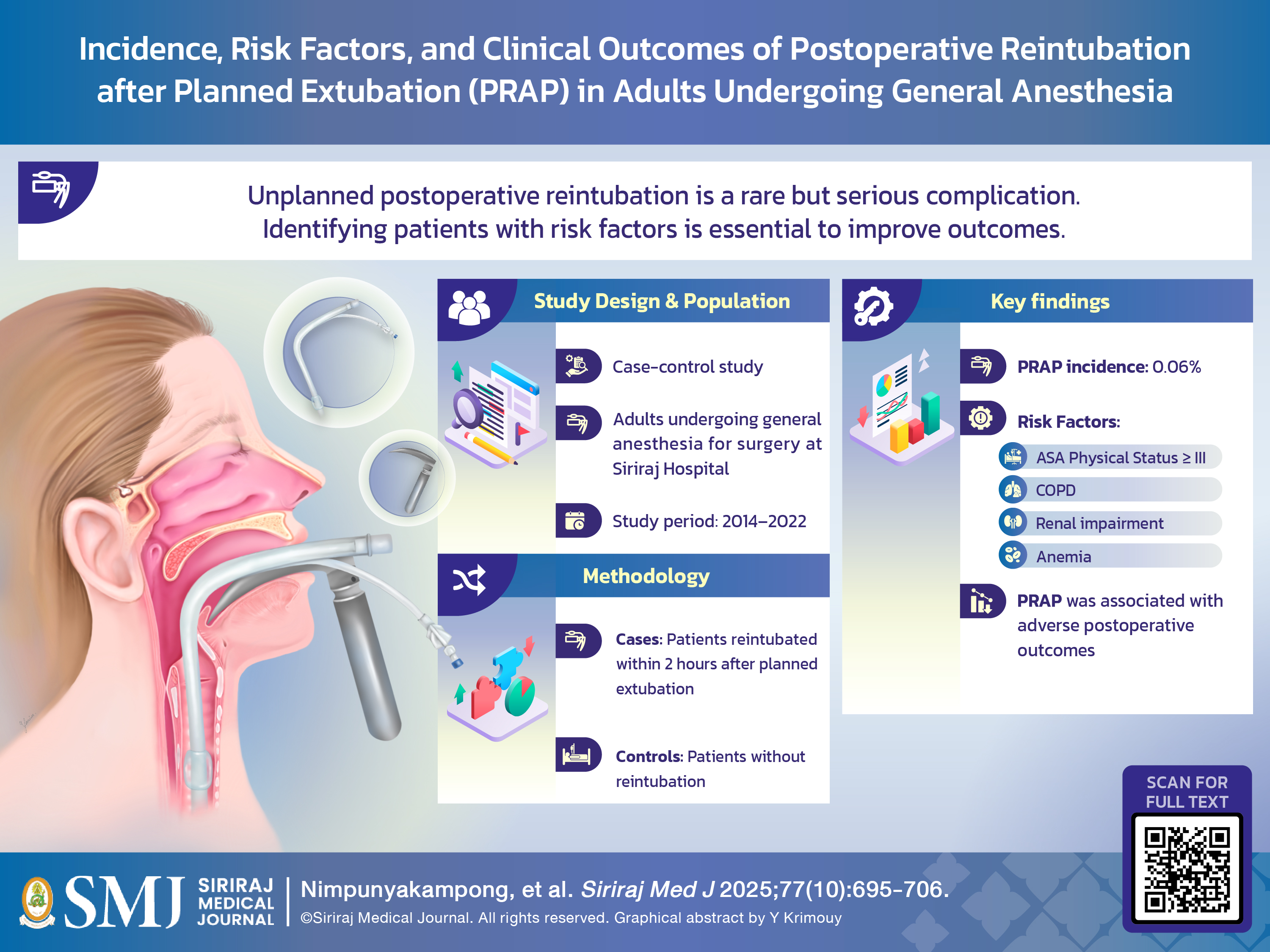
Objective: Postoperative reintubation after planned extubation (PRAP) is a complication following general anesthesia. This study aimed to determine the incidence, risk factors, and outcomes in a tertiary-care university hospital.
Materials and Methods: A retrospective case-control study was conducted between 2014 and 2022. The PRAP group included patients requiring reintubation within 2 h after planned extubation following general anesthesia, while the control group included patients who did not require reintubation. Cases and controls were matched in a 1:3 ratio, with time-matched controls randomly selected within 2 weeks. Descriptive statistics and logistic regression
were utilized for analysis.
Results: Of 139,103 patients, 88 PRAP cases were identified, yielding an incidence of 0.06% (95% Confidence Interval [CI], 0.05–0.08). Multivariate analysis revealed independent risk factors associated with PRAP: the American Society of Anesthesiologists Physical Status (ASA) ≥ III (adjusted odds ratio [aOR], 2.72; 95% CI, 1.58–4.66; P < 0.001), hemoglobin < 12 g/dL (aOR, 1.76; 95% CI, 1.02–3.01; P = 0.041), creatinine clearance < 60 mL/min (aOR, 3.38; 95% CI, 2.16–5.30; P < 0.001), and chronic obstructive pulmonary disease (COPD) (aOR, 18.73; 95% CI, 1.60–219.22; P = 0.020). PRAP was associated with increased 30-day mortality, cardiac arrest, and prolonged length of hospital and intensive care unit stay (all, P < 0.001).
Conclusion: The incidence of PRAP was 0.06%. Independent risk factors associated with PRAP were ASA, hemoglobin, creatinine clearance, and COPD. PRAP is associated with adverse postoperative outcomes, highlighting the need for preventive strategies and careful perioperative management.
References
Acheampong D, Guerrier S, Lavarias V, Pechman D, Mills C, Inabnet W, et al. Unplanned postoperative reintubation following general and vascular surgical procedures: Outcomes and risk factors. Ann Med Surg (Lond). 2018;33:40-3.
Liu S, Dong Y, Wan L, Luo A, Chen H, Xu H. Incidence and outcome of reintubation in the postanesthesia care unit: A single-center, retrospective, observational matched cohort study in China. J Perianesth Nurs. 2023;38(6):912-7.e1.
Ramachandran SK, Nafiu OO, Ghaferi A, Tremper KK, Shanks A, Kheterpal S. Independent predictors and outcomes of unanticipated early postoperative tracheal intubation after nonemergent, noncardiac surgery. Anesthesiology. 2011;115(1):44-53.
Benham-Hermetz J, Mitchell V. Safe tracheal extubation after general anaesthesia. BJA Educ. 2021;21(12):446-54.
Ting PC, Chou AH, Yang MW, Ho AC, Chang CJ, Chang SC. Postoperative reintubation after planned extubation: a review of 137,866 general anesthetics from 2005 to 2007 in a Medical Center of Taiwan. Acta Anaesthesiol Taiwan. 2010;48(4):167-71.
Tillquist MN, Gabriel RA. Incidence and risk factor for early postoperative reintubation J Clin Anesth. 2016;31:80-9.
Rujirojindakul P, Geater AF, Mcneil EB, Vasinanukorn P, Prathep S, Asim W, et al. Risk factors for reintubation in the post-anaesthetic care unit: a case-control study. Br J Anaesth. 2012;109(4):636-42.
Hayashi LY, Gazzotti MR, Vidotto MC, Jardim JR. Incidence, indication and complications of postoperative reintubation after elective intracranial surgery. Sao Paulo Med J. 2013;131(3):158-65.
Glanemann M, Kaisers U, Langrehr JM, Schenk R, Stange BJ, Muller AR, et al. Incidence and indications for reintubation during postoperative care following orthotopic liver transplantation. J Clin Anesth. 2001;13(5):377-82.
Chinachoti T, Chau-In W, Suraseranivongse S, Kitsampanwong W, Kongrit P. Postoperative reintubation after planned extubation in Thai Anesthesia Incidents Study (THAI Study). J Med Assoc Thai. 2005;88 Suppl 7:S84-94.
Banik RK, Honeyfield K, Qureshi S, Reddy SG. Incidence and mortality rate of perioperative reintubation: Case series of 196 patients. Aana J. 2021;89(6):476-9.
Ramsay DP, Quinn P, Gin V, Starkie TD, Fry RA, Grummitt S. National quality improvement indicators project: an initial descriptive study. Anaesth Intensive Care. 2021;49(6):455-67.
Xie Z, Liu J, Yang Z, Tang L, Wang S, Du Y, et al. Risk factors for post-operative planned reintubation in patients after general anesthesia: a systematic review and meta-analysis. Front Med (Lausanne). 2022;9:839070.
Popat M, Mitchell V, Dravid R, Patel A, Swampillai C, Higgs A. Difficult Airway Society Guidelines for the management of tracheal extubation. Anaesthesia. 2012;67(3):318-40.
Sofjan I, Vazquez S, Dominguez J, Sekhri N, Wecksell M, Samuel BM, et al. Risk factors for postoperative unplanned reintubation in a cohort of patients undergoing general anesthesia. Cureus. 2023;15(5):e38949.
Marquez-Lara A, Nandyala SV, Fineberg SJ, Singh K. Incidence, outcomes, and mortality of reintubation after anterior cervical fusion. Spine (Phila Pa 1976). 2014;39(2):134-9.
American Society of Anesthesiologists. Statement on ASA Physical Status Classification System 2020 [cited 2023 December 29]. Available from: https://www.asahq.org/standards-and-practice-parameters/statement-on-asa-physical-status-classification-system.
Lee HJ, Woo JH, Cho S, Oh HW, Joo H, Baik HJ. Risk Factors for Perioperative Respiratory Adverse Events in Children with Recent Upper Respiratory Tract Infection: A Single-Center-Based Retrospective Study. Ther Clin Risk Manag. 2020;16:1227-34.
Hafen BB, Sharma S. Oxygen Saturation. In: StatPearls [Internet]. Treasure Island (FL): StatPearls Publishing. Available from: https://www.ncbi.nlm.nih.gov/books/NBK525974/.
Ho KKL, Pinsky JL, Kannel WB, Levy D. The epidemiology of heart failure: The Framingham Study. Journal of the American College of Cardiology. 1993;22(4, Supplement 1):A6-A13.
Thygesen K, Alpert JS, Jaffe AS, Chaitman BR, Bax JJ, Morrow DA, et al. Fourth Universal Definition of Myocardial Infarction (2018). Circulation. 2018;138(20):e618-e51.
Cheung AK, Chang TI, Cushman WC, Furth SL, Hou FF, Ix JH, et al. KDIGO 2021 Clinical practice guideline for the management of blood pressure in chronic kidney disease. Kidney Int. 2021;99(3):S1-S87.
Singer M, Deutschman CS, Seymour CW, Shankar-Hari M, Annane D, Bauer M, et al. The Third International Consensus Definitions for Sepsis and Septic Shock (Sepsis-3). JAMA. 2016;315(8):801-10.
Widick P, Winer ES. Leukocytosis and Leukemia. Primary Care: Clinics in Office Practice. 2016;43(4):575-87.
Appiah-Ankam J, Hunter JM. Pharmacology of neuromuscular blocking drugs. Continuing Education in Anaesthesia Critical Care & Pain. 2004;4(1):2-7.
Santos FNC, Braga AdFdA, Ribeiro CJBdL, Braga FSdS, Carvalho VH, Junqueira FEF. Use of protocol and evaluation of postoperative residual curarization incidence in the absence of intraoperative acceleromyography – Randomized clinical trial. Brazilian Journal of Anesthesiology (English Edition). 2017;67(6):592-9.
Ting P-C, Chou A-H, Yang M-W, Ho AC-Y, Chang C-J, Chang S-C. Postoperative reintubation after planned extubation: A review of 137,866 general anesthetics from 2005 to 2007 in a Medical Center of Taiwan. Acta Anaesthesiologica Taiwanica. 2010;48(4):167-71.
Miskovic A, Lumb AB. Postoperative pulmonary complications. British Journal of Anaesthesia. 2017;118(3):317-34.
Ruetzler K, Smilowitz NR, Berger JS, Devereaux PJ, Maron BA, Newby LK, et al. Diagnosis and Management of Patients With Myocardial Injury After Noncardiac Surgery: A Scientific Statement From the American Heart Association. Circulation. 2021;144(19):e287-e305.
Mehta RL, Kellum JA, Shah SV, Molitoris BA, Ronco C, Warnock DG, et al. Acute Kidney Injury Network: report of an initiative to improve outcomes in acute kidney injury. Critical Care. 2007;11(2):R31.
Rowe TA, Juthani-Mehta M. Diagnosis and management of urinary tract infection in older adults. Infect Dis Clin North Am. 2014;28(1):75-89.
Owens CD, Stoessel K. Surgical site infections: epidemiology, microbiology and prevention. Journal of Hospital Infection. 2008;70:3-10.
Chen S, Zhang Y, Che L, Shen L, Huang Y. Risk factors for unplanned reintubation caused by acute airway compromise after general anesthesia: a case-control study. BMC Anesthesiol. 2021;21(1):17.
Moon JS, Cannesson M. A century of technology in anesthesia & analgesia. Anesth Analg. 2022;135(2S Suppl 1):S48-S61.
Murphy GS, Brull SJ. Quantitative neuromuscular monitoring and postoperative outcomes: A narrative review. Anesthesiology. 2022;136(2):345-61.
Hackett NJ, De Oliveira GS, Jain UK, Kim JYS. ASA class is a reliable independent predictor of medical complications and mortality following surgery. Int J Surg. 2015;18:184-90.
Mayhew D, Mendonca V, Murthy BVS. A review of ASA physical status – historical perspectives and modern developments. Anaesthesia. 2019;74(3):373-9.
Duggappa DR, Rao GV, Kannan S. Anaesthesia for patient with chronic obstructive pulmonary disease. Indian J Anaesth. 2015;59(9):574-83.
Lee AHY, Snowden CP, Hopkinson NS, Pattinson KTS. Pre-operative optimisation for chronic obstructive pulmonary disease: a narrative review. Anaesthesia. 2021;76(5):681-94.
Khetarpal R, Bali K, Chatrath V, Bansal D. Anesthetic considerations in the patients of chronic obstructive pulmonary disease undergoing laparoscopic surgeries. Anesth Essays Res. 2016;10(1):7-12.
Riveros C, Ranganathan S, Shah YB, Huang E, Xu J, Hsu E, et al. Association of chronic kidney disease with postoperative outcomes: a national surgical quality improvement program (NSQIP) multi-specialty surgical cohort analysis. BMC Nephrol. 2024;25(1):305.
Chowdhury SR, Mclure HA. Chronic kidney disease and anaesthesia. BJA Educ. 2022;22(8):321-8.
Khamiees M, Raju P, Degirolamo A, Amoateng-Adjepong Y, Manthous CA. Predictors of extubation outcome in patients who have successfully completed a spontaneous breathing trial. Chest. 2001;120(4):1262-70.
Hawkins T, Agarwal S, Evans CR. Centre for Perioperative Care anaemia guideline: Implications for anaesthesia. Br J Anaesth. 2023;130(2):115-9.
Greco KM, Conti BM, Bucci CJ, Galvagno SM, Jr. Rocuronium is associated with an increased risk of reintubation in patients with soft tissue infections. J Clin Anesth. 2016;34:186-91.
Lin HT, Ting PC, Chang WY, Yang MW, Chang CJ, Chou AH. Predictive risk index and prognosis of postoperative reintubation after planned extubation during general anesthesia: a single-center retrospective case-controlled study in Taiwan from 2005 to 2009. Acta Anaesthesiol Taiwan. 2013;51(1):3-9.
Cammu G. Residual Neuromuscular Blockade and Postoperative Pulmonary Complications: What Does the Recent Evidence Demonstrate? Curr Anesthesiol Rep. 2020;10(2):131-6.
Russotto V, Myatra SN, Laffey JG, Tassistro E, Antolini L, Bauer P, et al. Intubation Practices and Adverse Peri-intubation Events in Critically Ill Patients From 29 Countries. JAMA. 2021;325(12):1164-72.
Higgs A, Mcgrath BA, Goddard C, Rangasami J, Suntharalingam G, Gale R, et al. Guidelines for the management of tracheal intubation in critically ill adults. Br J Anaesth. 2018;120(2):323-52.
Mantaga S, Thanakiattiwibun C, Siriussawakul A, Mantaga S, Asanathong N, Jiamjira-Anon N, et al. Incidence of Adverse Perioperative Airway Complications in Obese Non-Pregnant and Pregnant Patients Undergoing General Anesthesia. Siriraj Med J. 2022;74(3):178-84.
Pangthipampai P, Chinachoti T, Halilamien P, Jirativanont T, Nivatpumin P, Jalayanavin S, et al. Factors Contributing to Delayed Extubation After Cervical Spine Surgery in Siriraj Hospital. Siriraj Med J. 2020;63(4):123-7.
National Guideline Centre. Preoperative tests (update): Routine preoperative tests for elective surgery. 2016. London: National Institute for Health and Care Excellence (NICE).
Published
How to Cite
Issue
Section
Categories
License
Copyright (c) 2025 Siriraj Medical Journal

This work is licensed under a Creative Commons Attribution-NonCommercial-NoDerivatives 4.0 International License.
Authors who publish with this journal agree to the following conditions:
Copyright Transfer
In submitting a manuscript, the authors acknowledge that the work will become the copyrighted property of Siriraj Medical Journal upon publication.
License
Articles are licensed under a Creative Commons Attribution-NonCommercial-NoDerivatives 4.0 International License (CC BY-NC-ND 4.0). This license allows for the sharing of the work for non-commercial purposes with proper attribution to the authors and the journal. However, it does not permit modifications or the creation of derivative works.
Sharing and Access
Authors are encouraged to share their article on their personal or institutional websites and through other non-commercial platforms. Doing so can increase readership and citations.