
Morphologic Features and Morphometric Measurements of Human Oocytes That Failed to Cleave after Intracytoplasmic Sperm Injection (ICSI)
DOI:
https://doi.org/10.33192/smj.v77i12.274826Keywords:
Morphologic features, morphometric measurements, human oocytes, failed, cleave, intracytoplasmic sperm injection, ICSIAbstract
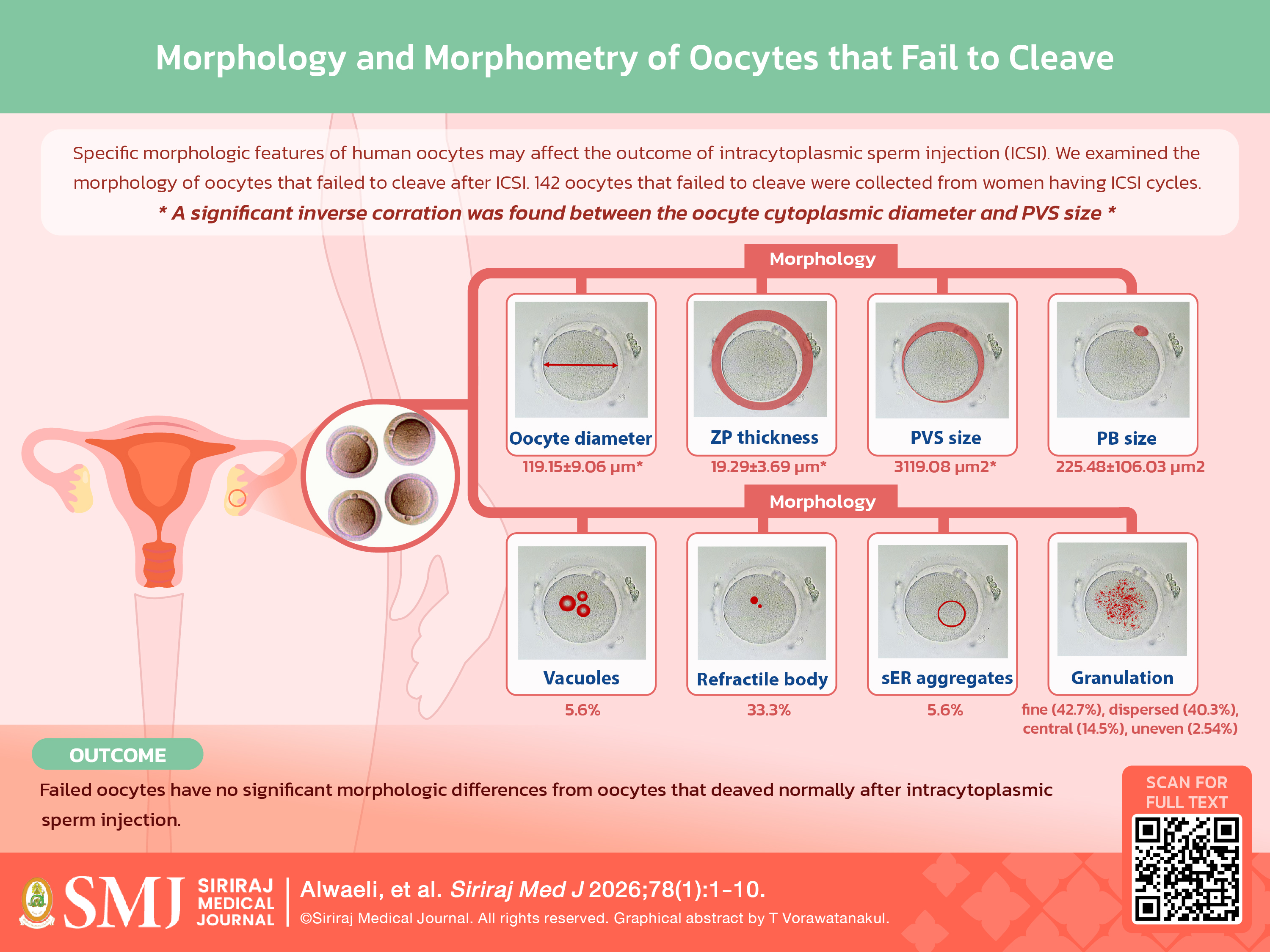
Objective: Human oocytes collected for in vitro fertilization (IVF) vary in morphologic features and measurements. This study aimed to describe the morphology of human oocytes that failed to cleave after intracytoplasmic sperm injection (ICSI).
Materials and Methods: Oocytes that failed to cleave post-ICSI were collected from IVF cycles. The oocytes were microscopically examined and the cytoplasmic diameter, zona pellucida thickness, perivitelline space (PVS) size, and first polar body (PBI) size were measured. The granularity pattern of cytoplasm; the color of cytoplasm; the presence of smooth endoplasmic reticulum (sER) aggregates, vacuoles, refractile bodies, and pronuclei; and, the status of polar bodies were all recorded.
Results: A total of 142 oocytes were analyzed. The mean cytoplasmic diameter was 119.15±9.06 μm (range: 90.66-137.79 μm). The mean zona pellucida thickness was 19.29±3.69 μm (range: 12.86-33.69 μm). The mean PVS size was 3119.08 μm2 (range: 765-6448 μm2). The mean PBI size was 225.48±106.03 μm2 (range: 53.56-703.65 μm2). The cytoplasm showed fine (42.7%), dispersed (40.3%), central (14.5%), and uneven (2.54%) patterns of granulation. Other cytoplasmic abnormalities included refractile bodies (33.3%), sER aggregates (5.6%), vacuoles (5.6%), and dark cytoplasm (14.5%). A significant inverse correlation was found between the oocyte cytoplasmic diameter and PVS size.
Conclusion: The morphologic abnormalities in oocytes that failed to cleave after ICSI are not significantly different from those observed in the general population of human oocytes. The oocyte cytoplasmic diameter was found to significantly inversely correlate with PVS size.
References
Ebner T, Moser M, Tews G. Is oocyte morphology prognostic of embryo developmental potential after ICSI? Reprod Biomed Online. 2006;12:507–12.
Balaban B, Urman B. Effect of oocyte morphology on embryo development and implantation. Reprod Biomed Online. 2006;12:608–15.
Ebner T, Yaman C, Moser M, Sommergruber M, Feichtinger O, Tews G. Prognostic value of first polar body morphology on fertilization rate and embryo quality in intracytoplasmic sperm injection. Hum Reprod. 2000;15:427–30.
Mikkelsen AL, Lindenberg S. Morphology of in-vitro matured oocytes: Impact on fertility potential and embryo quality. Hum Reprod. 2001;16:1714–8.
De Sutter P, Dozortsev D, Qian C, Dhont M. Oocyte morphology does not correlate with fertilization rate and embryo quality after intracytoplasmic sperm injection. Hum Reprod. 1996;11:595–7.
Balaban B, Urman B, Sertac A, Alatas C, Aksoy S, Mercan R. Oocyte morphology does not affect fertilization rate, embryo quality and implantation rate after intracytoplasmic sperm injection. Hum Reprod. 1998;13:3431–3.
Xia, P. Intracytoplasmic sperm injection: Correlation of oocyte grade based on polar body, perivitelline space and cytoplasmic inclusions with fertilization rate and embryo quality. Hum Reprod. 1997;12:1750–5.
Chamayou S, Ragolia C, Alecci C, Storaci G, Maglia E, Russo E, et al. Meiotic spindle presence and oocyte morphology do not predict clinical ICSI outcomes: A study of 967 transferred embryos. Reprod Biomed Online. 2006;13(5):661–7.
Serhal PF, Ranieri DM, Kinis A, Marchant S, Davies M, Khadum IM. Oocyte morphology predicts outcome of intracytoplasmic sperm injection. Hum Reprod. 1997;12(6):1267-70.
Phophong P, Choavaratana R, Suppinyopong S, Loakirkkiat P, Karavakul C. Comparison of Human Menopausal Gonadotrophin and Recombinant Follicle-Stimulating Hormone in In-Vitro Fertilisation and Pregnancy Outcome. Siriraj Med J. 2020; 53(11):805-10.
Hu J, Molinari E, Darmon SK, Zhang L, Patrizio P, Barad DH, et al. Predictive value of cytoplasmic granulation patterns during in vitro fertilization in metaphase II oocytes: part II, donor oocyte cycles. Fertil Steril. 2021;116(5):133-40.
Assi MH, Al-Rubai AJ, Alwaeli AM. Effect of Anthropometric Parameters on Quadriceps Femoris (Q) Angle: An Analytical Cross-Sectional Study from Iraq. Al-Rafidain J Med Sci. 2024;7(2):61-65.
Kahraman S, Yakın K, Dönmez E, Şamlı H, Bahçe M, Cengiz G, et al. Relationship between granular cytoplasm of oocytes and pregnancy outcome following intracytoplasmic sperm injection. Hum Reprod. 2000;15(11):2390–3.
Xiao-fang Yi, Hong-Lin Xi, Si-Lin Zhang, Yang J. Relationship between the positions of cytoplasmic granulation and the oocytes developmental potential in human. Sci Rep. 2019;10(9):7215.
Sun F, Cun J, Huang R, Chen Y, Verwoerd G, Yu Y. Different occurrence rates of centrally located cytoplasmic granulation in one cohort oocytes show distinctive embryo competence and clinical outcomes. Reprod Biol. 2022;22(3):100649.
Merviel P, Cabry R, Chardon K, Haraux E, Scheffler F, Mansouri N, et al. Impact of oocytes with CLCG on ICSI outcomes and their potential relation to pesticide exposure. J Ovarian Res. 2017;10(1):42.
Zhang L, Zeng L, Liu H, Jia H, Wu Y, He C. Effects of Oocyte Cytoplasmic Central Granulation on Embryonic Development, Blastocyst Formation, and Pregnancy Outcome in Technology and Its Mechanism. Cell Mol Biol (Noisy-le-grand). 2022;68(5):161-9.
Takahashi H, Otsuki J, Yamamoto M, Saito H, Hirata R, Habara T, et al. Clinical outcomes of MII oocytes with refractile bodies in patients undergoing ICSI and single frozen embryo transfer. Reprod Med Biol. 2019;19(1):75–81.
Wang M, Gao L, Yang Q, Long R, Zhang Y, Jin L, et al. Does smooth endoplasmic reticulum aggregation in oocytes impact the chromosome aneuploidy of the subsequent embryos? A propensity score matching study. J Ovarian Res. 2023;16(1):59.
Fancsovits P, Murber A, Gilán ZT, János Rigó Jr, Urbancsek J. Human oocytes containing large cytoplasmic vacuoles can result in pregnancy and viable offspring. Reprod BioMed Online. 2011;23(4):513-6.
Balakier H, Bouman D, Sojecki A, Librach C, Squire JA. Morphological and cytogenetic analysis of human giant oocytes and giant embryos. Hum Reprod. 2002;17(9):2394–401.
Romão GS, Araújo MC, de Melo AS, Navarro P, Ferriani R, Dos Reis RM. Oocyte diameter as a predictor of fertilization and embryo quality in assisted reproduction cycles. Fertil Steril. 2010;93(2):621-5.
Weghofer A, Kushnir VA, Darmon SK, Jafri H, Lazzaroni-Tealdi E, Zhang L, et al. Age, body weight and ovarian function affect oocyte size and morphology in non-PCOS patients undergoing intracytoplasmic sperm injection (ICSI). PLoS One. 2019;14(10):e0222390.
Kitasaka H, Konuma Y, Tokoro M, Fukunaga N, Asada Y. Oocyte cytoplasmic diameter of >130 mm can be used to determine human giant oocytes. F S Sci. 2022;3(1):10–17.
Yu EJ, Ahn H, Lee JM, Jee B, Kim SH. Fertilization and embryo quality of mature oocytes with specific morphological abnormalities. Clin Exp Reprod Med. 2015;42(4):156-62.
Taheri F, Mehriz A, Khalili MA, Halvaei I. The influence of ovarian hyperstimulation drugs on morphometry and morphology of human oocytes in ICSI program. Taiwan J Obstet Gynecol. 2018;57(2):205-10.
Balakier H, Sojecki A, Motamedi G, Bashar S, Mandel R, Librach C. Is the zona pellucida thickness of human embryos influenced by women's age and hormonal levels? Fertil Steril. 2012;98(1):77–83.
Shi SL, Yao GD, Jin HX, Song WY, Zhang FL, Yang HY, et al. Correlation between morphological abnormalities in the human oocyte zona pellucida, fertilization failure and embryonic development. Int J Clin Exp Med. 2016;9(1):260-7.
Faramarzi A, Khalili MA, Omidi M. Morphometric analysis of human oocytes using time lapse: does it predict embryo developmental outcomes? Human Fertility. 2019;22(3):171-6.
Yoshida N, Niimura S. Size of the perivitelline space and incidence of polyspermy in rabbit and hamster oocytes. Reprod Med Biol. 2011;10(1):31–41.
Balaban B, Urman B. Effect of oocyte morphology on embryo development and implantation. Reprod Biomed Online. 2006;12(5):608–15.
Hassa H, Aydın Y, Taplamacıoğlu F. The role of perivitelline space abnormalities of oocytes in the developmental potential of embryos. J Turk Ger Gynecol Assoc. 2014;15(3): 161-3.
Zanetti BF, Braga D, Setti A, Figueira R, Iaconelli A, Borges E. Is perivitelline space morphology of the oocyte associated with pregnancy outcome in intracytoplasmic sperm injection cycles? Eur J Obstet Gynecol Reprod Biol. 2018;231:225-9.
Rienzi L, Ubaldi FM, Iacobelli M, Minasi MG, Romano S, Ferrero S, et al. Significance of metaphase II human oocyte morphology on ICSI outcome. Fertil Steril. 2008;90(5):1692–700.
Rienzi L, Balaban B, Ebner T, Mandelbaum J. The oocyte. Hum Reprod. 2012;27(Suppl 1):i2-21.
Ciotti PM, Notarangelo L, Morselli-Labate AM, Felletti V, Porcu E, Venturoli S. First polar body morphology before ICSI is not related to embryo quality or pregnancy rate. Hum Reprod. 2004;19(10):2334–9.
Published
How to Cite
License
Copyright (c) 2025 Siriraj Medical Journal

This work is licensed under a Creative Commons Attribution-NonCommercial-NoDerivatives 4.0 International License.
Authors who publish with this journal agree to the following conditions:
Copyright Transfer
In submitting a manuscript, the authors acknowledge that the work will become the copyrighted property of Siriraj Medical Journal upon publication.
License
Articles are licensed under a Creative Commons Attribution-NonCommercial-NoDerivatives 4.0 International License (CC BY-NC-ND 4.0). This license allows for the sharing of the work for non-commercial purposes with proper attribution to the authors and the journal. However, it does not permit modifications or the creation of derivative works.
Sharing and Access
Authors are encouraged to share their article on their personal or institutional websites and through other non-commercial platforms. Doing so can increase readership and citations.