Efficacy and Safety of Early Post-ICU Admission Colloid Resuscitation with 5% Albumin Versus 4% Gelatin Following 30 mL/kg Crystalloid in Septic Shock Patients Upon General Surgical ICU Admission: A Retrospective Study
DOI:
https://doi.org/10.33192/smj.v77i10.275519Keywords:
Early Colloid Resuscitation, 5% Albumin, 4% Gelatin, 30 mL/kg Crystalloid Solution, Surgical Septic ShockAbstract
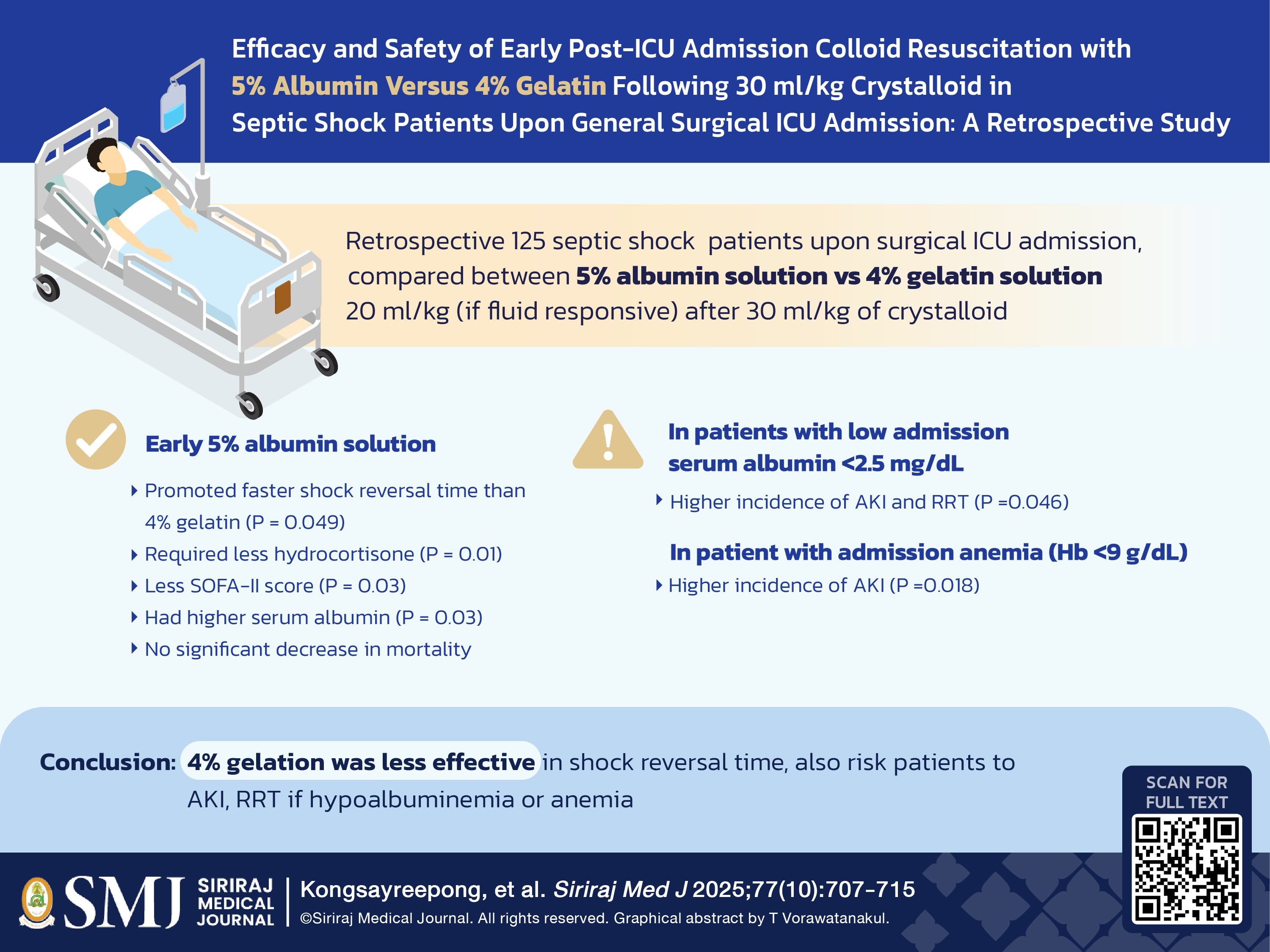
Objective: To compare the efficacy and safety of early post-ICU admission colloid resuscitation with 5% albumin versus 4% gelatin after 30 ml/kg crystalloid solution in septic shock patients upon general surgical ICU admission at Thailand’s largest tertiary reference center.
Materials and Methods: This retrospective study included 125 adults with septic shock admitted to the ICU (September 2017-July 2018). After 30 mL/kg crystalloid, patients received 20 mL/kg of either 4% gelatin (Group G) or 5% albumin (Group A) if fluid responsive. The main efficacy was time to vasopressor discontinuation, and the main safety outcome was the incidence of acute kidney injury (AKI) per KDIGO criteria, within 72 hours of ICU admission. Other safety endpoints included allergic reactions, the need for renal replacement therapy (RRT), and 90-day mortality.
Results: Of 125 patients, 62 received gelatin and 63 albumin. Despite being older, having more severe baseline illness, higher proportion undergoing surgical drainage prior to ICU admission, and a greater incidence of intraabdominal infections, Group A achieved faster vasopressor discontinuation (48 vs. 60 h; p=0.049), required less hydrocortisone (p=0.01), had lower SOFA-II scores (p=0.03), and higher serum albumin (p=0.03). In patients with hypoalbuminemia (<2.5 g/dL) or anemia (<9 g/dL), Group G was associated with higher AKI and RRT rates (p<0.05). No allergic reactions occurred, and ICU stay, hospital stay, and 90-day mortality were not different.
Conclusion: Early 4% gelatin was associated with slower shock reversal and higher AKI risk compared with 5% albumin in critically ill surgical patients, while hospital stay and 90-day mortality were not different.
References
Vincent JL, De Backer D. Circulatory shock. N Engl J Med. 2013;369(18):1726-34.
Cecconi M, De Backer D, Antonelli M, Beale R, Bakker J, Hofer C, et al. Consensus on circulatory shock and hemodynamic monitoring. Task force of the European Society of Intensive Care Medicine. Intensive Care Med. 2014;40(12):1795-815.
Legrand M, Bezemer R, Kandil A, Demirci C, Payen D, Ince C. The role of renal hypoperfusion in development of renal microcirculatory dysfunction in endotoxemic rats. Intensive Care Med. 2011;37(9):1534-42.
Corrêa TD, Vuda M, Blaser AR, Takala J, Djafarzadeh S, Dünser MW, et al. Effect of treatment delay on disease severity and need for resuscitation in porcine fecal peritonitis. Crit Care Med. 2012;40(10):2841-9.
Vincent JL, Sakr Y, Sprung CL, Ranieri VM, Reinhart K, Gerlach H, et al. Sepsis in European intensive care units: results of the SOAP study. Crit Care Med. 2006;34(2):344-53.
Boyd JH, Forbes J, Nakada TA, Walley KR, Russell JA. Fluid resuscitation in septic shock: a positive fluid balance and elevated central venous pressure are associated with increased mortality. Crit Care Med. 2011;39(2):259-65.
Vincent JL, De Backer D, Wiedermann CJ. Fluid management in sepsis: The potential beneficial effects of albumin. J Crit Care. 2016;35:161-7.
Caironi P, Tognoni G, Masson S, Fumagalli R, Pesenti A, Romero M, et al. Albumin replacement in patients with severe sepsis or septic shock. N Engl J Med. 2014;370(15):1412-21.
Moeller C, Fleischmann C, Thomas-Rueddel D, Vlasakov V, Rochwerg B, Theurer P, et al. How safe is gelatin? A systematic review and meta-analysis of gelatin-containing plasma expanders vs crystalloids and albumin. J Crit Care. 2016;35:75-83.
Bayer O, Reinhart K, Sakr Y, Kabisch B, Kohl M, Riedemann NC, et al. Renal effects of synthetic colloids and crystalloids in patients with severe sepsis: a prospective sequential comparison. Crit Care Med. 2011;39(6):1335-42.
Singer M, Deutschman CS, Seymour CW, Shankar-Hari M, Annane D, Bauer M, et al. The Third International Consensus Definitions for Sepsis and Septic Shock (Sepsis-3). JAMA. 2016;315(8):801-10.
Levey AS. Defining AKD: The Spectrum of AKI, AKD, and CKD. Nephron. 2022;146(3):302-5.
Lameire NH, Levin A, Kellum JA, Cheung M, Jadoul M, Winkelmayer WC, et al. Harmonizing acute and chronic kidney disease definition and classification: report of a Kidney Disease: Improving Global Outcomes (KDIGO) Consensus Conference. Kidney Int. 2021;100(3):516-26.
Finfer S, Bellomo R, Boyce N, French J, Myburgh J, Norton R. A comparison of albumin and saline for fluid resuscitation in the intensive care unit. N Engl J Med. 2004;350(22):2247-56.
Tongyoo S, Chayakul C, Kanoknatsiwattana S, Permpikul C. Albumin Versus Gelatin Solution for the Treatment of Refractory Septic Shock: A Patient Baseline-Matched-Cohort Study. Siriraj Med J. 2020;72(6):451-61.
Published
How to Cite
Issue
Section
Categories
License
Copyright (c) 2025 Siriraj Medical Journal

This work is licensed under a Creative Commons Attribution-NonCommercial-NoDerivatives 4.0 International License.
Authors who publish with this journal agree to the following conditions:
Copyright Transfer
In submitting a manuscript, the authors acknowledge that the work will become the copyrighted property of Siriraj Medical Journal upon publication.
License
Articles are licensed under a Creative Commons Attribution-NonCommercial-NoDerivatives 4.0 International License (CC BY-NC-ND 4.0). This license allows for the sharing of the work for non-commercial purposes with proper attribution to the authors and the journal. However, it does not permit modifications or the creation of derivative works.
Sharing and Access
Authors are encouraged to share their article on their personal or institutional websites and through other non-commercial platforms. Doing so can increase readership and citations.