
Hospital Mortality and Predicting Factors in Patients with Sepsis-associated Acute Kidney Injury Requiring Renal Replacement Therapy
DOI:
https://doi.org/10.33192/smj.v78i11.275788Keywords:
Acute kidney injury, Sepsis, Septic shock, Renal replacement therapy, MortalityAbstract
Objective: to investigate the clinical predictors for hospital mortality in patients with sepsis-associated acute kidney injury who required renal replacement therapy.
Materials and Methods: A retrospective cohort study enrolling adult patients hospitalized in medical wards at Siriraj Hospital between 2018-2021, who were concurrently diagnosed with sepsis and acute kidney injury. Patients who previously received long-term renal replacement therapy were excluded. We compared clinical characteristics and treatment strategies, then analyzed the predictors of mortality according to hospital mortality.
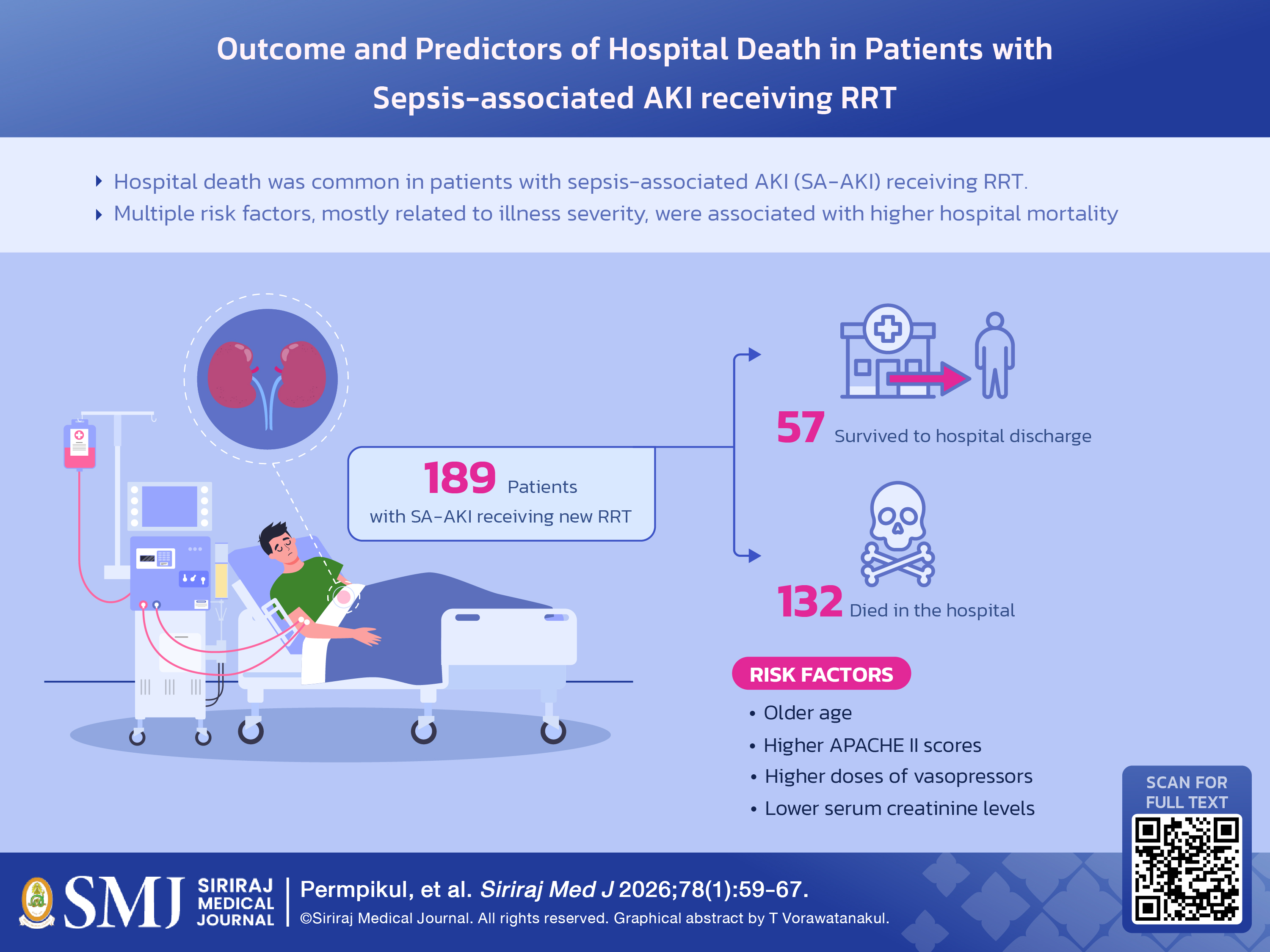
Results: Among 189 patients with acute kidney injury requiring renal replacement therapy, 132 (69.8%) died during hospitalization. A receiver operating characteristic curve analysis for predictors of hospital mortality revealed cutoff values for age > 60 years, SOFA score > 10, APACHE II score > 20, total colloid in 72 hr > 1,500 mL, maximum vasopressor > 0.3 mcg/kg/min, white blood cell count < 12 cells/µL, serum creatinine < 4 mg/dL, and serum albumin < 2.5. Multivariate analysis identified age > 60 (OR 2.8, 1.27-6.38), APACHE II score > 20 (OR 2.57, 1.23-5.42), and maximum vasopressor dose > 0.3 mcg/kg/min (OR 4.26, 1.94-9.86) as independent mortality predictors, while creatinine > 4 mg/dL was protective (OR 0.36, 0.17-0.75).
Conclusion: Patients with sepsis-associated acute kidney injury who underwent renal replacement therapy had high hospital mortality. Age > 60 years, APACHE II score > 20, maximum vasopressor dose > 0.3 mcg/kg/min, and serum creatinine ≤ 4 mg/dL were predictors for hospital mortality.
References
Uchino S, Kellum JA, Bellomo R, Doig GS, Morimatsu H, Morgera S, et al. Acute renal failure in critically ill patients: a multinational, multicenter study. JAMA. 2005;294(7):813-8.
Angus DC, Linde-Zwirble WT, Lidicker J, Clermont G, Carcillo J, Pinsky MR. Epidemiology of severe sepsis in the United States: analysis of incidence, outcome, and associated costs of care. Crit Care Med. 2001;29(7):1303-10.
Bagshaw SM, Laupland KB, Doig CJ, Mortis G, Fick GH, Mucenski M, et al. Prognosis for long-term survival and renal recovery in critically ill patients with severe acute renal failure: a population-based study. Crit Care. 2005;9(6):R700-9.
Silvester W, Bellomo R, Cole L. Epidemiology, management, and outcome of severe acute renal failure of critical illness in Australia. Crit Care Med. 2001;29(10):1910-5.
Neveu H, Kleinknecht D, Brivet F, Loirat P, Landais P. Prognostic factors in acute renal failure due to sepsis. Results of a prospective multicentre study. The French Study Group on Acute Renal Failure. Nephrol Dial Transplant. 1996;11(2):293-9.
Bagshaw SM, Uchino S, Bellomo R, Morimatsu H, Morgera S, Schetz M, et al. Septic acute kidney injury in critically ill patients: clinical characteristics and outcomes. Clin J Am Soc Nephrol. 2007;2(3):431-9.
Bouchard J, Acharya A, Cerda J, Maccariello ER, Madarasu RC, Tolwani AJ, et al. A Prospective International Multicenter Study of AKI in the Intensive Care Unit. Clin J Am Soc Nephrol. 2015;10(8):1324-31.
Alobaidi R, Basu RK, Goldstein SL, Bagshaw SM. Sepsis-associated acute kidney injury. Semin Nephrol. 2015;35(1):2-11.
Bagshaw SM, George C, Bellomo R, Committee ADM. Changes in the incidence and outcome for early acute kidney injury in a cohort of Australian intensive care units. Crit Care. 2007;11(3):R68.
Hoste EA, Bagshaw SM, Bellomo R, Cely CM, Colman R, Cruz DN, et al. Epidemiology of acute kidney injury in critically ill patients: the multinational AKI-EPI study. Intensive Care Med. 2015;41(8):1411-23.
Murugan R, Karajala-Subramanyam V, Lee M, Yende S, Kong L, Carter M, et al. Acute kidney injury in non-severe pneumonia is associated with an increased immune response and lower survival. Kidney Int. 2010;77(6):527-35.
Yegenaga I, Hoste E, Van Biesen W, Vanholder R, Benoit D, Kantarci G, et al. Clinical characteristics of patients developing ARF due to sepsis/systemic inflammatory response syndrome: results of a prospective study. Am J Kidney Dis. 2004;43(5):817-24.
Hoste EA, Lameire NH, Vanholder RC, Benoit DD, Decruyenaere JM, Colardyn FA. Acute renal failure in patients with sepsis in a surgical ICU: predictive factors, incidence, comorbidity, and outcome. J Am Soc Nephrol. 2003;14(4):1022-30.
Vincent JL, Sakr Y, Sprung CL, Ranieri VM, Reinhart K, Gerlach H, et al. Sepsis in European intensive care units: results of the SOAP study. Crit Care Med. 2006;34(2):344-53.
Dellinger RP, Levy MM, Rhodes A, Annane D, Gerlach H, Opal SM, et al. Surviving Sepsis Campaign: international guidelines for management of severe sepsis and septic shock, 2012. Intensive Care Med. 2013;39(2):165-228.
Palevsky PM, Liu KD, Brophy PD, Chawla LS, Parikh CR, Thakar CV, et al. KDOQI US commentary on the 2012 KDIGO clinical practice guideline for acute kidney injury. Am J Kidney Dis. 2013;61(5):649-72.
Tongyoo S, Tanyalakmara T, Naorungroj T, Promsin P, Permpikul C. The Association of High Dose Vasopressor and Delayed Vasopressor Titration with 28-Day Mortality in Adult Patients with Septic Shock. Journal of Health Science and Medical Research. 2022.
Chertow GM, Soroko SH, Paganini EP, Cho KC, Himmelfarb J, Ikizler TA, et al. Mortality after acute renal failure: models for prognostic stratification and risk adjustment. Kidney Int. 2006;70(6):1120-6.
Chayakul MT, S.; Permpikul, C. Incidence and Outcomes of Sepsis-Related Cardiomyopathy: A Prospective Cohort Study. Journal of the Medical Association of Thailand. 2021;104(3):497-505.
Ronco C, Bellomo R, Kellum J. Understanding renal functional reserve. Intensive Care Med. 2017;43(6):917-20.
Kadivarian S, Heydarpour F, Karimpour H, Shahbazi F. Measured versus estimated creatinine clearance in critically ill patients with acute kidney injury: an observational study. Acute Crit Care. 2022;37(2):185-92.
Macedo E, Bouchard J, Soroko SH, Chertow GM, Himmelfarb J, Ikizler TA, et al. Fluid accumulation, recognition and staging of acute kidney injury in critically-ill patients. Crit Care. 2010;14(3):R82.
Grams ME, Estrella MM, Coresh J, Brower RG, Liu KD, National Heart L, et al. Fluid balance, diuretic use, and mortality in acute kidney injury. Clin J Am Soc Nephrol. 2011;6(5):966-73.
Published
How to Cite
License
Copyright (c) 2025 Siriraj Medical Journal

This work is licensed under a Creative Commons Attribution-NonCommercial-NoDerivatives 4.0 International License.
Authors who publish with this journal agree to the following conditions:
Copyright Transfer
In submitting a manuscript, the authors acknowledge that the work will become the copyrighted property of Siriraj Medical Journal upon publication.
License
Articles are licensed under a Creative Commons Attribution-NonCommercial-NoDerivatives 4.0 International License (CC BY-NC-ND 4.0). This license allows for the sharing of the work for non-commercial purposes with proper attribution to the authors and the journal. However, it does not permit modifications or the creation of derivative works.
Sharing and Access
Authors are encouraged to share their article on their personal or institutional websites and through other non-commercial platforms. Doing so can increase readership and citations.