
The Efficacy of Oral Risperidone Solution to Reduce the Incidence and Severity of Postoperative Delirium After Vascular Surgery: A Randomized Controlled Trial
DOI:
https://doi.org/10.33192/smj.v77i10.276806Keywords:
Vascular surgery, Postoperative delirium, RisperidoneAbstract
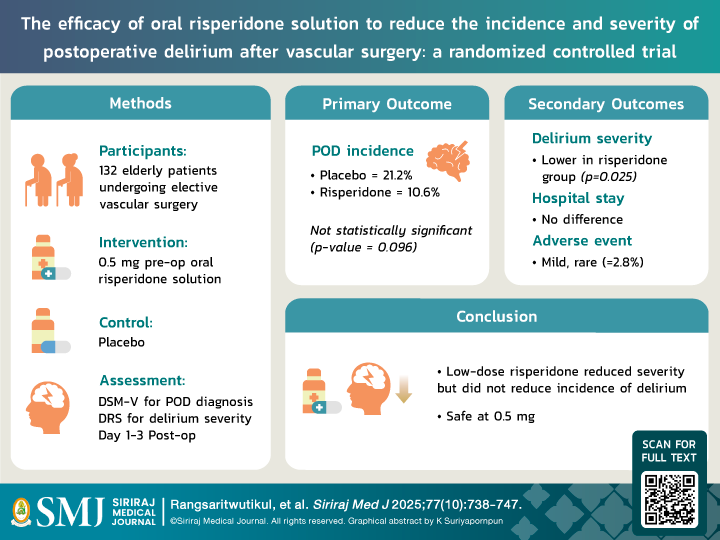
Objective: To determine the efficacy of the preoperative oral solution of risperidone in preventing Postoperative delirium (POD) and reducing the severity of POD in patients with geriatric vascular disease.
Materials and Methods: Randomized, double-blind, placebo controlled trial. A total of 140 elderly patients scheduled for vascular surgery were enrolled and randomly assigned to either the risperidone group (0.5 mg oral solution of risperidone within 1 hour before surgery) or the placebo group.
Results: POD was assessed daily using the DSM-5 criteria, and its severity was measured with the Delirium Rating Scale (DRS) for the first three days after surgery. The incidence and severity of POD were compared between the two groups. Potential side effects of risperidone, and the length of hospital stay were also recorded. There were no statistical differences in demographic data between the two groups. The incidence of POD was 10.6% compared to 21.2 % in the intervention group without statistical significance (p-value=0.096). However, the severity of POD, measured by the DRS, was significantly lower in the risperidone group (2.0 vs. 6.0, p value=0.025). The length of hospital stay did not show significant differences between the two groups.
Conclusions: The overall incidence of POD in this study without intervention was 21.2%. Preoperative administration of oral risperidone (0.5mg) reduced the severity of POD, but did not affect the incidence of POD or the length of hospital stay in this population.
References
Baril DT, Ghosh K, Rosen AB. Trends in the incidence, treatment, and outcomes of acute lower extremity ischemia in the United States Medicare population. J Vasc Surg. 2014;60(3):669-77.e2.
Whitlock EL, Vannucci A, Avidan MS. Postoperative delirium. Minerva Anestesiol. 2011;77(4):448-56.
Oh ST, Park JY. Postoperative delirium. Korean J Anesthesiol. 2019;72(1):4-12.
Ha A, Krasnow RE, Mossanen M, Nagle R, Hshieh TT, Rudolph JL, et al. A contemporary population-based analysis of the incidence, cost, and outcomes of postoperative delirium following major urologic cancer surgeries. Urol Oncol. 2018;36(7):341.e15-e22.
Aitken SJ, Blyth FM, Naganathan V. Incidence, prognostic factors and impact of postoperative delirium after major vascular surgery: A meta-analysis and systematic review. Vasc Med. 2017;22(5):387-97.
Brown CHt, Laflam A, Max L, Lymar D, Neufeld KJ, Tian J, et al. The Impact of Delirium After Cardiac Surgical Procedures on Postoperative Resource Use. Ann Thorac Surg. 2016;101(5):1663-9.
Wang Y, Bu X, Zhao N, Wang S, Wang X, Ge Y, et al. Dexmedetomidine effect on delirium in elderly patients undergoing general anesthesia: A protocol for systematic review and meta-analysis. Medicine (Baltimore). 2021;100(48):e27782.
Pluta MP, Dziech M, Czempik PF, Szczepańska AJ, Krzych Ł J. Antipsychotic Drugs in Prevention of Postoperative Delirium-What Is Known in 2020? Int J Environ Res Public Health. 2020;17(17).
Naaz S, Ozair E. Dexmedetomidine in current anaesthesia practice- a review. J Clin Diagn Res. 2014;8(10):GE01-4.
Kaneko T, Cai J, Ishikura T, Kobayashi M, Naka T, Kaibara N. Prophylactic consecutive administration of haloperidol can reduce the occurrence of postoperative delirium in gastrointestinal surgery. Yonago Acta Med. 1999;42(3):179-84.
Kalisvaart KJ, de Jonghe JF, Bogaards MJ, Vreeswijk R, Egberts TC, Burger BJ, et al. Haloperidol prophylaxis for elderly hip-surgery patients at risk for delirium: a randomized placebo-controlled study. J Am Geriatr Soc. 2005;53(10):1658-66.
Vochteloo AJ, Moerman S, van der Burg BL, de Boo M, de Vries MR, Niesten DD, et al. Delirium risk screening and haloperidol prophylaxis program in hip fracture patients is a helpful tool in identifying high-risk patients, but does not reduce the incidence of delirium. BMC Geriatr. 2011;11:39.
Wang W, Li HL, Wang DX, Zhu X, Li SL, Yao GQ, et al. Haloperidol prophylaxis decreases delirium incidence in elderly patients after noncardiac surgery: a randomized controlled trial*. Crit Care Med. 2012;40(3):731-9.
Prakanrattana U, Prapaitrakool S. Efficacy of risperidone for prevention of postoperative delirium in cardiac surgery. Anaesth Intensive Care. 2007;35(5):714-9.
Hakim SM, Othman AI, Naoum DO. Early treatment with risperidone for subsyndromal delirium after on-pump cardiac surgery in the elderly: a randomized trial. Anesthesiology. 2012;116(5):987-97.
Chaput AJ, Bryson GL. Postoperative delirium: risk factors and management: Continuing Professional Development. Can J Anesth. 2012;59(3):304-20.
Phannarus H, Muangpaisan W, Siritipakorn P, Pianchob S, Supapueng O. Development of a Thai tool for assessing behavioral and psychological symptoms of dementia: A confirmatory factor analysis. Brain Behav. 2020;10(11):e01816.
Perneczky R, Wagenpfeil S, Komossa K, Grimmer T, Diehl J, Kurz A. Mapping scores onto stages: mini-mental state examination and clinical dementia rating. Am J Geriatr Psychiatry. 2006;14(2):139-44.
Trzepacz PT, Dew MA. Further analyses of the Delirium Rating Scale. Gen Hosp Psychiatry. 1995;17(2):75-9.
Vasunilashorn SM, Fong TG, Helfand BKI, Hshieh TT, Marcantonio ER, Metzger ED, et al. Psychometric Properties of a Delirium Severity Score for Older Adults and Association With Hospital and Posthospital Outcomes. JAMA Netw Open. 2022;5(3):e226129.
Vasunilashorn SM, Fong TG, Albuquerque A, Marcantonio ER, Schmitt EM, Tommet D, et al. Delirium Severity Post-Surgery and its Relationship with Long-Term Cognitive Decline in a Cohort of Patients without Dementia. J Alzheimers Dis. 2018;61(1):347-58.
Raphael L, Edna E, Irina K, Oded H. The Efficacy of Low-Dose Risperidone Treatment for Post-Surgical Delirium in Elderly Orthopedic Patients. Medicina (Kaunas). 2023;59(6):1052.
Heykants J, Huang ML, Mannens G, Meuldermans W, Snoeck E, Van Beijsterveldt L, et al. The pharmacokinetics of risperidone in humans: a summary. J Clin Psychiatry. 1994;55 Suppl:13-7.
Published
How to Cite
Issue
Section
Categories
License
Copyright (c) 2025 Siriraj Medical Journal

This work is licensed under a Creative Commons Attribution-NonCommercial-NoDerivatives 4.0 International License.
Authors who publish with this journal agree to the following conditions:
Copyright Transfer
In submitting a manuscript, the authors acknowledge that the work will become the copyrighted property of Siriraj Medical Journal upon publication.
License
Articles are licensed under a Creative Commons Attribution-NonCommercial-NoDerivatives 4.0 International License (CC BY-NC-ND 4.0). This license allows for the sharing of the work for non-commercial purposes with proper attribution to the authors and the journal. However, it does not permit modifications or the creation of derivative works.
Sharing and Access
Authors are encouraged to share their article on their personal or institutional websites and through other non-commercial platforms. Doing so can increase readership and citations.