
Application of Artificial Intelligence for Osteoporosis Screening Using Chest Radiographs
DOI:
https://doi.org/10.33192/smj.v78i1.277295Keywords:
AI, BMD, osteoporosis, screening, chest radiographAbstract
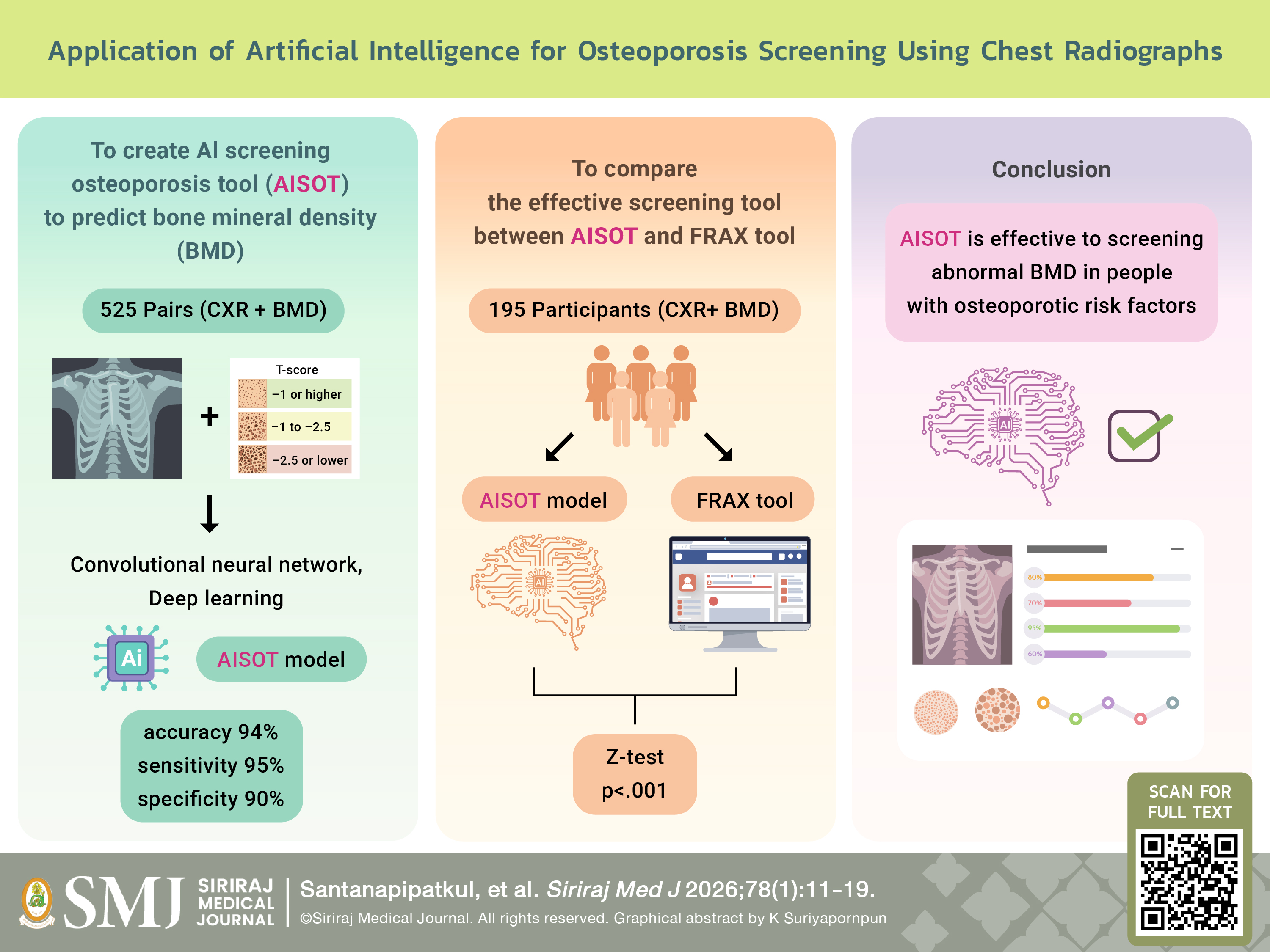
Objective: To create the artificial intelligence screening osteoporosis tool (AISOT) to predict bone mineral density (BMD) using chest radiographs and to describe statistics characterizing the tool's effectiveness and satisfaction of the tool usage.
Materials and Methods: All 525 BMD examinations individually paired with chest radiographs during the years2022–2023. The AISOT was developed based on deep learning concept on chest radiograph images to predict BMD value. Both BMD observed and predicted values were classified osteoporosis condition by using T-scores of preclinical guidelines. The AISOT demonstrated the accuracy, sensitivity, specificity at 94% (95% CI: 84 -99%), 95% (95% CI: 83-99%) and 90% (95% CI: 56- 99%) respectively. The AISOT model was tested with 195 participants. The research instrument was a questionnaire developed by the researcher including personal health history, observed and predicted BMD values, FRAX tool osteoporosis evaluation and AISOT satisfaction. Z-test was utilized to compare statistics characterized the tool effectiveness.
Results: The AISOT vs the FRAX tool comprised accuracy at 74% (95% CI: 67- 80%) vs 51% (95% CI: 44 -58%) (p < .001); sensitivity at 61% (95% CI: 52-70%) vs 24 % (95% CI: 17-33%) (p = .012); specificity at 93% (95% CI: 85-98%) vs 92% (95% CI: 84-97%) (p > .05); PPV at 94% vs 83% (p = .015); NPV at 61% vs 44% (p = .016). AISOT satisfaction was at very satisfied level (mean = 4.81, SD.= 0.434).
Conclusions: AISOT is effective for screening abnormal BMD in people with osteoporotic risk factors. Future study of various settings will enhance its credibility.
References
National Institute of Arthritis and Musculoskeletal and Skin Diseases. Osteoporosis. [Internet] 2022 [cited 2024 Dec 15]. Available from: https://www.niams.nih.gov/health-topics/osteoporosis#:~:text=Osteoporosis%20is%20a%20bone%20disease,of%20fractures%20(broken%20bones).
Taechakraichana N. Treatment and Prevention of Osteoporosis in Menopause. Siriraj Med J [Internet]. 2005 [cited 2025 Oct 9];57(12):555-6. Available from: https://he02.tci-thaijo.org/index.php/sirirajmedj/article/view/245661
Charoenngam N, Pongchaiyakul C. Current issues in evaluation and management of osteoporosis in Thailand. Osteoporos Sarcopenia. 2023;9(2):53-9.
Pongchaiyakul C, Songpattanasilp T, Taechakraichana N. Burden of Osteoporosis in Thailand. J Med Assoc Thai. 2008;91(2):261-7.
Nuti R, Brandi ML, Checchia G, Di Munno O, Dominguez L, Falaschi P, et al. Guidelines for the management of osteoporosis and fragility fractures. Intern Emerg Med. 2019;14(1):85-102.
Johns Hopkins Medicine. Bone Densitometry. [Internet]. (n.d.) [cited 2024 Jan 10]. Available from: https://www.hopkinsmedicine.org/health/treatment-tests-and-therapies/bone-
Mithal A, Bansal B, Kyer CS, Ebeling P. The Asia-Pacific Regional Audit-Epidemiology, Costs, and Burden of Osteoporosis in India 2013: A report of International Osteoporosis Foundation. Indian J Endocrinol Metab. 2014;18(4):449-54.
Drug and Medical Supply Information Center, Ministry of Public Health. Osteoporosis Screening (W 316). [Internet] 2011 [cited 2024 Jan 20]. Available from: https://dmsic.moph.go.th/index/detail/1385
Sharma S. Drawing insights from COVID-19-infected patients using CT scan images and machine learning techniques: a study on 200 patients. Environ Sci Pollut Res Int. 2020;27(29): 37155-37163.
Whitlock RH, Leslie WD, Shaw J, Rigatto C, Thorlacius L, Komenda P, et al. The Fracture Risk Assessment Tool (FRAX®) predicts fracture risk in patients with chronic kidney disease. Kidney Int. 2019;95(2):447-54.
Webb R. Two proportion Z-test and confidence interval. [Internet]. 2023. [cited 2024 Dec 20]. Available from: https://stats.libretexts.org/Bookshelves/Introductory_Statistics/Mostly_Harmless_Statistics_(Webb)/09%3A_Hypothesis_Tests_and_Confidence_Intervals_for_Two_Populations/9.03%3A_Two_Proportion_Z-Test_and_Confidence_Interval
Liu RW, Ong W, Makmur A, Kumar N, Low XZ, Shuliang G, et al. Application of artificial intelligence methods on osteoporosis classification with radiographs—A Systematic Review. Bioengineering (Basel). 2024;11(5):484.
RadiologyInfo.org. Chest X-ray. Radio Society of North America. [Internet]. 2025. [cited 2024 Dec 12]. Available from: https://www.radiologyinfo.org/en/info/chestrad
Jonathan AC Sterne, Miguel A Hernán, Alexandra McAleenan, Barnaby C Reeves, Julian PT Higgins. Cochrane Handbooks for Systematic Reviews of Interventions: Assessing Risk of Bias in a Non-randomized Study. [Internet]. (n.d.). [cited 2024 Dec 12]. Available from: https://www.cochrane.org/authors/handbooks-and-manuals/handbook/current/chapter-25
Murad MH, Lin L, Chu H, Hasan B, Alsibai RA, Abbas AS, et al. The association of sensitivity and specificity with disease prevalence: analysis of 6909 studies of diagnostic test accuracy. CMAJ. 2023;195(27):E925-E931.
Caraguel CG, Vanderstichel R. The two-step Fagan's nomogram: ad hoc interpretation of a diagnostic test result without calculation. Evid Based Med. 2013;18(4):125-8.
Published
How to Cite
License
Copyright (c) 2025 Siriraj Medical Journal

This work is licensed under a Creative Commons Attribution-NonCommercial-NoDerivatives 4.0 International License.
Authors who publish with this journal agree to the following conditions:
Copyright Transfer
In submitting a manuscript, the authors acknowledge that the work will become the copyrighted property of Siriraj Medical Journal upon publication.
License
Articles are licensed under a Creative Commons Attribution-NonCommercial-NoDerivatives 4.0 International License (CC BY-NC-ND 4.0). This license allows for the sharing of the work for non-commercial purposes with proper attribution to the authors and the journal. However, it does not permit modifications or the creation of derivative works.
Sharing and Access
Authors are encouraged to share their article on their personal or institutional websites and through other non-commercial platforms. Doing so can increase readership and citations.