
Diagnostic Performance of AI-CAD Digital Mammography for Breast Cancer: Experience from Siriraj Breast Imaging Center
DOI:
https://doi.org/10.33192/smj.v78i3.277476Keywords:
Breast Neoplasms, Mammography, Artificial Intelligence, Computer-Aided Detection, Observer VariationAbstract
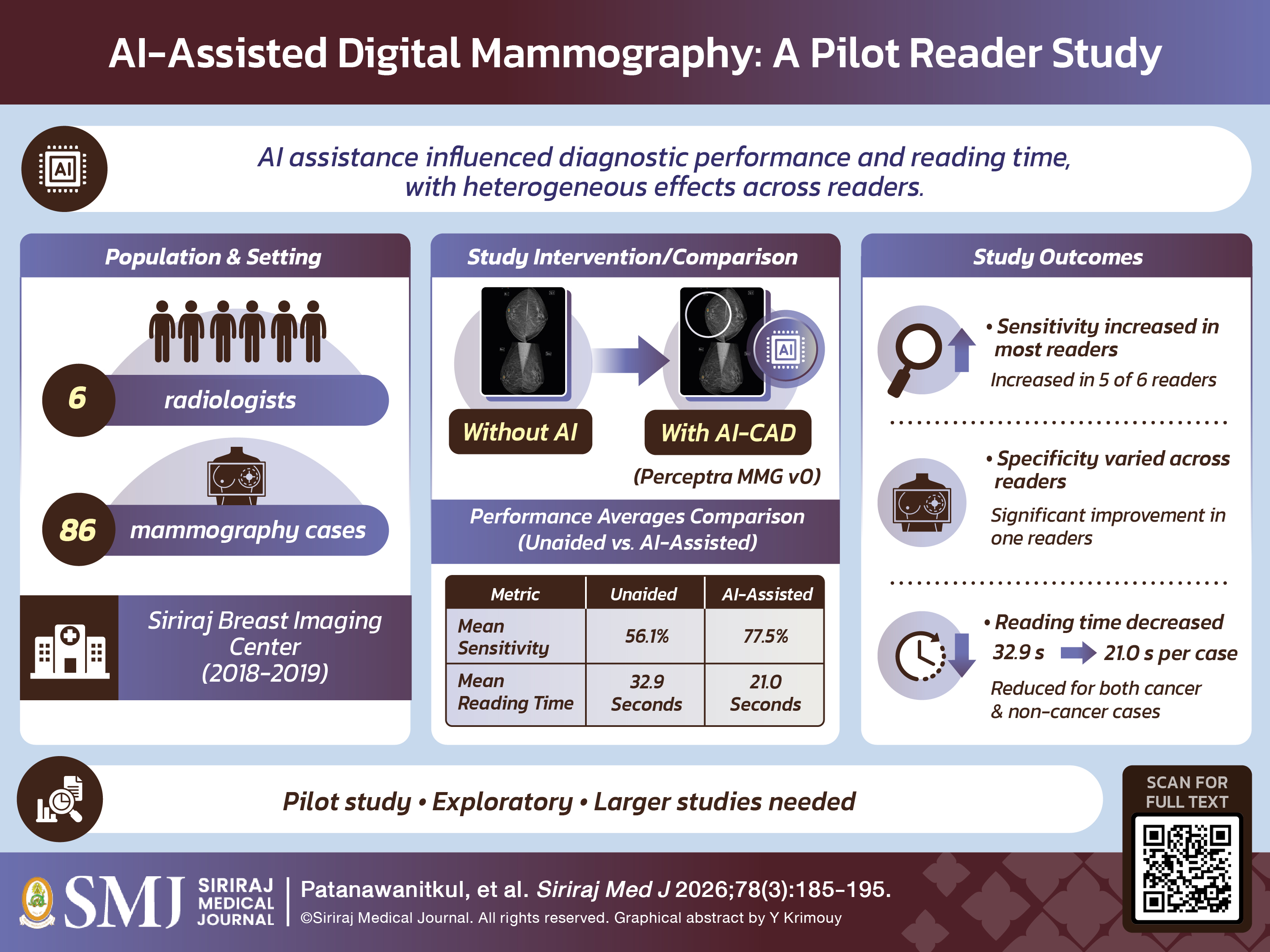
Objective: To evaluate the diagnostic performance of radiologists with varying breast imaging experience when interpreting digital mammograms with and without artificial intelligence (AI). This work represents the initial phase of an AI development program at Siriraj Hospital, aiming toward broader integration of AI into breast cancer detection and clinical practice in Thailand.
Materials and Methods: In this retrospective study, six radiologists independently reviewed 86 digital mammograms — 40 confirmed cancer cases and 46 normal cases (including 28 false positives and 18 true negatives) — collected between 2018 and 2019 at the Siriraj Breast Imaging Center. Each radiologist interpreted all cases twice: unaided and AI-assisted, with a two-week washout period to minimize recall bias. Diagnostic performance metrics included sensitivity, specificity, false positive/negative rates, and reading time.
Results: With AI assistance, sensitivity increased in five of six readers, with mean sensitivity rising from 56.1% to 77.5%, although this difference did not reach statistical significance. Changes in specificity were variable across readers, with a statistically significant improvement observed in one reader (52.2% to 78.3%, P < 0.05). Mean reading time decreased from 32.9 seconds to 21.0 seconds per case with AI assistance (P < 0.01), with reductions observed for both cancer cases and normal cases.
Conclusion: In this pilot study, AI assistance was associated with trends toward improved diagnostic performance and reduced reading time, with statistically significant improvement observed in only a subset of readers. These preliminary findings require confirmation in larger, adequately powered multi-reader multi-case (MRMC) studies.
References
Khatcheressian JL, Hurley P, Bantug E, Esserman LJ, Grunfeld E, Halberg F, et al. Breast cancer follow-up and management after primary treatment: American Society of Clinical Oncology clinical practice guideline update. J Clin Oncol. 2013;31(7):961-5.
Torre LA, Bray F, Siegel RL, Ferlay J, Lortet-Tieulent J, Jemal A. Global cancer statistics, 2012. CA Cancer J Clin. 2015;65(2):87-108.
Nelson HD, Tyne K, Naik A, Bougatsos C, Chan BK, Humphrey L, et al. Screening for breast cancer: an update for the U.S. Preventive Services Task Force. Ann Intern Med. 2009;151(10):727-37, W237-742.
Marmot MG, Altman DG, Cameron DA, Dewar JA, Thompson SG, Wilcox M. The benefits and harms of breast cancer screening: an independent review. Br J Cancer. 2013;108(11):2205-40.
Tabar L, Yen AM, Wu WY, Chen SL, Chiu SY, Fann JC, et al. Insights from the breast cancer screening trials: how screening affects the natural history of breast cancer and implications for evaluating service screening programs. Breast J. 2015;21(1):13-20.
Radiology ACo, D'Orsi CJ. ACR BI-RADS atlas: breast imaging reporting and data system; mammography, ultrasound, magnetic resonance imaging, follow-up and outcome monitoring, data dictionary: ACR, American College of Radiology; 2013.
Lehman CD, Arao RF, Sprague BL, Lee JM, Buist DS, Kerlikowske K, et al. National performance benchmarks for modern screening digital mammography: update from the Breast Cancer Surveillance Consortium. Radiology. 2017;283(1):49-58.
Giger ML, Karssemeijer N, Schnabel JA. Breast image analysis for risk assessment, detection, diagnosis, and treatment of cancer. Annu Rev Biomed Eng. 2013;15:327-57.
Katalinic A, Bartel C, Raspe H, Schreer I. Beyond mammography screening: quality assurance in breast cancer diagnosis (The QuaMaDi Project). Br J Cancer. 2007;96(1):157-61.
Destounis SV, DiNitto P, Logan-Young W, Bonaccio E, Zuley ML, Willison KM. Can computer-aided detection with double reading of screening mammograms help decrease the false-negative rate? Initial experience. Radiology. 2004;232(2):578-84.
Bird RE, Wallace TW, Yankaskas BC. Analysis of cancers missed at screening mammography. Radiology. 1992;184(3):613-7.
Majid AS, de Paredes ES, Doherty RD, Sharma NR, Salvador X. Missed breast carcinoma: pitfalls and pearls. Radiographics. 2003;23(4):881-95.
Weber RJ, van Bommel RM, Louwman MW, Nederend J, Voogd AC, Jansen FH, et al. Characteristics and prognosis of interval cancers after biennial screen-film or full-field digital screening mammography. Breast Cancer Res Treat. 2016;158(3):471-83.
Broeders M, Onland-Moret N, Rijken H, Hendriks J, Verbeek A, Holland R. Use of previous screening mammograms to identify features indicating cases that would have a possible gain in prognosis following earlier detection. Eur J Cancer. 2003;39(12):1770-5.
Beam CA, Sullivan DC, Layde PM. Effect of human variability on independent double reading in screening mammography. Acad Radiol. 1996;3(11):891-897.
Rimmer A. Radiologist shortage leaves patient care at risk, warns royal college. BMJ. 2017;359.
Fenton JJ, Abraham L, Taplin SH, Geller BM, Carney PA, D’Orsi C, et al. Effectiveness of computer-aided detection in community mammography practice. J Natl Cancer Inst. 2011;103(15):1152-61.
Fenton JJ, Taplin SH, Carney PA, Abraham L, Sickles EA, D'Orsi C, et al. Influence of computer-aided detection on performance of screening mammography. N Engl J Med. 2007;356(14):1399-409.
Lehman CD, Wellman RD, Buist DS, Kerlikowske K, Tosteson AN, Miglioretti DL, et al. Diagnostic accuracy of digital screening mammography with and without computer-aided detection. JAMA Intern Med. 2015;175(11):1828-37.
Freer TW, Ulissey MJ. Screening mammography with computer-aided detection: prospective study of 12,860 patients in a community breast center. Radiology. 2001;220(3):781-6.
Azavedo E, Zackrisson S, Mejàre I, Arnlind MH. Is single reading with computer-aided detection (CAD) as good as double reading in mammography screening? A systematic review. BMC Med Imaging. 2012;12(1):1-12.
Litjens G, Kooi T, Bejnordi BE, Setio AAA, Ciompi F, Ghafoorian M, et al. A survey on deep learning in medical image analysis. Med Image Anal. 2017;42:60-88.
Kim H-E, Kim HH, Han B-K, Kim KH, Han K, Nam H, et al. Changes in cancer detection and false-positive recall in mammography using artificial intelligence: a retrospective, multireader study. Lancet Digit Health. 2020;2(3):e138-e48.
Fisches Z, Ball M, Mukama T, Štih V, Payne N, Hickman S, et al. Strategies for integrating artificial intelligence into mammography screening programmes: a retrospective simulation analysis. Lancet Digit Health. 2024;6:e803.
Hashim HT, Alhatemi AQM, Daraghma M, Ali HT, Khan MA, Sulaiman FA, et al. Artificial intelligence versus radiologists in detecting early-stage breast cancer from mammograms: a meta-analysis of paradigm shifts. Pol J Radiol. 2025;90:e1-e8.
Eisemann N, Bunk S, Mukama T, Baltus H, Elsner SA, Gomille T, et al. Nationwide real-world implementation of AI for cancer detection in population-based mammography screening. Nat Med. 2025;31(3):917-24.
Rodríguez-Ruiz A, Krupinski E, Mordang J-J, Schilling K, Heywang-Köbrunner SH, Sechopoulos I, et al. Detection of breast cancer with mammography: effect of an artificial intelligence support system. Radiology. 2019;290(2):305-14.
Kooi T, Litjens G, Van Ginneken B, Gubern-Mérida A, Sánchez CI, Mann R, et al. Large scale deep learning for computer aided detection of mammographic lesions. Med Image Anal. 2017;35:303-12.
Trister AD, Buist DS, Lee CI. Will machine learning tip the balance in breast cancer screening? JAMA Oncol. 2017;3(11):1463-4.
Goh S, Goh RSJ, Chong B, Ng QX, Koh GCH, Ngiam KY, et al. Challenges in Implementing Artificial Intelligence in Breast Cancer Screening Programs: Systematic Review and Framework for Safe Adoption. J Med Internet Res. 2025;27:e62941.
Rodriguez-Ruiz A, Lång K, Gubern-Merida A, Broeders M, Gennaro G, Clauser P, et al. Stand-alone artificial intelligence for breast cancer detection in mammography: comparison with 101 radiologists. J Natl Cancer Inst. 2019;111(9):916-22.
Pacilè S, Lopez J, Chone P, Bertinotti T, Grouin JM, Fillard P. Improving breast cancer detection accuracy of mammography with the concurrent use of an artificial intelligence tool. Radiol Artif Intell. 2020;2(6):e190208.
Limchareon S, Kongpromsuk S, Klinwichit P, On-uean A. Radiologist’s Role in Artificial Intelligence Era. Siriraj Med J. 2022;74(12):891-4.
Miyawaki I, Banerjee I, Batalini F, Campello Jorge CA, Celi L, Cobanaj M, et al. Global Disparities in Artificial Intelligence-Based Mammogram Interpretation for Breast Cancer: A Scientometric Analysis of Representation, Trends, and Equity. Eur J Cancer. 2025;220:115394.
Sung J, Park S, Lee SM, Bae W, Park B, Jung E, et al. Added Value of Deep Learning–based Detection System for Multiple Major Findings on Chest Radiographs: A Randomized Crossover Study. Radiology. 2021;299(2):450-9.
Hupse R, Samulski M, Lobbes MB, Mann RM, Mus R, den Heeten GJ, et al. Computer-aided detection of masses at mammography: interactive decision support versus prompts. Radiology. 2013;266(1):123-9.
Tucker L, Gilbert FJ, Astley SM, Dibden A, Seth A, Morel J, et al. Does Reader Performance with Digital Breast Tomosynthesis Vary according to Experience with Two-dimensional Mammography? Radiology. 2017;283(2):371-80.
Evans KK, Birdwell RL, Wolfe JM. If you don't find it often, you often don't find it: why some cancers are missed in breast cancer screening. PLoS One. 2013;8(5):e64366.
Gur D, Bandos AI, Cohen CS, Hakim CM, Hardesty LA, Ganott MA, et al. The "laboratory" effect: comparing radiologists' performance and variability during prospective clinical and laboratory mammography interpretations. Radiology. 2008;249(1):47-53.
Published
How to Cite
License
Copyright (c) 2026 Siriraj Medical Journal

This work is licensed under a Creative Commons Attribution-NonCommercial-NoDerivatives 4.0 International License.
Authors who publish with this journal agree to the following conditions:
Copyright Transfer
In submitting a manuscript, the authors acknowledge that the work will become the copyrighted property of Siriraj Medical Journal upon publication.
License
Articles are licensed under a Creative Commons Attribution-NonCommercial-NoDerivatives 4.0 International License (CC BY-NC-ND 4.0). This license allows for the sharing of the work for non-commercial purposes with proper attribution to the authors and the journal. However, it does not permit modifications or the creation of derivative works.
Sharing and Access
Authors are encouraged to share their article on their personal or institutional websites and through other non-commercial platforms. Doing so can increase readership and citations.