
Comparison of Bridging and Contactless Technique for Umbilical Catheter Securement in Preterm Infants: A Pilot Randomized Controlled Trial
DOI:
https://doi.org/10.33192/smj.v78i1.277689Keywords:
Umbilical catheterization, securement, preterm infants, skin injuryAbstract
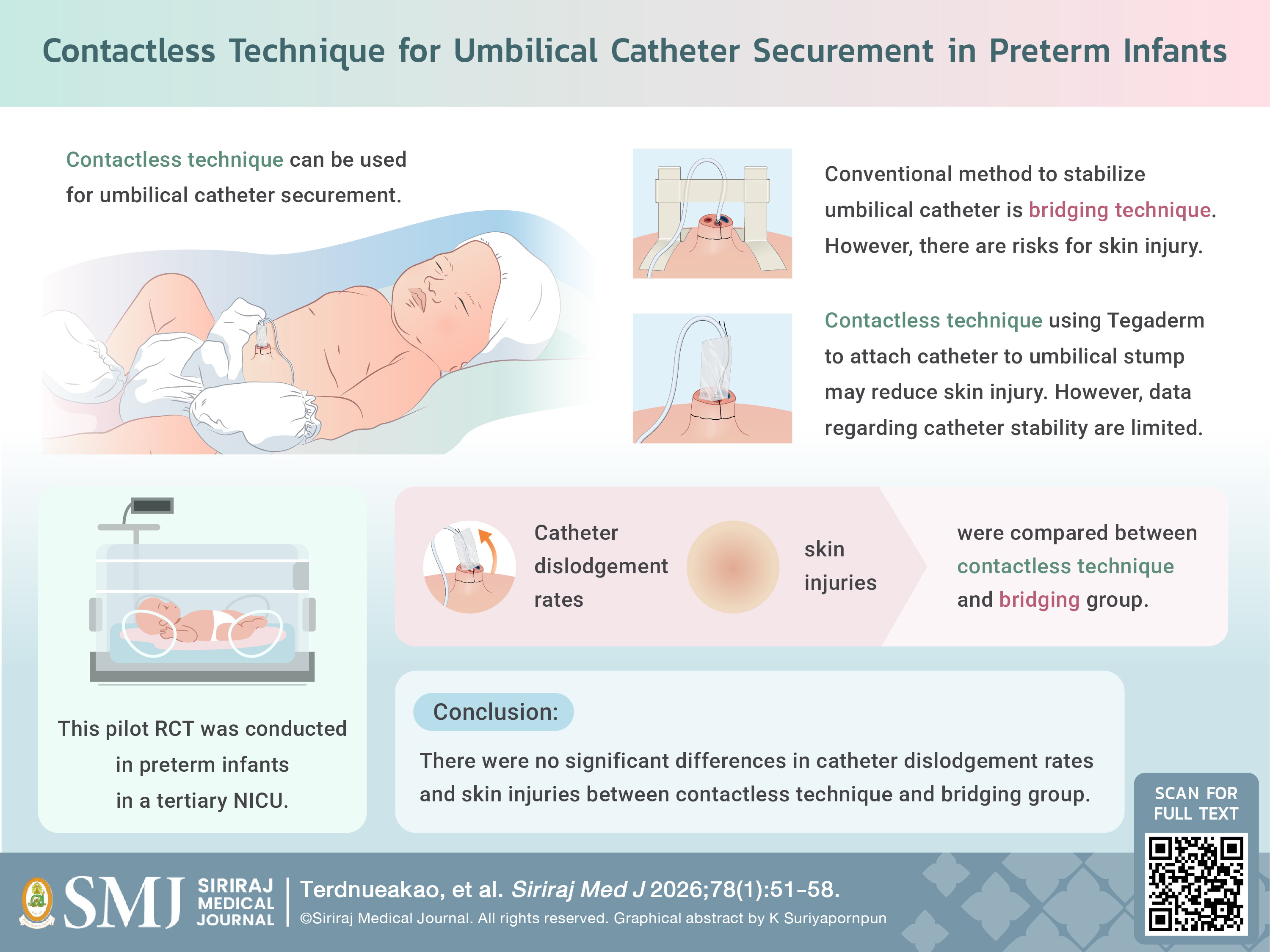
Objective: To compare the rate of catheter dislodgement between the bridging technique and contactless technique (CLT) for umbilical catheter securement in preterm infants.
Materials and Methods: This pilot randomized controlled trial enrolled 30 preterm infants who were randomized in a 1:1 ratio into either the bridging or CLT group. The primary outcome was catheter dislodgement. Secondary outcomes included skin injury, procedural duration, and complications such as omphalitis, catheter-related bloodstream infection (CRBSI), and hypothermia.
Results: A total of 15 patients were included in each group. In the CLT group, 25 catheters were placed (12 umbilical arterial catheters (UAC) and 13 umbilical venous catheters (UVC)), while 24 catheters were placed in the bridging group (10 UACs and 14 UVCs). There was no significant difference in catheter dislodgement rates (1 in 25 catheters in the CLT group vs 0 in 24 catheters in the bridging group, p = 1.00). There was no CRBSI in either group. Skin injuries were minimal, with one case in the bridging group and none in the CLT group (p = 1.00). Repositioning challenges were observed with the CLT after the umbilical stump had dried.
Conclusion: The CLT method demonstrated comparable catheter stability to the bridging technique and may reduce skin injury. It is cost-effective and simple to apply. However, its effectiveness in extremely preterm infants requires further investigation.
References
Nash P. Umbilical catheters, placement, and complication management. J Infus Nurs. 2006;29(6):346-52.
Elser HE. Options for securing umbilical catheters. Adv Neonatal Care. 2013;13(6):426-9.
South M, Magnay A. Simple method for securing umbilical catheters. Arch Dis Child. 1988;63(7 Spec No):750-1.
Stewart DL, Wilkerson S, Fortunato SJ. New technique for stabilizing umbilical artery catheters in very low birthweight infants. J Perinatol. 1989;9(4):458-9.
Grauaug AA, Tompkins JR. The KEMH method for securing umbilical catheters. J Paediatr Child Health. 1992;28(6):436-7.
Hindley DT, Lewis MA, Robinson MJ. Method for securing umbilical lines. Arch Dis Child Fetal Neonatal Ed. 1994;70(1):F79-80.
de Oliveira Marcatto J, Santos AS, Oliveira AJF, Costa ACL, Regne GRS, da Trindade RE, et al. Medical adhesive-related skin injuries in the neonatology department of a teaching hospital. Nurs Crit Care. 2022;27(4):583-8.
Visscher MO, McKeown K, Nurre M, Strange R, Mahan T, Kinnett M, et al. Skin Care for the Extremely Low-Birthweight Infant. Neoreviews. 2023;24(4):e229-e42.
D'Andrea V, Prontera G, Pinna G, Cota F, Fattore S, Costa S, et al. Securement of Umbilical Venous Catheter Using Cyanoacrylate Glue: A Randomized Controlled Trial. J Pediatr. 2023;260:113517.
Shukla H, Ferrara A. Rapid estimation of insertional length of umbilical catheters in newborns. Am J Dis Child. 1986;140(8):786-8.
Akar S, Dincer E, Topcuoğlu S, Yavuz T, Akay H, Gokmen T, et al. Determination of Accurate Position of Umbilical Venous Catheters in Premature Infants. Am J Perinatol. 2022;39(4):369-72.
Lean WL, Dawson JA, Davis PG, Theda C, Thio M. Accuracy of 11 formulae to guide umbilical arterial catheter tip placement in newborn infants. Arch Dis Child Fetal Neonatal Ed. 2018;103(4):F364-f9.
McNichol L, Lund C, Rosen T, Gray M. Medical adhesives and patient safety: state of the science: consensus statements for the assessment, prevention, and treatment of adhesive-related skin injuries. Orthop Nurs. 2013;32(5):267-81.
Perl JR, Crabtree-Beach T, Olyaei A, Hedges M, Jordan BK, Scottoline B. Reducing umbilical catheter migration rates by using a novel securement device. J Perinatol. 2024;44(9):1359-64.
Thangkratok P, Pongpirul K, Sriratanaban J. Transpore Tape and Transparent Film Dressing on the Incidence of Early-Stage Phlebitis: A Comparative Randomized Trial. Siriraj Medical Journal. 2025;77(6):411-8.
Mohamed A, Mohsen N, Solis-Garcia G, Nasef N, Shah P. Comparing Malposition and Complications Associated with Ultrasound-Guided versus Radiography-Guided Central Catheter Tip-Position in Neonates: A Systematic Review and Meta-Analysis. Neonatology. 2025:1-11.
D'Andrea V, Prontera G, Rubortone SA, Pezza L, Pinna G, Barone G, et al. Umbilical Venous Catheter Update: A Narrative Review Including Ultrasound and Training. Front Pediatr. 2021;9:774705.
Published
How to Cite
License
Copyright (c) 2025 Siriraj Medical Journal

This work is licensed under a Creative Commons Attribution-NonCommercial-NoDerivatives 4.0 International License.
Authors who publish with this journal agree to the following conditions:
Copyright Transfer
In submitting a manuscript, the authors acknowledge that the work will become the copyrighted property of Siriraj Medical Journal upon publication.
License
Articles are licensed under a Creative Commons Attribution-NonCommercial-NoDerivatives 4.0 International License (CC BY-NC-ND 4.0). This license allows for the sharing of the work for non-commercial purposes with proper attribution to the authors and the journal. However, it does not permit modifications or the creation of derivative works.
Sharing and Access
Authors are encouraged to share their article on their personal or institutional websites and through other non-commercial platforms. Doing so can increase readership and citations.