
Incidence and Factors Associated with Perioperative Respiratory Adverse Events in Pediatric Patients with Upper Respiratory Tract Infection Undergoing Surgery Under General Anesthesia: A Retrospective Cohort Study
DOI:
https://doi.org/10.33192/smj.v78i1.277950Keywords:
Anesthesia, Children, Factors, Pediatric, Perioperative respiratory adverse events, Upper respiratory tract infectionsAbstract
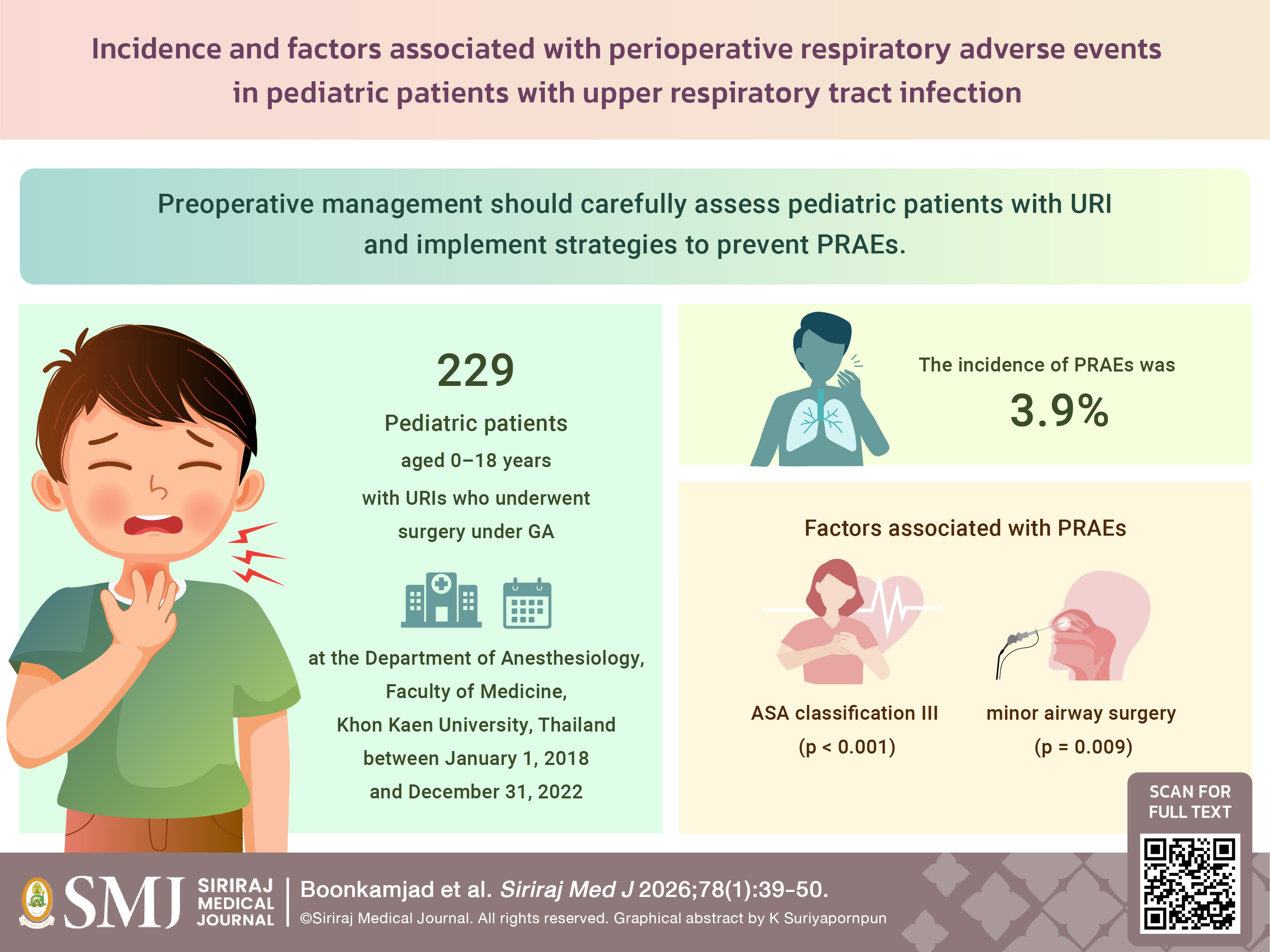
Objective: The primary objective is to determine the incidence of perioperative respiratory adverse events (PRAEs) in pediatric patients with upper respiratory tract infections (URIs) undergoing general anesthesia (GA); the secondary objective is to identify associated risk factors, including the COLDS score.
Materials and Methods: This retrospective cohort study included pediatric patients aged 0–18 years with URIs who underwent surgery under GA at the Department of Anesthesiology, Faculty of Medicine, Khon Kaen University, Khon Kaen, Thailand, between January 1, 2018, and December 31, 2022.
Results: A total of 229 pediatric patients were analyzed, with a PRAE incidence of 3.9%. In univariable logistic regression analysis, the American Society of Anesthesiologists (ASA) classification III, severe URI, underlying respiratory disease, endotracheal tube use, emergency surgery, and minor airway surgery (compared with other surgery types) were identified as factors associated with PRAEs. In multivariable analysis, only ASA classification III compared with ASA classification II (adjusted odds ratio [OR] 83.33; 95% CI, 7.10 to 1363.56; p < 0.001) and minor airway surgery compared with other surgery types (adjusted OR 18.54; 95% CI, 1.97 to 237.98; p = 0.009) remained significantly associated with PRAEs.
Conclusion: The incidence of PRAEs in pediatric patients with URIs undergoing GA was 3.9%. ASA classification III and minor airway surgery were associated with PRAEs. Careful preoperative assessment and targeted prevention strategies are recommended for pediatric patients with URIs to reduce PRAEs.
References
Stepanovic B, Regli A, Becke-Jakob K, von Ungern-Sternberg BS. Preoperative preparation of children with upper respiratory tract infection: a focussed narrative review. Br J Anaesth. 2024;133(6):1212-21.
Lema GF, Berhe YW, Gebrezgi AH, Getu AA. Evidence-based perioperative management of a child with upper respiratory tract infections (URTIs) undergoing elective surgery; A systematic review. Int J Surg Open. 2018;12:17–24.
Jarraya A, Kammoun M, Ammar S, Feki W, Kolsi K. Predictors of perioperative respiratory adverse events among children with upper respiratory tract infection undergoing pediatric ambulatory ilioinguinal surgery: a prospective observational research. World J Pediatr Surg. 2023;6(2):e000524.
Pohplook J, Puwarawuttipanit W, Koositamongkol S, Rongrungruang Y. Factors Influencing Severity and Impact of Symptoms in Patients with Upper Respiratory Tract Infection at Community Hospitals and Health-Promoting Hospitals. Siriraj Med J. 2021;73(8):510-7.
Regli A, Becke K, von Ungern-Sternberg BS. An update on the perioperative management of children with upper respiratory tract infections. Curr Opin Anesthesiol. 2017;30(3):362.
Malviya S, Voepel-Lewis T, Siewert M, Pandit UA, Riegger LQ, Tait AR. Risk Factors for Adverse Postoperative Outcomes in Children Presenting for Cardiac Surgery with Upper Respiratory Tract Infections. Anesthesiology. 2003;98(3):628–32.
Wudineh DM, Berhe YW, Chekol WB, Adane H, Workie MM. Perioperative Respiratory Adverse Events Among Pediatric Surgical Patients in University Hospitals in Northwest Ethiopia; A Prospective Observational Study. Front Pediatr. 2022;10:827663.
Lee S, Reddington E, Koutsogiannaki S, Hernandez MR, Odegard KC, DiNardo JA, et al. Incidence and Risk Factors for Perioperative Cardiovascular and Respiratory Adverse Events in Pediatric Patients With Congenital Heart Disease Undergoing Noncardiac Procedures. Anesth Analg. 2018;127(3):724.
Ramgolam A, Hall GL, Zhang G, Hegarty M, von Ungern-Sternberg BS. Inhalational versus Intravenous Induction of Anesthesia in Children with a High Risk of Perioperative Respiratory Adverse Events: A Randomized Controlled Trial. Anesthesiology. 2018;128(6):1065–74.
von Ungern-Sternberg BS, Boda K, Chambers NA, Rebmann C, Johnson C, Sly PD, et al. Risk assessment for respiratory complications in paediatric anaesthesia: a prospective cohort study. Lancet Lond Engl. 2010;376(9743):773–83.
Lee BJ, August DA. COLDS: A heuristic preanesthetic risk score for children with upper respiratory tract infection. Pediatr Anesth. 2014;24(3):349–50.
Kim HS, Kim YS, Lim BG, Lee JH, Song J, Kim H. Risk Assessment of Perioperative Respiratory Adverse Events and Validation of the COLDS Score in Children with Upper Respiratory Tract Infection. Med Kaunas Lith. 2022;58(10):1340.
Lee HJ, Woo JH, Cho S, Oh HW, Joo H, Baik HJ. Risk Factors for Perioperative Respiratory Adverse Events in Children with Recent Upper Respiratory Tract Infection: A Single-Center-Based Retrospective Study. Ther Clin Risk Manag. 2020;16:1227-34.
Shenoy U, Chirayath B, Narayanan PV, Francis A, Thomas MK, Rajagopal R. Predictors of Perioperative Respiratory Adverse Events in Children Undergoing Surgery for Oropharyngeal Cleft Deformity: A Prospective Observational Study (PRAE-OPCD Study). Paediatr Anaesth. 2025;35(12):1024-8.
Published
How to Cite
License
Copyright (c) 2025 Siriraj Medical Journal

This work is licensed under a Creative Commons Attribution-NonCommercial-NoDerivatives 4.0 International License.
Authors who publish with this journal agree to the following conditions:
Copyright Transfer
In submitting a manuscript, the authors acknowledge that the work will become the copyrighted property of Siriraj Medical Journal upon publication.
License
Articles are licensed under a Creative Commons Attribution-NonCommercial-NoDerivatives 4.0 International License (CC BY-NC-ND 4.0). This license allows for the sharing of the work for non-commercial purposes with proper attribution to the authors and the journal. However, it does not permit modifications or the creation of derivative works.
Sharing and Access
Authors are encouraged to share their article on their personal or institutional websites and through other non-commercial platforms. Doing so can increase readership and citations.