
Prevalence and Factors Associated with Urologic Abnormalities in Hypospadias Patients
DOI:
https://doi.org/10.33192/smj.v78i1.278201Keywords:
Hypospadias, kidney-ureter-bladder (KUB), ultrasonography, urogenital anomalies, voiding cystourethrogramAbstract
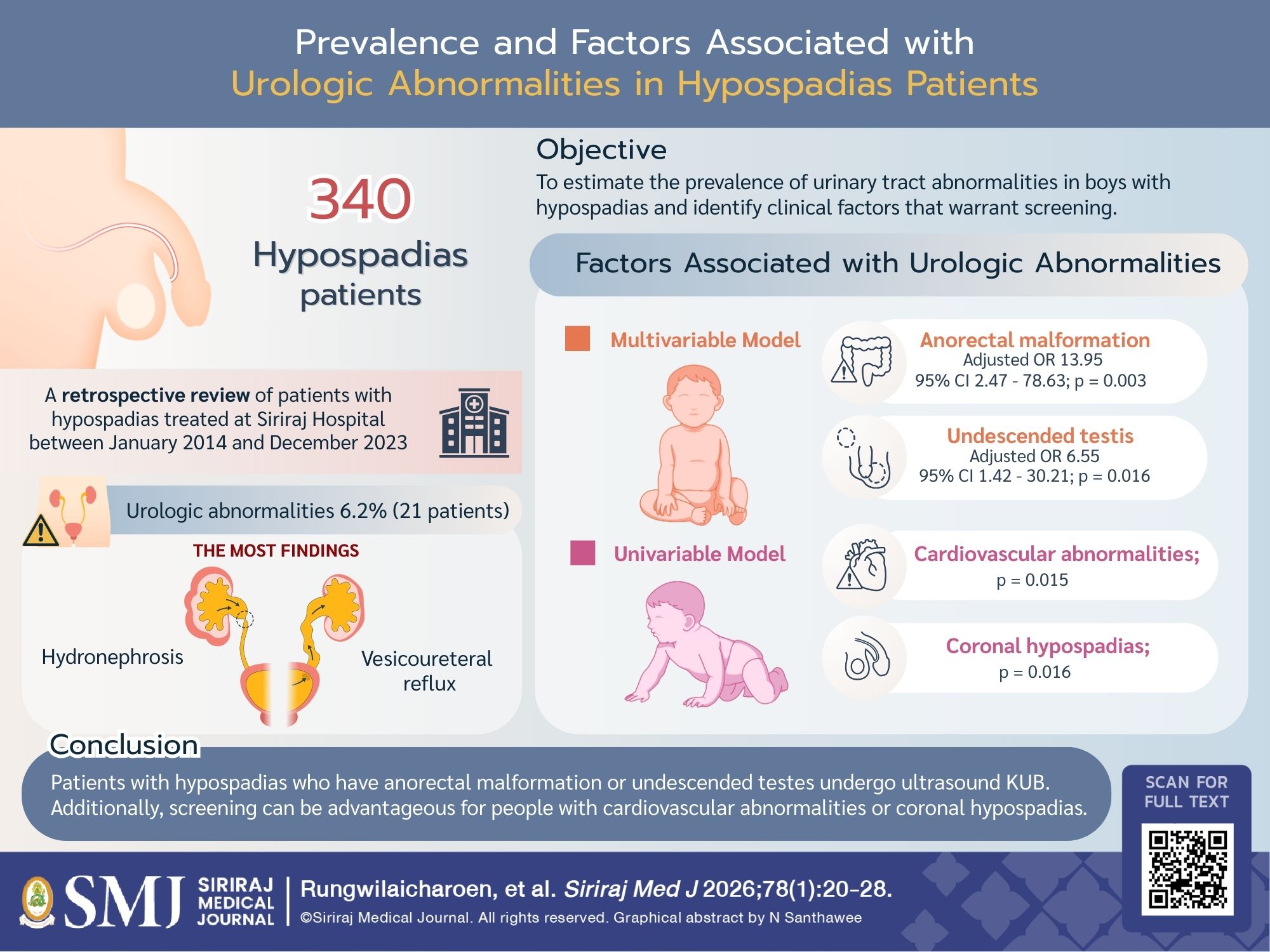
Objective: To estimate the prevalence of urinary tract abnormalities in boys with hypospadias and identify clinical factors that warrant screening.
Materials and Methods: A retrospective review was conducted of patients with hypospadias treated at Siriraj Hospital between January 2014 and December 2023. No standardized radiographic screening protocol was applied.
Results: Urinary tract abnormalities were identified in 6.2% (21/340) of patients with hypospadias. The most prevalent findings were vesicoureteral reflux (VUR) and hydronephrosis, primarily non-obstructive, non-reflux hydronephrosis. Ultrasound KUB was a valuable screening tool (n = 95), detecting 19 urinary tract abnormalities and 13 additional abnormalities. Analysis of KUB-related anomalies in hypospadias showed no direct relationship between urethral opening and the frequency of urinary tract abnormalities, except in coronal hypospadias, which demonstrated a higher rate of anomalies. On multivariable binary logistic regression, anorectal malformation (adjusted OR 13.95, 95% CI 2.47 - 78.63; p = 0.003) and undescended testis (adjusted OR 6.55, 95% CI 1.42 - 30.21; p = 0.016) predicted KUB abnormalities in patients with hypospadias. In the univariable model, cardiovascular abnormalities and coronal hypospadias were also significantly associated with urinary tract abnormalities (p = 0.015 and p = 0.006, respectively), with medium to high effect sizes.
Conclusion: Of patients with hypospadias, 6.2% had anomalies of the urinary tract. It is advised that patients with hypospadias who additionally have anorectal anomalies or undescended testes undergo ultrasound KUB. Additionally, screening can be advantageous for patients with cardiovascular abnormalities or coronal hypospadias.
References
Sujijantararat P. Pediatric urology: What’s new? Siriraj Med J. 2007;59(5):259-63.
Cerasaro TS, Brock WA, Kaplan GW. Upper urinary tract anomalies associated with congenital hypospadias: Is screening necessary? J Urol. 1986;135(3):537-8.
Shima H, Ikoma F, Terakawa T, Satoh Y, Nagata H, Shimada K, et al. Developmental anomalies associated with hypospadias. J Urol. 1979;122:619-21.
Davenport M, MacKinnon AE. The value of ultrasound screening of the upper urinary tract in hypospadias. Br J Urol. 1988;62:595-6.
Friedman T, Shalom A, Hoshen G, Brodovsky S, Tieder M, Westrich M. Detection and incidence of anomalies associated with hypospadias. Pediatr Nephrol. 2008;23:1809-16.
Gupta L, Sharma S, Gupta DK. Is there a need to do routine sonological, urodynamic study and cystourethroscopic evaluation of patients with simple hypospadias? Pediatr Surg Int. 2010;26:971-6.
Chariatte V, Ramseyer P, Cachat F. Urological screening for upper and lower urinary tract anomalies in patients with hypospadias: A systematic literature review. Evid Based Med. 2013;18(1):11-20.
Snodgrass W. Hypospadias. In: Hulbert WC, Rabinowitz R, Mevorach RA, editors. Pediatric Urology for the Primary Care Physician. New York: Springer; 2014.p.229-35.
Wu WH, Chuang JH, Ting YC, Lee SY, Hsieh CS. Developmental anomalies and disabilities associated with hypospadias. J Urol. 2002;168:229-32.
Moore CC. The role of routine radiographic screening of boys with hypospadias: a prospective study. J Pediatr Surg. 1990;25:339-41.
Kelly D, Harte FB, Roe P. Urinary tract anomalies in patients with hypospadias. Br J Urol. 1984;56:316-8.
Pengvanich P, Mungnirandr A, Ruangtrakool R. Associated genitourinary abnormalities in low-type anorectal malformation and urological investigations. J Med Assoc Thai. 2017; 100(3):S95-S100.
Published
How to Cite
License
Copyright (c) 2025 Siriraj Medical Journal

This work is licensed under a Creative Commons Attribution-NonCommercial-NoDerivatives 4.0 International License.
Authors who publish with this journal agree to the following conditions:
Copyright Transfer
In submitting a manuscript, the authors acknowledge that the work will become the copyrighted property of Siriraj Medical Journal upon publication.
License
Articles are licensed under a Creative Commons Attribution-NonCommercial-NoDerivatives 4.0 International License (CC BY-NC-ND 4.0). This license allows for the sharing of the work for non-commercial purposes with proper attribution to the authors and the journal. However, it does not permit modifications or the creation of derivative works.
Sharing and Access
Authors are encouraged to share their article on their personal or institutional websites and through other non-commercial platforms. Doing so can increase readership and citations.