Effectiveness of a Facilitator-Led Internet-Based Parent Management Training (Net PAMA Program) on Positive Parenting Skills Among Parents of Children Aged 7-12 Years: A Quasi-Experimental Study in Thailand
DOI:
https://doi.org/10.33192/smj.v78i4.278403Keywords:
children, internet-based intervention, parenting, problem behavior, self-esteemAbstract
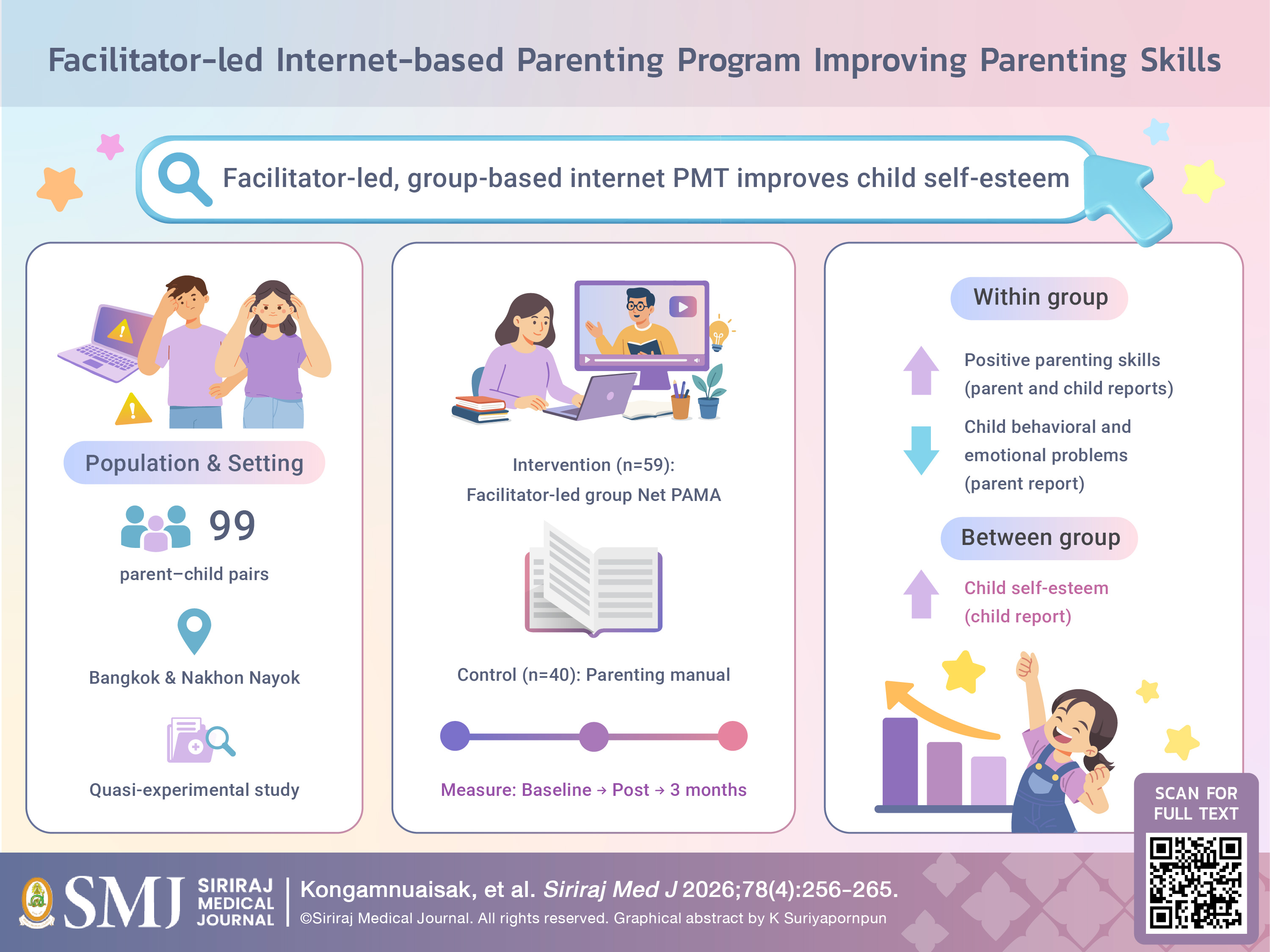
Objective: This quasi-experimental study evaluated the effectiveness of a facilitator-led, internet-based parent training program (Net PAMA) in improving positive parenting skills among parents of children aged 7-12 years.
Materials and Methods: The study involved 99 parent-child pairs, divided into an intervention group of 59 pairs and a control group of 40 pairs. Data were collected at three time points: before training, immediately after, and at a 3-month follow-up. The effectiveness of the training was measured using the Positive Parenting Scale (POPS), the Thai version of the Pediatric Symptom Checklist (PSC-17), and a pictorial self-esteem scale for children. Statistical data were analyzed using a linear-mixed model.
Results: The study found no significant difference between the intervention and control groups in parent- or childreported POPS scores at the 3-month follow-up. However, within the intervention group, both parent-reported (p < 0.001) and child-reported (p = 0.017) POPS scores significantly increased from baseline to the 3-month follow-up. Similarly, although between-group differences in PSC-17 scores were not significant, parent-reported PSC-17 scores in the intervention group decreased significantly from baseline (p = 0.002). Notably, children in the intervention group had significantly higher self-esteem scores than the control group at the 3-month follow-up (p = 0.003).
Conclusion: The facilitator-led Net PAMA program was effective in enhancing child self-esteem but ineffective in increasing positive parenting skills and reducing child behavioral problems. Nevertheless, the results are promising and support further investigation with a larger sample size and more rigorous study design.
References
Lichtenstein P, Cederlof M, Lundstrom S, D'Onofrio BM, Anckarsater H, Larsson H, et al. Associations between conduct problems in childhood and adverse outcomes in emerging adulthood: a longitudinal Swedish nationwide twin cohort. J Child Psychol Psychiatry. 2022;61(7):798-806.
Vuoksimaa E, Rose RJ, Pulkkinen L, Palviainen T, Rimfeld K, Lundstrom S, et al. Higher aggression is related to poorer academic performance in compulsory education. J Child Psychol Psychiatry. 2021;62(3):327-38.
Winter SM, Dittrich K, Dorr P, Overfeld J, Moebus I, Murray E, et al. Immediate impact of child maltreatment on mental, developmental, and physical health trajectories. J Child Psychol Psychiatry. 2022;63(9):1027-45.
Ryan R, O'Farrelly C, Ramchandani P. Parenting and child mental health. London J Prim Care (Abingdon). 2017;9(6):86-94.
Weber L, Kamp-Becker I, Christiansen H, Mingebach T. Treatment of child externalizing behavior problems: a comprehensive review and meta-meta-analysis on effects of parent-based interventions on parental characteristics. Eur Child Adolesc Psychiatry. 2019;28(8):1025-36.
Kling A, Forster M, Sundell K, Melin L. A randomized controlled effectiveness trial ofparent management training with varying degrees of therapist support. Behav Ther. 2010;41(4):530-42.
Ogden T, Hagen KA. Treatment effectiveness of Parent Management Training in Norway: a randomized controlled trial of children with conduct problems. J Consult Clin Psychol. 2008;76(4):607-21.
Thijssen J, Vink G, Muris P, de Ruiter C. The Effectiveness of Parent Management Training-Oregon Model in Clinically Referred Children with Externalizing Behavior Problems in The Netherlands. Child Psychiatry Hum Dev. 2017;48(1):136-50.
Dishion T, Forgatch M, Chamberlain P, Pelham WE. The Oregon Model of Behavior Family Therapy: From Intervention Design to Promoting Large-Scale System Change. Behav Ther. 2016;47(6):812-37.
Webster-Stratton C, Rinaldi J, Jamila MR. Long-Term Outcomes of Incredible Years Parenting Program: Predictors of Adolescent Adjustment. Child Adolesc Ment Health. 2011;16(1):38-46.
Sanders MR. Triple P-Positive Parenting Program: towards an empirically validated multilevel parenting and family support strategy for the prevention of behavior and emotional problems in children. Clin Child Fam Psychol Rev. 1999;2(2):71-90.
Eyberg SM, Matarazzo RG. Training parents as therapists: a comparison between individual parent-child interaction training and parent group didactic training. J Clin Psychol. 1980;36(2):492-9.
Hogstrom J, Enebrink P, Melin B, Ghaderi A. Eighteen-Month Follow-Up of Internet-Based Parent Management Training for Children with Conduct Problems and the Relation of Homework Compliance to Outcome. Child Psychiatry Hum Dev. 2015;46(4):577-88.
Irvine AB, Gelatt VA, Hammond M, Seeley JR. A randomized study of internet parent training accessed from community technology centers. Prev Sci. 2015;16(4):597-608.
McGoron L, Hvizdos E, Bocknek EL, Montgomery E, Ondersma SJ. Feasibility of Internet-based Parent Training for Low-income Parents of Young Children. Child Youth Serv Rev. 2018;84:198-205.
O'Shea A, Kaplan K, Solomon P, Salzer MS. Randomized Controlled Trial of an Internet-Based Educational Intervention for Mothers With Mental Illnesses: An 18-Month Follow-Up. Psychiatr Serv. 2019;70(8):732-5.
Prinz RJ, Metzler CW, Sanders MR, Rusby JC, Cai C. Online-delivered parenting intervention for young children with disruptive behavior problems: a noninferiority trial focused on child and parent outcomes. J Child Psychol Psychiatry. 2022;63(2):199-209.
Ristkari T, Kurki M, Suominen A, Gilbert S, Sinokki A, Kinnunen M, et al. Web-Based Parent Training Intervention with Telephone Coaching for Disruptive Behavior in 4-Year-Old Children in Real-World Practice: Implementation Study. J Med Internet Res. 2019;21(4):e11446.
Parent J, Anton MT, Loiselle R, Highlander A, Breslend N, Forehand R, et al. A randomized controlled trial of technology-enhanced behavioral parent training: sustained parent skill use and child outcomes at follow-up. J Child Psychol Psychiatry. 2022;63(9):992-1001.
Wannapaschaiyong P, Penphattarakul A, Rojmahamongkol P, Sutchritpongsa S.
The relationship between primary caregivers’ psychosocial factors and self-esteem in children and adolescents with attention-deficit/hyperactivity disorder: an exploratory cross-sectional study. Siriraj Med J. 2023;75(8):584-91.
Atsariyasing W, Chanpen S, Chaiudomsom C, Jeerasup N, Inta P, Thongseiratch T, et al. Effectiveness of an Internet-Based Parent Management Training Program (Net PAMA): A Multicenter, Randomized Controlled Trial. Department of Psychiatry, Faculty of Medicine Siriraj Hospital, Mahidol University; 2021. (Unpublished manuscript)
Thanaariyapaisan P, Chanpen S, Pornnoppadol C, Chaiudomsom C, Jeerasup N, Inta P, et al. Development of Positive Parenting Scale (POPS). Department of Psychiatry, Faculty of Medicine Siriraj Hospital, Mahidol University; 2021. (Unpublished manuscript)
Pornnoppadol C, Chanpen S, Vasupanrajit A, Apinuntavech S. Reliability and Validity Thai version of Pediatric Symptom Checklist – 17 (PSC-17). Department of Psychiatry, Faculty of Medicine Siriraj Hospital, Mahidol University; 2018. (Unpublished manuscript)
Lamphasukjit P. A Further Development of Self-Esteem Inventory to Pictorial Form for the 2nd – 6th Grade Students [Thesis]. Mahidol University; 2022.
Martin M, Steele B, Spreckelsen TF, Lachman JM, Gardner F, Shenderovich Y. The Association Between Facilitator Competent Adherence and Outcomes in Parenting Programs: A Systematic Review and SWIM Analysis. Prev Sci. 2023;24(7):1314-26.
Rogers J, Hyun SH, McDaniels M, Spencer K, House S, Pfund C. What Impacts Perceived Facilitator Effectiveness in Small Group Learning Experiences: Examining Facilitations of Research Mentor Training. Understanding Interventions J. 2024;15(1):1-14.
Hosiri T, Jongjaroen A, Imaroonrak S, Sumalrot T, Phattharayuttawat S. Role of resilience in the relationship between adverse childhood experiences and behavior problems among Thai adolescents in a province of Southern Thailand: a school-based cross-sectional study. Siriraj Med J. 2024;76(5):282-92.
Published
How to Cite
License
Copyright (c) 2026 Siriraj Medical Journal

This work is licensed under a Creative Commons Attribution-NonCommercial-NoDerivatives 4.0 International License.
Authors who publish with this journal agree to the following conditions:
Copyright Transfer
In submitting a manuscript, the authors acknowledge that the work will become the copyrighted property of Siriraj Medical Journal upon publication.
License
Articles are licensed under a Creative Commons Attribution-NonCommercial-NoDerivatives 4.0 International License (CC BY-NC-ND 4.0). This license allows for the sharing of the work for non-commercial purposes with proper attribution to the authors and the journal. However, it does not permit modifications or the creation of derivative works.
Sharing and Access
Authors are encouraged to share their article on their personal or institutional websites and through other non-commercial platforms. Doing so can increase readership and citations.