
Prevalence, Predictive Factors, and Surgical Outcomes of Strabismus in High Myopia
DOI:
https://doi.org/10.33192/smj.v78i3.278985Keywords:
Myopia, Strabismus, Prevalence, Predictive Value of Tests, Predictive factors, Ophthalmologic Surgical ProceduresAbstract
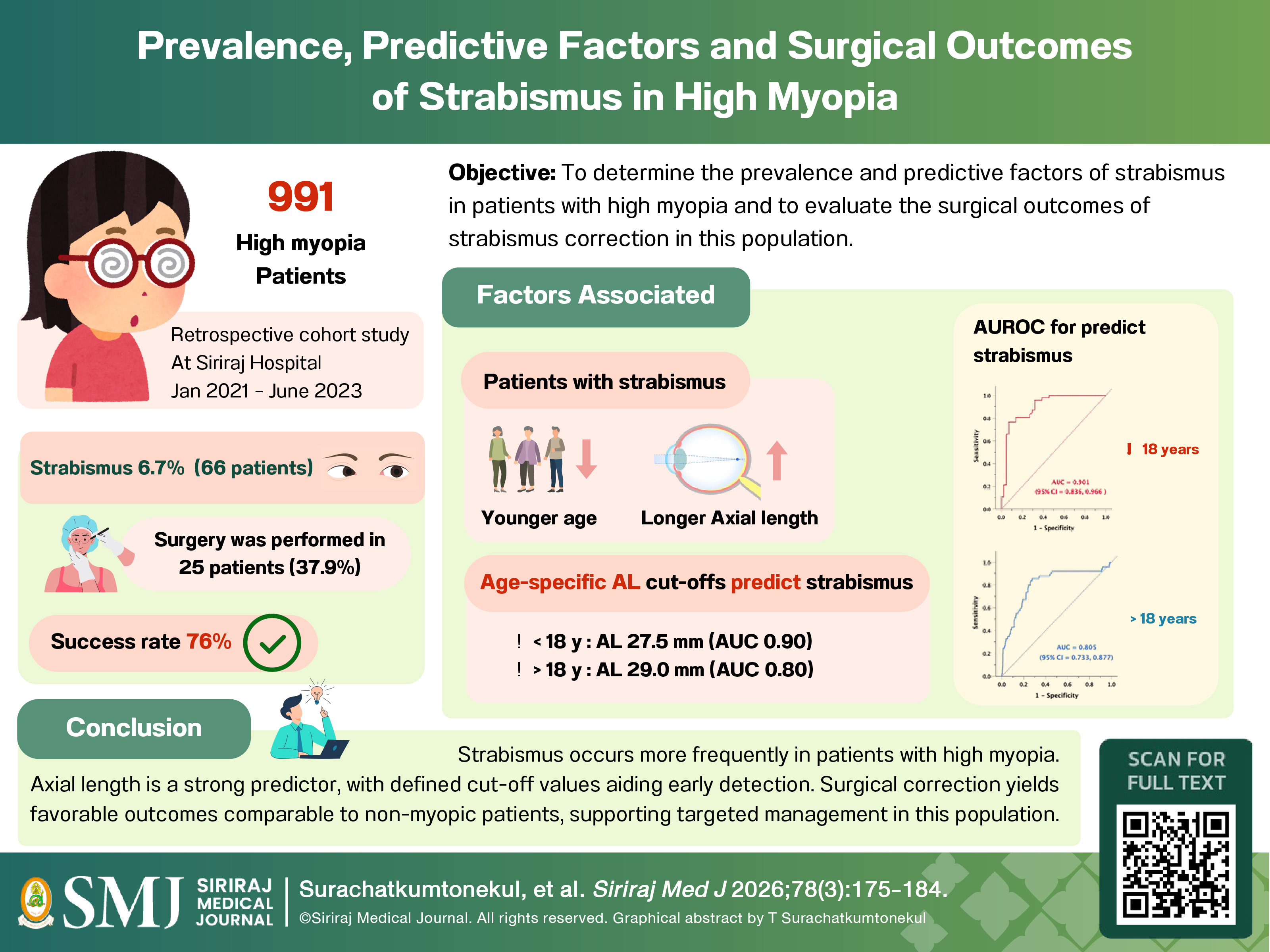
Objective: To determine the prevalence and predictive factors of strabismus in patients with high myopia and to evaluate the surgical outcomes of strabismus correction in this population.
Materials and Methods: This retrospective cohort study included 991 patients with high myopia (1,880 eyes) who attended Siriraj Hospital between January 2021 and June 2023. High myopia was defined as a spherical equivalent (SE) ≤ -5.0 diopters or an axial length (AL) ≥ 26.5 mm. Collected data included demographics, visual acuity, refractive error, axial length, strabismus type, and surgical outcomes. Surgical success was defined as postoperative alignment within 8 prism diopters (PD) at the 8-week follow-up. ROC curve analysis was performed to determine optimal AL cut-off values for predicting strabismus.
Results: Strabismus was identified in 6.7% (66/991) of patients. The mean SE and AL were -11.41 ± 4.87 D and 28.35 ± 2.06 mm, respectively. Patients with strabismus were younger and had longer AL compared to those without strabismus (p < 0.01). ROC analysis showed optimal AL thresholds of 27.5 mm for patients ≤18 years and 29.0 mm for patients >18 years, demonstrating high sensitivity, specificity, and predictive accuracy (AUC = 0.90 and 0.80, respectively). Surgical intervention was performed in 25 patients (37.9%), achieving a success rate of 76%.
Conclusions: Strabismus is more prevalent in individuals with high myopia than in the general population. Axial length is a strong predictor, and defined cut-offs can guide early detection. Surgical outcomes are favorable and comparable to those in non-myopic patients, supporting targeted management strategies in this population.
References
World Health Organization. The High Impact of Myopia and High Myopia. WHO; 2017. Accessed Nov. 14, 2019.
Holden BA, Fricke TR, Wilson DA, Jong M, Naidoo KS, Sankaridurg P, et al. Global prevalence of myopia and high myopia and temporal trends from 2000 through 2050. Ophthalmology. 2016;123(5):1036-42.
Surachatkumtonekul T. Strabismus in high myopia. In: Wongsakittirak S, Somkijrungroj T, editors. Thai Academy of Ophthalmology (Jaksu Vichakan) by the Royal College of Ophthalmologists of Thailand, Vol. 7. Bangkok: Thammasat University Press; 2023. p. 153-66.
Jonas JB, Bikbov MM, Kazakbaeva GM, Wang YX, Xu J, Nangia V, et al. Positive and Negative Associations of Myopia with Ocular Diseases in Population-Based Studies. Ophthalmology. 2024;131(12):1427-35.
Haarman AEG, Enthoven CA, Tideman JWL, Tedja MS, Verhoeven VJM, Klaver CCW. The Complications of Myopia: A Review and Meta-Analysis. Invest Ophthalmol Vis Sci. 2020;61(4):49.
Foster PJ, Jiang Y. Epidemiology of myopia. Eye (Lond). 2014;28(2):202-8.
Fieß A, Elflein HM, Urschitz MS, Pesudovs K, Münzel T, Wild PS, et al. Prevalence of Strabismus and Its Impact on Vision-Related Quality of Life. Ophthalmology. 2020;127(8):1113-22.
Tanaka A, Ohno Matsui K, Shimada N, Hayashi K, Shibata Y, Yoshida T, et al. Prevalence of strabismus in patients with pathologic myopia. J Med Dent Sci. 2010;57(1):75-82.
Jenchitr W, Jaradaroonchay M, Sakulsiritiwakorn N. Strabismus And Amblyopia In Thailand. Interprof J Health Sci [internet]. 2023 Oct. 5 [cited 2025 May 14];11(1):38-43. Available from: https://li05.tci-thaijo.org/index.php/IJHS/article/view/9
Hashemi H, Pakzad R, Heydarian S, Yekta A, Aghamirsalim M, Shokrollahzadeh F, et al. Global and regional prevalence of strabismus: a comprehensive systematic review and meta-analysis. Strabismus. 2019;27(2):54-65.
Miyata M, Kido A, Miyake M, Tamura H, Kamei T, Wada S, et al. Prevalence and Incidence of Strabismus by Age Group in Japan: A Nationwide Population-Based Cohort Study. Am J Ophthalmol. 2024;262:222-8.
Yamaguchi M, Yokoyama T, Shiraki K. Surgical Procedure for Correcting Globe Dislocation in Highly Myopic Strabismus. Am J Ophthalmol. 2010;149(2):341-6.e2.
Adams GGW, Sloper JJ. Update on squint and amblyopia. J R Soc Med. 2003;96(1):3-6.
Du R, Xie S, Igarashi Yokoi T, Watanabe T, Uramoto K, Takahashi H, et al. Continued increase of axial length and its risk factors in adults with high myopia. JAMA Ophthalmol. 2021;139(10):1096-103.
Nakao Y, Kimura T. Prevalence and anatomic mechanism of highly myopic strabismus among Japanese with severe myopia. Jpn J Ophthalmol. 2014;58(2):218-24.
Yetkin AA. Factors Affecting Surgical Success Rates in Pediatric Horizontal Strabismus Surgery. Cureus. 2024;16(11):e74758.
Kampanartsanyakorn S, Surachatkumtonekul T, Dulayajinda D, Jumroendararasmee M, Tongsae S. The outcomes of horizontal strabismus surgery and influencing factors of the surgical success. J Med Assoc Thai. 2005;88 Suppl 9:S94-9.
Surachatkumtonekul T, Tongsai S, Sathianvichitr K, Sangsre P, Saiman M, Sermsripong W, et al. Corneal curvature change after strabismus surgery: an experience from a single academic center. Siriraj Med J. 2024;76(10):713-21.
Demer JL. Muscle paths matter in strabismus associated with axial high myopia. Am J Ophthalmol. 2010;149(2):184-186.e1.
Yokoyama T, Tabuchi H, Ataka S, Shiraki K, Miki T, Mochizuki K. The mechanism of development in progressive esotropia with high myopia. In: Proceedings of the transactions of the 26th meeting of European strabismological Association (ed Faber JT De), Barcelona, 14–16 September 2000.p.218-21.
Tan RJD, Demer JL. Heavy eye syndrome versus sagging eye syndrome in high myopia. J AAPOS. 2015;19(6):500-6.
Aoki Y, Nishida Y, Hayashi O, Nakamura J, Oda S, Yamade S, et al. Magnetic resonance imaging measurements of extraocular muscle path shift and posterior eyeball prolapse from the muscle cone in acquired esotropia with high myopia. Am J Ophthalmol. 2003;136(3):482-9.
Krzizok TH, Schroeder BU. Measurement of recti eye muscle paths by magnetic resonance imaging in highly myopic and normal subjects. Invest Ophthalmol Vis Sci. 1999; 40:2554-60.
Monga S, Kekunnaya R, Sachdeva V. Exotropia-hypotropia complex in high myopia. J Pediatr Ophthalmol Strabismus. 2013;50(6):340-6.
ธรรมนูญ สุรชาติกำธรกุล. ภาวะตาเหล่ในผู้ป่วยสายตาสั้นมาก. ใน: ศักดิ์ชัย วงศกิตติรักษ์ ธนาพงษ์ สมกิจรุ่งโรจน์, บรรณาธิการ. จักษุ. วิชาการ โดย ราชวิทยาลัยจักษุแพทย์แห่งประเทศไทย เล่ม 7. กรุงเทพฯ: โรงพิมพ์มหาวิทยาลัยธรรมศาสตร์; 2566. หน้า 153-66. (In Thai)
Phamonvaechavan P, Saksiriwutto P. Surgical treatment of myopic strabismus fixus by loop myopexy augmented with scleral fixation: a case report. Siriraj Med J. 2019;71(4):318-21.
Chaudhuri Z, Demer JL. Sagging eye syndrome: connective tissue involution as a cause of horizontal and vertical strabismus in older patients. JAMA Ophthalmol. 2013;131(5):
-25.
Additional Files
Published
How to Cite
License
Copyright (c) 2026 Siriraj Medical Journal

This work is licensed under a Creative Commons Attribution-NonCommercial-NoDerivatives 4.0 International License.
Authors who publish with this journal agree to the following conditions:
Copyright Transfer
In submitting a manuscript, the authors acknowledge that the work will become the copyrighted property of Siriraj Medical Journal upon publication.
License
Articles are licensed under a Creative Commons Attribution-NonCommercial-NoDerivatives 4.0 International License (CC BY-NC-ND 4.0). This license allows for the sharing of the work for non-commercial purposes with proper attribution to the authors and the journal. However, it does not permit modifications or the creation of derivative works.
Sharing and Access
Authors are encouraged to share their article on their personal or institutional websites and through other non-commercial platforms. Doing so can increase readership and citations.