
Optical Interventions for Myopia Control
DOI:
https://doi.org/10.33192/smj.v78i4.279511Keywords:
Optical Interventions, Myopia ControlAbstract
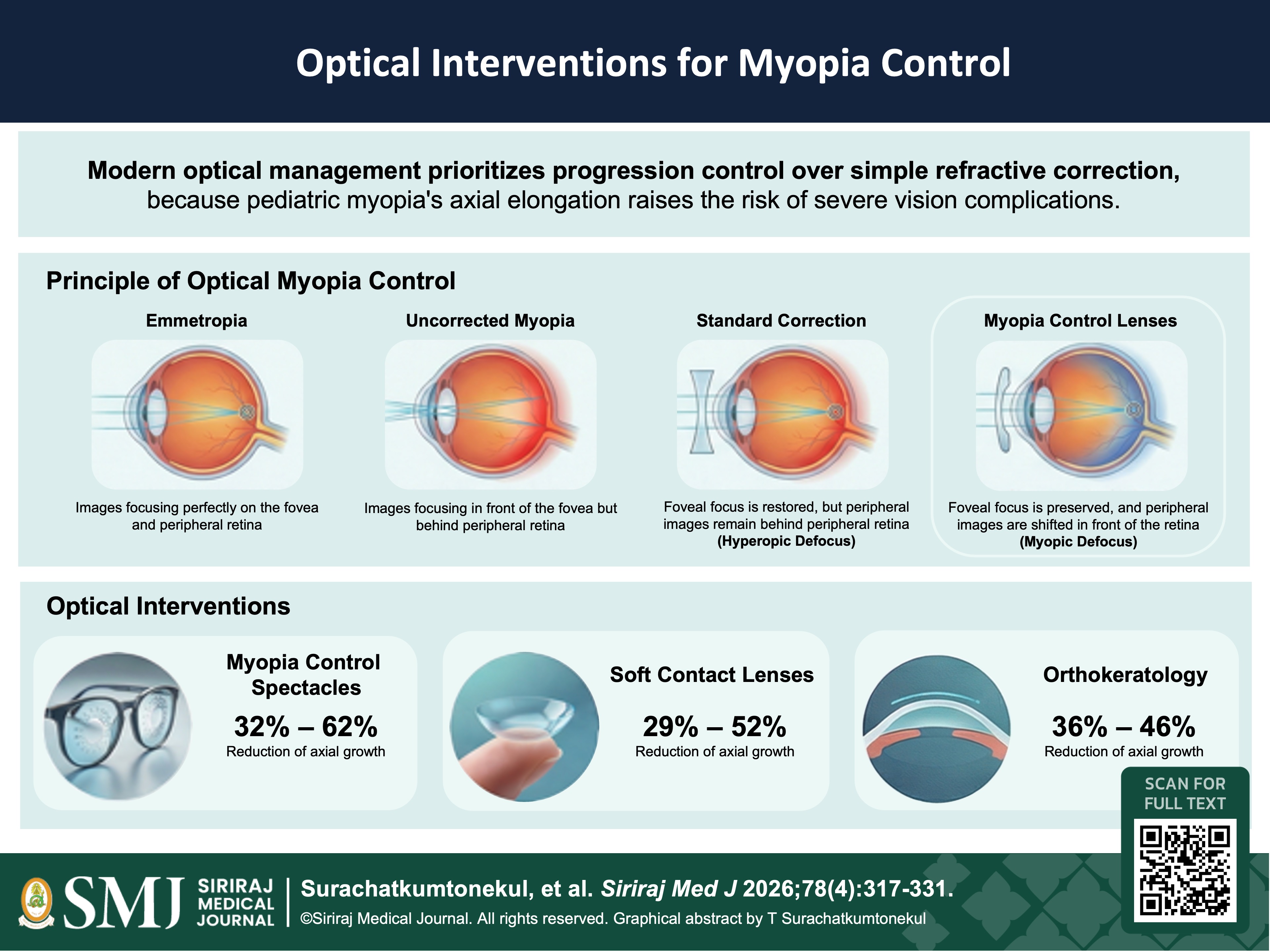
Pediatric myopia is a major public health challenge driven primarily by progressive axial elongation, which substantially increases the lifetime risk of vision-threatening complications, such as myopic macular degeneration. Accordingly, contemporary management emphasizes myopia control rather than simple refractive correction. Current strategies include behavioral modification, low-dose atropine, and — most critically — optical interventions. These interventions encompass a variety of myopia-control spectacle lenses, such as Defocus Incorporated Multiple Segments (DIMS), Highly Aspherical Lenslet (HAL), and newer designs such as Cylindrical Annular Refractive Elements (CARE) and Lenslet-ARray-Integrated (LARI), which use lenslet arrays to project a plane or volume of myopic defocus in front of the peripheral retina. In contrast, Diffusion Optics Technology (DOT) employs microscopic light-scattering elements to reduce retinal image contrast without forming a secondary focal plane. Beyond spectacles, additional modalities, including multifocal soft contact lenses, dual-focus designs, and orthokeratology, rely on the same underlying principle of myopic defocus. All these optical strategies operate by manipulating the peripheral visual profile to suppress pro-elongation signals in the growing eye. Existing evidence demonstrates a 30%–60% reduction in axial elongation, depending on the technology employed. Combination therapy, particularly the integration of optical devices with low-dose atropine, offers superior efficacy compared with monotherapy, especially in children with rapid progression. Standard monitoring includes axial length measurement every six months and cycloplegic refraction one to two times per year. General practitioners play a pivotal role in identifying high-risk children and in facilitating timely referral to ophthalmologists for definitive evaluation and evidence-based intervention.
References
Yingyong P. Refractive errors survey in primary school children (6-12 year old) in 2 provinces: Bangkok and Nakhonpathom (one year result). J Med Assoc Thai. 2010;93(10):1205-1210.
Yokkumpol P, Jenchitr W. Incidence and progression of myopia in secondary school students: Follow-up for 2 years. J. Curr. Sci. Technol. 2019;9(2):99-105.
Morgan IG, Ohno-Matsui K, Saw SM. Myopia. Lancet. 2012;379(9827):1739–48.
Dolgin E. The myopia boom. Nature. 2015;519(7543):276–8.
Holden BA, Fricke TR, Wilson DA, Jong M, Naidoo KS, Sankaridurg P, et al. Global Prevalence of Myopia and High Myopia and Temporal Trends from 2000 through 2050. Ophthalmology. 2016;123(5):1036–42.
Yam JC, Tang SM, Kam KW, Chen LJ, Yu M, Law AK, et al. High prevalence of myopia in children and their parents in Hong Kong Chinese Population: the Hong Kong Children Eye Study. Acta Ophthalmol. 2020;98(5):e639–e48.
Bullimore MA, Brennan NA. Myopia Control: Why Each Diopter Matters. Optom Vis Sci. 2019;96(6):463–5.
Jones D, Chow A, Fadel D, Gonzalez Meijome JM, Grzybowski A, Kollbaum P, et al. IMI-Instrumentation for Myopia Management. Invest Ophthalmol Vis Sci. 2025;66(9):7.
Haarman AEG, Enthoven CA, Tideman JWL, Tedja MS, Verhoeven VJM, Klaver CCW. The Complications of Myopia: A Review and Meta-Analysis. Invest Ophthalmol Vis Sci. 2020;61(4):49.
Arrigo A, Aragona E, Bianco L, Antropoli A, Saladino A, Bandello F, et al. The Clinical Role of the Choroidal Assessment in High Myopia: Characteristics and Association With Neovascular and Atrophic Complications. Invest Ophthalmol Vis Sci. 2023;64(12):16.
Zhu Z, Chen Y, Tan Z, Xiong R, McGuinness MB, Muller A. Interventions recommended for myopia prevention and control among children and adolescents in China: a systematic review. Br J Ophthalmol. 2023;107(2):160–6.
Bullimore MA, Saunders KJ, Baraas RC, Berntsen DA, Chen Z, Chia AWL, et al. IMI-Interventions for Controlling Myopia Onset and Progression 2025. Invest Ophthalmol Vis Sci. 2025;66(12):39.
Rose KA, Morgan IG, Ip J, Kifley A, Huynh S, Smith W, et al. Outdoor activity reduces the prevalence of myopia in children. Ophthalmology. 2008;115(8):1279–85.
Huang HM, Chang DS, Wu PC. The Association between Near Work Activities and Myopia in Children-A Systematic Review and Meta-Analysis. PLoS One. 2015;10(10):e0140419.
Chia A, Lu QS, Tan D. Five-Year Clinical Trial on Atropine for the Treatment of Myopia 2: Myopia Control with Atropine 0.01% Eyedrops. Ophthalmology. 2016;123(2):391–9.
Zhang XJ, Zhang Y, Yip BHK, Kam KW, Tang F, Ling X, et al. Five-Year Clinical Trial of the Low-Concentration Atropine for Myopia Progression (LAMP) Study: Phase 4 Report. Ophthalmology. 2024;131(9):1011–20.
Surachatkumtonekul T, Jutasompakorn P, Wiriyaudomchart S, Hokierti K, Sri-in J. Efficacy of atropine eye drops for suppressing myopia progression in Thai children. Siriraj Med J. 2023;75(11):794–9.
Sri-in J, Sisan W, Kingkhangphloo P, Jutasompakorn P, Chandranipapongse W, Chatsiricharoenkul S, et al. Stability and sterility of extemporaneously prepared 0.01% atropine ophthalmic solution in artificial tears and balanced salt solution. Siriraj Med J. 2022;74(2):91–99.
Logan NS, Bullimore MA. Optical interventions for myopia control. Eye (Lond). 2024;38(3):455–63.
Troilo D, Smith EL, 3rd, Nickla DL, Ashby R, Tkatchenko AV, Ostrin LA, et al. IMI - Report on Experimental Models of Emmetropization and Myopia. Invest Ophthalmol Vis Sci. 2019;60(3):M31–M88.
Smith EL, 3rd, Kee CS, Ramamirtham R, Qiao-Grider Y, Hung LF. Peripheral vision can influence eye growth and refractive development in infant monkeys. Invest Ophthalmol Vis Sci. 2005;46(11):3965–72.
Smith EL, 3rd, Ramamirtham R, Qiao-Grider Y, Hung LF, Huang J, Kee CS, et al. Effects of foveal ablation on emmetropization and form-deprivation myopia. Invest Ophthalmol Vis Sci. 2007;48(9):3914–22.
Smith EL, 3rd, Hung LF, Huang J. Relative peripheral hyperopic defocus alters central refractive development in infant monkeys. Vision Res. 2009;49(19):2386–92.
Charman WN, Radhakrishnan H. Peripheral refraction and the development of refractive error: a review. Ophthalmic Physiol Opt. 2010;30(4):321–38.
Benavente-Perez A, Nour A, Troilo D. Axial eye growth and refractive error development can be modified by exposing the peripheral retina to relative myopic or hyperopic defocus. Invest Ophthalmol Vis Sci. 2014;55(10):6765–73.
Gwiazda J, Thorn F, Bauer J, Held R. Myopic children show insufficient accommodative response to blur. Invest Ophthalmol Vis Sci. 1993;34(3):690–4.
Goss DA, Rainey BB. Relationship of accommodative response and nearpoint phoria in a sample of myopic children. Optom Vis Sci. 1999;76(5):292–4.
Goss DA. Overcorrection as a means of slowing myopic progression. Am J Optom Physiol Opt. 1984;61(2):85–93.
Logan NS, Wolffsohn JS. Role of un-correction, under-correction and over-correction of myopia as a strategy for slowing myopic progression. Clin Exp Optom. 2020;103(2):133–7.
Lam CSY, Tang WC, Tse DY, Lee RPK, Chun RKM, Hasegawa K, et al. Defocus Incorporated Multiple Segments (DIMS) spectacle lenses slow myopia progression: a 2-year randomised clinical trial. Br J Ophthalmol. 2020;104(3):363–8.
Lam CSY, Tang WC, Zhang HY, Lee PH, Tse DYY, Qi H, et al. Long-term myopia control effect and safety in children wearing DIMS spectacle lenses for 6 years. Sci Rep. 2023;13(1):5475.
Bao J, Huang Y, Li X, Yang A, Zhou F, Wu J, et al. Spectacle Lenses With Aspherical Lenslets for Myopia Control vs Single-Vision Spectacle Lenses: A Randomized Clinical Trial. JAMA Ophthalmol. 2022;140(5):472–8.
Li X, Huang Y, Liu C, Chang X, Cui Z, Yang Q, et al. Myopia control efficacy of spectacle lenses with highly aspherical lenslets: results of a 5-year follow-up study. Eye Vis (Lond). 2025;12(1):10.
Chen X, Wu M, Yu C, Ohlendorf A, Li W, Liu N, et al. Efficacy of Cylindrical Annular Refractive Elements (CARE) Spectacle Lenses in Slowing Myopia Progression Over 2 Years. Am J Ophthalmol. 2025;278:203–11.
Rappon J, Chung C, Young G, Hunt C, Neitz J, Neitz M, et al. Control of myopia using diffusion optics spectacle lenses: 12-month results of a randomised controlled, efficacy and safety study (CYPRESS). Br J Ophthalmol. 2023;107(11):1709–15.
Laughton D, Hill JS, McParland M, Tasso V, Woods J, Zhu X, et al. Control of myopia using diffusion optics spectacle lenses: 4-year results of a multicentre randomised controlled, efficacy and safety study (CYPRESS). BMJ Open Ophthalmol. 2024;9(1):e001790.
Rappon J, Neitz J, Neitz M, Chung C, Chalberg TW. Two-year effectiveness of a novel myopia management spectacle lens with full-time wearers. Investigative Ophthalmology & Visual Science. 2022;63(7):408.
Su B, Cho P, Vincent SJ, Zheng J, Chen J, Ye C, et al. Novel Lenslet-ARray-Integrated Spectacle Lenses for Myopia Control: A 1-Year Randomized, Double-Masked, Controlled Trial. Ophthalmology. 2024;131(12):1389–97.
Su B, Cho P, Vincent SJ, Zheng J, Chen J, Lin H, et al. Two-year results of Lenslet-ARray-Integrated spectacle lenses for myopia control in children. Eye Vis (Lond). 2025;12(1):45.
Gwiazda JE, Hyman L, Norton TT, Hussein ME, Marsh-Tootle W, Manny R, et al. Accommodation and related risk factors associated with myopia progression and their interaction with treatment in COMET children. Invest Ophthalmol Vis Sci. 2004;45(7):2143–51.
Correction of Myopia Evaluation Trial 2 Study Group for the Pediatric Eye Disease Investigator G. Progressive-addition lenses versus single-vision lenses for slowing progression of myopia in children with high accommodative lag and near esophoria. Invest Ophthalmol Vis Sci. 2011;52(5):2749–57.
Cheng D, Woo GC, Drobe B, Schmid KL. Effect of bifocal and prismatic bifocal spectacles on myopia progression in children: three-year results of a randomized clinical trial. JAMA Ophthalmol. 2014;132(3):258–64.
Tabernero J, Vazquez D, Seidemann A, Uttenweiler D, Schaeffel F. Effects of myopic spectacle correction and radial refractive gradient spectacles on peripheral refraction. Vision Res. 2009;49(17):2176–86.
Yuval C, Otzem C, Laura BS, Shirel R, Dana GN, Atalia W, et al. Evaluating the Effect of a Myopia Control Spectacle Lens Among Children in Israel: 12-Month Results. Am J Ophthalmol. 2024;257:103–12.
Tarutta EP, Proskurina OV, Tarasova NA, Milash SV, Markosyan GA. Long-term results of perifocal defocus spectacle lens correction in children with progressive myopia. Vestn Oftalmol. 2019;135(5):46–53.
Walline JJ, Greiner KL, McVey ME, Jones-Jordan LA. Multifocal contact lens myopia control. Optom Vis Sci. 2013;90(11):1207–14.
Walline JJ, Walker MK, Mutti DO, Jones-Jordan LA, Sinnott LT, Giannoni AG, et al. Effect of High Add Power, Medium Add Power, or Single-Vision Contact Lenses on Myopia Progression in Children: The BLINK Randomized Clinical Trial. JAMA. 2020;324(6):571–80.
Raffa LH, Allinjawi K, Sharanjeet K, Akhir SM, Mutalib HA. Myopia control with soft multifocal contact lenses: 18-month follow-up. Saudi J Ophthalmol. 2021;35(4):325–31.
Anstice NS, Phillips JR. Effect of dual-focus soft contact lens wear on axial myopia progression in children. Ophthalmology. 2011;118(6):1152–61.
Chamberlain P, Peixoto-de-Matos SC, Logan NS, Ngo C, Jones D, Young G. A 3-year Randomized Clinical Trial of MiSight Lenses for Myopia Control. Optom Vis Sci. 2019;96(8):556–67.
Chamberlain P, Bradley A, Arumugam B, Hammond D, McNally J, Logan NS, et al. Long-term Effect of Dual-focus Contact Lenses on Myopia Progression in Children: A 6-year Multicenter Clinical Trial. Optom Vis Sci. 2022;99(3):204–12.
Mathur A, Atchison DA. Effect of orthokeratology on peripheral aberrations of the eye. Optom Vis Sci. 2009;86(5):E476–84.
Kang P, Swarbrick H. Peripheral refraction in myopic children wearing orthokeratology and gas-permeable lenses. Optom Vis Sci. 2011;88(4):476–82.
Kakita T, Hiraoka T, Oshika T. Influence of overnight orthokeratology on axial elongation in childhood myopia. Invest Ophthalmol Vis Sci. 2011;52(5):2170–4.
Cho P, Cheung SW. Retardation of myopia in Orthokeratology (ROMIO) study: a 2-year randomized clinical trial. Invest Ophthalmol Vis Sci. 2012;53(11):7077–85.
Choi KY, Cheung JKW, Wong GTK, Li PH, Chan SSH, Lam TC, et al. Myopia Control Efficacy and Long-Term Safety of a Novel Orthokeratology Lens (MESOK Study)-A Randomized Controlled Clinical Trial Combining Clinical and Tear Proteomics Data. J Clin Med. 2023;12(9).
Youssef MA, Shehata AR, Adly AM, Ahmed MR, Abo-Bakr HF, Fawzy RM, Gouda AT. Efficacy of repeated low-level red light (RLRL) therapy on myopia outcomes in children: a systematic review and meta-analysis. BMC Ophthalmol.2024;24(1):78.
Fedtke C, Chen Z, Tilia D, Li L, Chen X, Ehrmann K, et al. Spatio-Temporal Optical Phase Kit for Myopia Control: Stage 1 Results from a Randomized Controlled Clinical Trial in Chinese Children. Ophthalmology. 2025;132(12):1344–56.
Sim BX, Loh KL, Htoon HM, Sri Y, Balakrishnan M, Chan Poh Lin P, et al. Additive Effect of Highly Aspherical Lenslet Target Spectacles to Children Inadequately Controlled by Atropine Monotherapy. Ophthalmol Sci. 2025;5(4):100753.
Huang Z, Chen XF, He T, Tang Y, Du CX. Synergistic effects of defocus-incorporated multiple segments and atropine in slowing the progression of myopia. Sci Rep. 2022;12(1):22311.
Nucci P, Lembo A, Schiavetti I, Shah R, Edgar DF, Evans BJW. A comparison of myopia control in European children and adolescents with defocus incorporated multiple segments (DIMS) spectacles, atropine, and combined DIMS/atropine. PLoS One. 2023;18(2):e0281816.
Cao X, Guo Z, Wei Z, Ming H, Ma B, Zhao Y, et al. Effect of 0.01% atropine eye drops combined with different optical treatments to control low myopia in Chinese children. Cont Lens Anterior Eye. 2025;48(1):102317.
Yum HR, Han SY, Park SH, Shin SY. Synergistic Effect of Dual-Focus Soft Contact Lenses and 0.05% Atropine on Myopia Control in Children With Rapidly Progressing Myopia. Eye Contact Lens. 2025;51(2):92–7.
Jones JH, Mutti DO, Jones-Jordan LA, Walline JJ. Effect of Combining 0.01% Atropine with Soft Multifocal Contact Lenses on Myopia Progression in Children. Optom Vis Sci. 2022;99(5):434–42.
Kinoshita N, Konno Y, Hamada N, Kanda Y, Shimmura-Tomita M, Kaburaki T, et al. Efficacy of combined orthokeratology and 0.01% atropine solution for slowing axial elongation in children with myopia: a 2-year randomised trial. Sci Rep. 2020;10(1):12750.
Tan Q, Ng AL, Cheng GP, Woo VC, Cho P. Combined 0.01% atropine with orthokeratology in childhood myopia control (AOK) study: A 2-year randomized clinical trial. Cont Lens Anterior Eye. 2023;46(1):101723.
Xu S, Li Z, Zhao W, Zheng B, Jiang J, Ye G, et al. Effect of atropine, orthokeratology and combined treatments for myopia control: a 2-year stratified randomised clinical trial. Br J Ophthalmol. 2023;107(12):1812–7.
Cheng KH, Leung SL, Hoekman HW, Beekhuis WH, Mulder PG, Geerards AJ, et al. Incidence of contact-lens-associated microbial keratitis and its related morbidity. Lancet. 1999;354(9174):181–5.
Morgan PB, Efron N, Hill EA, Raynor MK, Whiting MA, Tullo AB. Incidence of keratitis of varying severity among contact lens wearers. Br J Ophthalmol. 2005;89(4):430–6.
Chalmers RL, Wagner H, Mitchell GL, Lam DY, Kinoshita BT, Jansen ME, et al. Age and other risk factors for corneal infiltrative and inflammatory events in young soft contact lens wearers from the Contact Lens Assessment in Youth (CLAY) study. Invest Ophthalmol Vis Sci. 2011;52(9):6690–6.
Lam DY, Kinoshita BT, Jansen ME, Mitchell GL, Chalmers RL, McMahon TT, et al. Contact lens assessment in youth: methods and baseline findings. Optom Vis Sci. 2011;88(6):708–15.
Bullimore MA, Richdale K. Incidence of Corneal Adverse Events in Children Wearing Soft Contact Lenses. Eye Contact Lens. 2023;49(5):204–11.
Van Meter WS, Musch DC, Jacobs DS, Kaufman SC, Reinhart WJ, Udell IJ, et al. Safety of overnight orthokeratology for myopia: a report by the American Academy of Ophthalmology. Ophthalmology. 2008;115(12):2301–13 e1.
Bullimore MA, Sinnott LT, Jones-Jordan LA. The risk of microbial keratitis with overnight corneal reshaping lenses. Optom Vis Sci. 2013;90(9):937–44.
Bullimore MA, Mirsayafov DS, Khurai AR, Kononov LB, Asatrian SP, Shmakov AN, et al. Pediatric Microbial Keratitis With Overnight Orthokeratology in Russia. Eye Contact Lens. 2021;47(7):420–5.
Gao Y, Lim EW, Yang A, Drobe B, Bullimore MA. The impact of spectacle lenses for myopia control on visual functions. Ophthalmic Physiol Opt. 2021;41(6):1320–31.
Lumb E, Sulley A, Logan NS, Jones D, Chamberlain P. Six years of wearer experience in children participating in a myopia control study of MiSight(R) 1 day. Cont Lens Anterior Eye. 2023;46(4):101849.
Berntsen DA, Barr JT, Mitchell GL. The effect of overnight contact lens corneal reshaping on higher-order aberrations and best-corrected visual acuity. Optom Vis Sci. 2005;82(6):490–7.
Chamberlain P, Hammond DS, Bradley A, Arumugam B, Richdale K, McNally J, et al. Eye growth and myopia progression following cessation of myopia control therapy with a dual-focus soft contact lens. Optom Vis Sci. 2025;102(5):353–8.
Cho P, Cheung SW. Discontinuation of orthokeratology on eyeball elongation (DOEE). Cont Lens Anterior Eye. 2017;40(2):82–7.
Eppenberger LS, Grzybowski A, Schmetterer L, Ang M. Myopia Control: Are We Ready for an Evidence Based Approach? Ophthalmol Ther. 2024;13(6):1453-77.
Agyekum S, Chan PP, Adjei PE, Zhang Y, Huo Z, Yip BHK, et al. Cost-Effectiveness Analysis of Myopia Progression Interventions in Children. JAMA Netw Open. 2023;6(11):e2340986.
Gifford KL, Richdale K, Kang P, Aller TA, Lam CS, Liu YM, et al. IMI - Clinical Management Guidelines Report. Invest Ophthalmol Vis Sci. 2019;60(3):M184–M203.
Verkicharla PK, Thakur S, Kekunnaya R, Dhakal R, Manoharan MK, Gupta SK, et al. The "IMPACT" myopia management guidelines. Indian J Ophthalmol. 2023;71(7):2882–4.
Tapasztó B, Flitcroft DI, Aclimandos WA, Jonas JB, De Faber JHN, Nagy ZZ, et al. Myopia management algorithm. Annexe to the article titled Update and guidance on management of myopia. European Society of Ophthalmology in cooperation with International Myopia Institute. Eur J Ophthalmol. 2024;34(4):952–66.
Zhang S, Webber AL, Dai S. Myopia progression management: current trends and future directions. Clin Exp Ophthalmol. 2025;0:1–10. doi:10.1111/ceo.70024.
Lee SS-Y, Lingham G, Sanfilippo PG, Hammond CJ, Saw S-M, Guggenheim JA, Yazar S, Mackey DA. Incidence and progression of myopia in early adulthood. JAMA Ophthalmol. 2022;140(2):162–9.
Published
How to Cite
License
Copyright (c) 2026 Siriraj Medical Journal

This work is licensed under a Creative Commons Attribution-NonCommercial-NoDerivatives 4.0 International License.
Authors who publish with this journal agree to the following conditions:
Copyright Transfer
In submitting a manuscript, the authors acknowledge that the work will become the copyrighted property of Siriraj Medical Journal upon publication.
License
Articles are licensed under a Creative Commons Attribution-NonCommercial-NoDerivatives 4.0 International License (CC BY-NC-ND 4.0). This license allows for the sharing of the work for non-commercial purposes with proper attribution to the authors and the journal. However, it does not permit modifications or the creation of derivative works.
Sharing and Access
Authors are encouraged to share their article on their personal or institutional websites and through other non-commercial platforms. Doing so can increase readership and citations.