
Clinical Characteristics and Surgical Outcomes of Renal Epithelioid Angiomyolipoma: A Comparison with the Classic Type
DOI:
https://doi.org/10.33192/smj.v78i3.279923Keywords:
Angiomyolipoma, Epithelioid, Renal, Surgery, ClassicAbstract
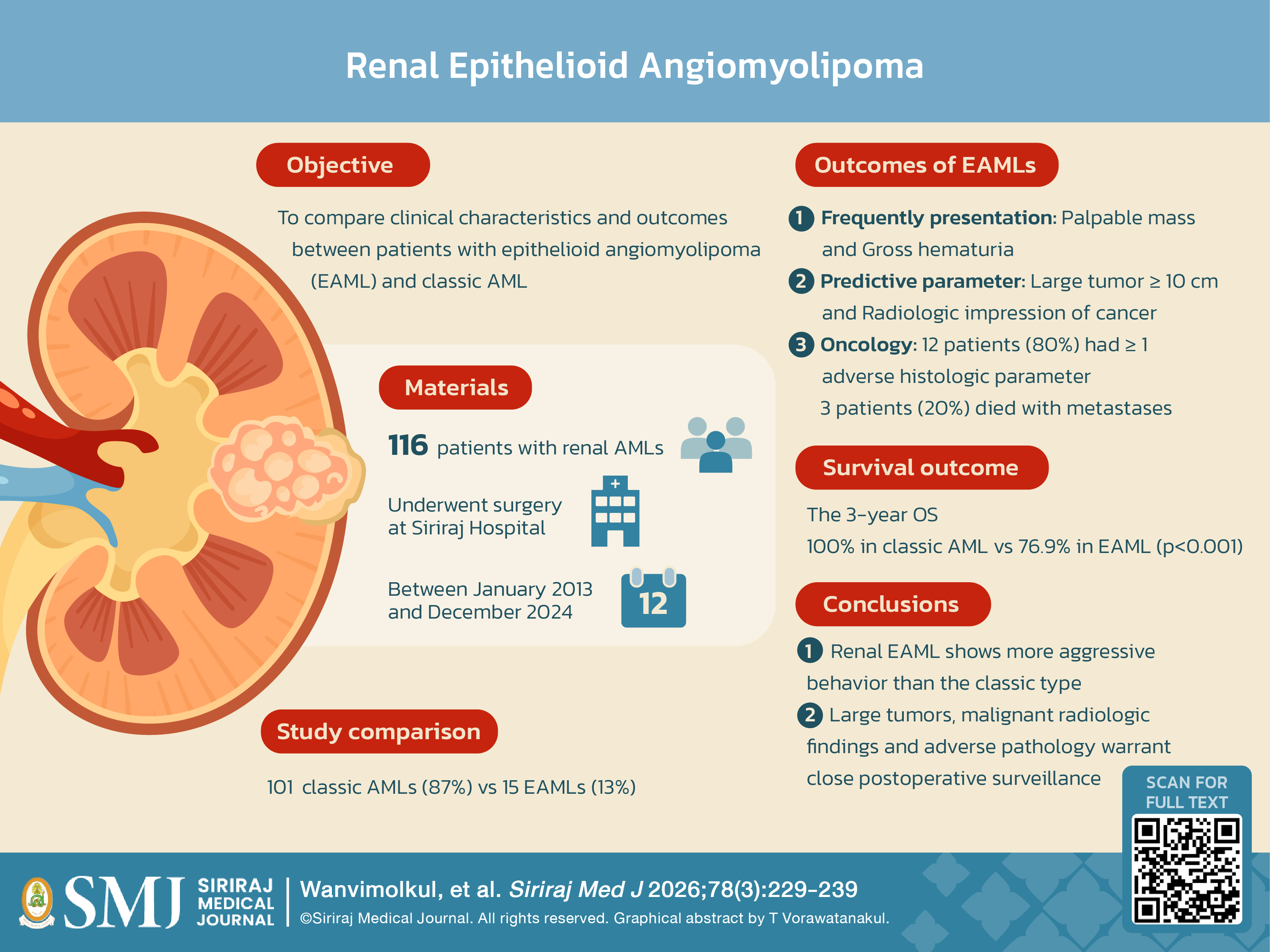
Objective: To compare clinical characteristics and surgical outcomes between patients with epithelioid angiomyolipoma (EAML) and classic angiomyolipoma (AML), and to identify factors associated with EAML diagnosis.
Materials and Methods: All patients with renal AML who underwent surgery at Siriraj Hospital between January 2013 and December 2024 were reviewed. Clinical features and surgical outcomes were compared between patients with classic AML and those with EAML, and predictors of EAML were evaluated using multivariable analyses.
Results: Among 116 eligible patients, 101 had classic AML and 15 had EAML (12.9%). Most patients were female and were diagnosed in their fifth decade. Demographics, tumor laterality, prevalence of tuberous sclerosis complex gene mutation, and comorbidities did not differ between the 2 groups. Palpable mass (26.7%) and hematuria (13.3%) were more frequent in patients with EAML than in those with classic AML. Most patients with EAML underwent radical or partial nephrectomy due to suspected malignancy. In multivariable analysis, tumor size ≥ 10 cm (odds ratio 15.44; P = 0.003) and a radiologic impression of cancer (odds ratio 46.98; P < 0.001) independently predicted EAML. Four patients with EAML had adverse pathologic features and experienced poor survival; 3 patients died with metastases. The 3-year overall survival was 100% in classic AML and 76.9% in EAML (P < 0.001).
Conclusions: Patients with EAML had less favorable surgical outcomes than those with classic AML. Larger tumor size and a preoperative radiologic impression of malignancy were associated with an EAML diagnosis. Adverse pathologic features in EAML suggest malignant potential.
References
Lopez-Beltran A, Scarpelli M, Montironi R, Kirkali Z. 2004 WHO classification of the renal tumors of the adults. European Urology [Internet]. 2006 Jan 18;49(5):798–805. Available from: https://pubmed.ncbi.nlm.nih.gov/16442207/
Lane BR, Aydin H, Danforth TL, Zhou M, Remer EM, Novick AC, et al. Clinical correlates of renal angiomyolipoma subtypes in 209 patients: classic, fat poor, tuberous sclerosis associated and epithelioid. The Journal of Urology [Internet]. 2008 Jul 17;180(3):836–43. Available from: https://doi.org/10.1016/j.juro.2008.05.04
Vos N, Oyen R. Renal angiomyolipoma: The good, the bad, and the ugly. Journal of the Belgian Society of Radiology [Internet]. 2018 Jan 1;102(1). Available from: https://pubmed.ncbi.nlm.nih.gov/30039053/
Chuang CK, Lin HCA, Tasi HY, Lee KH, Kao Y, Chuang FL, et al. Clinical presentations and molecular studies of invasive renal epithelioid angiomyolipoma. International Urology and Nephrology [Internet]. 2017 May 25;49(9):1527–36. Available from: https://pubmed.ncbi.nlm.nih.gov/28547571/
Yang J, Liang C, Yang L. Advancements in the diagnosis and treatment of renal epithelioid angiomyolipoma: A narrative review. The Kaohsiung Journal of Medical Sciences [Internet]. 2022 Sep 3;38(10):925–32. Available from: https://pubmed.ncbi.nlm.nih.gov/36056704/
Lee W, Choi SY, Lee C, Yoo S, You D, Jeong IG, et al. Does epithelioid angiomyolipoma have poorer prognosis, compared with classic angiomyolipoma? Investigative and Clinical Urology [Internet]. 2018 Jan 1;59(6):357. Available from: https://pubmed.ncbi.nlm.nih.gov/30402567/
Delhorme J b., Fontana A, Levy A, Terrier P, Fiore M, Tzanis D, et al. Renal angiomyolipomas: At least two diseases. A series of patients treated at two European institutions. European Journal of Surgical Oncology [Internet]. 2016 Dec 5;43(4):831–6. Available from: https://pubmed.ncbi.nlm.nih.gov/28007324/
Tsai H, Lee K, Ng K, Kao Y, Chuang C. Clinicopathologic analysis of renal epithelioid angiomyolipoma: Consecutively excised 23 cases. The Kaohsiung Journal of Medical Sciences [Internet]. 2019 Jan 1;35(1):33–8. Available from: https://pubmed.ncbi.nlm.nih.gov/30844148/
Nese N, Martignoni G, Fletcher CD, Gupta R, Pan CC, Kim H, et al. Pure epithelioid PECOMas (So-Called epithelioid angiomyolipoma) of the kidney. The American Journal of Surgical Pathology [Internet]. 2011 Jan 22;35(2):161–76. Available from: https://pubmed.ncbi.nlm.nih.gov/21263237/
Zhang J, Wang WJ, Chen LH, Wang N, Wang MW, Liu H, et al. Primary renal malignant epithelioid angiomyolipoma with distant metastasis: a case report and literature review. Frontiers in Oncology [Internet]. 2023 Aug 22;13. Available from: https://pmc.ncbi.nlm.nih.gov/articles/PMC10477911/
Mai KT, Perkins DG, Collins JP. Epithelioid cell variant of renal angiomyolipoma. Histopathology [Internet]. 1996 Mar 1;28(3):277–80. Available from: https://pubmed.ncbi.nlm.nih.gov/8729052/
Lee KH, Tsai HY, Kao YT, Lin HC, Chou YC, Su SH, et al. Clinical behavior and management of three types of renal angiomyolipomas. Journal of the Formosan Medical Association [Internet]. 2018 Mar 15;118(1):162–9. Available from: https://pubmed.ncbi.nlm.nih.gov/29549981/
Boorjian SA, Sheinin Y, Crispen PL, Lohse CM, Kwon ED, Leibovich BC. Hormone receptor expression in renal angiomyolipoma: Clinicopathologic correlation. Urology [Internet]. 2008 Mar 29;72(4):927–32. Available from: https://doi.org/10.1016/j.urology.2008.01.067
Aydin H, Magi-Galluzzi C, Lane BR, Sercia L, Lopez JI, Rini BI, Zhou M. Renal angiomyolipoma: clinicopathologic study of 194 cases with emphasis on the epithelioid histology and tuberous sclerosis association. Am J Surg Pathol. 2009 Feb;33(2):289-97.
Swärd J, Henrikson O, Lyrdal D, Peeker R, Lundstam S. Renal angiomyolipoma-patient characteristics and treatment with focus on active surveillance. Scandinavian Journal of Urology [Internet]. 2020 Jan 23;54(2):141–6. Available from: https://doi.org/10.1080/21681805.2020.1716066
Thiravit S, Teerasamit W, Thiravit P. The different faces of renal angiomyolipomas on radiologic imaging: a pictorial review. British Journal of Radiology [Internet]. 2018 Jan 12;91(1084). Available from: https://doi.org/10.1259/bjr.20170533
Froemming AT, Boland J, Cheville J, Takahashi N, Kawashima A. Renal Epithelioid Angiomyolipoma: imaging characteristics in nine cases with Radiologic-Pathologic correlation and review of the literature. American Journal of Roentgenology [Internet]. 2013 Jan 23;200(2):W178–86. Available from: https://doi.org/10.2214/ajr.12.8776
Overweight as an avoidable cause of cancer in Europe. PubMed [Internet]. 2001 Feb 1; Available from: https://doi.org/10.1002/1097-0215(200002)9999:9999
Wolk A, Gridley G, Svensson M, Nyrén O, McLaughlin JK, Fraumeni JF, et al. A prospective study of obesity and cancer risk (Sweden). Cancer Causes & Control [Internet]. 2001 Jan 1;12(1):13–21. Available from: https://doi.org/10.1023/a:1008995217664
Lei JH, Liu LR, Wei Q, Song TR, Yang L, Yuan HC, et al. A Four-Year Follow-up Study of Renal Epithelioid Angiomyolipoma: A Multi-Center Experience and Literature review. Scientific Reports [Internet]. 2015 May 5;5(1). Available from: https://pubmed.ncbi.nlm.nih.gov/25939249/
Brimo F, Robinson B, Guo C, Zhou M, Latour M, Epstein JI. Renal Epithelioid angiomyolipoma with atypia: A series of 40 cases with emphasis on clinicopathologic prognostic indicators of malignancy. The American Journal of Surgical Pathology [Internet]. 2010 Apr 20;34(5):715–22. Available from: https://doi.org/10.1097/pas.0b013e3181d90370
Chaiyasoot W, Yodying J, Limsiri T. Selective Arterial Embolization of Renal Angiomyolipoma: Efficacy, Tumor Volume Reduction and Complications. Siriraj Med J [internet]. 2021 Mar. 31 [cited 2026 Feb. 5];73(5):337-43. available from: https://he02.tci-thaijo.org/index.php/sirirajmedj/article/view/250279
Published
How to Cite
License
Copyright (c) 2026 Siriraj Medical Journal

This work is licensed under a Creative Commons Attribution-NonCommercial-NoDerivatives 4.0 International License.
Authors who publish with this journal agree to the following conditions:
Copyright Transfer
In submitting a manuscript, the authors acknowledge that the work will become the copyrighted property of Siriraj Medical Journal upon publication.
License
Articles are licensed under a Creative Commons Attribution-NonCommercial-NoDerivatives 4.0 International License (CC BY-NC-ND 4.0). This license allows for the sharing of the work for non-commercial purposes with proper attribution to the authors and the journal. However, it does not permit modifications or the creation of derivative works.
Sharing and Access
Authors are encouraged to share their article on their personal or institutional websites and through other non-commercial platforms. Doing so can increase readership and citations.