Prevalence of Iron Deficiency and Iron Deficiency Anemia in Exclusively Breastfed Term Infants in a Tertiary Hospital in Thailand Using the WHO Revised Criteria for Anemia
DOI:
https://doi.org/10.33192/smj.v78i6.280298Keywords:
Iron deficiency, Iron deficiency anemia, Exclusive breastfeeding, Exclusively breastfed infant, Iron supplementationAbstract
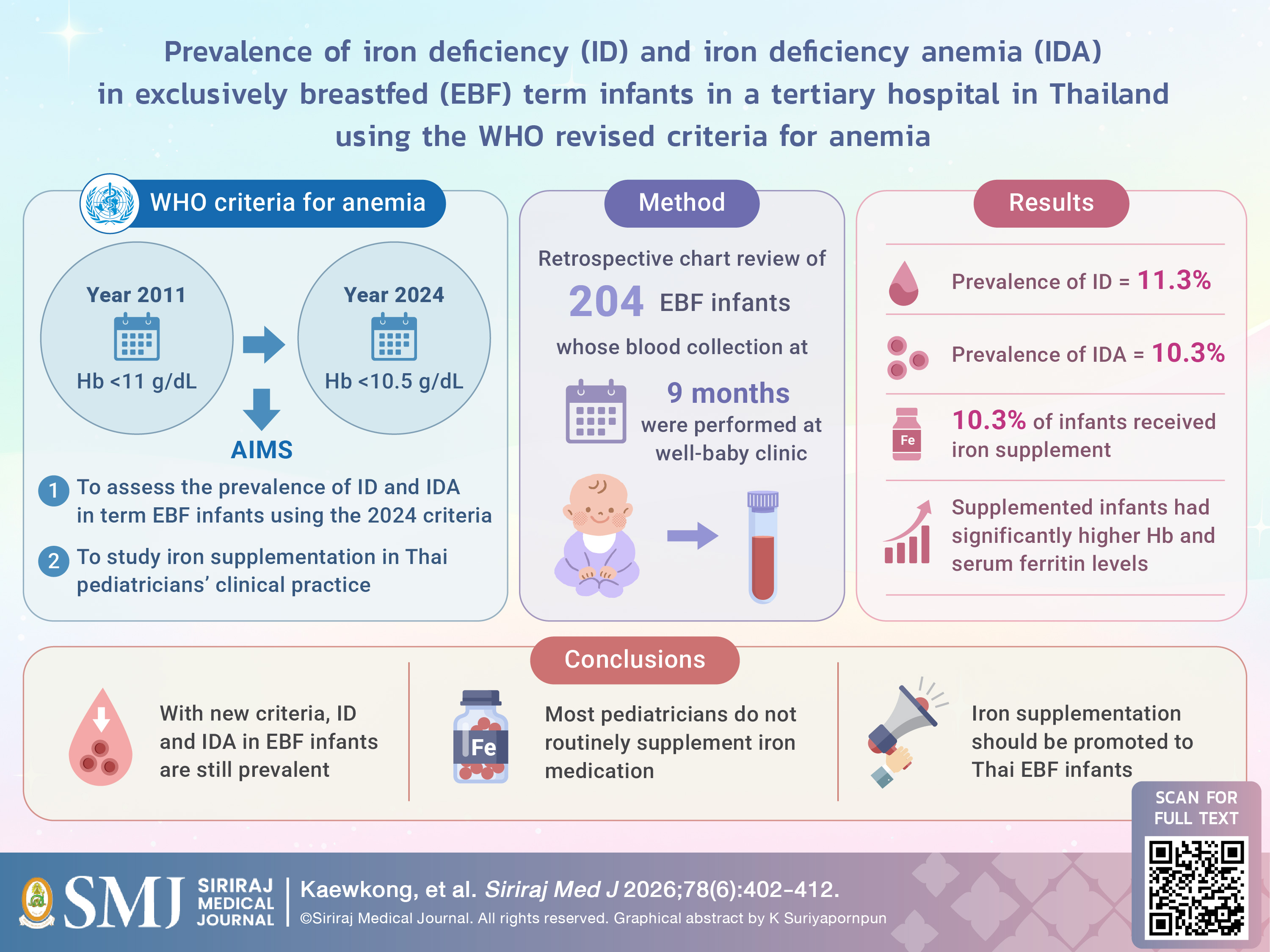
Objective: To assess the prevalence and associated factors of iron deficiency (ID) and iron deficiency anemia (IDA) in term exclusively breastfed (EBF) infants using the new 2024 Hb cutoff, and to study iron supplementation in Thai pediatricians’ clinical practice.
Materials and Methods: A retrospective chart review included healthy term EBF infants for ≥ 6 months from January 2014 to July 2022. Blood samples collected between 6 and 12 months were analyzed for CBC and serum ferritin (SF) levels. IDA was defined as Hb level < 10.5 g/dL and SF < 12 ng/ml, and ID was defined when SF < 12 ng/ml but Hb ≥ 10.5 g/dL.
Results: Of the 204 participants, 59.8% were female and mean age at blood collection was 9.4 months. Using 2024 criteria for anemia, the prevalence of ID and IDA was 11.3% and 10.3%, respectively. Daily iron supplementation was provided to 10.3% of infants, with the median dose of 1.23 mg/kg/day. No statistically significant risk factors (sex, birth order, birth weight, maternal age, numbers of maternal underlying conditions, receiving iron supplementation, liver paste consumption after age 6 months, and growth status) for ID or IDA were identified. Supplemented infants had significantly higher levels of Hb and SF.
Conclusions: Using the new criteria, ID and IDA are still prevalent. Most pediatricians do not routinely prescribe iron medication for EBF infants. Supplemented infants demonstrated more favorable Hb and SF levels. The potential role of iron supplementation to prevent ID and IDA during infancy in resource-limited countries should be emphasized.
References
World Health Organization. Guideline on haemoglobin cutoffs to define anaemia in individuals and populations [Internet]. Geneva: World Health Organization; 2024 [cited 2024 Dec 1]. Available from: https://www.who.int/publications/i/item/9789240088542
Varea A, Disalvo L, Fasano MV, Sala M, Avico AJ, Azrack MÁ, et al. Effectiveness of weekly and daily iron administration for the prevention of iron deficiency anemia in infants. Arch Argent Pediatr. 2023;121(4):e202202815.
Pivina L, Semenova Y, Doşa MD, Dauletyarova M, Bjørklund G. Iron Deficiency, Cognitive functions, and neurobehavioral disorders in children. J Mol Neurosci. 2019;68(1):1-10.
Baker RD, Greer FR. Diagnosis and prevention of iron deficiency and iron-deficiency anemia in infants and young children (0-3 years of age). Pediatrics. 2010;126(5):1040-50.
Meinzen-Derr JK, Guerrero ML, Altaye M, Ortega-Gallegos H, Ruiz-Palacios GM, Morrow AL. Risk of infant anemia is associated with exclusive breast-feeding and maternal anemia in a Mexican cohort. J. Nutr. 2006;136(2):452-8.
Tantracheewathorn S, Lohajaroensub S. Incidence and risk factors of iron deficiency anemia in term infants. J Med Assoc Thai. 2005;88(1):45-51.
Chokviriyakorn N. Prevalence of and factors associated with iron deficiency among Thai toddlers aged 12 - 36 months in the well child clinic of Luang Pho Taweesak Hospital. Vajira Med J. 2017;61:43–54.
Phuakpet K. Anemia screening. In: Guideline in child health supervision [Internet]. Bangkok: The Royal College of Pediatricians of Thailand; 2014 [cited 2024 Dec 1]. Available from: http://datahpc9.anamai.moph.go.th/group_sr/allfile/1612321975.pdf
The Royal College of Pediatricians of Thailand. Guideline in child health supervision [Internet]. Bangkok: The Royal College of Pediatricians of Thailand; 2021 [cited 2024 Dec 1]. Available from: https://drive.google.com/file/d/116EdUOc0TQaQLYrtlmRaff72PcS6DT-d/view
Bureau of Nutrition, Department of Health, Ministry of Public Health. Mother and child health handbook [Internet]. Bangkok: Ministry of Public Health; 2023 [cited 2024 Dec 1]. Available from: https://www.hp.anamai.moph.go.th
World Health Organization. Haemoglobin concentrations for the diagnosis of anaemia and assessment of severity [Internet]. Geneva: World Health Organization; 2011 [cited 2024 Dec 1]. Available from: https://iris.who.int/handle/10665/85839
World Health Organization. WHO guideline on use of ferritin concentration to assess iron status in individuals and populations [Internet]. Geneva: World Health Organization; 2020 [cited 2024 Dec 1]. Available from: https://www.who.int/publications/i/item/9789240000124
Braat S, Fielding KL, Han J, Jackson VE, Zaloumis S, Xu JXH, et al. Haemoglobin thresholds to define anaemia from age 6 months to 65 years: estimates from international data sources. Lancet Haematol. 2024;11(4):e253-e64.
Sittimol A, Saengpanit P, Vatthana N, Rojmahamongkol P. Prevalence of iron deficiency anemia in exclusively breastfed infants after a 5-month iron supplementation. Sci Rep. 2024;14(1):23924.
Fenton TR, Kim JH. A systematic review and meta-analysis to revise the Fenton growth chart for preterm infants. BMC Pediatr. 2013;13:59.
De Onis M. World Health Organization Reference Curves. In: Frelut ML, editor. The ECOG’s eBook on child and adolescent obesity [Internet]. European Childhood Obesity Group; 2015 [cited 2024 Dec 1]. Available from: https://ebook.ecog-obesity.eu/wp-content/uploads/2015/02/ECOG-Obesity-eBook-World-Health-Organization-Reference-Curves.pdf
Yang Z, Lönnerdal B, Adu-Afarwuah S, Brown KH, Chaparro CM, Cohen RJ, et al. Prevalence and predictors of iron deficiency in fully breastfed infants at 6 mo of age: comparison of data from 6 studies. Am J Clin Nutr. 2009;89(5):1433-40.
Sundararajan S, Rabe H. Prevention of iron deficiency anemia in infants and toddlers. Pediatr Res. 2021; 89(1):63–73.
Domellöf M, Cohen RJ, Dewey KG, Hernell O, Rivera LL, Lönnerdal B. Iron supplementation of breast-fed Honduran and Swedish infants from 4 to 9 months of age. J Pediatr. 2001;138(5):679-87.
Georgieff MK. Maternal gestational iron status and infant haematological and neurodevelopmental outcomes. BJOC. 2023;130(Suppl 3):92-6.
Engkakul P, Kositamongkol S. Prevalence of iron deficiency in infants of diabetic mothers at the age of 6 to 12 months. J Med Assoc Thai. 2020;103(12):1262-8.
An H, Chen H, Li Z, Zhang L, Zhang Y, Liu J, et al. Association of gestational hypertension with anemia under 5 years old: two large longitudinal Chinese birth cohorts. Nutrients. 2022;14(8):1621.
Nagpal J, Sachdev HP, Singh T, Mallika V. A randomized placebo-controlled trial of iron supplementation in breastfed young infants initiated on complementary feeding: effect on haematological status. J Health Popul Nutr. 2004;22(2):203-11.
Khorwanichakij N, Kungwankiattichai S, Owattanapanich W. Validation of several formulas to differentiate thalassemia from iron deficiency anemia and proposal of a thalassemia-iron deficiency discrimination (TID) predictive score. Siriraj Med J. 2022;74(4):256-65.
Sirichamratsakul K, Sangkhathat S, Chongsuvivatwong V. Referral patterns, co-occurring conditions and survival outcomes of biliary atresia in Thailand: Security Office Registry. Siriraj Med J. 2025;77(9):610-9.
Sinlapamongkolkul P, Pusongchai T, Buaboonnum J, Satayasai W, Surapolchai P. Diagnostic utility of reticulocyte hemoglobin equivalent for identifying iron deficiency in hospitalized children in a thalassemia-endemic region: a single-center cross-sectional study. Siriraj Med J. 2026;78(1):68-78.
Published
How to Cite
License
Copyright (c) 2026 Siriraj Medical Journal

This work is licensed under a Creative Commons Attribution-NonCommercial-NoDerivatives 4.0 International License.
Authors who publish with this journal agree to the following conditions:
Copyright Transfer
In submitting a manuscript, the authors acknowledge that the work will become the copyrighted property of Siriraj Medical Journal upon publication.
License
Articles are licensed under a Creative Commons Attribution-NonCommercial-NoDerivatives 4.0 International License (CC BY-NC-ND 4.0). This license allows for the sharing of the work for non-commercial purposes with proper attribution to the authors and the journal. However, it does not permit modifications or the creation of derivative works.
Sharing and Access
Authors are encouraged to share their article on their personal or institutional websites and through other non-commercial platforms. Doing so can increase readership and citations.