
The Upregulation of Anti-apoptotic BIRC3 Expression Facilitates Zika Virus Infection
DOI:
https://doi.org/10.33192/smj.v78i4.280320Keywords:
Apoptosis, BIRC3 gene, Zika virus infectionAbstract
Objective: The aim of this study was to investigate the apoptotic gene expression profile and to identify the genes involved in apoptosis and ZIKV infection.
Materials and Methods: SH-SY5Y cell line was infected with ZIKV at an MOI of 5. The cells were stained with Annexin V and propidium iodide to determine apoptosis. A real-time polymerase chain reaction array was employed to determine the apoptotic gene expression profile in a ZIKV-infected SH-SY5Y cell line. Western blot analysis was performed to confirm the expression of BIRC3 in both SH-SY5Y and A549 cell lines. Knockdown of the BIRC3 was done in ZIKV-infected A549 cell line using BIRC3 -specific siRNA. The ZIKV production was measured by focus-forming unit assay.
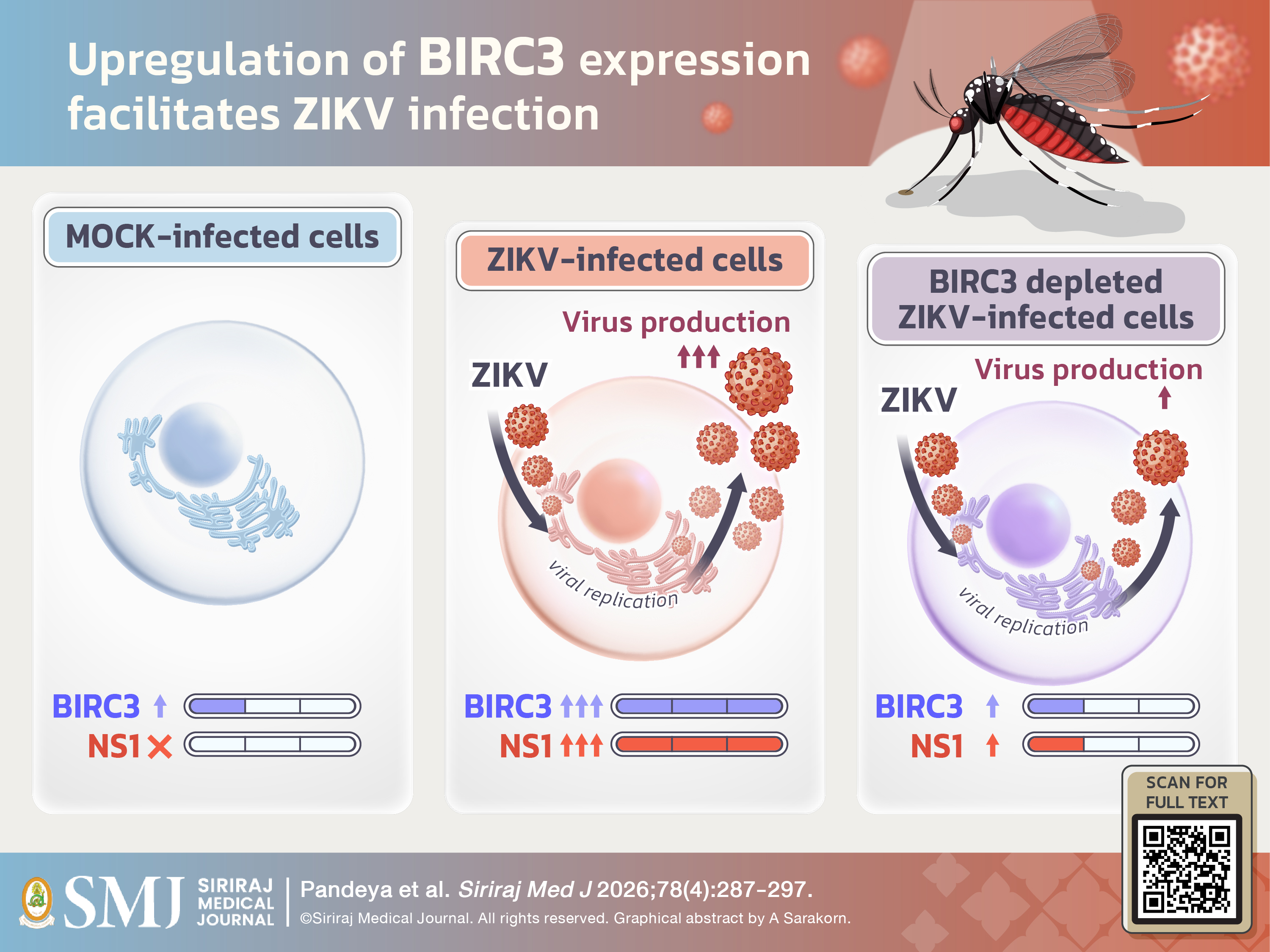
Results: Apoptotic genes in both extrinsic and intrinsic pathways, such as TNF-α, TRAIL, FAS, CASP8, CASP9, and BIRC3, were found to be upregulated. The anti-apoptotic gene BIRC3 was selected and found to be upregulated at the protein level in both ZIKV-infected SH-SY5Y and ZIKV-infected A549 cell lines. Knockdown of the BIRC3 gene in ZIKV-infected A549 cell line decreased Zika virus NS1 protein expression and Zika virion production.
Conclusion: The upregulation of anti-apoptotic BIRC3 expression facilitates Zika virus infection.
References
Dick GW, Kitchen SF, Haddow AJ. Zika virus. I. Isolations and serological specificity. Trans R Soc Trop Med Hyg. 1952;46(5):509-20.
Medin CL, Rothman AL. Zika Virus: The Agent and Its Biology, With Relevance to Pathology. Arch Pathol Lab Med. 2017;141(1):33-42.
Besnard M, Lastere S, Teissier A, Cao-Lormeau V, Musso D. Evidence of perinatal transmission of Zika virus, French Polynesia, December 2013 and February 2014. Euro Surveill. 2014;19(13).
Musso D, Gubler DJ. Zika Virus. Clin Microbiol Rev. 2016;29(3):487-524.
Mesci P, Macia A, Moore SM, Shiryaev SA, Pinto A, Huang CT, et al. Blocking Zika virus vertical transmission. Sci Rep. 2018;8(1):1218.
Liang B, Guida JP, Costa Do Nascimento ML, Mysorekar IU. Host and viral mechanisms of congenital Zika syndrome. Virulence. 2019;10(1):768-75.
Calvet G, Aguiar RS, Melo ASO, Sampaio SA, de Filippis I, Fabri A, et al. Detection and sequencing of Zika virus from amniotic fluid of fetuses with microcephaly in Brazil: a case study. Lancet Infect Dis. 2016;16(6):653-60.
Leeyaphan C, Tantrapornpong P. Cutaneous Manifestations and Associated Systemic Findings of Patients with Zika Infections. Siriraj Med J. 2020;72(4):321-9.
Brasil P, Pereira JP, Jr., Moreira ME, Ribeiro Nogueira RM, Damasceno L, Wakimoto M, et al. Zika Virus Infection in Pregnant Women in Rio de Janeiro. N Engl J Med. 2016;375(24):2321-34.
Rasmussen SA, Jamieson DJ, Honein MA, Petersen LR. Zika Virus and Birth Defects--Reviewing the Evidence for Causality. N Engl J Med. 2016;374(20):1981-7.
Cao-Lormeau VM, Blake A, Mons S, Lastere S, Roche C, Vanhomwegen J, et al. Guillain-Barre Syndrome outbreak associated with Zika virus infection in French Polynesia: a case-control study. Lancet. 2016;387(10027):1531-9.
Gulland A. Zika virus is a global public health emergency, declares WHO. BMJ. 2016;352:i657.
Solomon IH, Milner DA, Folkerth RD. Neuropathology of Zika Virus Infection. J Neuroinfect Dis. 2016;7(2).
Chimelli L, Avvad-Portari E. Congenital Zika virus infection: a neuropathological review. Childs Nerv Syst. 2018;34(1):95-9.
Kim JA, Seong RK, Kumar M, Shin OS. Favipiravir and Ribavirin Inhibit Replication of Asian and African Strains of Zika Virus in Different Cell Models. Viruses. 2018;10(2).
Goodfellow FT, Willard KA, Wu X, Scoville S, Stice SL, Brindley MA. Strain-Dependent Consequences of Zika Virus Infection and Differential Impact on Neural Development. Viruses. 2018;10(10).
Gabriel E, Ramani A, Karow U, Gottardo M, Natarajan K, Gooi LM, et al. Recent Zika Virus Isolates Induce Premature Differentiation of Neural Progenitors in Human Brain Organoids. Cell Stem Cell. 2017;20(3):397-406 e5.
Turpin J, El Safadi D, Lebeau G, Krejbich M, Chatelain C, Despres P, et al. Apoptosis during ZIKA Virus Infection: Too Soon or Too Late? Int J Mol Sci. 2022;23(3).
Rothan HA, Fang S, Mahesh M, Byrareddy SN. Zika Virus and the Metabolism of Neuronal Cells. Mol Neurobiol. 2019;56(4):2551-7.
Souza BS, Sampaio GL, Pereira CS, Campos GS, Sardi SI, Freitas LA, et al. Zika virus infection induces mitosis abnormalities and apoptotic cell death of human neural progenitor cells. Sci Rep. 2016;6:39775.
Frumence E, Roche M, Krejbich-Trotot P, El-Kalamouni C, Nativel B, Rondeau P, et al. The South Pacific epidemic strain of Zika virus replicates efficiently in human epithelial A549 cells leading to IFN-beta production and apoptosis induction. Virology. 2016;493:217-26.
Li C, Xu D, Ye Q, Hong S, Jiang Y, Liu X, et al. Zika Virus Disrupts Neural Progenitor Development and Leads to Microcephaly in Mice. Cell Stem Cell. 2016;19(1):120-6.
Martinot AJ, Abbink P, Afacan O, Prohl AK, Bronson R, Hecht JL, et al. Fetal Neuropathology in Zika Virus-Infected Pregnant Female Rhesus Monkeys. Cell. 2018;173(5):1111-22 e10.
de Sousa JR, Azevedo RSS, Martins Filho AJ, Araujo MTF, Moutinho ERC, Baldez Vasconcelos BC, et al. Correlation between Apoptosis and in Situ Immune Response in Fatal Cases of Microcephaly Caused by Zika Virus. Am J Pathol. 2018;188(11):2644-52.
Ghosh Roy S, Sadigh B, Datan E, Lockshin RA, Zakeri Z. Regulation of cell survival and death during Flavivirus infections. World J Biol Chem. 2014;5(2):93-105.
Lee JK, Kim JA, Oh SJ, Lee EW, Shin OS. Zika Virus Induces Tumor Necrosis Factor-Related Apoptosis Inducing Ligand (TRAIL)-Mediated Apoptosis in Human Neural Progenitor Cells. Cells. 2020;9(11).
Yang S, Gorshkov K, Lee EM, Xu M, Cheng YS, Sun N, et al. Zika Virus-Induced Neuronal Apoptosis via Increased Mitochondrial Fragmentation. Front Microbiol. 2020;11:598203.
Reyes-Del Valle J, Chavez-Salinas S, Medina F, Del Angel RM. Heat shock protein 90 and heat shock protein 70 are components of dengue virus receptor complex in human cells. J Virol. 2005;79(8):4557-67.
Srisutthisamphan K, Jirakanwisal K, Ramphan S, Tongluan N, Kuadkitkan A, Smith DR. Hsp90 interacts with multiple dengue virus 2 proteins. Sci Rep. 2018;8(1):4308.
Rothan HA, Zhong Y, Sanborn MA, Teoh TC, Ruan J, Yusof R, et al. Small molecule grp94 inhibitors block dengue and Zika virus replication. Antiviral Res. 2019;171:104590.
Zane L, Sibon D, Legras C, Lachuer J, Wierinckx A, Mehlen P, et al. Clonal expansion of HTLV-1 positive CD8+ cells relies on cIAP-2 but not on c-FLIP expression. Virology. 2010;407(2):341-51.
Wang Z, Ni J, Li J, Shi B, Xu Y, Yuan Z. Inhibition of hepatitis B virus replication by cIAP2 involves accelerating the ubiquitin-proteasome-mediated destruction of polymerase. J Virol. 2011;85(21):11457-67.
Rodrigue-Gervais IG, Labbe K, Dagenais M, Dupaul-Chicoine J, Champagne C, Morizot A, et al. Cellular inhibitor of apoptosis protein cIAP2 protects against pulmonary tissue necrosis during influenza virus infection to promote host survival. Cell Host Microbe. 2014;15(1):23-35.
Jitsatja A, Ramphan S, Promma P, Kuadkitkan A, Wikan N, Uiprasertkul M, et al. Comparative analysis of a Thai congenital-Zika-syndrome-associated virus with a Thai Zika-fever-associated virus. Arch Virol. 2020;165(8):1791-801.
Dangsagul W, Ruchusatsawat K, Tawatsin A, Changsom D, Noisumdaeng P, Putchakarn S, et al. Zika virus isolation, propagation, and quantification using multiple methods. PLoS One. 2021;16(7):e0255314.
Strober W. Trypan blue exclusion test of cell viability. Curr Protoc Immunol. 2001;Appendix 3:Appendix 3B.
Rieger AM, Nelson KL, Konowalchuk JD, Barreda DR. Modified annexin V/propidium iodide apoptosis assay for accurate assessment of cell death. J Vis Exp. 2011(50).
Livak KJ, Schmittgen TD. Analysis of relative gene expression data using real-time quantitative PCR and the 2(-Delta Delta C(T)) Method. Methods. 2001;25(4):402-8.
Han X, Wang J, Yang Y, Qu S, Wan F, Zhang Z, et al. Zika virus infection induced apoptosis by modulating the recruitment and activation of pro-apoptotic protein Bax. J Virol. 2021;95(8).
Cosentino K, Hertlein V, Jenner A, Dellmann T, Gojkovic M, Pena-Blanco A, et al. The interplay between BAX and BAK tunes apoptotic pore growth to control mitochondrial-DNA-mediated inflammation. Mol Cell. 2022;82(5):933-49 e9.
Clem RJ. Viral IAPs, then and now. Semin Cell Dev Biol. 2015;39:72-9.
Frazzi R. BIRC3 and BIRC5: multi-faceted inhibitors in cancer. Cell Biosci. 2021;11(1):8.
Lopez-Huertas MR, Mateos E, Sanchez Del Cojo M, Gomez-Esquer F, Diaz-Gil G, Rodriguez-Mora S, et al. The presence of HIV-1 Tat protein second exon delays fas protein-mediated apoptosis in CD4+ T lymphocytes: a potential mechanism for persistent viral production. J Biol Chem. 2013;288(11):7626-44.
Keller SA, Hernandez-Hopkins D, Vider J, Ponomarev V, Hyjek E, Schattner EJ, Cesarman E. NF-kappaB is essential for the progression of KSHV- and EBV-infected lymphomas in vivo. Blood. 2006;107(8):3295-302.
Lee JY, Nguyen TTN, Myoung J. Zika Virus-Encoded NS2A and NS4A Strongly Downregulate NF-kappaB Promoter Activity. J Microbiol Biotechnol. 2020;30(11):1651-8.
Turpin J, Frumence E, Desprès P, Viranaicken W, Krejbich-Trotot P. The ZIKA Virus Delays Cell Death Through the Anti-Apoptotic Bcl-2 Family Proteins. Cells. 2019;8(11).
Published
How to Cite
License
Copyright (c) 2026 Siriraj Medical Journal

This work is licensed under a Creative Commons Attribution-NonCommercial-NoDerivatives 4.0 International License.
Authors who publish with this journal agree to the following conditions:
Copyright Transfer
In submitting a manuscript, the authors acknowledge that the work will become the copyrighted property of Siriraj Medical Journal upon publication.
License
Articles are licensed under a Creative Commons Attribution-NonCommercial-NoDerivatives 4.0 International License (CC BY-NC-ND 4.0). This license allows for the sharing of the work for non-commercial purposes with proper attribution to the authors and the journal. However, it does not permit modifications or the creation of derivative works.
Sharing and Access
Authors are encouraged to share their article on their personal or institutional websites and through other non-commercial platforms. Doing so can increase readership and citations.