
Is Erythema Toxicum Neonatorum in Neonates Associated with Atopic Diseases?
DOI:
https://doi.org/10.33192/smj.v78i5.280505Keywords:
Atopic diseases, Erythema Toxicum Neonatorum, Newborn, RashAbstract
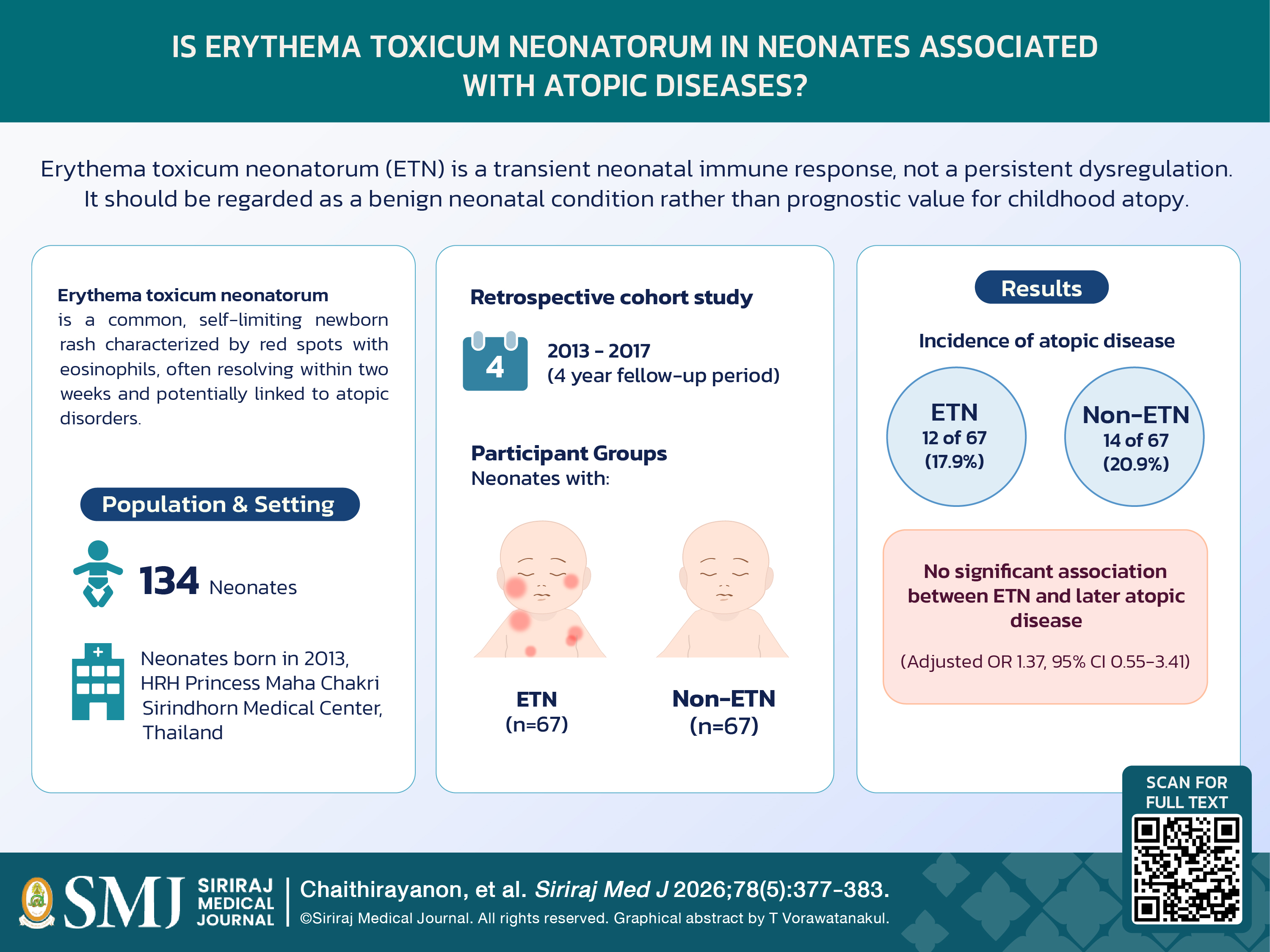
Objective: Erythema toxicum neonatorum (ETN) is a benign rash commonly observed in newborns, typically resolving spontaneously within one to two weeks. The lesions are characterized by multiple erythematous macules containing eosinophils and are known to be associated with peripheral eosinophilia, a condition commonly seen in atopic diseases. Therefore, the presence of ETN may be associated with the subsequent development of atopic diseases. This study aimed to determine the prevalence of atopic diseases in newborns with and without ETN and to evaluate the association between the presence of ETN and the manifestation of atopic diseases during childhood.
Materials and Methods: This retrospective cohort study utilized electronic medical records and telephone interviews of subjects born at HRH Princess Maha Chakri Sirindhorn Medical Center in 2013. Participants were divided into two groups: newborns with ETN and those without ETN. The follow-up period for diagnosing atopic diseases extended to four years after birth (2017).
Results: A total of 134 newborns were included in the study (67 with ETN and 67 without ETN). During the followup period, 12 of 67 newborns with ETN and 14 of 67 newborns without ETN developed atopic diseases. Statistical analysis revealed that the presence of ETN was not associated with an increased risk of developing atopic diseases (adjusted odds ratio (OR) 1.37; 95% CI 0.55-3.41). However, a significant association was found between a family history of atopic diseases and the development of atopic conditions in the children.
Conclusions: The presence of ETN does not increase the risk of developing atopic diseases during childhood.
References
Chang MW, Jiang SB, Orlow SJ. Atypical erythema toxicum neonatorum of delayed onset in a term infant. Pediatr Dermatol. 1999;16(2):137-41.
Monteagudo B, Labandeira J, Cabanillas M, Acevedo A, Toribio J. Prospective study of erythema toxicum neonatorum: epidemiology predisposing factors. Pediatr Dermatol. 2012;29(2):166-8.
Eichenfield LF, Frieden IJ, Esterly NB. Neonatal Dermatology. 2nd ed. Philadelphia: Saunders, 2008.
González Echeverría F, Martínez Rodríguez J, Ancín Chandía T, Córdoba Iturriaga A. Is neonatal toxic erythema a risk factor in the development of allergy in childhood? An Esp Pediatr. 1997;47(5):515-20.
Boralevi F. Erythema toxicum neonatorum: Still a Problem in 2005? Dermatology (Basel). 2005;210(4):257-8.
Liu C, Feng J, Qu R, Zhou H, Ma H, Niu X, et al. Epidemiologic study of the predisposing factors in erythema toxicum neonatorum. Dermatology (Basel). 2005;210(4):269-72.
Monti F, Agostini F, Gobbi F, Neri E, Schianchi S, Arcangeli F. Quality of life measures in Italian children with atopic dermatitis and their families. Ital J Pediatr. 2011;37:59.
Thomsen SF. Epidemiology and natural history of atopic diseases. Eur Clin Respir J. 2015;2:10.3402.
Puangpet P, Boonpuen N, Saipornchai K, Suchaoin R, Poompakdeepan P, McFadden J. Patch testing of Thai children with eczema. Siriraj Med J. 2023;75(2):70-5.
Martin LB, Kita H, Leiferman KM, Gleich GJ. Eosinophils in allergy: role in disease, degranulation, and cytokines. Int Arch Allergy Immunol. 1996;109(3):207-15.
Odelram H, Björkstén B, Leander E, Kjellman NI. Predictors of atopy in newborn babies. Allergy. 1995;50(7):585-92.
Uehara M, Izukura R, Sawai T. Blood eosinophilia in atopic dermatitis. Clin Exp Dermatol. 1990;15(4):264-6.
Crnković HT, Bendelja K, Šimić Klarić A, Tomić Rajić M, Drkulec V, Aberle N. Family history and cord blood eosinophil count as predictors for atopic manifestations. Cent Eur J Public Health. 2019;27(4):267-71.
Witmer CP, Susi A, Min SB, Nylund CM. Early infant risk factors for pediatric eosinophilic esophagitis. J Pediatr Gastroenterol Nutr. 2018;67(5):610-5.
Herr M, Clarisse B, Nikasinovic L, Foucault C, Le Marec AM, Giordanella JP, et al. Does allergic rhinitis exist in infancy? Findings from the PARIS birth cohort. Allergy. 2011;66(2):214-21.
Ong PY, Boguniewicz M. Atopic dermatitis. Prim Care. 2008;35(1):105-17, vii.
Kantor R, Kim A, Thyssen JP, Silverberg JI. Association of atopic dermatitis with smoking: A systematic review and meta-analysis. J Am Acad Dermatol. 2016;75(6):1119-25.e1.
Thomsen SF. Epidemiology and natural history of atopic diseases. Eur Clin Respir J. 2015;2.
Ravn NH, Halling AS, Berkowitz AG, Rinnov MR, Silverberg JI, Egeberg A, Thyssen JP. How does parental history of atopic disease predict the risk of atopic dermatitis in a child? A systematic review and meta-analysis. J Allergy Clin Immunol. 2020;145(4):1182-93.
Published
How to Cite
License
Copyright (c) 2026 Siriraj Medical Journal

This work is licensed under a Creative Commons Attribution-NonCommercial-NoDerivatives 4.0 International License.
Authors who publish with this journal agree to the following conditions:
Copyright Transfer
In submitting a manuscript, the authors acknowledge that the work will become the copyrighted property of Siriraj Medical Journal upon publication.
License
Articles are licensed under a Creative Commons Attribution-NonCommercial-NoDerivatives 4.0 International License (CC BY-NC-ND 4.0). This license allows for the sharing of the work for non-commercial purposes with proper attribution to the authors and the journal. However, it does not permit modifications or the creation of derivative works.
Sharing and Access
Authors are encouraged to share their article on their personal or institutional websites and through other non-commercial platforms. Doing so can increase readership and citations.