
The Association Between Online Gaming Addiction and Depression, Social Anxiety, and Loneliness Among Thai Young Adults
DOI:
https://doi.org/10.33192/smj.v78i6.280617Keywords:
Depression, loneliness, online gaming addiction, social anxietyAbstract
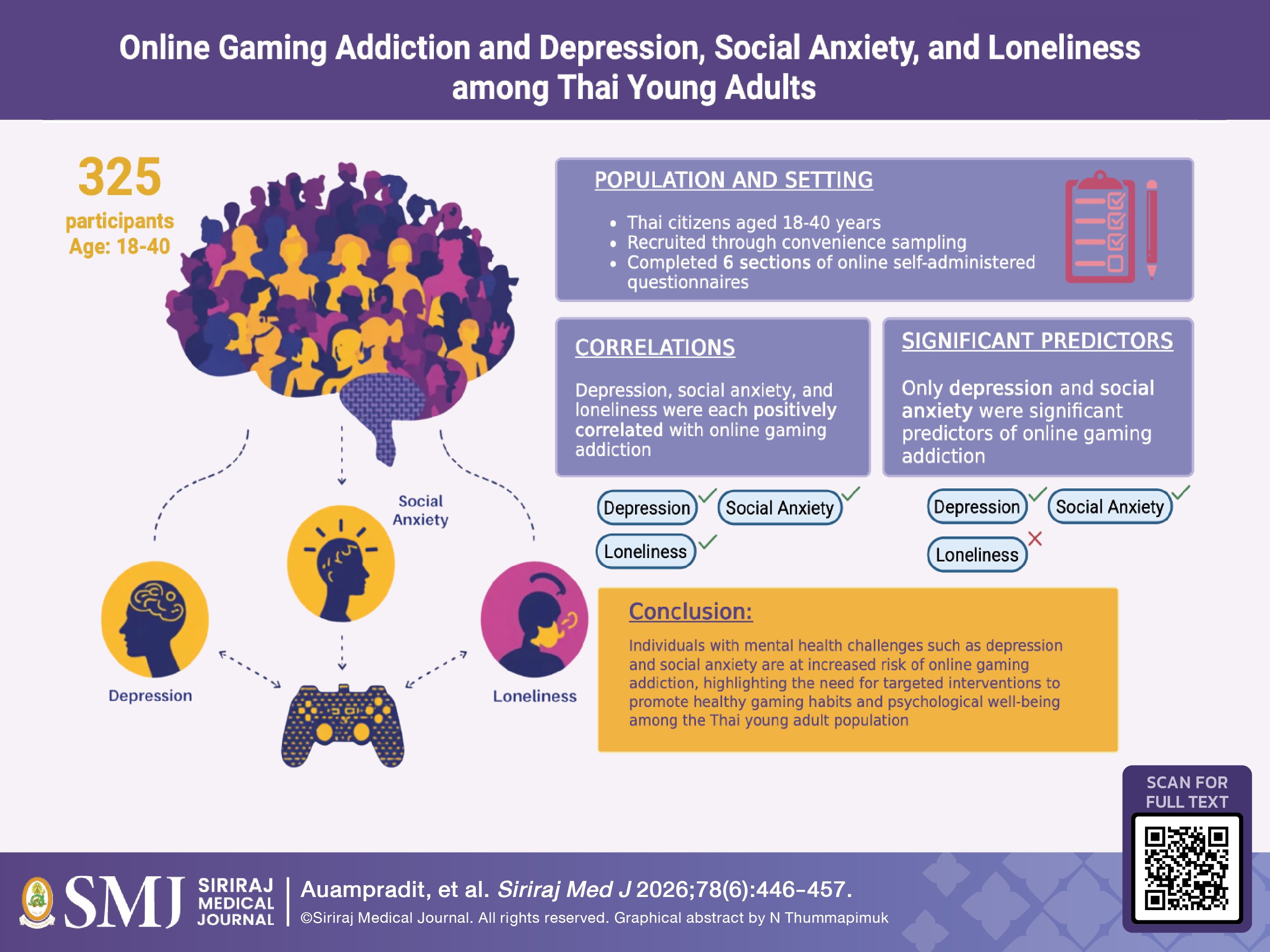
Objective: This study aimed to examine the association between online gaming addiction, depression, social anxiety, and loneliness, as well as the predictive roles of these psychological factors to online gaming addiction among Thai young adults.
Materials and Methods: A cross-sectional study was employed to collect data from 325 Thai citizens aged 18 to 40 years using a convenience sampling method. Online questionnaires included: demographic data, online gaming behavior data, Internet Gaming Disorder Scale–Short Form (IGDS9-SF), Patient Health Questionnaire-9 (PHQ-9), Brief Form of the Social Phobia and Anxiety Inventory (SPAI-B) – Adult Version, and 6-item Revised UCLA Loneliness Scale (RULS-6) were employed. Pearson’s correlation coefficient and stepwise multiple regression analyses were conducted to assess both the correlations and the predictive power of the variables.
Results: Pearson correlation analyses revealed significant positive associations between online gaming addiction and depression (r = 0.575, p < 0.001), social anxiety (r = 0.519, p < 0.001), and loneliness (r = 0.377, p < 0.001). Further regression analyses demonstrated that depression (b = 0.416, p < 0.001) and social anxiety (b = 0.228, p < 0.001) were significant predictors of online gaming addiction, whereas loneliness was not.
Conclusion: Individuals with mental health challenges such as depression and social anxiety face a higher risk of online gaming addiction. Clinicians should systematically screen for these conditions and implement targeted, evidence-based interventions, including cognitive-behavioral therapy, emotional regulation training, and social skills development, to effectively mitigate problematic gaming behaviors and enhance psychological well-being among the young adult population in Thailand.
References
Li F, Zhang D, Wu S, Zhou R, Dong C, Zhang J. Positive effects of online games on the growth of college students: a qualitative study from China. Front Psychol. 2023;14:1008211.
Wei H-T, Chen M-H, Huang P-C, Bai Y. The association between online gaming, social phobia, and depression: an internet survey. BMC Psychiatry. 2012;12:92.
Lim J-A, Lee J-Y, Jung H, Sohn B, Choi S-W, Kim Y, et al. Changes of quality of life and cognitive function in individuals with Internet gaming disorder: A 6-month follow-up. Medicine. 2016;95:e5695.
Taechoyotin P, Tongrod P, Thaweerungruangkul T, Towattananon N, Teekapakvisit P, Aksornpusitpong C, et al. Prevalence and associated factors of internet gaming disorder among secondary school students in rural community, Thailand: a cross-sectional study. BMC Res Notes. 2020;13(1):11.
Wang Y. The impact of interparental conflicts on online game addiction symptomatology: the mediating roles of the parent-adolescent relationship and loneliness in adolescents. Psychol Rep. 2022;125(5):2337-56.
Li L, Niu Z, Griffiths MD, Wang W, Chang C, Mei S. A network perspective on the relationship between gaming disorder, depression, alexithymia, boredom, and loneliness among a sample of Chinese university students. Technol Soc. 2021;67:101740.
Phetphum C, Keeratisiroj O, Prajongjeep A. The association between mobile game addiction and mental health problems and learning outcomes among Thai youths classified by gender and education levels. Asian J Soc Health Behav. 2024;6:196-202.
Alhamoud MA, Alkhalifah AA, Althunyan AK, Mustafa T, Alqahtani HA, Awad FAA. Internet gaming disorder: Its prevalence and associated gaming behavior, anxiety, and depression among high school male students, Dammam, Saudi Arabia. J Family Community Med. 2022;29(2):93-101.
Saetia S, Charoenporn V, Charernboon T. Prevalence of gaming disorder and its association with depression and anxiety among undergraduate students at Thammasat University. J Psychiatr Assoc Thai. 2023;68(1):26-35.
Niazi A, Gul M, Niazi Y. The Association Between Loneliness, Social Anxiety, and Gaming Addiction in Male University Students. Bulletin of Business and Economics (BBE). 2024;13.
Yang T, He Y, He C, Yang Y, Wu L, Wei B, et al. The relationship between anxiety and internet gaming disorder in children during COVID-19 lockdown: a network analysis. Front Psychiatry. 2023;14:1144413.
Wu D, Liu M, Li D, Yin H. The longitudinal relationship between loneliness and both social anxiety and mobile phone addiction among rural left‐behind children: a cross‐lagged panel analysis. J Adolesc. 2024;96(5):969-82.
Radzi M, Subhi N, Shaari A. Internet gaming disorder: depression, anxiety and stress among gamers. Int J Acad Res Bus Soc Sci. 2023;13(12).
Rujataronjai W, Varma P. The impact of video game addiction on depression, anxiety, and stress among Thai adolescents, mediated by self-regulation and social support. Scholar Hum Sci. 2017;8(2).
Taechoyotin P, Tongrod P, Thaweerungruangkul T, Towattananon N, Teekapakvisit P, Aksornpusitpong C, et al. Prevalence and associated factors of internet gaming disorder among secondary school students in rural community, Thailand: a cross-sectional study. BMC Research Notes. 2020;13(1):11.
Chia DXY, Ng CWL, Kandasami G, Seow MYL, Choo CC, Chew PKH, et al. Prevalence of Internet Addiction and Gaming Disorders in Southeast Asia: A Meta-Analysis. Int J Environ Res Public Health. 2020;17(7):2582.
Vollmer C, Randler C, Horzum mb, Ayas T. Computer game addiction in adolescents and its relationship to chronotype and personality. SAGE Open. 2014;4:1-9.
Chen KH, Oliffe JL, Kelly MT. Internet gaming disorder: an emergent health issue for men. Am J Mens Health. 2018;12(4):1151-9.
Pornnoppadol C, Pariwatcharakul P. The development of Internet Gaming Disorder Scale-Short-Form (IGDS9-SF). 2021.
Lotrakul M, Sumrithe S, Saipanish R. Reliability and validity of the Thai version of the PHQ-9. BMC Psychiatry. 2008;8:46.
Arunsri K. Validity and reliability of the Thai version of the brief form of the Social Phobia and Anxiety Inventory. Singburi Hosp J. 2023;31(3):36-47.
Wongpakaran N, Wongpakaran T, Pinyopornpanish M, Simcharoen S, Suradom C, Varnado P, et al. Development and validation of a 6-item revised UCLA Loneliness Scale (RULS-6) using Rasch analysis. Br J Health Psychol. 2020;25(2):233-56.
You S, Wang X, Hu Z, He J. Parent‒child relationships and gaming addiction: a systematic review and meta-analysis. J Youth Adolesc. 2025;54:2713-29.
Ostinelli E, Zangani C, Giordano B, Maestri D, Gambini O, D'Agostino A, et al. Depressive symptoms and depression in individuals with Internet Gaming Disorder: a systematic review and meta-analysis. J Affect Disord. 2021;284:136-42.
Haddad C, Malaeb D, Sacre H, Khalil J, Khansa W, Hajj R, et al. Association of problematic internet use with depression, impulsivity, anger, aggression and social anxiety: Results of a national study among Lebanese adolescents. Pediatr Investig. 2021;5(4):255-64.
Alhamoud MA, Alkhalifah AA, Althunyan AK, Mustafa T, Alqahtani HA, Awad FAA. Internet gaming disorder: Its prevalence and associated gaming behavior, anxiety, and depression among high school male students, Dammam, Saudi Arabia. J Family Community Med. 2022;29(2):93-101.
Ye X-L, Zhang W, Zhao F. Depression and internet addiction among adolescents: a meta-analysis. Psychiatry Res. 2023;326:115311.
Nurmagandi B, Hamid A. Predisposing factors associated with online gaming addiction : a systematic review. Jurnal Profesi Medika : Jurnal Kedokteran dan Kesehatan. 2020;14.
Nurmagandi B, Suratmini D. The correlation between depression with online game addiction among adolescents: Systematic review. J Psy Nurs. 2024;15(1):93-102.
Gioia F, Colella G, Boursier V. Evidence on Problematic Online Gaming and Social Anxiety over the Past Ten Years: a Systematic Literature Review. Curr Addict Rep. 2022;9.
Darvesh N, Radhakrishnan A, Lachance CC, Nincic V, Sharpe JP, Ghassemi M, et al. Exploring the prevalence of gaming disorder and internet gaming disorder: a rapid scoping review. Syst Rev. 2020;9(1):68.
Carras M, Shi J, Hard G, Saldanha I. Evaluating the quality of evidence for gaming disorder: A summary of systematic reviews of associations between gaming disorder and depression or anxiety. PLoS One. 2020;15(10):e0240032.
Bonnaire C, Baptista D. Internet gaming disorder in male and female young adults: The role of alexithymia, depression, anxiety and gaming type. Psychiatry Res. 2019;272:521-30.
Martončik M, Lokša J. Do World of Warcraft (MMORPG) players experience less loneliness and social anxiety in online world (virtual environment) than in real world (offline)? Comput Human Behav. 2016;56:127-34.
Yılmaz R, Sulak S, Griffiths M, Karaoğlan Yılmaz FG. An exploratory examination of the relationship between internet gaming disorder, smartphone addiction, social appearance anxiety and aggression among undergraduate students. J Affect Disord. 2023;11:100483.
Zhang YN. The influence of online games on adolescent personality and psychological development. Mod Commun. 2003;(5):91-95.
Kim Y-Y, Kim M-H. The impact of social factors on excessive online game usage, moderated by online self-identity. Clust Comput. 2017;20(1):569-82.
Rujataronjai W, Varma P. The impact of video game addiction on depression, anxiety, and stress among Thai adolescents, mediated by self-regulation and social support. Scholar Hum Sci. 2017;8(2).
Prochnow T, Patterson M, Hartnell L. Social support, depressive symptoms, and online gaming network communication. Ment Health Soc Incl. 2020;24:49-58.
Wang E, Wang M. Social support and social interaction ties on internet addiction: integrating online and offline contexts. Cyberpsychol Behav Soc Netw. 2013;16(11):843-9.
Eichenbaum A, Kattner F, Bradford D, Gentile D, Green C. Role-playing and real-time strategy games associated with greater probability of internet gaming disorder. Cyberpsychol Behav Soc Netw. 2015;18:480-5.
Scott J, Porter-Armstrong AP. Impact of multiplayer online role-playing games upon the psychosocial well-being of adolescents and young adults: reviewing the evidence. Psychiatry J. 2013;2013:464685.
Squire K, Wells G, Anderson-Coto MJ, Steinkuehler C. Casual games, cognition, and play across the lifespan: a critical synthesis. ACM Games. 2023;1(2):14.
Mozafar Saadati H, Mirzaei H, Khodamoradi F. Association between internet addiction and loneliness across the world: a meta-analysis and systematic review. SSM - Population Health. 2021;16:100948.
Islam M, Apu MM, Akter R, Tultul P, Anjum R, Nahar Z, et al. Internet addiction and loneliness among school-going adolescents in Bangladesh in the context of the COVID-19 pandemic: Findings from a cross-sectional study. Heliyon. 2023;9:e13340.
Caplan S. Relations among loneliness, social anxiety, and problematic internet use. Cyberpsychol Behav. 2007;10:234-42.
Sarıalioğlu A, Atay T, Arikan D. Determining the relationship between loneliness and internet addiction among adolescents during the COVID-19 pandemic in Turkey. J Pediatr Nurs. 2021;63:117-24.
Victor C, Qualter P, Barreto M. What is loneliness: insights from the BBC Loneliness Experiment. Innov Aging. 2019;3:S373.
Barreto M, Victor C, Hammond C, Eccles A, Richins M, Qualter P. Loneliness around the world: age, gender, and cultural differences in loneliness. Pers Individ Dif. 2020;169:110066.
Heu LC, van Zomeren M, Hansen N. Lonely alone or lonely together? A cultural-psychological examination of individualism–collectivism and loneliness in five European countries. Pers Soc Psychol Bull. 2019;45(5):780-93.
Lykes V, Kemmelmeier M. What predicts loneliness? Cultural difference between individualistic and collectivistic societies in Europe. J Cross Cult Psychol. 2014;45:468-90.
Wang Y, Zeng Y. Relationship between loneliness and internet addiction: a meta-analysis. BMC Public Health. 2024;24(1):858.
Dong W, Tang H, Wu S, Lu G, Shang Y, Chen C. The effect of social anxiety on teenagers’ internet addiction: the mediating role of loneliness and coping styles. BMC Psychiatry. 2024;24(1):395.
Lee J-Y, Ko D, Lee H. Loneliness, regulatory focus, interpersonal competence, and online game addiction: a moderated mediation model. Internet Res. 2019;29.
Saeed M. The role of loneliness as a predictor of internet addiction with a mediating effect of self-esteem and moderating effect of resilience among international students in China. Int J Psychosoc Rehabil. 2019;2:4729.
Cudo A, Kopiś N, Zabielska-Mendyk E. Personal distress as a mediator between self-esteem, self-efficacy, loneliness and problematic video gaming in female and male emerging adult gamers. PLoS One. 2019;14(12):e0226213.
Gao B, Cai Y, Zhao C, Qian Y, Zheng R, Liu C. Longitudinal associations between loneliness and online game addiction among undergraduates: A moderated mediation model. Acta Psychol (Amst). 2024;243:104134.
Published
How to Cite
License
Copyright (c) 2026 Siriraj Medical Journal

This work is licensed under a Creative Commons Attribution-NonCommercial-NoDerivatives 4.0 International License.
Authors who publish with this journal agree to the following conditions:
Copyright Transfer
In submitting a manuscript, the authors acknowledge that the work will become the copyrighted property of Siriraj Medical Journal upon publication.
License
Articles are licensed under a Creative Commons Attribution-NonCommercial-NoDerivatives 4.0 International License (CC BY-NC-ND 4.0). This license allows for the sharing of the work for non-commercial purposes with proper attribution to the authors and the journal. However, it does not permit modifications or the creation of derivative works.
Sharing and Access
Authors are encouraged to share their article on their personal or institutional websites and through other non-commercial platforms. Doing so can increase readership and citations.