
Association between Time in Therapeutic Range (TTR) and Clinical Outcomes in Patients on Warfarin: A 7-year Retrospective Cohort Study
DOI:
https://doi.org/10.33192/smj.v78i6.281110Keywords:
Warfarin, time in therapeutic range, international normalized ratio, therapeutic efficacy, Related Factor; Behaviour; Patient Safety; Intensive Care UnitAbstract
Objective: To evaluate the relationship between TTR and long-term clinical outcomes, focusing on the efficacy and safety of warfarin therapy.
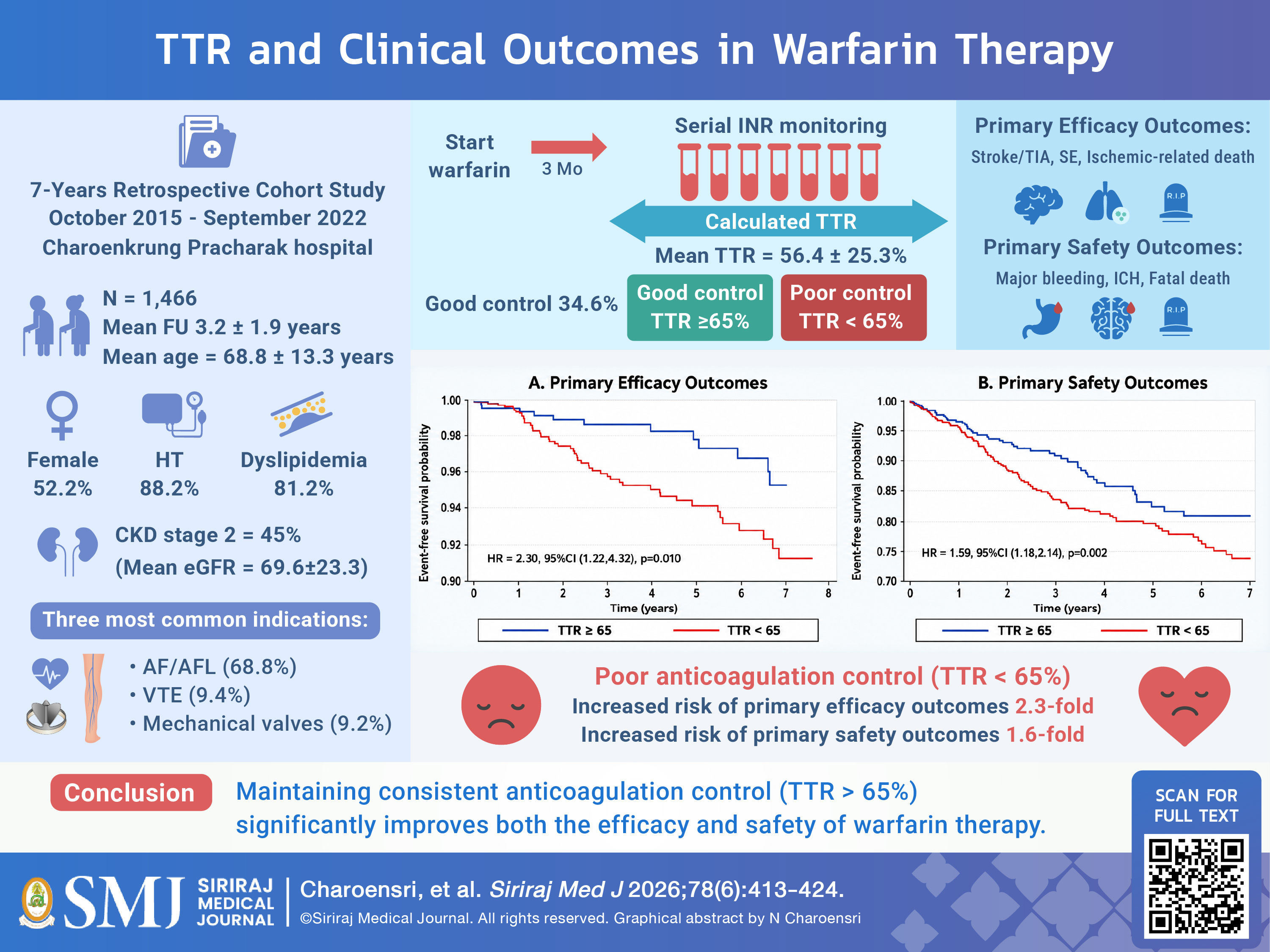
Materials and Methods: A retrospective cohort study (2015-2022) of 1,466 patients at Charoenkrung Pracharak Hospital. TTR was calculated using the Rosendaal method. Patients were categorized into two groups: good control (TTR ≥ 65%) and poor control (TTR < 65%). Efficacy outcomes included ischemic stroke or transient ischemic attack (TIA), systemic embolism (SE), and ischemic-related death. Safety outcomes included major bleeding, intracranial hemorrhage (ICH), and fatal bleeding. Cox proportional hazards regression was used to determine association between TTR and clinical outcomes.
Results: Mean age was 68.8±13.3 years (52.2% female). Mean follow-up duration was 3.2±1.9 years, with a mean TTR of 56.36±25.34%. Three most common indications were atrial fibrillation/flutter (AF/AFL) (68.8%), venous thromboembolism (VTE) (9.4%), and mechanical heart valves (9.2%). Compared to the good control group, patients with poor control (TTR < 65%) had significantly higher incidence rates of both efficacy (1.29 vs. 0.56 per 100 person-years) and safety outcomes (4.69 vs. 2.92 per 100 person-years). After adjusting for potential confounders, poor control was independently associated with an increased risk of primary efficacy outcomes (aHR 2.30; 95% CI 1.22–4.32; p=0.01) and primary safety outcomes (aHR 1.59; 95% CI 1.18–2.14; p=0.01).
Conclusion: Poor anticoagulation control (TTR < 65%) is strongly associated with an increased risk of both thromboembolic and hemorrhagic complications. Maintaining a TTR ≥ 65% remains a critical therapeutic target consistently linked to better clinical outcomes in real-world practice.
References
The Heart Association of Thailand under the Royal Patronage of H.M. the King. Guidelines for oral anticoagulant therapy 2010 [Internet]. 2010 [cited 2021 Oct 1]. Available from: https://thaiheart.org/home
Hindricks G, Potpara T, Dagres N, Arbelo E, Bax JJ, Blomstrom-Lundqvist C, et al. 2020 ESC guidelines for the diagnosis and management of atrial fibrillation developed in collaboration with the European Association for Cardio-Thoracic Surgery (EACTS). Eur Heart J. 2021;42(5):373-498.
Chao TF, Joung B, Takahashi Y, Lim TW, Choi EK, Chan YH, et al. 2021 Focused update of the 2017 consensus guidelines of the Asia Pacific Heart Rhythm Society (APHRS) on stroke prevention in atrial fibrillation. J Arrhythm. 2021;37(6):1389-426.
Otto CM, Nishimura RA, Bonow RO, Carabello BA, Erwin JP 3rd, Gentile F, et al. 2020 ACC/AHA guideline for the management of patients with valvular heart disease: A report of the American College of Cardiology/American Heart Association Joint Committee on Clinical Practice Guidelines. Circulation. 2021;143(5):e72-e227.
Pruekprasert K, Ruangsetakit C, Wongwanit C, Chinsakchai K, Hongku K, Puangpanngam N, et al. Presence of residual venous thrombus at warfarin withdrawal: a predictor for recurrence after a first episode of symptomatic provoked proximal deep venous thrombosis in Thai population? Siriraj Med J. 2019;71(6):486-90.
Wattanachai N, Kaewmoongkun S. Warfarin pharmacology and factors affecting its response. Srinagarind Med J. 2017;32(2):189-99.
Bassand JP, Virdone S, Goldhaber SZ, Camm AJ, Fitzmaurice DA, Fox KAA, et al. Early risks of death, stroke/systemic embolism, and major bleeding in patients with newly diagnosed atrial fibrillation. Circulation. 2019;139(6):787-98.
Chatterjee NA, Lubitz SA. Systemic embolic events (SEE) in atrial fibrillation: SEEing embolic risk more clearly. Circulation. 2015;132(9):787-9.
Szummer K, Gasparini A, Eliasson S, Arnlov J, Qureshi AR, Barany P, et al. Time in therapeutic range and outcomes after warfarin initiation in newly diagnosed atrial fibrillation patients with renal dysfunction. J Am Heart Assoc. 2017;6(3):e004925.
Williams BA, Evans MA, Honushefsky AM, Berger PB. Prediction model for time in therapeutic range while on warfarin in newly diagnosed atrial fibrillation. J Am Heart Assoc. 2017;6(10):e006669.
Siddiqui S, DeRemer CE, Waller JL, Jaspal S, Gujral JS. Variability in the calculation of time in therapeutic range for the quality control measurement of warfarin. J Innov Card Rhythm Manag. 2018;9(12):3428-34.
Reiffel JA. Time in the therapeutic range for patients taking warfarin in clinical trials: useful, but also misleading, misused, and overinterpreted. Circulation. 2017;135(16):1475-7.
Reiffel JA. Time in the therapeutic range (TTR): an overly simplified conundrum. J Innov Card Rhythm Manag. 2017;8(3):2643-6.
Connolly SJ, Pogue J, Eikelboom J, Flaker G, Commerford P, Franzosi MG, et al. Benefit of oral anticoagulant over antiplatelet therapy in atrial fibrillation depends on the quality of international normalized ratio control achieved by centers and countries as measured by time in therapeutic range. Circulation. 2008;118(20):2029-37.
Haas S, Cate HT, Accetta G, Angchaisuksiri P, Bassand JP, Camm AJ, et al. Quality of vitamin K antagonist control and 1-year outcomes in patients with atrial fibrillation: a global perspective from the GARFIELD-AF registry. PLoS One. 2016;11(10):e0164076.
Connolly SJ, Ezekowitz MD, Yusuf S, Eikelboom J, Oldgren J, Parekh A, et al. Dabigatran versus warfarin in patients with atrial fibrillation. N Engl J Med. 2009;361(12):1139-51.
Chan YH, See LC, Tu HT, Yeh YH, Chang SH, Wu LS, et al. Efficacy and safety of apixaban, dabigatran, rivaroxaban, and warfarin in Asians with nonvalvular atrial fibrillation. J Am Heart Assoc. 2018;7(8):e008150.
Krittayaphong R, Chantrarat T, Rojjarekampai R, Jittham P, Sairat P, Lip GYH. Poor time in therapeutic range control is associated with adverse clinical outcomes in patients with non-valvular atrial fibrillation: a report from the nationwide COOL-AF registry. J Clin Med. 2020;9(6):1698.
Kidney Disease: Improving Global Outcomes (KDIGO) Glomerular Diseases Work Group. KDIGO 2021 Clinical practice guideline for the management of glomerular diseases. Kidney Int. 2021;100(4 Suppl):S1-276.
Tsoris A, Marlar CA. Use of the Child-Pugh score in liver disease. In: StatPearls [Internet]. Treasure Island (FL): StatPearls Publishing; 2024 [cited 2026 Mar 16]. Available from: https://www.ncbi.nlm.nih.gov/books/NBK542308/
Kleindorfer DO, Towfighi A, Chaturvedi S, Cockroft KM, Gutierrez J, Lombardi-Hill D, et al. 2021 guideline for the prevention of stroke in patients with stroke and transient ischemic attack: a guideline from the American Heart Association/American Stroke Association. Stroke. 2021;52(7):e364-467.
Knuuti J, Wijns W, Saraste A, Capodanno D, Barbato E, Funck-Brentano C, et al. 2019 ESC guidelines for the diagnosis and management of chronic coronary syndromes. Eur Heart J. 2020;41(3):407-77.
Del Campo M, Roberts G. Changes in warfarin sensitivity during decompensated heart failure and chronic obstructive pulmonary disease. Ann Pharmacother. 2015;49(9):962-8.
McDonagh TA, Metra M, Adamo M, Gardner RS, Baumbach A, Bohm M, et al. 2021 ESC guidelines for the diagnosis and treatment of acute and chronic heart failure. Eur Heart J. 2021;42(36):3599-726.
Rudski LG, Lai WW, Afilalo J, Hua L, Handschumacher MD, Chandrasekaran K, et al. Guidelines for the echocardiographic assessment of the right heart in adults: a report from the American Society of Echocardiography. J Am Soc Echocardiogr. 2010;23(7):685-713.
Chartrungsan A, Laksanabunsong P, Nimmannit A, Suwanawiboon B, Poungvarin N, Wongkornrat W, et al. Comparison of temporary interruption of warfarin therapy for 3 and 5 days before surgery in Thailand: A randomized controlled trial. Siriraj Med J. 2013;65(3):69-72.
Mak M, Lam C, Pineda SJ, Lou M, Xu LY, Meeks C, et al. Pharmacogenetics of warfarin in a diverse patient population. J Cardiovasc Pharmacol Ther. 2019;24(6):521-33.
Shen AY, Yao JF, Brar SS, Jorgensen MB, Chen W. Racial/ethnic differences in the risk of intracranial hemorrhage among patients with atrial fibrillation. J Am Coll Cardiol. 2007;50(4):309-15.
Li YG, Lee SR, Choi EK, Lip GY. Stroke prevention in atrial fibrillation: focus on Asian patients. Korean Circ J. 2018;48(8):665-84.
Gaikwad T, Ghosh K, Shetty S. VKORC1 and CYP2C9 genotype distribution in Asian countries. Thromb Res. 2014;134(3):537-44.
Falcone GJ, Radmanesh F, Brouwers HB, Battey TW, Devan WJ, Valant V, et al. APOE and variants increase risk of warfarin-related intracerebral hemorrhage. Neurology. 2014;83(13):1139-46.
Shendre A, Parmar GM, Dillon C, Beasley TM, Limdi NA. Influence of age on warfarin dose, anticoagulation control, and risk of hemorrhage. Pharmacotherapy. 2018;38(6):588-96.
Siriussawakul A, Suraarunsumrit P, Srinonprasert V, Somnuke P, Limratana P, Sura-amonrattana U, et al. Predictive models for screening of postoperative cognitive dysfunction in older surgical patients. Siriraj Med J. 2026;78(3):196-204.
Miura T, Nishinaka T, Terada T, Yonezawa K. Relationship between aging and dosage of warfarin: the current status of warfarin anticoagulant therapy for Japanese outpatients in a department of cardiovascular medicine. J Cardiol. 2009;53(3):355-60.
Choichanchaikul S, Malathum P, Kanjanajaree S. The Use of warfarin in older adults: a case study and caring. Rama Nurs J. 2008;14(3):366-84. [in Thai]
Agarwal MA, Potukuchi PK, Sumida K, Naseer A, Molnar MZ, George LK, et al. Clinical outcomes of warfarin initiation in advanced chronic kidney disease patients with incident atrial fibrillation. JACC Clin Electrophysiol. 2020;6(13):1658-68.
Limdi NA, Beasley TM, Baird MF, Goldstein JA, McGwin G, Arnett DK, et al. Kidney function influences warfarin responsiveness and hemorrhagic complications. J Am Soc Nephrol. 2009;20(4):912-21.
Poomlek V, Chaitree W, Thongcharoen P, Panchavinnin P, Opartkiattikul N. A Comparative study of portable monitors (CoaguChek® XS) for international normalized ratio (INR). Siriraj Med J. 2008;60(1):10-3.
Abdel-Aziz MI, Ali MA, Hassan AK, Elfaham TH. Factors influencing warfarin response in hospitalized patients. Saudi Pharm J. 2015;23(6):642-9.
Williams B, Zou L, Pittet JF, Chao W. Sepsis-induced coagulopathy: a comprehensive narrative review of pathophysiology, clinical presentation, diagnosis, and management strategies. Anesth Analg. 2024;138(4):696-711.
Srdic T, Durasevic S, Lakic I, Ruzicic A, Vujovic P, Jevdovic T, et al.From molecular mechanisms to clinical therapy: understanding sepsis-induced multiple organ dysfunction. Int J Mol Sci. 2024;25(14):7770.
Department of Disease Control, Ministry of Public Health. COVID-19 Dashboard [Internet]. 2026 [cited 2026 Feb. 21]. Available from: https://ddc.moph.go.th/covid19-dashboard/
Mohseni Afshar Z, Tavakoli Pirzaman A, Hosseinzadeh R, Babazadeh A, Taghizadeh Moghadam MA, Miri SR, et al. Anticoagulant therapy in COVID-19: a narrative review. Clin Transl Sci. 2023;16(9):1510-25.
Tang N, Li D, Wang X, Sun Z. Abnormal coagulation parameters are associated with poor prognosis in patients with novel coronavirus pneumonia. J Thromb Haemost. 2020;18(4):844-7.
Schulman S, Sholzberg M, Spyropoulos AC, Zarychanski R, Resnick HE, Bradbury CA, et al; International Society on Thrombosis and Haemostasis. ISTH guidelines for antithrombotic treatment in COVID-19. J Thromb Haemost. 2022;20(10):2214-25
Schulman S, Arnold DM, Bradbury CA, Broxmeyer L, Connors JM, Falanga A, et al. 2023 ISTH update of the 2022 ISTH guidelines for antithrombotic treatment in COVID-19. J Thromb Haemost. 2024;22(6):1779-97.
Thachil J, Tang N, Gando S, Falanga A, Cattaneo M, Levi M, et al. ISTH interim guidance on recognition and management of coagulopathy in COVID-19. J Thromb Haemost. 2020;18(5):1023-6.
Van Gelder IC, Rienstra M, Bunting KV, Casado-Arroyo R, Caso V, Crijns HJ, et al. 2024 ESC guidelines for the management of atrial fibrillation developed in collaboration with the European Association for Cardio-Thoracic Surgery (EACTS). Eur Heart J. 2024;45(36):3314-414.
Published
How to Cite
License
Copyright (c) 2026 Siriraj Medical Journal

This work is licensed under a Creative Commons Attribution-NonCommercial-NoDerivatives 4.0 International License.
Authors who publish with this journal agree to the following conditions:
Copyright Transfer
In submitting a manuscript, the authors acknowledge that the work will become the copyrighted property of Siriraj Medical Journal upon publication.
License
Articles are licensed under a Creative Commons Attribution-NonCommercial-NoDerivatives 4.0 International License (CC BY-NC-ND 4.0). This license allows for the sharing of the work for non-commercial purposes with proper attribution to the authors and the journal. However, it does not permit modifications or the creation of derivative works.
Sharing and Access
Authors are encouraged to share their article on their personal or institutional websites and through other non-commercial platforms. Doing so can increase readership and citations.