
Association Between Executive Functions and Bullying Among High School Students in a Province of Central Thailand
DOI:
https://doi.org/10.33192/smj.v78i6.281316Keywords:
Adolescent, bullying, cyberbullying, executive functions, schoolAbstract
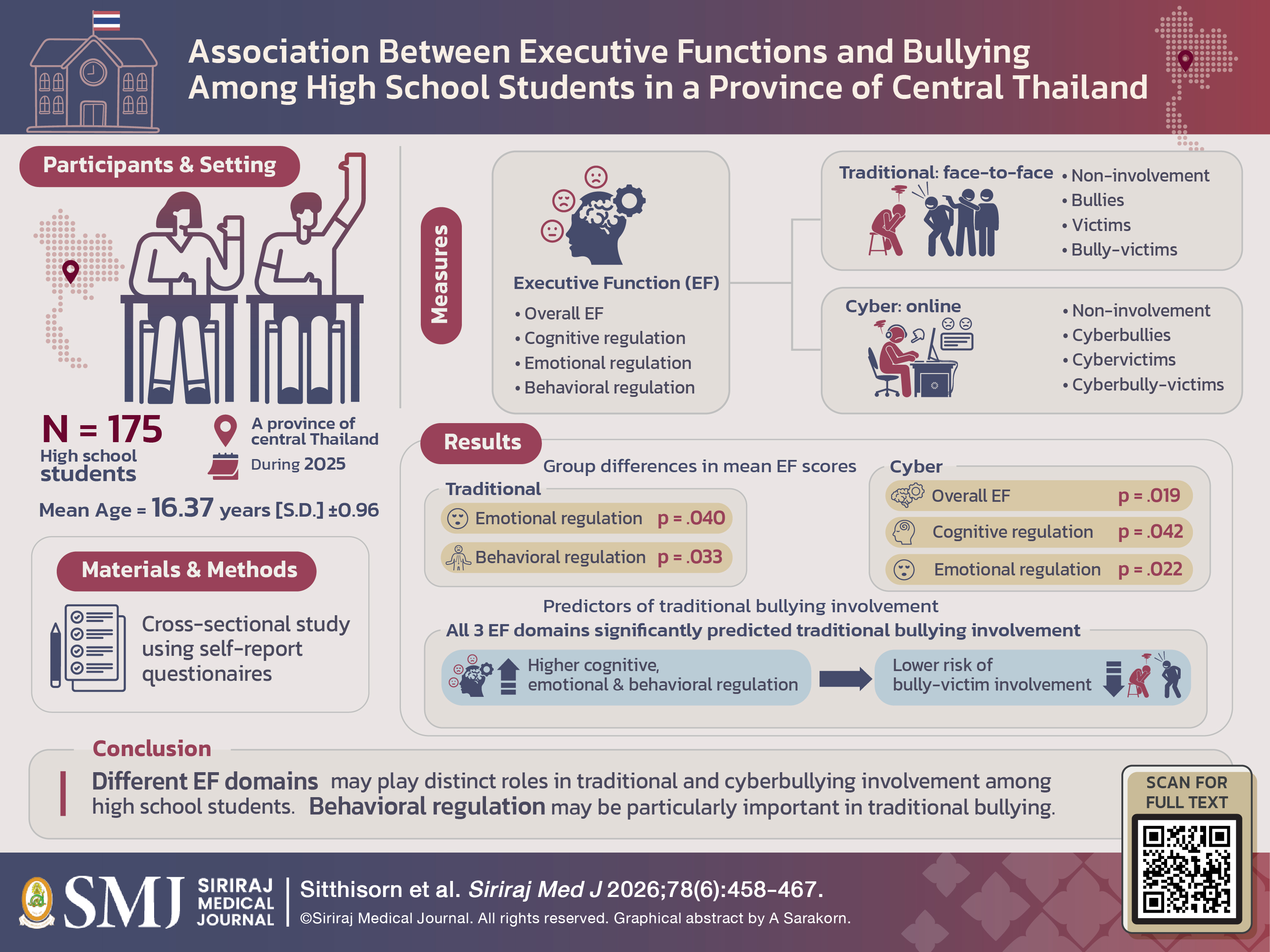
Objective: To examine and compare executive function (EF) profiles across different bullying roles and to assess whether EF predicts involvement in bullying among high school students.
Materials and Methods: A cross-sectional study was conducted among 175 high school students from schools in a province in central Thailand between May and August 2025. Data were collected using validated Thai versions of the Executive Function Inventory, the Revised Olweus Bully/Victim Questionnaire, and the Cyber-Aggression Perpetration and Victimization Scale. Statistical analyses included one-way ANOVA (with Welch's ANOVA and Games-Howell post hoc tests where appropriate), Tukey's HSD test, and multinomial logistic regression.
Results: Emotional and behavioral regulation showed significant group differences in traditional bullying (p = .040 and p = .033, respectively), while overall EF, cognitive, and emotional regulation differed significantly across cyberbullying groups (p = .019, .042, and .022, respectively). All three EF domains (cognitive, emotional, and behavioral regulation) were significant predictors of traditional bullying involvement (OR = .25, p =.024; OR = .29, p = .047; OR = .19, p = .009, respectively).
Conclusion: Different EF domains play distinct roles in traditional and cyberbullying behaviors in adolescents. Interventions targeting behavioral regulation skills may be particularly effective in reducing traditional bullying, while cyberbullying appears to involve multiple EF domains and may require more comprehensive intervention strategies.
References
Friedman NP, Robbins TW. The role of prefrontal cortex in cognitive control and executive function. Neuropsychopharmacology. 2022;47(1):72-89.
Diamond A. Executive functions. Annu Rev Psychol. 2013;64:135-68.
Gioia GA, Isquith PK, Retzlaff PD, Espy KA. Confirmatory factor analysis of the Behavior Rating Inventory of Executive Function (BRIEF) in a clinical sample. Child Neuropsychol. 2002;8(4):249-57.
Chutabhakdikul N, Thanasetkorn P, Lertawasdatrakul O, Ruksee N. Tool development and evaluation criteria for assessment of executive function in early childhood. Nakhon Pathom: Research Center for Neuroscience, Institute of Molecular Biosciences, Mahidol University; 2017. (in Thai).
Smith PK, Mahdavi J, Carvalho M, Fisher S, Russell S, Tippett N. Cyberbullying: its nature and impact in secondary school pupils. J Child Psychol Psychiatry. 2008;49(4):376-85.
Eyuboglu M, Eyuboglu D, Pala SC, Oktar D, Demirtas Z, Arslantas D, et al. Traditional school bullying and cyberbullying: Prevalence, the effect on mental health problems and self-harm behavior. Psychiatry Res. 2021;297:113730.
Smith P. Focus on: Bullying 2022 [Internet]. London: Anti-Bullying Alliance; 2022 [cited 2026 Feb 13]. Available from: https://anti-bullyingalliance.org.uk/sites/default/files/uploads/attachments/Focus_on_Bullying_2022.pdf
Chudal R, Tiiri E, Brunstein Klomek A, Ong SH, Fossum S, Kaneko H, et al. Victimization by traditional bullying and cyberbullying and the combination of these among adolescents in 13 European and Asian countries. Eur Child Adolesc Psychiatry. 2022;31(9):1391-404.
Wang CW, Musumari PM, Techasrivichien T, Suguimoto SP, Tateyama Y, Chan CC, et al. Overlap of traditional bullying and cyberbullying and correlates of bullying among Taiwanese adolescents: a cross-sectional study. BMC Public Health. 2019;19(1):1756
Sakarinkhul C, Wacharasindhu A. Prevalence of bullying and associated psychosocial factors among lower secondary school students in Muang, Chiangmai. J Psychiatr Assoc Thailand. 2014;59(3):22
Coolidge FL, DenBoer JW, Segal DL. Personality and neuropsychological correlates of bullying behavior. Personality and Individual Differences. 2004;36(7):1559-69.
Kishimoto T, Ji X, Ding X. The Multivariate Associations Among Bullying Experiences, Executive Function, and Psychological Disturbance. School Mental Health. 2023;15(4):1158-72.
Caetano LAO, Oliveira WA, Nascimento LCG, Manochio-Pina MG, Ramos SB, Silva JL. Relações entre funções executivas e bullying: revisão integrativa da literatura. Psicologia: Teoria e Prática. 2021;23(2):1-24.
Real Fernández M, Navarro Soria I, Collado-Valero J, Lavigne-Cervan R, Delgado Domenech B. Ciberacoso y funciones ejecutivas en niños y adolescentes: una revisión sistemática. Revista de Educación. 2022;(397):69-95.
Camacho A, Ortega-Ruiz R, Romera EM. Longitudinal associations between cybervictimization, anger rumination, and cyberaggression. Aggress Behav. 2021;47(3):332-42.
Morea A, Calvete E. Understanding the Perpetuation of Cyberbullying Victimization in Adolescents: The Role of Executive Functions. Res Child Adolesc Psychopathol. 2022;50(10):1299-311.
Chularut P, Aeamtussana T, Kambhu Na Ayudhaya P. A construction of executive function inventory for adolescent students of senior high school level. Suthiparithat. 2019;33(107):94-106.
Tapanya S. A survey of bullying problem of students in Thailand. Chiang Mai: Faculty of Medicine Chiang-Mai University; 2006.
Solberg ME, Olweus D. Prevalence estimation of school bullying with the Olweus Bully/Victim Questionnaire. Aggr Behav. 2003;29(3):239-68.
Shapka JD, Maghsoudi R. Examining the validity and reliability of the cyber-aggression and cyber-victimization scale. Computers in Human Behavior. 2017;69:10-7.
Anuroj K, Pittayaratsatien N. Validity and reliability of the cyber-aggression perpetration and victimization scale: Thai version. J Psychiatr Assoc Thailand. 2019;64(1):45–60.
Anuroj K. Effects of cyberbullying and coping strategies on depression. J Med Assoc Thai. 2022;105(Suppl 1):S58–67.
Laisuwannachart P, Suteeprasert T, Bunsiriluck S. Factors predicting cyberbullying perpetration and victimization among students in central Thailand. J Ment Health Th. 2022;30(2):100-13.
Halliday S, Taylor A, Turnbull D, Gregory T. The Relationship Between Traditional and Cyber Bullying Victimization in Early Adolescence and Emotional Wellbeing: A Cross-Sectional, Population-Based Study. International Journal of Bullying Prevention. 2022;6(2):110-23.
Jia P, Li C, Xie X. From victimization of traditional bullying to perpetration of cyberbullying: the roles of moral disengagement, social support, and gender. BMC Psychol. 2025;13(1):1418.
Jenkins LN, Tennant JE, Demaray MK. Executive functioning and bullying participant roles: Differences for boys and girls. Journal of School Violence. 2018;17(4):521-37.
Berlin L, Bohlin G. Response inhibition, hyperactivity, and conduct problems among preschool children. J Clin Child Adolesc Psychol. 2002;31(2):242-51.
Simmons JA, Antshel KM. Bullying and Depression in Youth with ADHD: A Systematic Review. Child & Youth Care Forum. 2020;50(3):379-414.
Sittanomai N, Laugeson E, Chantaratin S, Tarugsa J, Sainampran D, Sathirangkul V, et al. Social Skills Training Using the Thai Version of UCLA PEERS® in Thai Adolescents with Autism Spectrum Disorder. Siriraj Med J. 2021;73(7):471-7.
Salehinejad MA, Ghanavati E, Rashid MHA, Nitsche MA. Hot and cold executive functions in the brain: A prefrontal-cingular network. Brain Neurosci Adv. 2021;5:23982128211007769
Poon K. Hot and Cool Executive Functions in Adolescence: Development and Contributions to Important Developmental Outcomes. Front Psychol. 2017;8:2311.
Zelazo PD, Müller U. Executive function in typical and atypical development. In: Goswami U, editor. The Wiley-Blackwell handbook of childhood cognitive development. 2nd ed. Oxford: Wiley-Blackwell; 2010. p. 574-603.
Zelazo PD, Blair CB, Willoughby MT. Executive function: implications for education. Washington (DC): National Center for Education Research, Institute of Education Sciences, US Department of Education; 2016. (NCER 2017-2000).
Arato N, Zsido AN, Lenard K, Labadi B. Cybervictimization and Cyberbullying: The Role of Socio-Emotional Skills. Front Psychiatry. 2020;11:248.
Kowalski RM, Giumetti GW, Schroeder AN, Lattanner MR. Bullying in the digital age: a critical review and meta-analysis of cyberbullying research among youth. Psychol Bull. 2014;140(4):1073-137.
Verlinden M, Veenstra R, Ghassabian A, Jansen PW, Hofman A, Jaddoe VW, et al. Executive functioning and non-verbal intelligence as predictors of bullying in early elementary school. J Abnorm Child Psychol. 2014;42(6):953-66.
Potard C, Henry A, Pochon R, Kubiszewski V, Combes C, Brouté V, et al. Sex Differences in the Relationships between School Bullying and Executive Functions in Adolescence. Journal of School Violence. 2021;20(4):483-98.
Published
How to Cite
License
Copyright (c) 2026 Siriraj Medical Journal

This work is licensed under a Creative Commons Attribution-NonCommercial-NoDerivatives 4.0 International License.
Authors who publish with this journal agree to the following conditions:
Copyright Transfer
In submitting a manuscript, the authors acknowledge that the work will become the copyrighted property of Siriraj Medical Journal upon publication.
License
Articles are licensed under a Creative Commons Attribution-NonCommercial-NoDerivatives 4.0 International License (CC BY-NC-ND 4.0). This license allows for the sharing of the work for non-commercial purposes with proper attribution to the authors and the journal. However, it does not permit modifications or the creation of derivative works.
Sharing and Access
Authors are encouraged to share their article on their personal or institutional websites and through other non-commercial platforms. Doing so can increase readership and citations.