
Prevalence and Biopsychosocial Factors Associated with Relapse in Patients with First-Episode Schizophrenia in a Clinical Setting in Southern Thailand
DOI:
https://doi.org/10.33192/smj.v78i6.281451Keywords:
First-episode schizophrenia, Relapse, Medication adherence, Cognitive insight, Coping strategies, Social support, Substance useAbstract
Objective: This study aimed to assess the prevalence of relapse among patients with first-episode schizophrenia and identify its associated biopsychosocial factors.
Materials and Methods: This was a cross-sectional study conducted at a major psychiatric hospital in southern Thailand. This study included patients aged 18–59 years diagnosed with schizophrenia within the preceding 3 years. Data were collected using a demographic questionnaire and five standardized instruments. Descriptive statistics and univariate and multivariate logistic regression analyses were performed to identify factors associated with relapse.
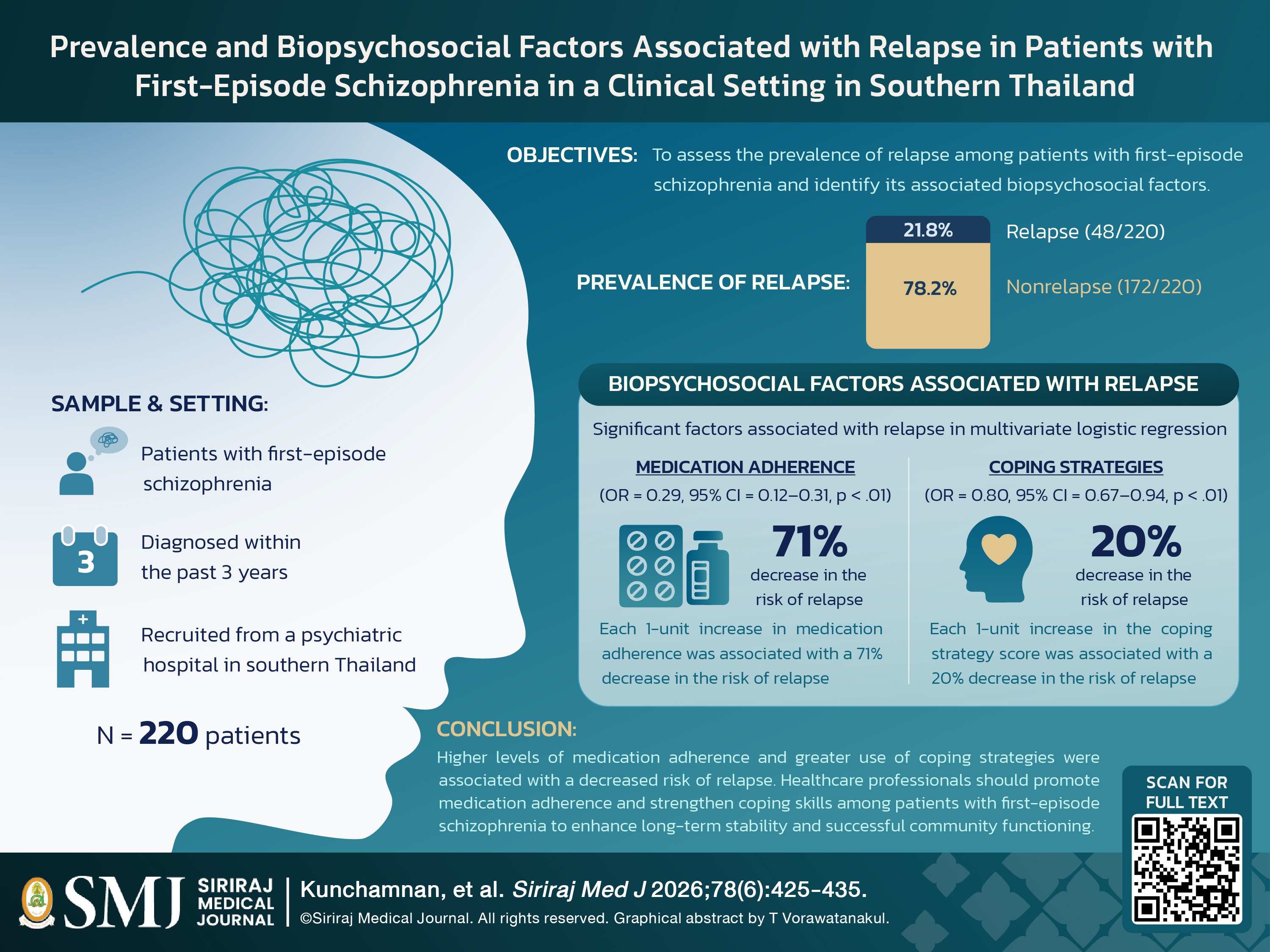
Results: A total of 220 patients were included in this study. The prevalence of relapse was 21.8%. The univariate analysis revealed that medication adherence, coping strategies, social support, substance use (p < .01), and cognitive insight (p < .05) were significantly associated with relapse. In the multivariate logistic regression analysis, medication adherence and coping strategies remained independently associated with relapse. Particularly, each one-unit increase in medication adherence was associated with a 71% decrease in the risk of relapse (odds ratio [OR] = 0.29, 95% confidence interval [CI] = 0.12–0.31, p < .01). Similarly, each one-unit increase in the coping strategy score was associated with a 20% decrease in the risk of relapse (OR = 0.80, 95% CI = 0.67–0.94, p < .01).
Conclusion: Higher levels of medication adherence and greater use of coping strategies were associated with a decreased risk of relapse. Healthcare professionals should promote medication adherence and strengthen coping skills among patients with first-episode schizophrenia to enhance long-term stability and successful community functioning.
References
Department of Mental Health. New case rates and prevalence of schizophrenia (F20.xx) [Internet]. [cited 2024 Jul 9]. Available from: https://hdcservice.moph.go.th/hdc/reports
World Health Organization. Schizophrenia [Internet]. [cited 2022 Apr 25]. Available from: https://www.who.int/news-room/factsheets/detail/schizophrenia
Sadock BJ, Sadock AV. Kaplan and Sadock's Synopsis of Psychiatry. 11th ed. Philadelphia: Lippincott Williams & Wilkins; 2022.
World Health Organization. Mental disorders [Internet]. [cited 2024 Apr 25]. Available from: http://www.who.int/news-room/fact-sheets/detail/mental-disorders
Department of Mental Health. Manual for caring for schizophrenia patients in health district hospitals (Physician’s Edition). Nonthaburi: Victoria Image Co., Ltd.; 2017.
American Psychiatric Association. Diagnostic and statistical manual of mental disorders. 5th ed. Arlington (VA): American Psychiatric Association; 2013. p. 87-122.
Shen Y, Wu X. Advances in implementation strategies for treatment adherence in schizophrenia: a narrative review. Front Psychiatry. 2026;17:1752130.
Kelebie M, Kibralew G, Fentahun S, Rtbey G, Aderaw M, Endeshaw W, et al. Clinical outcomes in first-episode schizophrenia: identifying predictors of relapse. Soc Psychiatry Psychiatr Epidemiol. 2026;61(2):343-56.
Intharit J, Kittiwattanagul K, Chaveepojnkamjorn W, Tudpor K. Risk and protective factors of relapse in patients with first-episode schizophrenia from perspectives of health professionals: a qualitative study in northeastern Thailand. F1000Res. 2021;10:499.
Engel GL. The need for a new medical model: a challenge for biomedicine. Science. 1977;196(4286):129-36.
Runglirdsittikul K. Trends and associated factors in the transition from substance-induced psychotic disorder to schizophrenia: a retrospective study in Samutprakarn Hospital. J Psychiatr Assoc Thailand [Internet]. 2025;70(3):393-406. [cited 2026 Apr 5]. Available from: https://he01.tci-thaijo.org/index.php/JPAT/article/view/278387
Catalan A, Salazar de Pablo G, Aymerich C, Guinart D, Goena J, Madaria L, et al. “Short” versus “long” duration of untreated psychosis in people with first-episode psychosis: a systematic review and meta-analysis of baseline status and follow-up outcomes. Schizophr Bull. 2025;51(5):1206-30.
Pothimas N, Tungpunkom P, Chanprasit C, Kitsumban V. A cross-sectional study of factors predicting relapse in people with schizophrenia. J Med Mil Nurs. 2020;24(4):448-59.
Lee SU, Soh M, Ryu V, Kim CE, Park S, Roh S, et al. Analysis of the Health Insurance Review and Assessment Service data from 2011 to 2015. Int J Ment Health Syst. 2018;12:9.
Sun X, Tian T, Jia Q, Wang J, Su Q, Qiu Y, et al. Impact of duration of untreated psychosis on early clinical outcomes in drug-naïve schizophrenia: a 12-week follow-up study. J Psychiatr Res. 2025;190:499-511.
Stacy P, Frantz J, Miller G, Merrill B, Gainer D. A narrative review of the pathophysiology and treatment of methamphetamine-associated psychosis. Int J Ment Health Addiction. 2025;23:3837–52.
Neyra A, Parro-Torres C, Ros-Cucurull E, Carrera I, Echarri E, Torrens M. Management of schizophrenia and comorbid substance use disorders: expert review and guidance. Ann Gen Psychiatry. 2024;23(1):40.
Lui SSY, Lam JPY, Lam JWS, Chui WWH, Mui JHC, Siu BWM, et al. Cognitive insight is correlated with cognitive impairments and contributes to medication adherence in schizophrenia patients. Asian J Psychiatr. 2021;60:102644.
Songmuang T, Songmuang A. Adherence to antipsychotic medication and relapse rates in patients with schizophrenia after referral to primary care units. J Health Sci Thai. 2022;31(1):70-79.
Pitanupong J, Ratanaapiromyakij P, Teetharatkul T. Factors associated with readmission among individuals with one previous episode of schizophrenia in southern Thailand: a university hospital-based retrospective study. J Health Sci Med Res. 2021;40(6):657-70.
Mitikhin V, Kuzminova M, Alieva L. The role of resilience and coping behavior in schizophrenia in the prevention of psychosis relapse. Eur Psychiatry. 2024;67(S1):S746-7.
Chawang O, Klubwong M, Lomwong N, Tepsoh S. Development of cognitive flexibility and inhibition control recovery program on coping in patients with schizophrenia. APHEIT. 2021;3(2):53-61.
Jiang N, Jin W, Fu Z, Cao H, Zheng H, Wang Q, et al. Effects of social support on medication adherence among patients with schizophrenia: serial multiple mediation model. Patient Prefer Adherence. 2024;18:947-55.
Pothimas N, Tungpunkom P, Chanprasit C, Kitsumban V. A cross-sectional study of factors predicting relapse in people with schizophrenia. J Med Mil Nurs. 2020;24(4):448-59.
Devon HA, Block ME, Moyle-Wright P, Ernst DM, Hayden SJ, Lazzara DJ, et al. A psychometric toolbox for testing validity and reliability. J Nurs Scholarsh. 2007;39(2):155-64.
Overall JE, Gorham DR. The brief psychiatric rating scale. Psychol Rep. 1962;10(3):799-812.
Kittiratpaiboon P. Lecture notes on the development of psychiatric patient assessment tools at Suanprung Hospital. Chiang Mai: Suanprung Hospital; 2001.
Beck AT, Baruch E, Balter JM, Steer RA, Warman DM. A new instrument for measuring insight: the Beck Cognitive Insight Scale. Schizophr Res. 2004;68(2-3):319-29.
Ketchai S, Sitthimongkol Y, Vongsirimas N, Petrasuwan S. Predictors of depressive symptoms in individuals with first-episode schizophrenia. Thai Nurs Council J. 2012;30(4):90-124.
Jannah S, Sutrangsee W, Nukaew O. The effect of the Islamic-based illness education program (IBIEP) on medication adherence among patients with schizophrenia: a pilot study. Songklanagarind J Nurs. 2016;36(2):14-29.
Thompson K, Kulkarni J, Sergejew AA. Reliability and validity of a new medication adherence rating scale (MARS) for the psychoses. Schizophr Res. 2000;42(3):241-7.
Rungrojwattanasiri P, Suntornchaiya R, Uppasen R. The effect of a group-based social support program on medication adherence behaviors among elderly patients with depression. J Psychiatr Nurs Ment Health. 2017;31(1):119-32.
Carver CS, Scheier MF, Weintraub JK. Assessing coping strategies: a theoretically based approach. J Pers Soc Psychol. 1989;56(2):267-83.
Numsang T, Tantrarungroj T. Validity and reliability of the Brief COPE inventory: Thai version. J Psychiatr Assoc Thailand. 2018;63(2):189-98.
Huang L, Lei W, Xu F, Liu H, Yu L. Emotional responses and coping strategies in nurses and nursing students during COVID-19 outbreak: a comparative study. PLoS One. 2020;15(8):e0237303.
Quiroga-Garza A, Cepeda-Lopez CA, Villarreal-Zambrano S, Villalobos-Daniel VE, Carreno DF, Eisenbeck N. How having a clear why can help us cope with almost anything: meaningful well-being and the COVID-19 pandemic in Mexico. Front Psychol. 2021;12:1-10.
Zimet GD, Dahlem NW, Zimet SG, Farley GK. The multidimensional scale of social support. J Pers Assess. 1988;52(1):30-41.
Wongpakaran T, Wongpakaran N. A comparison of reliability and construct validity between the original and the revised version of the Rosenberg Self-Esteem Scale. Psychiatry Investig. 2012;9(1):54-8.
Chareonyooth N, Saima-in H, Konsila W. Empowerment in chronic schizophrenia patients: nursing roles. J Health Sci. 2021;5(3):24-35.
Hongkananukraw T, Charernboon T. Employment opportunity and associated factors among patients with schizophrenia. J Psychiatr Assoc Thailand. 2019;64(3):259-70.
Louwma J, Virasiri S, Suitra P. Family function among people with schizophrenia in a community context, Kalasin Province, Thailand. Thai J Public Health. 2020;50(3):365-77.
Pitanupong J, Karakate A, Tepsuan L, Sritrangnant G. Attitudes toward long-acting injectable antipsychotics among schizophrenia patients in Southern Thailand: a multihospital-based cross-sectional survey. Siriraj Med J. 2022;74(3):193-201.
Graipaspong N. Nicotine dependence and psychiatric symptoms in schizophrenic patients. J Ment Health Thai [Internet]. 2019 Oct 9 [cited 2026 Mar 18];27(3):171-82.
Siafis S, Brandt L, McCutcheon RA, Gutwinski S, Schneider-Thoma J, Bighelli I, et al. Relapse in clinically stable adult patients with schizophrenia or schizoaffective disorder: evidence-based criteria derived by equipercentile linking and diagnostic test accuracy meta-analysis. Lancet Psychiatry. 2024;11(1):36–46.
Benjehma R, Upasen R. Predicting factors of remission in persons with schizophrenia, Srithanya Hospital. Nurs Sci J. 2020;47(4):66-75.
El Jabiry SE, Bouazzaoui MA, Barrimi M, Elghazouani F, Oneib B. Stress, coping strategies, and relapse among schizophrenia patients at the psychiatric hospital of Oujda, Morocco. Pan Afr Med J. 2025;52:97.
Lohacheewa S, Chanapan N. Factors predicting positive and negative experiences in providing care to schizophrenic patients of caregivers. J Psychiatr Nurs Ment Health. 2020;34(1):103-17.
Kalkan E, Kavak Budak F. The effect of insight on medication adherence in patients with schizophrenia. Perspect Psychiatr Care. 2020;56(1):222-8.
Birulés I, López-Carrilero R, Cuadras D, Pousa E, Barrigón ML, Barajas A, et al. Cognitive insight in first-episode psychosis: changes during metacognitive training. J Pers Med. 2020;10(4):253.
Choorat N, Tohpaerah M, Piboonrungroj P, Tepsoh S, Akachi N. Schizophrenia relapse prevention model in Cho-I-Rong, Narathiwat Province with multicultural community participation. PNU Sci J. 2020;12(3):213-28.
Chansuvarn S, Champangern V, Kachat S, Photong P, Sripho S. Problems and causes of recurrence among psychiatric patients using substances in the community. J Boromarajonani Coll Nurs Suphanburi. 2023;6(2):67-77.
Hongkittiyanon T, Tipawong A. Relationships between social support and quality of life in schizophrenia patients. J R Thai Army Nurses. 2018;19:478-94.
Published
How to Cite
License
Copyright (c) 2026 Siriraj Medical Journal

This work is licensed under a Creative Commons Attribution-NonCommercial-NoDerivatives 4.0 International License.
Authors who publish with this journal agree to the following conditions:
Copyright Transfer
In submitting a manuscript, the authors acknowledge that the work will become the copyrighted property of Siriraj Medical Journal upon publication.
License
Articles are licensed under a Creative Commons Attribution-NonCommercial-NoDerivatives 4.0 International License (CC BY-NC-ND 4.0). This license allows for the sharing of the work for non-commercial purposes with proper attribution to the authors and the journal. However, it does not permit modifications or the creation of derivative works.
Sharing and Access
Authors are encouraged to share their article on their personal or institutional websites and through other non-commercial platforms. Doing so can increase readership and citations.