
Low-Temperature Atmospheric Pressure Plasma in Acute Wound Healing: A Multi-Center Randomized Controlled Trial Using Split-Thickness Skin Graft Donor Sites as a Standardized Human Model
DOI:
https://doi.org/10.33192/smj.v78i6.281469Keywords:
Acute wound model, split-thickness skin graft donor site, plasma medicine, wound healingAbstract
Objective: To determine whether low-temperature atmospheric-pressure plasma (LTAPP) improves acute wound healing, using split-thickness skin graft (STSG) donor sites as a standardized clinical model.
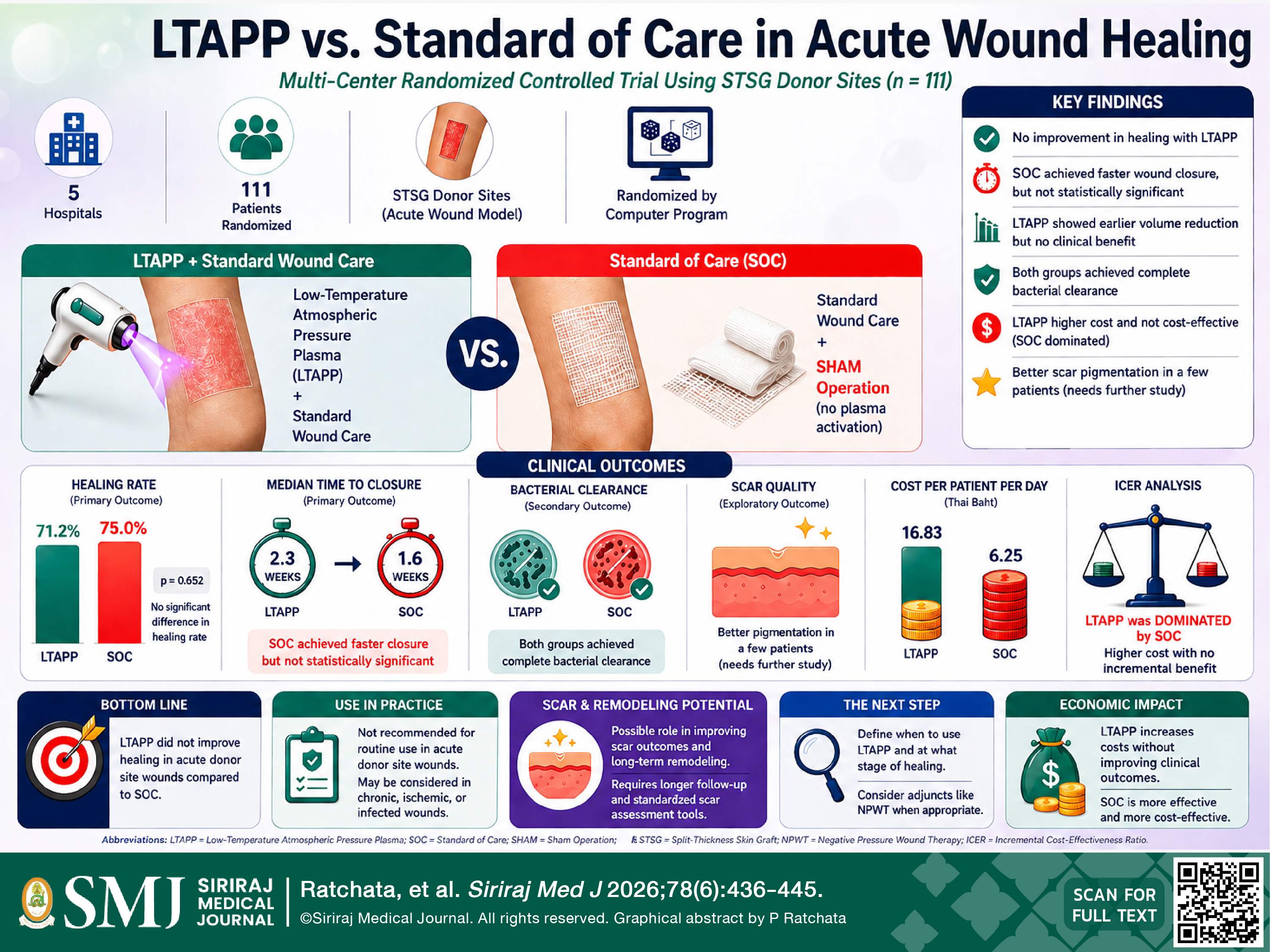
Materials and Methods: A multi-center randomized controlled trial was conducted across five tertiary hospitals. A total of 111 patients undergoing STSG were randomized to receive standard of care (SOC) with LTAPP or SOC with sham treatment. Primary outcomes included wound healing rates and wound size/volume reduction. Secondary outcomes included exudate clearance, bacterial burden, and cost-effectiveness.
Results: Healing rates were comparable between LTAPP and SOC groups (71.2% vs. 75.0%, p=0.652). SOC achieved faster wound closure (median 1.6 vs. 2.3 weeks), while LTAPP demonstrated earlier wound volume reduction without translating into improved clinical healing. Both groups achieved complete bacterial clearance. LTAPP incurred significantly higher costs and was not cost-effective, with ICER analysis showing dominance by SOC. Better scar pigmentation quality was observed in a few patients.
Conclusion: Using STSG donor sites as a controlled acute wound model, LTAPP did not improve healing outcomes compared to SOC. These findings suggest that LTAPP may have limited utility in uncomplicated acute wounds but reinforce the value of donor site models for evaluating emerging wound technologies. Future research on LTAPP in wounds should focus on chronic, ischemic, or infected wounds where biological modulation may be more impactful.
References
Brown JE, Holloway SL. An evidence-based review of split-thickness skin graft donor site dressings. Int Wound J. 2018;15(6):1000-9.
Hecker A, Lumenta DB, Brinskelle P, Sawetz I, Steiner A, Michelitsch B, et al. A randomized controlled trial of three advanced wound dressings in split-thickness skin grafting donor sites—a personalized approach? J Pers Med. 2022;12(9):1395.
Lohsiriwat V, Chuangsuwanich A. Comparison of the ionic silver-containing hydrofiber and paraffin gauze dressing on split-thickness skin graft donor sites. Ann Plast Surg. 2009;62(4):421-2.
Braný D, Dvorská D, Halašová E, Škovierová H. Cold atmospheric plasma: a powerful tool for modern medicine. Int J Mol Sci. 2020;21(8):2932.
Kolimi P, Narala S, Nyavanandi D, Youssef AAA, Dudhipala N. Innovative treatment strategies to accelerate wound healing: trajectory and recent advancements. Cells. 2022;11(15):2439.
Heuer K, Hoffmanns MA, Demir E, Baldus S, Volkmar CM, Röhle M, et al. The topical use of non-thermal dielectric barrier discharge (DBD): nitric oxide related effects on human skin. Nitric Oxide. 2015;44:52-60.
Chuangsuwanich A, Assadamongkol T, Boonyawan D. The healing effect of low-temperature atmospheric-pressure plasma in pressure ulcer: a randomized controlled trial. Int J Low Extrem Wounds. 2016;15(4):313-9.
Cui HS, Jung SY, Choi YS, Park JH, Kim JB, Shin CH. Effect of combining low-temperature plasma, negative pressure wound therapy, and mesenchymal stem cells on wound healing. Int J Mol Sci. 2020;21(10):3675.
Heinlin J, Zimmermann JL, Zeman F, Bunk W, Isbary G, Landthaler M, et al. Randomized placebo-controlled human pilot study of cold atmospheric argon plasma on skin graft donor sites. Wound Repair Regen. 2013;21(6):800-7.
Hashemi S, Sadeghi M, Savardashtaki A, Mazandarani A, Ghorbani A. Mechanisms, challenges, and translational perspectives of cold atmospheric plasma in cancer and wound healing. Adv Redox Res. 2026;18:100159.
Suwanchinda A, Nararatwanchai T. Efficacy and safety of the innovative cold atmospheric-pressure plasma technology in the treatment of keloid: a randomized controlled trial. J Cosmet Dermatol. 2022;21(12):6788-97.
Nie L, Wang Y, Chen X, Lu X, Gan L, Liu D, Shi J. Inhibitory effects and mechanisms of low-temperature plasma on hypertrophic scar. AIP Adv. 2023;13(12):125025.
Van Welzen A, Hoch M, Wahl P, Weber F, Rode S, Tietze JK, et al. The response and tolerability of a novel cold atmospheric plasma wound dressing for the healing of split skin graft donor sites: a controlled pilot study. Skin Pharmacol Physiol. 2021;34(6):328-36.
Chuangsuwanich A, Jiamchisri N, Muangsombat S, Chuangsuwanich T, Asuvapongpatana S. The efficacy of wall-typed suction and polyurethane foam in vacuum-assisted wound dressing system. J Med Assoc Thai. 2020;103(4):401–405.
Anghel EL, Kim PJ. Negative-pressure wound therapy: a comprehensive review of the evidence. Plast Reconstr Surg. 2016;138(3 Suppl):129S–137S.
Published
How to Cite
License
Copyright (c) 2026 Siriraj Medical Journal

This work is licensed under a Creative Commons Attribution-NonCommercial-NoDerivatives 4.0 International License.
Authors who publish with this journal agree to the following conditions:
Copyright Transfer
In submitting a manuscript, the authors acknowledge that the work will become the copyrighted property of Siriraj Medical Journal upon publication.
License
Articles are licensed under a Creative Commons Attribution-NonCommercial-NoDerivatives 4.0 International License (CC BY-NC-ND 4.0). This license allows for the sharing of the work for non-commercial purposes with proper attribution to the authors and the journal. However, it does not permit modifications or the creation of derivative works.
Sharing and Access
Authors are encouraged to share their article on their personal or institutional websites and through other non-commercial platforms. Doing so can increase readership and citations.