Thyroid Disorders in Preterm Infants: Prevalence, Etiologies, and Thyroid Function Test Characteristics
DOI:
https://doi.org/10.33192/smj.v78i9.281716Keywords:
congenital hypothyroidism, hyperthyrotropinemia, hypothyroxinemia, maternal preeclampsia, preterm infants, thyroid disordersAbstract
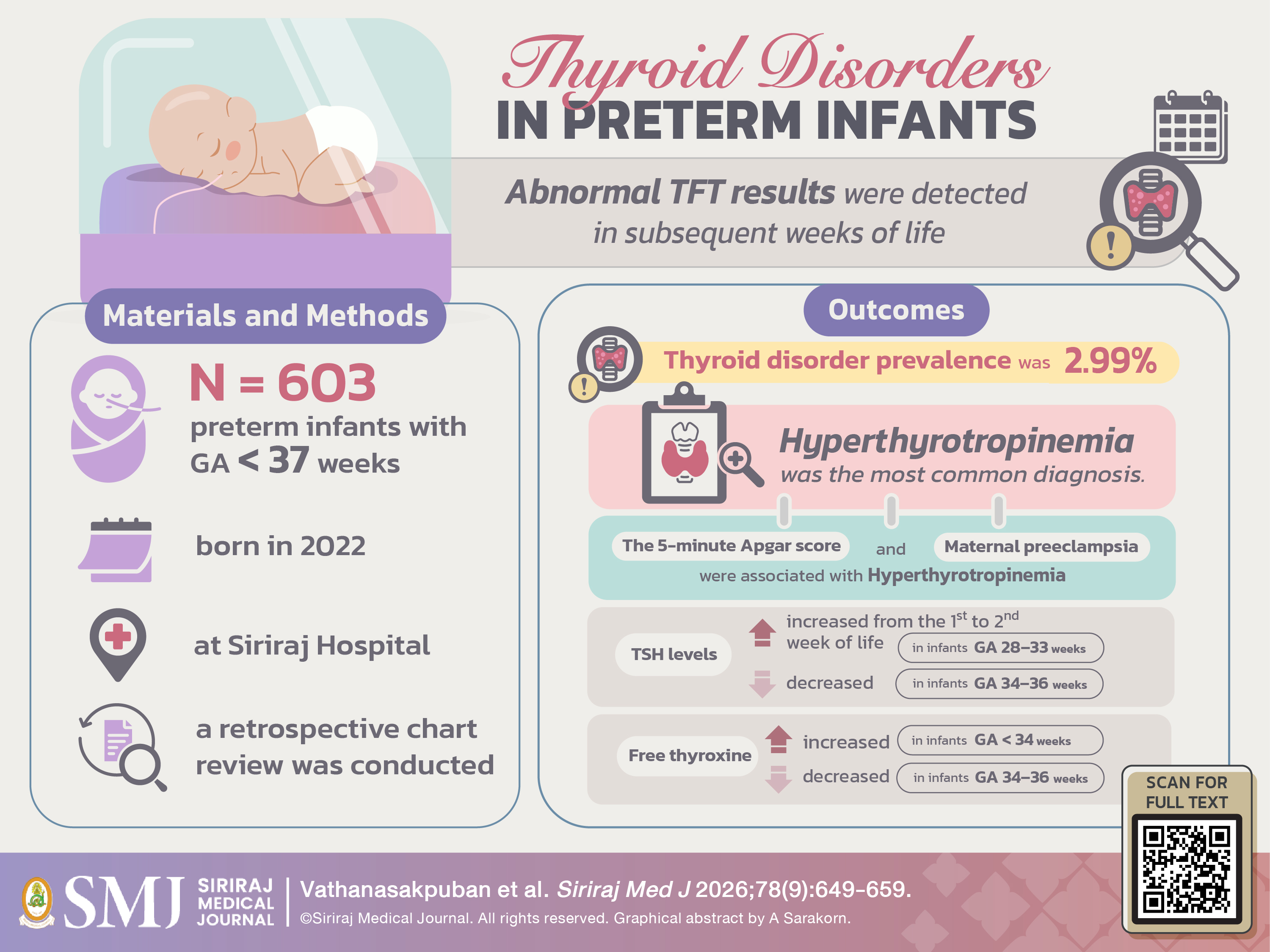
Background: Thyroid hormone is essential for preterm infant development, particularly neurological. Understanding thyroid disorder prevalence and function test characteristics enables proper interpretation and risk identification.
Objectives: To determine the prevalence, etiologies, risk factors, and thyroid function test characteristics of thyroid disorders in preterm infants.
Materials and Methods: This retrospective review included infants with gestational age (GA) < 37 weeks born at Siriraj Hospital in 2022. Infants with genetic syndromes, multiple congenital anomalies, chromosomal abnormalities, or maternal thyroid disease were excluded. Thyroid-stimulating hormone (TSH) from neonatal dried blood spots and thyroid function tests from blood were obtained at 1 week, 2 weeks, and from 4 weeks until term-corrected age. Multiple logistic regression identified risk factors.
Results: Among 603 infants, thyroid disorder prevalence was 2.99% (18/603). Disorders included hyperthyrotropinemia 8/18, hypothyroxinemia 4/18, congenital hypothyroidism 2/18, transiently elevated free thyroxine 2/18, central hypothyroidism 1/18, and transiently low TSH 1/18. Maternal preeclampsia was statistically significantly associated with hyperthyrotropinemia (P = 0.039; adjusted odds ratio 5.064; 95% CI 1.084–23.661). TSH increased from the first to second week in infants with GA 28–33 weeks, particularly GA 31–33 weeks, but decreased in GA 34–36 weeks. Free thyroxine increased with GA in infants < 34 weeks but decreased in GA 34–36 weeks.
Conclusions: Thyroid disorder prevalence was approximately 3%, with hyperthyrotropinemia most common. Maternal preeclampsia was a hyperthyrotropinemia risk factor. TSH and free thyroxine levels trended upward in infants with GA < 34 weeks but downward in GA > 34 weeks.
References
LaFranchi SH. Thyroid function in preterm/low birth weight infants: impact on diagnosis and management of thyroid dysfunction. Front Endocrinol (Lausanne). 2021;12:666207.
Mohamed AIAE, Ahmed El-Masry HM, Hassan AA, Sayed Younis MM, Aladawy MA, Hashem AM. Screening for thyroid dysfunction among preterm infants at Manfalout General Hospital, Assiut, Egypt. Annals of Neonatology. 2022;4(1):71-90.
Zhu L, Zhang X, He X, Yang X, Wang Y, Wang C et al. Reference intervals for serum thyroid hormones in preterm hospitalized infants. J Pediatr Endocrinol Metab. 2013;26(5-6):463-7.
Lee JH, Kim SW, Jeon GW, Sin JB. Thyroid dysfunction in very low birth weight preterm infants. Korean J Pediatr. 2015;58(6):224-9.
Grob F, Gutiérrez M, Leguizamón L, Fabres J. Hyperthyrotropinemia is common in preterm infants who are born small for gestational age. J Pediatr Endocrinol Metab. 2020;33(3):375-82.
Jeong MH, Lee N, Bae MH, Han YM, Park KH, Byun SY. Risk factors for delayed hyperthyrotropinemia in late preterm infants. Neonatal Med. 2019;26(4):204-12.
Rameshbabum M, Subramanian S, Sethuraman G. Thyroid function profiles in small versus appropriate for gestational age stable neonates with implications for screening cutoffs: a retrospective cross-sectional study. J Matern Fetal Neonatal Med. 2025;38(1):2517762.
Bosch-Giménez VM, Palazón-Bru A, Blasco-Barbero Á, Juste-Ruiz M, Rizo-Baeza MM, Cortés-Castell E. Multivariate analysis of thyrotropin in preterm newborns based on adequacy of weight for gestational age. Thyroid 2017;27(1):120-4.
Ali H, Mohamad HA, Aboelela MGM. Thyroid Function in Healthy Preterm Infants at the NICU of Assiut University Children's Hospital: An Observational Study. J Curr Med Res Pract. 2025;10(4):123-38.
Rehman A, Khan WI, Quddusi AI, Nadeem A, Iqbal I. Thyroid function disorders in low birth weight/preterm neonates admitted in NICU, Children Hospital Complex Multan. Professional Med J. 2020;27(08):1649-55.
Chung HR, Shin CH, Yang SW, Choi CW, Kim BI, Kim EK, et al. High incidence of thyroid dysfunction in preterm infants. J Korean Med Sci. 2009;24:627-31.
Linder N, Davidovitch N, Reichman B, Kuint J, Lubin D, Meyerovitch J, et al. Topical iodine-containing antiseptic and subclinical hypothyroidims in preterm infants. J Pediatr. 1997;131(3):434-9.
Smerdely P, Boyages S, Wu D, Leslie G, John E, Lim A, et al. Topical iodine-containing antiseptics and neonatal hypothyroidism in very-low-birthweight infants. Lancet. 1989;2(8664):661-4.
Brown RS. The thyroid. In: Brook CGD, Clayton P, Brown R, editors. Brook's clinical pediatric endocrinology. 6th ed. Oxford: Wiley-Blackwell; 2009. p. 250-82.
Prasad HK, Pulluru P, Venugopalan L, Murugesan G, Ramanathan S. Congenital hypothyroidism in Indian preterm babies–screening, prevalence, and aetiology. Pediatr Endocrinol Diabetes Metab. 2021;27(2):82-6.
Maneenil G, Juthong M, Thatrimontrichai A, Janjindamai W, Dissaneevate S, Jaruratanasirikul S. Incidence and risk factors of transient hypothyroxinemia of prematurity: a prospective cohort study. Turk J Pediatr. 2023;65:562-71.
Belet N, Imdat H, Yanık F, Küçüködük Ş. Thyroid function tests in preterm infants born to preeclamptic mothers with placental insufficiency. J Pediatr Endocrinol Metab. 2003;16(8):1131-5.
Toloza FJ, Derakhshan A, Männistö T, Bliddal S, Popova PV, Carty DM, et al. Association between maternal thyroid function and risk of gestational hypertension and pre-eclampsia: a systematic review and individual-participant data meta-analysis. Lancet Diabetes Endocrinol. 2022;10(4):243-52.
Deshpande S, Yelikar K, Patil S, Andurkar S. Maternal thyroid hormone status in pre-eclampsia: a tertiary care hospital based study. Int J Reprod Contracept Obstet Gynecol. 2015;4(6):1853-7.
Qublan H, Al-Kaisi I, Hindawi I, Hiasat M, Awamleh I, Hamaideh A, et al. Severe pre-eclampsia and maternal thyroid function. J Obstet Gynaecol. 2003;23(3):244-6.
Williams FL, Simpson J, Delahunty C, Ogston SA, Bongers-Schokking JJ, Murphy N et al. Developmental trends in cord and postpartum serum thyroid hormones in preterm infants. J Clin Endocrinol Metab. 2004;89(11):5314-20.
Published
How to Cite
License
Copyright (c) 2026 Siriraj Medical Journal

This work is licensed under a Creative Commons Attribution-NonCommercial-NoDerivatives 4.0 International License.
Authors who publish with this journal agree to the following conditions:
Copyright Transfer
In submitting a manuscript, the authors acknowledge that the work will become the copyrighted property of Siriraj Medical Journal upon publication.
License
Articles are licensed under a Creative Commons Attribution-NonCommercial-NoDerivatives 4.0 International License (CC BY-NC-ND 4.0). This license allows for the sharing of the work for non-commercial purposes with proper attribution to the authors and the journal. However, it does not permit modifications or the creation of derivative works.
Sharing and Access
Authors are encouraged to share their article on their personal or institutional websites and through other non-commercial platforms. Doing so can increase readership and citations.