
Accuracy of pH Measurement via pH Paper versus Urine pH Test Strips for Application in Ocular Chemical Injury
DOI:
https://doi.org/10.33192/smj.v78i8.281758Keywords:
Accuracy of pH measurement, ocular chemical injury, chemical eye injury, colorimetric pH test, pH measurement, pH paper, universal indicator paper, urine test strips, urine stripsAbstract
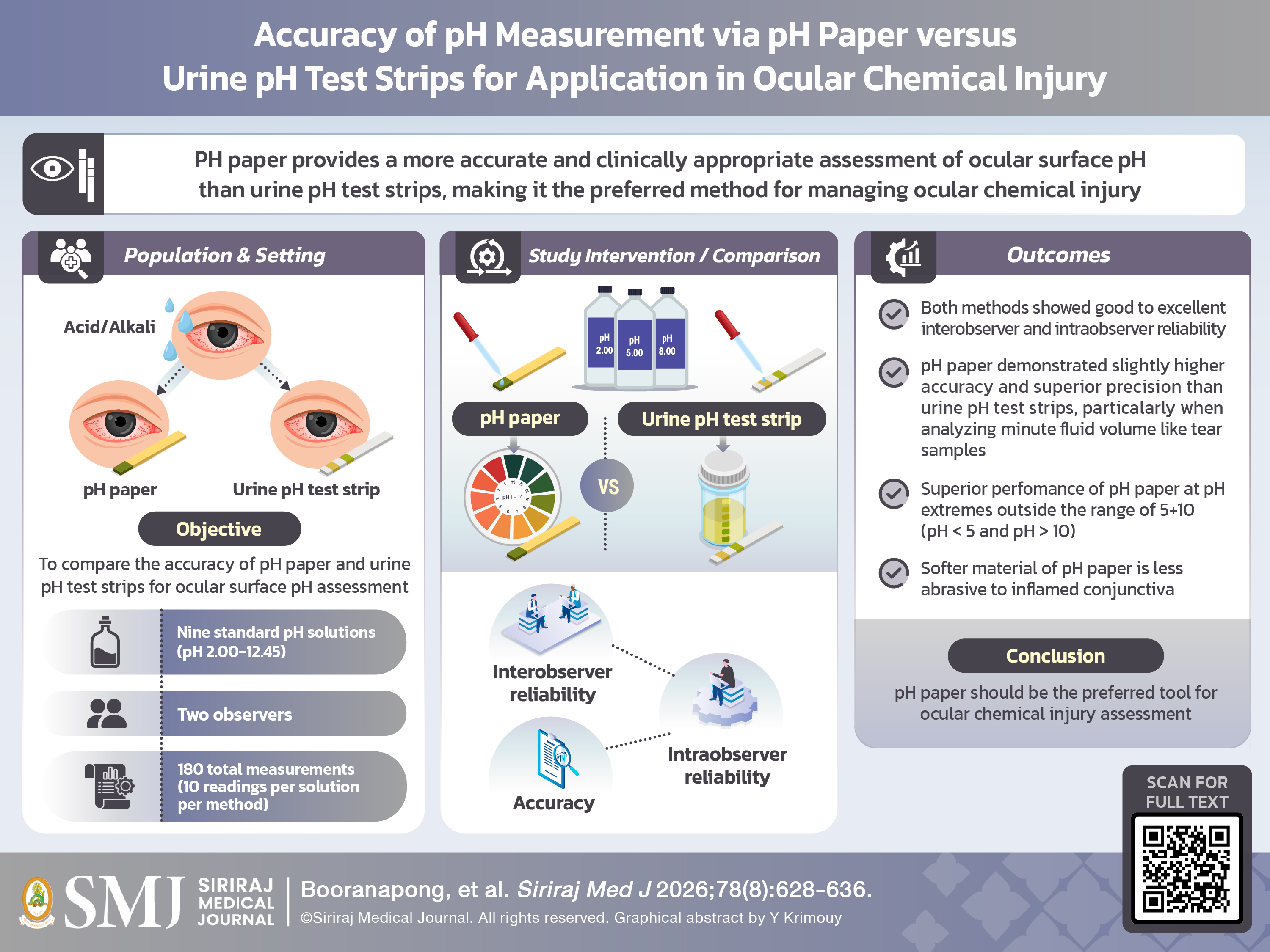
Objective: To evaluate and compare the accuracy of pH paper and urine pH test strips for ocular surface pH assessment in chemical eye injury settings.
Materials and Methods: Nine standard pH solutions (pH 2.00, 4.01, 5.00, 7.00, 8.00, 9.21, 10.00, 11.00, and 12.45) were measured by two observers. Each reference solution was measured 10 times using pH paper and 10 times via urine pH test strips, with each observer conducting five tests per method, resulting in a total of 180 measurements. Accuracy was defined as the percentage of measurements that matched the standard pH value.
Results: All the measurements exhibited good to excellent interobserver and intraobserver reliability. pH paper demonstrated slightly higher accuracy than urine pH test strips (pH paper: 44.4% [95% CI 34.6%–54.7%]; urine pH test strips: 37.8% [95% CI 28.5%–48.1%]). Bland–Altman analysis further indicated superior precision with pH paper measurements than those of the urine pH test strips (95% limits of agreement of -1.6 to +1.8 and -3.0 to +2.8, respectively), particularly at pH extremes outside the range of 5-10.
Conclusion: This study suggests that pH paper provides more accurate and reliable measurements than urine pH test strips across a wider pH range, particularly when analyzing minute fluid volumes like tear samples in cases of ocular chemical injury. Additionally, pH paper's soft texture is not just a matter of convenience but a safety advantage during acute trauma. Therefore, pH paper should be the preferred diagnostic tool for evaluating ocular chemical injury. However, clinical studies are needed to confirm these findings in real-world settings.
References
Quesada JM, Lloves JM, Delgado DV. Ocular chemical burns in the workplace: Epidemiological characteristics. Burns. 2020;46(5):1212-8.
Dua HS, Ting DSJ, Al Saadi A, Said DG. Chemical eye injury: pathophysiology, assessment and management. Eye. 2020;34(11):2001-19.
Spowart E, Pradhan S, Bruce C, Salvador-Culla B, Figueiredo G, Figueiredo FC. Outcomes in Acute Ocular Surface Chemical Injury-Role of pH Measurement on Presentation: A Retrospective Cohort Study. Ophthalmol Ther. 2025;14(8):1713-22.
Han, X. On Statistical Measures for Data Quality Evaluation. J Geogr Inf Syst. 2020;12(3):178-87.
Johnson KY, Lulich JP, Osborne CA. Evaluation of the reproducibility and accuracy of pH-determining devices used to measure urine pH in dogs. J Am Vet Med Assoc. 2007;230(3):364-9.
Lesho EP, Roth BJ. Is pH paper an acceptable, low-cost alternative to the blood gas analyzer for determining pleural fluid pH? Chest. 1997;112(5):1291-2.
Raskin RE, Murray KA, Levy JK. Comparison of home monitoring methods for feline urine pH measurement. Vet Clin Pathol. 2002;31(2):51-5.
Solana MJ, López-Herce J, Sánchez C, Cordero M, Urbano J, Botrán M, et al. Comparison of continuous pH-meter and intermittent pH paper monitoring of gastric pH in critically ill children. Eur J Gastroenterol Hepatol. 2012;24(1):33-6.
Metheny NA, Gunn EM, Rubbelke CS, Quillen TF, Ezekiel UR, Meert KL. Effect of pH Test-Strip Characteristics on Accuracy of Readings. Crit Care Nurse. 2017;37(3): 50-8.
De Coninck V, Keller EX, Rodríguez-Monsalve M, Doizi S, Audouin M, Haymann JP, et al. Evaluation of a Portable Urinary pH Meter and Reagent Strips. J Endourol. 2018;32(7):647-52.
Levine RL, Fromm RE Jr, Mojtahedzadeh M, Baghaie AA, Opekun AR Jr. Equivalence of litmus paper and intragastric pH probes for intragastric pH monitoring in the intensive care unit. Crit Care Med. 1994;22(6):945-8.
Song C-W, Kim H-K, Kim M-E. Clinical Usefulness of pH Papers in the Measurement of Salivary pH. J Oral Med Pain. 2015;40(3):124-9.
Mishima S, Gasset A, Klyce SD Jr, Baum JL. Determination of tear volume and tear flow. Invest Ophthalmol. 1966;5(3):264-76.
Monaghan MT, Brogan K, Lockington D, Rotchford AP, Ramaesh K. Variability in measuring pH using litmus paper and the relevance in ocular chemical injury. Eye. 2020;34(11):2133-4.
Connor AJ, Severn P. Use of a control test to aid pH assessment of chemical eye injuries. Emerg Med J. 2009;26(11):811-2.
Desai RA, Assimos DG. Accuracy of urinary dipstick testing for pH manipulation therapy. J Endourol. 2008;22(6):1367-70.
Published
How to Cite
License
Copyright (c) 2026 Siriraj Medical Journal

This work is licensed under a Creative Commons Attribution-NonCommercial-NoDerivatives 4.0 International License.
Authors who publish with this journal agree to the following conditions:
Copyright Transfer
In submitting a manuscript, the authors acknowledge that the work will become the copyrighted property of Siriraj Medical Journal upon publication.
License
Articles are licensed under a Creative Commons Attribution-NonCommercial-NoDerivatives 4.0 International License (CC BY-NC-ND 4.0). This license allows for the sharing of the work for non-commercial purposes with proper attribution to the authors and the journal. However, it does not permit modifications or the creation of derivative works.
Sharing and Access
Authors are encouraged to share their article on their personal or institutional websites and through other non-commercial platforms. Doing so can increase readership and citations.