The Effect of Sit-To-Stand and Heel-Raise Exercises on Dynamic Balance Function in Sedentary Male Adolescents
DOI:
https://doi.org/10.33192/smj.v78i9.282055Keywords:
adolescents, sedentary lifestyle, sit-to-stand, heel-raise, dynamic balanceAbstract
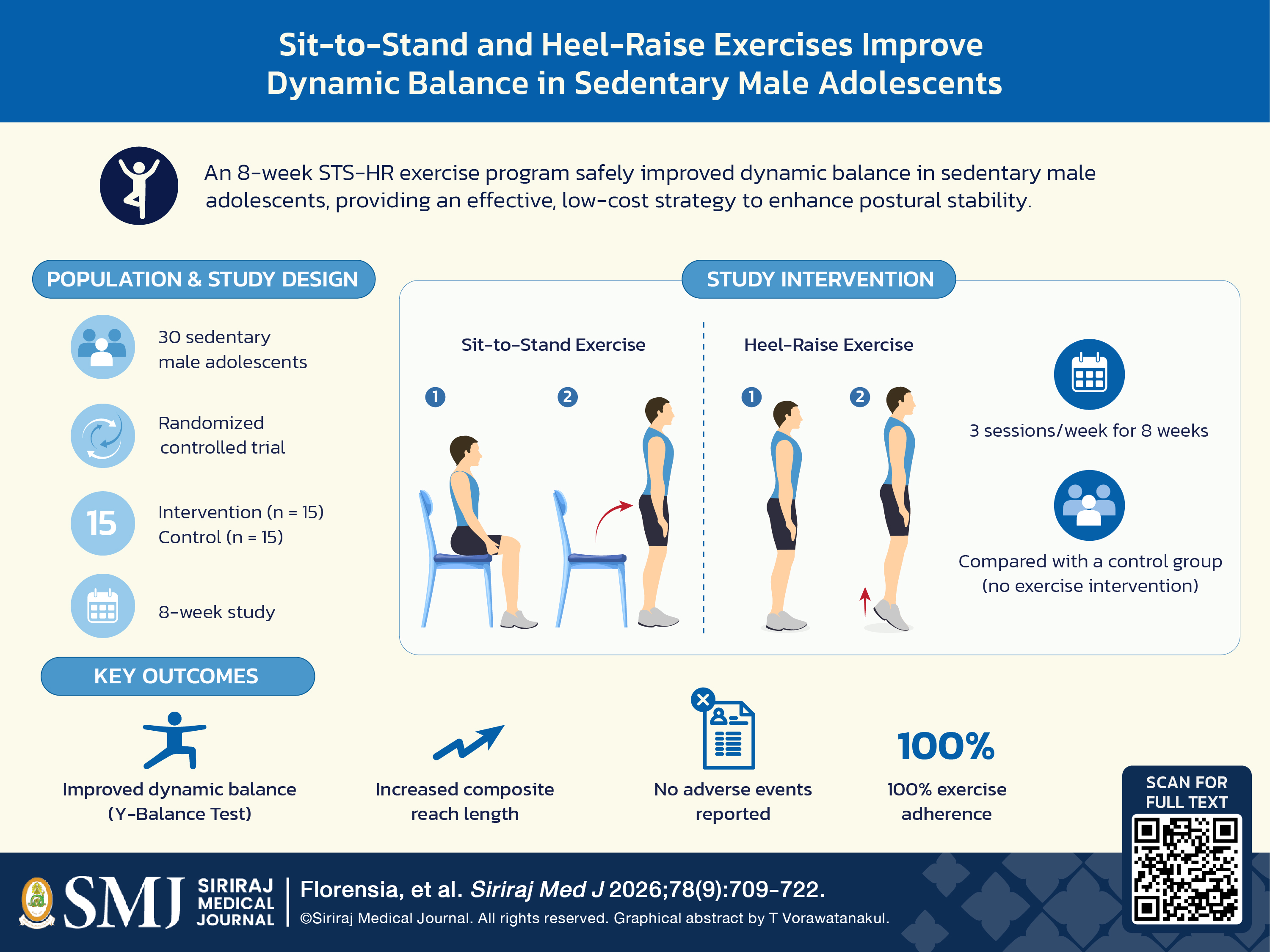
Objective: To evaluate the effect of combined sit-to-stand and heel-raise (STS-HR) exercises on dynamic balance function in sedentary male adolescents.
Materials and Methods: A randomized controlled trial with a pretest–posttest design was conducted involving 30 sedentary male adolescents, randomly allocated into a control group (n = 15) and an intervention group (n = 15). The intervention group performed STS-HR exercises three times per week for 8 weeks. Dynamic balance was assessed using the Y-Balance Test (YBT), with composite reach length (CRL) of both limbs as the primary outcome.
Results: No significant changes were observed in the control group across all YBT directions (p > 0.05). In contrast, the intervention group demonstrated significant improvements in anterior, posterolateral, and posteromedial reach directions, as well as CRL values for both limbs (p < 0.001). After adjustment for baseline bilateral composite score and caloric intake, the bilateral mean composite Y-Balance Test score at week 8 was 12.4 percentage points higher in the STS-HR group than in the control group (95% CI 8.6–16.1; p < 0.001; partial η² = 0.642).
Conclusion: Among sedentary male adolescents, the 8-week STS-HR program improved week-8 Y-Balance Test performance compared with the control condition. The clinical importance and longer-term functional implications of this improvement remain uncertain.
References
Patton GC, Sawyer SM, Santelli JS, Ross DA, Afifi R, Allen NB, et al. Our future: a Lancet commission on adolescent health and wellbeing. Lancet. 2016;387(10036):2423–78.
WHO. Global accelerated action for the health of adolescents (AA-HA!): guidance to support country implementation. Geneva; 2017.
van Sluijs EMF, Ekelund U, Crochemore-Silva I, Guthold R, Ha A, Lubans D, et al. Physical activity behaviours in adolescence: current evidence and opportunities for intervention. Lancet. 2021;398(10298):429–42.
WHO. Guidelines on physical activity and sedentary behaviour. Geneva; 2020.
WHO. Global action plan on physical activity 2018–2030: more active people for a healthier world. Geneva; 2018.
Barnett LM, Lai SK, Veldman SLC, Hardy LL, Cliff DP, Morgan PJ, et al. Correlates of Gross Motor Competence in Children and Adolescents: A Systematic Review and Meta-Analysis. Sports Medicine. 2016;46(11):1663–88.
Stodden DF, Goodway JD, Langendorfer SJ, Roberton MA, Rudisill ME, Garcia C, et al. A Developmental Perspective on the Role of Motor Skill Competence in Physical Activity: An Emergent Relationship. Quest. 2008;60(2):290–306.
Schwiertz G, Brueckner D, Schedler S, Kiss R, Muehlbauer T. Performance and reliability of the Lower Quarter Y Balance Test in healthy adolescents from grade 6 to 11. Gait Posture. 2019;67:142–6.
Balzanelli C, Spataro D, Redaelli de Zinis LO. Prevalence of Pediatric and Adolescent Balance Disorders: Analysis of a Mono-Institutional Series of 472 Patients. Children. 2021;8(11):1056.
Vongsirinavarat M, Kraiwong R. Falls among Older Adults with Type 2 Diabetes Mellitus with Peripheral Neuropathy. Siriraj Med J. 2021;72(2):92–8.
Yin L, Qin J, Chen Y, Xie J, Hong C, Huang J, et al. Impact of Body Mass Index on Static Postural Control in Adults With and Without Diabetes: A Cross-Sectional Study. Front Endocrinol (Lausanne). 2021;12:768185.
Marijančić V, Kezele TG, Peharec S, Dragaš-Zubalj N, Pavičić Žeželj S, Starčević-Klasan G. Relationship between Physical Activity and Sedentary Behavior, Spinal Curvatures, Endurance and Balance of the Trunk Muscles-Extended Physical Health Analysis in Young Adults. Int J Environ Res Public Health. 2023;20(20):6938.
Faigenbaum AD, Stracciolini A, Myer GD. Exercise deficit disorder in youth: a hidden truth. Acta Paediatr. 2011 Nov;100(11):1423–5; discussion 1425.
Lizama-Pérez R, Chirosa-Ríos LJ, Contreras-Díaz G, Jerez-Mayorga D, Jiménez-Lupión D, Chirosa-Ríos IJ. Effect of sit-to-stand-based training on muscle quality in sedentary adults: a randomized controlled trial. PeerJ. 2023;11:e15665.
Jones CJ, Rikli RE, Beam WC. A 30-s chair-stand test as a measure of lower body strength in community-residing older adults. Res Q Exerc Sport. 1999;70(2):113–9.
Chaiwan P, Srisawasdi G, Prachgosin P, Aekwattanaphol P, Jirapongpathai N. Effects of Exercise Through Telerehabilitation on Balance and Walking Speed in Older Adults with Diabetic Peripheral Neuropathy: A Randomized Controlled Trial. Siriraj Med J. 2025;77(6):403–10.
Chaovalit S, Taylor NF, Dodd KJ. Sit-to-stand exercise programs improve sit-to-stand performance in people with physical impairments due to health conditions: a systematic review and meta-analysis. Disabil Rehabil. 2020;42(9):1202–11.
Fujiwara K, Toyama H, Asai H, Yaguchi C, Irei M, Naka M, et al. Effects of regular heel-raise training aimed at the soleus muscle on dynamic balance associated with arm movement in elderly women. J Strength Cond Res. 2011;25(9):2605–15.
Pavão SL, Dos Santos AN, Cicuto Ferreira Rocha NA. Sex and age influence on postural sway during sit-to-stand movement in children and adolescents: Cross-sectional study. Int J Dev Neurosci. 2021;81(6):520–8.
Schedler S, Graf SM, Muehlbauer T. Effects of Different Balance Training Volumes on Children’s Dynamic Balance. Sports Med Int Open. 2022;6(01):E32–8.
Tepa W, Lertwanich P, Chuensiri N. Effects of Supervised Plyometric Training on Neuromuscular and Knee Functions for Late Phase Rehabilitation Program in Patients with Anterior Cruciate Ligament Reconstruction: A Randomized Controlled Trial. Siriraj Med J. 2024;76(6):353–65.
Hoch MC, Welsch LA, Hartley EM, Powden CJ, Hoch JM. Y-Balance Test Performance After a Competitive Field Hockey Season: A Pretest-Posttest Study. J Sport Rehabil. 2017;26(5).
Lowe L, Castillo F, Gokun Y, Williams DK, Israel M, Yates C. Static and Dynamic Balance Assessment in Healthy and Concussed Adolescent Athletes. Clin J Sport Med. 2022;32(4):385–90.
Muehlbauer T, Grundmann A, Vortkamp L, Schedler S. Effect of balance training on static and dynamic balance performance in male adolescents: role of training frequency. BMC Res Notes. 2022;15(1):365.
Linek P, Sikora D, Wolny T, Saulicz E. Reliability and number of trials of Y Balance Test in adolescent athletes. Musculoskelet Sci Pract. 2017;31:72–5.
Borgmann K, Brinkmann R, Bauer J, Hill MW, Muehlbauer T. Effect of Lower Limb Muscle Fatigue on Dynamic Balance Performance in Healthy Young Adults: Role of Arm Movement. Sports Med Int Open. 2024;8:a23462759.
Ortega FB, Artero EG, Ruiz JR, España-Romero V, Jiménez-Pavón D, Vicente-Rodriguez G, et al. Physical fitness levels among European adolescents: the HELENA study. Br J Sports Med. 2011;45(1):20–9.
Published
How to Cite
Issue
Section
Categories
License
Copyright (c) 2026 Siriraj Medical Journal

This work is licensed under a Creative Commons Attribution-NonCommercial-NoDerivatives 4.0 International License.
Authors who publish with this journal agree to the following conditions:
Copyright Transfer
In submitting a manuscript, the authors acknowledge that the work will become the copyrighted property of Siriraj Medical Journal upon publication.
License
Articles are licensed under a Creative Commons Attribution-NonCommercial-NoDerivatives 4.0 International License (CC BY-NC-ND 4.0). This license allows for the sharing of the work for non-commercial purposes with proper attribution to the authors and the journal. However, it does not permit modifications or the creation of derivative works.
Sharing and Access
Authors are encouraged to share their article on their personal or institutional websites and through other non-commercial platforms. Doing so can increase readership and citations.