
Design and Validation of a Low-Cost IoT-Based Medical Gas Monitoring System for Hospital Storage Rooms
DOI:
https://doi.org/10.33192/smj.v78i9.282246Keywords:
medical gas systems, carbon dioxide, internet of things, low-cost sensorAbstract
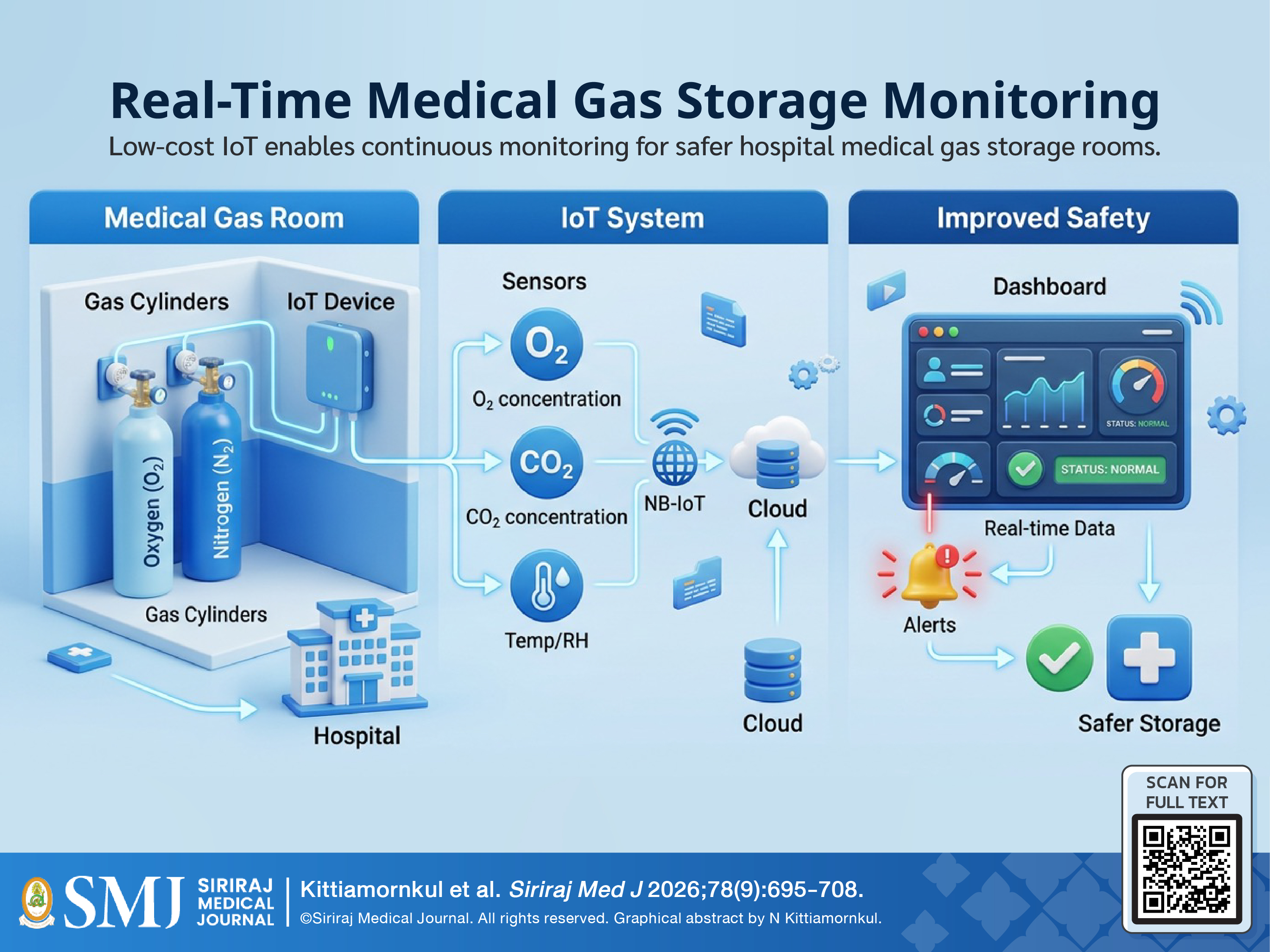
Objective: This study aimed to develop and evaluate a low-cost medical gas monitoring system to enhance safety in hospital gas storage rooms. Continuous monitoring of oxygen and carbon dioxide levels may help identify oxygendeficient or oxygen-enriched conditions and elevated carbon dioxide concentrations that may pose occupational safety risks to healthcare personnel.
Materials and Methods: An Internet of Things (IoT)-based device was developed to monitor medical gases and environmental conditions, including oxygen, carbon dioxide, temperature, and relative humidity. The system enables real-time monitoring and online data visualization. Sensor performance was validated against standard reference equipment.
Results: The developed system demonstrated normalized root mean square differences (nRMSD) of 15.47%, 0.085%, 4.80%, and 5.39% for carbon dioxide, oxygen, temperature, and relative humidity, respectively, under ambient environmental conditions. The corresponding normalized mean bias differences (nMBD) were -9.70%, 0.283%, 2.54%, and -3.00%, respectively. However, validation was conducted over a narrow ambient concentration range and did not include controlled gas concentrations near the predefined alarm thresholds. Therefore, these results represent preliminary measurement agreement under ambient conditions and do not establish alarm performance or safety-monitoring performance across the intended decision range.
Conclusion: The proposed low-cost monitoring system (approximately USD 255) enables continuous real-time monitoring of oxygen, carbon dioxide, temperature, and relative humidity under ambient environmental conditions. The system may support environmental monitoring and improve occupational safety in hospital medical gas storage areas.
References
Azuma K, Kagi N, Yanagi U, Osawa H. Effects of low-level inhalation exposure to carbon dioxide in indoor environments: a short review on human health and psychomotor performance. Environ Int. 2018;121 (Pt1):51-56.
Satish U, Mendell MJ, Shekhar K, Hotchi T, Sullivan D, Streufert S, Fisk WJ. Is CO2 an indoor pollutant? Direct effects of low-to-moderate CO2 concentrations on human decision-making performance. Environ Health Perspect. 2012;120(12):1671-7.
Divine T. Basics of NFPA 99 changes for hospital design: how engineers should navigate the changes to the 2018 edition of NFPA 99. Consult Specif Eng. 2020;57(5):10+.
Cherdchoo-ngarm P, Kolladaruengkri T, Chomchai S, Pisalsarakij D, Amornrat A, Deechoo T. Measurement of ethylene oxide gas and calculation of a safe period for contact at the medical sterilization unit in Siriraj Hospital. Siriraj Med J. 2004;56(3):129-34.
Clark JM, Lambertsen CJ. Pulmonary oxygen toxicity: a review. Pharmacol Rev.
;23(2):37-133.
McArdle WD, Katch FI, Katch VL. Essentials of exercise physiology. 5th ed. Philadelphia: Wolters Kluwer; 2019.
Kwon J, Ahn G, Kim G, Kim JC, Kim H. A study on NDIR-based CO2 sensor to apply remote air quality monitoring system. In: Proceedings of the 2009 ICCAS-SICE; 2009 Aug; Fukuoka, Japan. p. 1683-7.
Santonico M, Pennazza G, Parente FR, Grasso S, Zompanti A, Stornelli V, et al. A gas sensor device for oxygen and carbon dioxide detection. Proceedings. 2017;1:447.
Brown SL, Goulsbra CS, Evans MG, Heath T, Shuttleworth E. Low cost CO2 sensing: a simple microcontroller approach with calibration and field use. HardwareX. 2020;8:e00136.
Yasuda T, Yonemura S, Tani A. Comparison of the characteristics of small commercial NDIR CO2 sensor models and development of a portable CO2 measurement device. Sensors. 2012;12:3641-55.
Sribudda S, Harnpicharnchai K, Nankongnab N, Thongkum W. Development of a hospital air quality monitoring application utilizing IoT technology and Google Workspace: A case study of a hospital in Mahasarakham, Thailand. Stud Health Technol Inform. 2026;338:409-13.
Reindl DT, Beckman WA, Duffie JA. Evaluation of hourly tilted surface radiation models. Sol Energy. 1990;45(1):9-17. doi:10.1016/0038-092X(90)90061-G
Araújo T, Silva L, Aguiar A, Moreira A. Calibration assessment of low-cost carbon
dioxide sensors using the extremely randomized trees algorithm. Sensors. 2023;23(13):6153.
Rajagopal S, Lyngdoh DC, Anathapadmanabhan UK, Soangra R, Vasan N. IoT-enabled solutions for environmental monitoring in hospitals. Open Biomed Eng J. 2023;17.
Comcube Co., Ltd. Extech Instruments CO260 CO2/CO data logger [Internet]. Bangkok: Comcube Co., Ltd.; [cited 2026 Apr 10]. Available from: https://www.comcube.co.th/product/co260/.
Henan Yuante Technology Co., Ltd. Sky2000 multi-gas detector [Internet]. Zhengzhou: Henan Yuante Technology Co., Ltd.; [cited 2026 Apr 10]. Available from: https://yuante.en.made-in-china.com/product/PSXxCKFVMwpa/China-CO2- Co-O2-Nh3-Multi-Gas-Detector-for-Chicken-House.html.
Advanced Energy. Innova 1314i highly accurate, stable, quantitative, and remotely controllable gas monitoring system [Internet]. Denver (CO): Advanced Energy Industries, Inc.; [cited 2026 Apr 10]. Available from: https://emin.com.mm/advancedinnova1314i-advanced-energy-innova-1314i-gas-monitor-60cm3-60954/pr.html.
Published
How to Cite
Issue
Section
Categories
License
Copyright (c) 2026 Siriraj Medical Journal

This work is licensed under a Creative Commons Attribution-NonCommercial-NoDerivatives 4.0 International License.
Authors who publish with this journal agree to the following conditions:
Copyright Transfer
In submitting a manuscript, the authors acknowledge that the work will become the copyrighted property of Siriraj Medical Journal upon publication.
License
Articles are licensed under a Creative Commons Attribution-NonCommercial-NoDerivatives 4.0 International License (CC BY-NC-ND 4.0). This license allows for the sharing of the work for non-commercial purposes with proper attribution to the authors and the journal. However, it does not permit modifications or the creation of derivative works.
Sharing and Access
Authors are encouraged to share their article on their personal or institutional websites and through other non-commercial platforms. Doing so can increase readership and citations.