A Randomized Comparison among 0.67 μg/kg, 1 μg/ kg and 1.33 μg/kg of Perineural Dexmedetomidine for Ultrasound-guided Infraclavicular Block
DOI:
https://doi.org/10.33192/smj.v78i10.283472Keywords:
dexmedetomidine, brachial plexus blockAbstract
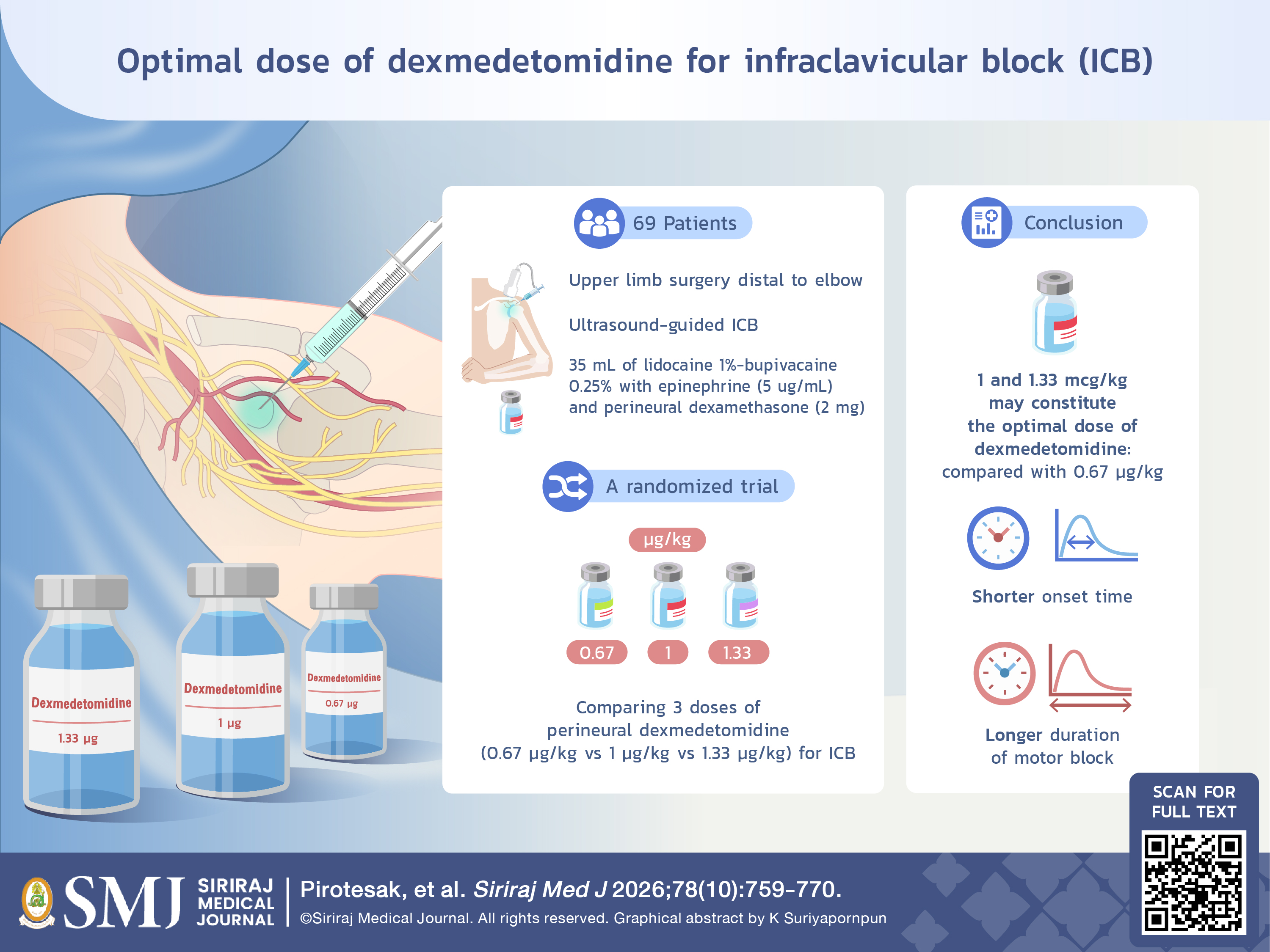
Objective: This randomized trial compared three doses of perineural dexmedetomidine for ultrasound-guided infraclavicular block: 0.67 μg/kg (D1), 1 μg/kg (D2), and 1.33 μg/kg (D3), using an identical admixture of 35 mL of lidocaine 1%- bupivacaine 0.25%- epinephrine 5 μg/mL- perineural dexamethasone (2 mg). We hypothesized a stepwise 15% increase in motor block duration from D1 to D2 to D3.
Materials and Methods: Sixty-nine subjects were randomized to three dexmedetomidine doses. The primary outcome was motor block duration. Secondary outcomes included block onset, surgical anesthesia, analgesia and sensory block duration, and dexmedetomidine-related adverse events.
Results: Motor block duration was longer with D2 and D3 than D1 by omnibus ANOVA/post-hoc testing [18.6 (3.8) vs. 15.8 (3.8) hours, P = 0.028; and 18.6 (4.2) vs. 15.8 (3.8) hours, P = 0.027, respectively]. However, Kaplan-Meier log-rank analysis showed no intergroup difference (P = 0.078). No other differences were observed in sensorimotor block or analgesia duration. Onset was shorter with D2 and D3 than D1 (15 [15-20] vs. 20 [20-25] minutes; P = 0.012; and 15 [15-20] vs. 20 [20-25] minutes; P = 0.007, respectively), with no difference between D2 and D3. Surgical anesthesia and adverse event rates were similar.
Conclusion: With this ICB regimen, 1 and 1.33 μg/kg dexmedetomidine may statistically prolong motor block and shorten onset compared with 0.67 μg/kg. Given inconsistent statistical findings and the secondary outcome of onset, these results are exploratory. Further studies should examine perineural dexmedetomidine for other local anesthetic molecules, injectates, and doses greater than 1.33 μg/kg.
References
Aliste J, Layera S, Bravo D, Aguilera G, Erpel H, García A, et al. Randomized comparison between perineural dexamethasone and combined dexamethasone- dexmedetomidine for ultrasound-guided infraclavicular block. Reg Anesth Pain Med. 2022;47:554-9.
Bravo D, Aliste J, Layera S, Fernández D, Leurcharusmee P, Samerchua A, et al. A multicenter, randomized comparison between 2, 5, and 8 mg of perineural dexamethasone for ultrasound-guided infraclavicular block. Reg Anesth Pain Med. 2019;44:46-51.
Shaika S, Singh J, Ghimire A, Shrestha B. Supraclavicular brachial plexus block: Comparison of varying doses of dexmedetomidine with ropivacaine. Kathmandu Unive Med J (KMUJ). 2021;19:345-50.
Ghazaly HF, Aly AAA, Zaher ZZ, Hassan MM, Mahmoud AA. Comparison of the efficacy of two doses of dexmedetomidine as an adjunct to levobupivacaine in infraclavicular brachial plexus block: Prospective double blinded randomized controlled trial. BMC Anesthesiol. 2022;22(1):338.
Akshara P, Govindan DK, Govindasamy J, Arif M, Sethuraman RM. Comparing different doses of dexmedetomidine combined with ropivacaine for ultrasound-guided supraclavicular brachial plexus block for upper limb surgeries: A prospective randomized controlled trial. Anesth Essays Res. 2022;16:94-7.
Casati A, Danelli G, Baciarello M, Corradi M, Leone S, Di Cianni S, et al. A prospective, randomized comparison between ultrasound and nerve stimulation guidance for multiple injection axillary brachial plexus block. Anesthesiology. 2007;106:992-6.
Konrad C, Schupfer G, Wietlisbach M, Gerber H. Learning manual skills in Anesthesiology: Is there a recommended number of cases for anesthetic procedures? Anesth Analg. 1998; 86: 635-9.
Tran DQ, Dugani S, Diachenko A, Correa JA, Finlayson RJ. Minimum effective volume of lidocaine for ultrasound-guided infraclavicular block. Reg Anesth Pain Med. 2011;36:190-4.
Samerchua A, Supphapipat K, Leurcharusmee P, Moolsan S, Promfang P, Finlayson RJ, et al. Perineural dexmedetomidine decreases the onset time of bupivacaine 0.5%- epinephrine- dexamethasone for infraclavicular block: A randomized controlled trial. Reg Anesth Pain Med. 2026; Jun 2:rapm-2026-107917. doi: 10.1136/rapm-2026-107917. Online ahead of print.
Jung HS, Seo HK, Kang JH, Jeong JY, Kim YS, Han NR. Optimal dose of perineural dexmedetomidine for interscalene brachial plexus block to control postoperative pain in patients undergoing arthroscopic shoulder surgery: A prospective, double-blind, randomized controlled study. Medicine (Baltimore). 2018;97:e0440.
Published
How to Cite
License
Copyright (c) 2026 Siriraj Medical Journal

This work is licensed under a Creative Commons Attribution-NonCommercial-NoDerivatives 4.0 International License.
Authors who publish with this journal agree to the following conditions:
Copyright Transfer
In submitting a manuscript, the authors acknowledge that the work will become the copyrighted property of Siriraj Medical Journal upon publication.
License
Articles are licensed under a Creative Commons Attribution-NonCommercial-NoDerivatives 4.0 International License (CC BY-NC-ND 4.0). This license allows for the sharing of the work for non-commercial purposes with proper attribution to the authors and the journal. However, it does not permit modifications or the creation of derivative works.
Sharing and Access
Authors are encouraged to share their article on their personal or institutional websites and through other non-commercial platforms. Doing so can increase readership and citations.