
Supercharged Colonic Interposition for Total Oesophageal Reconstruction: Technical Refinements, Perioperative Protocol, and Functional Outcomes
DOI:
https://doi.org/10.33192/smj.v78i10.284353Keywords:
oesophageal reconstruction, colonic interposition, supercharged flap, microvascular augmentation, visceral reconstruction, swallowing functionAbstract
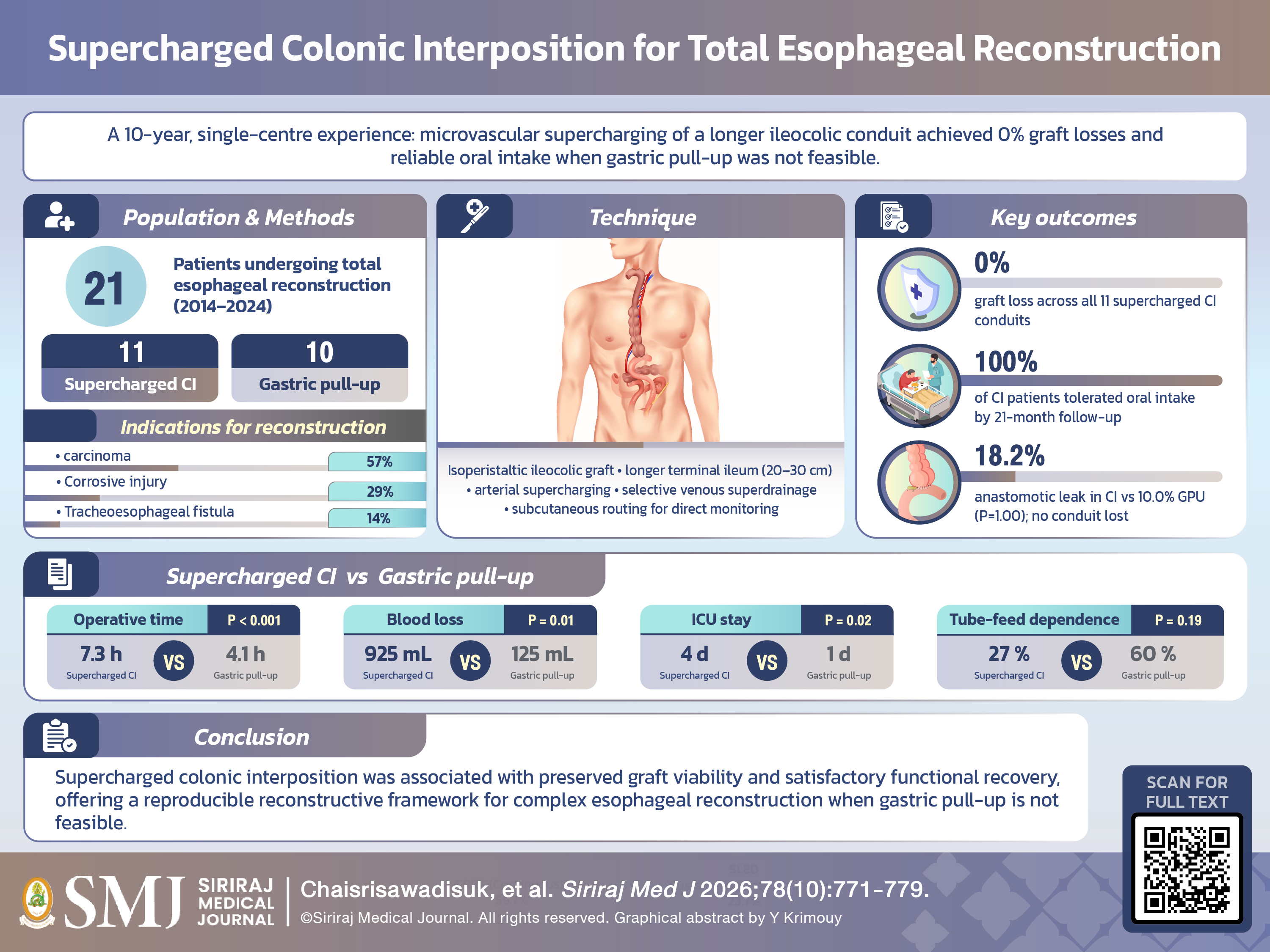
Objective: We report a 10-year experience with supercharged colonic interposition (CI) for total oesophageal reconstruction, focusing on technical refinements and functional outcomes.
Materials and Methods: A retrospective review of patients undergoing total oesophageal reconstruction (2014–2024) was conducted. A modified, supercharged CI was performed using a longer terminal ileal segment of 20–30 cm. Conduits were routed subcutaneously, and arterial supercharging—usually to the transverse cervical artery—was performed selectively. When congestion persisted, venous superdrainage was additionally implemented. Outcomes were compared with a contemporaneous gastric pull-up (GPU) cohort.
Results: Twenty-one patients underwent reconstruction (11 CI, 10 GPU). No graft failures occurred after supercharged CI. Anastomotic leakage occurred in 18.2% of CI and 10.0% of GPU patients (P=1.00) and was managed without conduit loss. Stricture was more frequent after CI (36.4% vs. 10.0%, P=0.31) and was successfully treated endoscopically. At a median follow-up of 21 months, all CI patients tolerated oral intake (45.5% solid, 45.5% soft diet); feeding tube dependence was 27.3% after CI vs. 60.0% after GPU (P=0.19).
Conclusions: Supercharged colonic interposition was associated with preserved graft viability and satisfactory functional recovery in patients requiring complex total oesophageal reconstruction. A defined selection algorithm, standardised technique, subcutaneous routing, and structured perioperative care offer a reproducible framework for complex oesophageal reconstruction when gastric pull-up is not feasible.
References
Markar S, Gronnier C, Duhamel A, Bigourdan JM, Badic B, du Rieu MC, et al. Pattern of postoperative mortality after esophageal cancer resection according to center volume: results from a large European multicenter study. Ann Surg Oncol. 2015;22(8):2615-23.
Abdel-Latif MM, O'Riordan J, Windle HJ, Carton E, Ravi N, Kelleher D, et al. NF-κB activation in esophageal adenocarcinoma: relationship to Barrett's metaplasia, survival, and response to neoadjuvant chemoradiotherapy. Ann Surg. 2004;239(4):491-500.
Orringer MB, Marshall B, Chang AC, Lee J, Pickens A, Lau CL. Two thousand transhiatal esophagectomies: changing trends, lessons learned. Ann Surg. 2007;246(3):363-74.
Irino T, Tsekrekos A, Coppola A, Scandavini CM, Shetye A, Lundell L, et al. Long-term functional outcomes after replacement of the esophagus with gastric, colonic, or jejunal conduits: a systematic literature review. Dis Esophagus. 2017;30(12):1-11.
Hamai Y, Hihara J, Emi M, Aoki Y, Okada M. Esophageal reconstruction using the terminal ileum and right colon in esophageal cancer surgery. Surg Today. 2012;42(4):342-50.
O'Rourke IC, Threlfall GN. Colonic interposition for oesophageal reconstruction with special reference to microvascular reinforcement of graft circulation. Aust N Z J Surg. 1986;56(10):767-71.
Shirakawa Y, Naomoto Y, Noma K, Sakurama K, Nishikawa T, Nobuhisa T, et al. Colonic interposition and supercharge for esophageal reconstruction. Langenbecks Arch Surg. 2006;391(1):19-23.
Marchi F, Kang SC, Cheong DCF, Hung SY, Wang SH, Chiu TH, et al. The benefits of the supercharged ileocolic flap in patients who underwent total esophagectomy and gastrectomy. J Reconstr Microsurg. 2021;37(6):475-85.
Mays AC, Yu P, Hofstetter W, Liu J, Xue A, Klebuc M, et al. The supercharged pedicled jejunal flap for total esophageal reconstruction: a retrospective review of 100 cases. Plast Reconstr Surg. 2019;144(5):1171-80.
Barzin A, Norton JA, Whyte R, Lee GK. Supercharged jejunum flap for total esophageal reconstruction: single-surgeon 3-year experience and outcomes analysis. Plast Reconstr Surg. 2011;127(1):173-80.
Chen HC, Tang YB, eds. Microsurgical reconstruction of the esophagus. Semin Surg Oncol. 2000; Wiley Online Library.
Greene CL, DeMeester SR, Augustin F, Worrell SG, Oh DS, Hagen JA, et al. Long-term quality of life and alimentary satisfaction after esophagectomy with colon interposition. Ann Thorac Surg. 2014;98(5):1713-20.
Awsakulsutthi S. Result of esophageal reconstruction using supercharged interposition colon in corrosive and Boehave's injury: Thammasat University Hospital experience. J Med Assoc Thai. 2010 Dec;93 Suppl 7:S303-6.
Chung JH, Lee SH, Yi E, Jung JS, Han JW, Kim TS, et al. A non-randomized retrospective observational study on the subcutaneous esophageal reconstruction after esophagectomy: is it feasible in high-risk patients? J Thorac Dis. 2017;9(3):675.
Blonk L, Gooszen J, Fakkert R, Eshuis WJ, Rietveld SCM, Wierdsma NJ, et al. Micronutrient deficiencies and anemia in the follow-up after gastroesophageal cancer surgery. Dis Esophagus. 2024;37(11):doae053.
Gonggetyai G, Techalertsuwan N, Nampoolsuksan C, Parakonthun T, Swangsri J, Methasate A, et al. Frailty and Upper Gastrointestinal Surgery: Initial Findings from Thailand’s First Surgical Frailty Study. Siriraj Med J [Internet]. 2025 Aug. 1 [cited 2026 Sep. 12];77(8):574-82.
Published
How to Cite
License
Copyright (c) 2026 Siriraj Medical Journal

This work is licensed under a Creative Commons Attribution-NonCommercial-NoDerivatives 4.0 International License.
Authors who publish with this journal agree to the following conditions:
Copyright Transfer
In submitting a manuscript, the authors acknowledge that the work will become the copyrighted property of Siriraj Medical Journal upon publication.
License
Articles are licensed under a Creative Commons Attribution-NonCommercial-NoDerivatives 4.0 International License (CC BY-NC-ND 4.0). This license allows for the sharing of the work for non-commercial purposes with proper attribution to the authors and the journal. However, it does not permit modifications or the creation of derivative works.
Sharing and Access
Authors are encouraged to share their article on their personal or institutional websites and through other non-commercial platforms. Doing so can increase readership and citations.