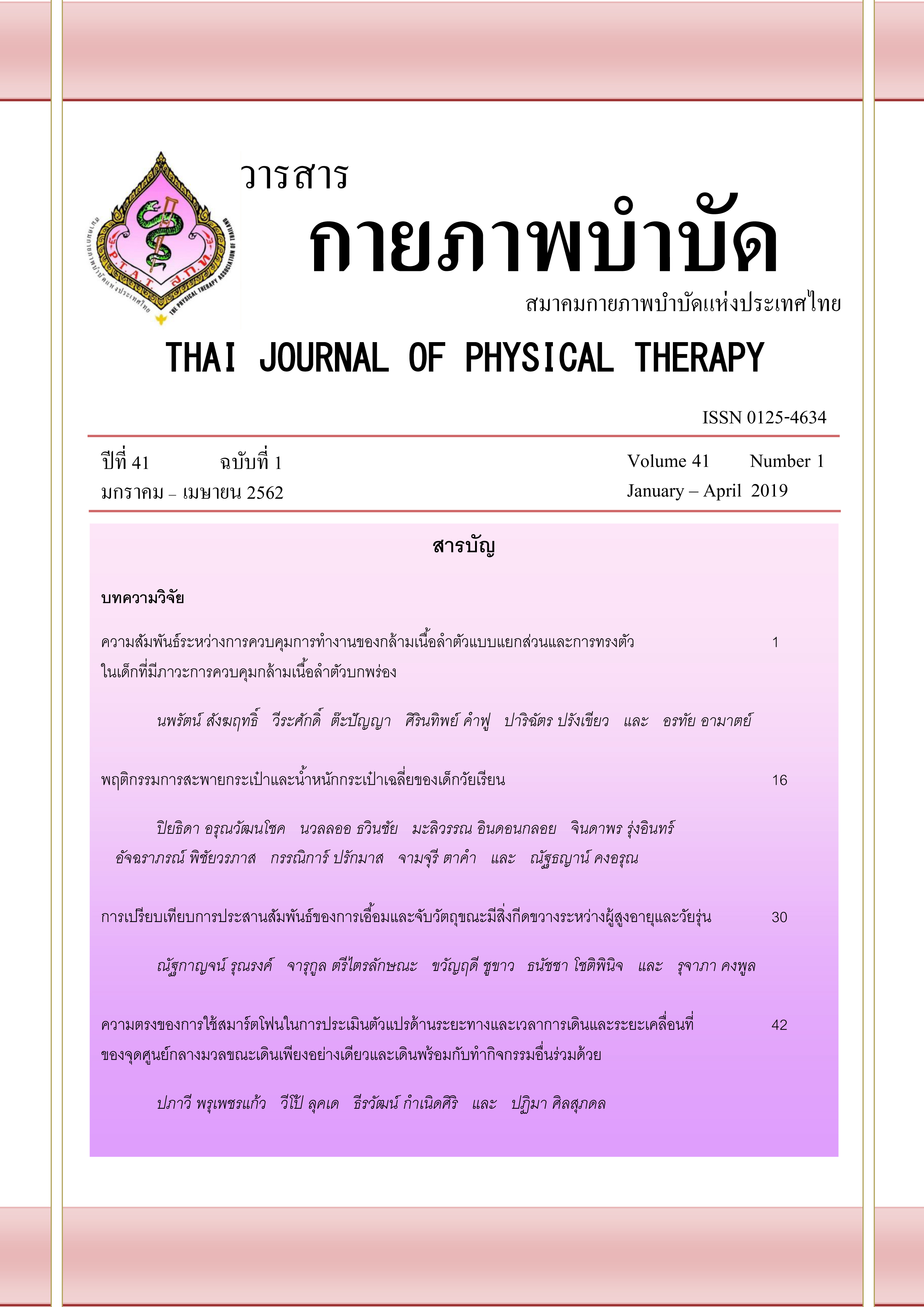
ความสัมพันธ์ระหว่างการควบคุมการทำงานของกล้ามเนื้อลำตัวแบบแยกส่วนและการทรงตัวในเด็กที่มีภาวะการควบคุมกล้ามเนื้อลำตัวบกพร่อง
Article Sidebar
Main Article Content
บทคัดย่อ
ที่มาและความสำคัญ: เด็กที่มีการควบคุมกล้ามเนื้อลำตัวบกพร่องที่จำกัดการทำงานของร่างกายส่งผลให้เรียนรู้การทรงท่าในแนวตั้งตรงล่าช้า ซึ่งอาจส่งผลกระทบต่อความล่าช้าของการทรงท่าในเด็ก จึงควรศึกษาความสัมพันธ์ระหว่างความสามารถในการควบคุมกล้ามเนื้อลำตัวและการทรงตัว ที่อาจเป็นปัจจัยเพิ่มการทรงตัวในเด็กที่มีการควบคุมกล้ามเนื้อลำตัวบกพร่องได้
วัตถุประสงค์: เพื่อศึกษาความสัมพันธ์ระหว่างระดับการควบคุมกล้ามเนื้อลำตัวโดย Segmental Assessment of Trunk Control (SATCo) กับการทรงตัวโดย Pediatrics Balance Scale (PBS) ในอาสา สมัครเด็กที่มีการควบคุมกล้ามเนื้อลำตัวบกพร่อง ที่ศูนย์การศึกษาพิเศษประจำจังหวัดพะเยาและประจำจังหวัดลำปาง อายุ 5-14 ปี จำนวน 21 ราย
วิธีการวิจัย: อาสาสมัครเด็กที่มีการควบคุมกล้ามเนื้อลำตัวบกพร่องทุกราย (ชาย 15 ราย หญิง 6 ราย) ได้รับการทดสอบการควบคุมกล้ามเนื้อลำตัวด้วยการประเมิน SATCo และทดสอบการทรงตัวในเด็กด้วย PBS ใช้สถิติ Spearman's rank correlation coefficient เพื่อหาความสัมพันธ์ของตัวแปรที่ต้องการศึกษาโดยกำหนดระดับนัยสำคัญทางสถิติที่ p < 0.05
ผลการวิจัย: พบว่าเด็กที่มีการควบคุมกล้ามเนื้อลำตัวบกพร่องที่ระดับ total SATCo มีความสัมพันธ์กับการทรงตัวกับการยกแขนขนานพื้นและเอนตัวไปข้างหน้า (reaching forward with outstretched arm) ในเชิงลบระดับพอใช้ (r=-0.440, p=0.046) ส่วนการควบคุมกล้ามเนื้อลำตัวบกพร่องด้วย SATCo ที่สภาวะ static เมื่อถูกประเมินการทรงตัวโดย PBS มีความสัมพันธ์กับหัวข้อการยืน 30 วินาทีโดยไม่ยึดเกาะ (standing unsupported) มีความสัมพันธ์เชิงบวกในระดับปานกลางถึงดี (r=0.578, p=0.006) และหัวข้อวางเท้าต่อเท้า (standing with one foot in front) มีความสัมพันธ์เชิงลบในระดับพอใช้ (r=-0.433, p=0.050) และการควบคุมกล้ามเนื้อลำตัวบกพร่องของ SATCo ที่สภาวะ total static และactive มีความสัมพันธ์กับ PBS หัวข้อการยืนนิ่งหลับตา (standing with eyes closed) มีความสัมพันธ์เชิงบวกในระดับปานกลาง (r=0.595, p=0.004; r=0.665, p=0.001; r=0.537, p=0.006) ตามลำดับ
สรุปผล: การควบคุมกล้ามเนื้อลำตัวในเด็กมีความสัมพันธ์ต่อการทรงตัวในเด็ก (functional balance) ที่มีการควบคุมกล้ามเนื้อลำตัวบกพร่อง
Article Details
เอกสารอ้างอิง
2. Naiyanan Jitpraphan. Prevention and care of children with Down syndrome. J Sc Net. 2014 Dec 29; 1(3): 73-87.
3. Molloy CA, Dietrich KN, Bhattacharya A. Postural stability in children with autism spectrum disorder. J Autism Dev Disord. 2003; 33(6): 643-52.
4. Jones MW, Morgan E, Shelton JE, et al. Cerebral palsy: introduction and diagnosis (part I). J Pediatr Health Care. 2007; 21(3): 146-52.
5. Downs J, Edwards A, McCormick D, et al. Effect of intervention on development of hip posture in very preterm babies. Arch Dis Child. 1991; 66(7 Spec No): 797-801.
6. Kott K, Held S. Refinement, Reliability, and Validity of the Segmental Assessment of Trunk Control. Pediatr Phys Ther. 2010; 22(3): 258.
7. Butler P, Saavedra MS, Sofranac MM, et al. Refinement, reliability and validity of the segmental assessment of trunk control (SATCo). Pediatr Phys Ther. 2010; 22(3): 246-57.
8. Rachwani J, Santamaria V, Saavedra SL, et al. The development of trunk control and its relation to reaching in infancy: a longitudinal study. Front Hum Neurosci. 2015; 9: 94.
9. Saavedra S, Woollacott M, van Donkelaar P. Head stability during quiet sitting in children with cerebral palsy: effect of vision and trunk support. Exp. Brain Res. 2010; 201(1): 13-23.
10. Ulrich BD. Opportunities for early intervention based on theory, basic neuroscience, and clinical science. Phys Ther. 2010; 90(12): 1868-80.
11. Karatas M, Çetin N, Bayramoglu M, et al. Trunk muscle strength in relation to balance and functional disability in unihemispheric stroke patients. Am J Phys Med Rehabil. 2004; 83(2): 81-7.
12. Temcharoensuk P, Lekskulchai R, Akamanon C, et al. Effect of horseback riding versus a dynamic and static horse riding simulator on sitting ability of children with cerebral palsy: a randomized controlled trial. J Phys Ther Sci. 2015; 27(1): 273-7.
13. Rakkha S, Lekskuchai R, Akamanon C. Effect of hippotherapy and dynamic saddle seat training on gross motor ability in children with cerebral palsy. Thai J of Phys Ther. 2014; 36(2): 51-9.
14. Franjoine MR, Gunther JS, Taylor MJ. Pediatric balance scale: a modified version of the berg balance scale for the school-age child with mild to moderate motor impairment. Pediatr Phys Ther. 2003; 15(2): 114-28.
15. Kubo M, Ulrich B. Coordination of pelvis-HAT (head, arms and trunk) in anterior–posterior and medio-lateral directions during treadmill gait in preadolescents with/without Down syndrome. Gait Posture. 2006; 23(4): 512-8.
16. Memari AH, Ghanouni P, Shayestehfar M, et al. Postural control impairments in individuals with autism spectrum disorder: a critical review of current literature. Asian J Sports Med. 2014; 5(3): e22963.
17. Kubilay NS, Yildirim Y, Kara B, et al. Effect of balance training and posture exercises on functional level in mental retardation. Turk J Ph Med Rehab. 2011; 22(2): 55-64.
18. Pavao SL, Barbosa KAF, de Oliveira Sato T, et al. Functional balance and gross motor function in children with cerebral palsy. Res Dev Disabil. 2014; 35(10): 2278-83.
19. Palisano RJ, Cameron D, Rosenbaum PL, et al. Stability of the gross motor function classification system. Dev Med Child Neurol. 2006; 48(06): 424-8.
20. Pavão SL, dos Santos AN, Woollacott MH, et al. Assessment of postural control in children with cerebral palsy: a review. Res Dev Disabil. 2013; 34(5): 1367-75.
21. Docherty CL, Arnold BL, Zinder SM, et al. Relationship between two proprioceptive measures and stiffness at the ankle. J Electromyogr Kinesiol. 2004; 14(3): 317-24.
22. Sim Y-j, Yang Y-j, Yi C-h. Immediate effect of Fabric Ankle Foot Orthosis on balance in children with unilateral cerebral palsy. J Kor Phys Ther. 2015; 22(2): 52-8.
