
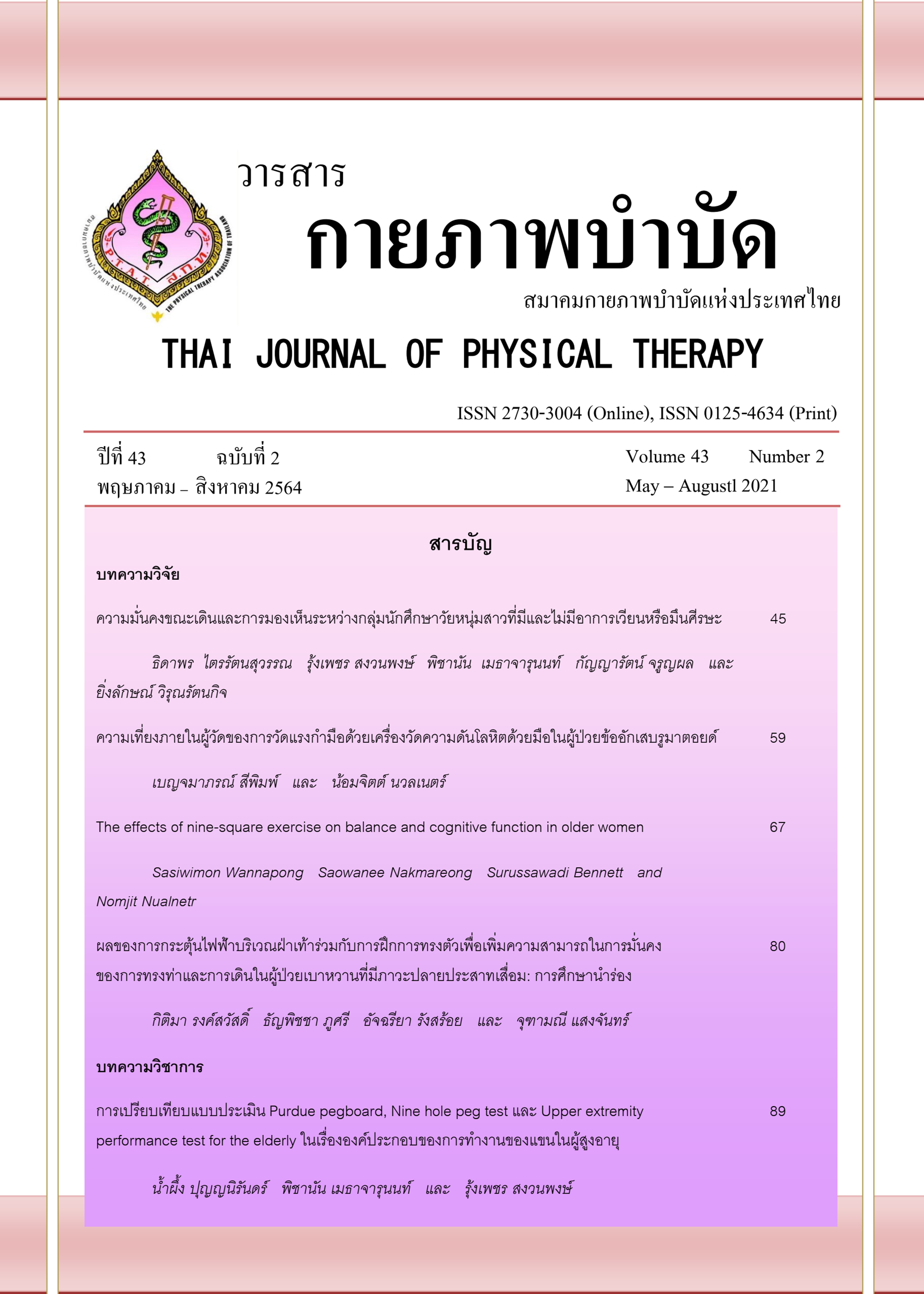
การเปรียบเทียบแบบประเมิน Purdue Pegboard, Nine hole peg test และ Upper Extremity Performance Test for the Elderly ในเรื่ององค์ประกอบของการทำงานของแขนในผู้สูงอายุ
Article Sidebar
Main Article Content
บทคัดย่อ
ปัจจุบันผู้สูงอายุมีจำนวนมากขึ้น อายุที่เพิ่มขึ้นมักส่งผลต่อการทำงานของระบบต่างๆ ของร่างกาย เช่น ระบบกระดูกและกล้ามเนื้อ ระบบประสาท เป็นต้น ส่งผลให้เกิดการจำกัดการทำกิจวัตรประจำวันต่างๆ รวมถึงการทำงานของแขนและมือของผู้สูงอายุ ทั้งในกิจกรรมที่ใช้แขนเพียงข้างเดียว เช่น การแปรงฟัน หรือกิจกรรมที่ใช้แขนทั้งสองข้างพร้อมกัน เช่น การขับรถ ด้วยเหตุนี้ จึงมีผู้พัฒนาแบบประเมินสำหรับทดสอบความสามารถของแขนจำนวนมาก ซึ่งในจำนวนนี้ แบบประเมิน Purdue pegboard (PPT), nine hole peg test (9-HPT) และ upper extremity performance test for the elderly (TEMPA) PPT และ 9-HPT เป็นแบบประเมินที่นิยมใช้ทดสอบการทำงานของแขนอย่างแพร่หลาย TEMPA เป็นแบบประเมินที่ถูกสร้างขึ้นเพื่อทดสอบความสามารถในการใช้รยางค์แขนในผู้สูงอายุ แบบประเมินประกอบไปด้วยการทำกิจกรรมต่างๆที่เหมือนกับการใช้รยางค์แขนในชีวิตประจำวัน จะเห็นได้ว่ามีแบบประเมินที่ใช้ประเมินรยางค์แขนอยู่มากมาย แต่การศึกษาที่ทำการวิเคราะห์รูปแบบของการทดสอบการใช้รยางค์แขน รวมถึงคุณสมบัติต่างๆของแบบประเมินยังมีอยู่จำนวนน้อย ดังนั้น วัตถุประสงค์ของบทความนี้คือ เพื่อเปรียบเทียบแบบประเมินในเรื่องขององค์ประกอบของการทำงานของรยางค์แขนในผู้สูงอายุ ประกอบด้วย 3 แบบประเมิน คือ แบบประเมิน PPT, 9-HPT และ TEMPA จากการพิจารณาพบว่า PPT และ TEMPA มีหัวข้อในการทดสอบความสามารถของรยางค์แขนมากกว่า 9-HPT แต่มีเพียงแบบประเมิน TEMPA ที่มีการให้คะแนนในเรื่องของคุณภาพการเคลื่อนไหวของผู้สูงอายุ อย่างไรก็ตาม ก็ยังไม่มีแบบประเมินใดที่ทดสอบได้ครอบคลุมทุกรูปแบบของการใช้แขน
Article Details
เอกสารอ้างอิง
Ageing and health [Internet]. [cited 2019 Jun 14]. Available from: https://www.who.int/news-room/fact-sheets/detail/ageing-and-health
Woytowicz E, Whitall J, Westlake KP. Age-related changes in bilateral upper extremity coordination. Curr Geriatr Rep. 2016 Sep;5(3):191–9.
Zhao KD, Robinson CA, Hilliard MJ. 11 - Biomechanics of the Upper Limb. In: Webster JB, Murphy DP, editors. Atlas of Orthoses and Assistive Devices (Fifth Edition) [Internet]. Philadelphia: Content Repository Only!; 2019. p. 127-133.e2. Available from: https://www.sciencedirect.com/science/article/pii/B9780323483230000111
Hoyer EH, Bastian AJ. The effects of task demands on bimanual skill acquisition. Exp Brain Res. 2013 Apr;226(2):193–208.
Fjell AM, Walhovd KB. Structural brain changes in aging: courses, causes and cognitive consequences. Rev Neurosci. 2010;21(3):187–221.
Schliebs R, Arendt T. The cholinergic system in aging and neuronal degeneration. Cholinergic Syst Brain Funct. 2011 Aug 10;221(2):555–63.
Martin J. Age and Grip Strength Predict Hand Dexterity in Adults. 2015;2015(10).
Sebastjan A, Skrzek A, Ignasiak Z, Stawinska T. Age-related changes in hand dominance and functional asymmetry in older adults. PloS One. 2017 May 30;12(5):e0177845–e0177845.
Learmonth G, Benwell CSY, Thut G, Harvey M. Age-related reduction of hemispheric lateralisation for spatial attention: An EEG study. NeuroImage. 2017 Jun 1;153:139–51.
Summers J, Lewis J, Fujiyama H. Aging effects on event and emergent timing in bimanual coordination. Vol. 29. 2009. 820 p.
Lafayette, IN 47903 USA. Purdue Pegboard Test User Instructions. 2015.
Instructions for the Purdue Pegboard | Career Trend [Internet]. [cited 2019 Jun 26]. Available from: https://careertrend.com/how-8094800-instructions-purdue-pegboard.html
Tiffin J, Asher EJ. The Purdue Pegboard: norms and studies of reliability and validity. J Appl Psychol. 1948;32(3):234–47.
Desrosiers J, Hébert R, Bravo G, Dutil E. The Purdue Pegboard Test: Normative data for people aged 60 and over. Disabil Rehabil. 1995 Jan 1;17(5):217–24.
Oxford Grice K, Vogel KA, Le V, Mitchell A, Muniz S, Vollmer MA. Adult Norms for a Commercially Available Nine Hole Peg Test for Finger Dexterity. Am J Occup Ther. 2003 Sep 1;57(5):570–3.
Beebe JA, Lang CE. Relationships and responsiveness of six upper extremity function tests during the first six months of recovery after stroke. J Neurol Phys Ther JNPT. 2009 Jun;33(2):96–103.
Earhart GM, Cavanaugh JT, Ellis T, Ford MP, Foreman KB, Dibble L. The 9-hole PEG test of upper extremity function: average values, test-retest reliability, and factors contributing to performance in people with Parkinson disease. J Neurol Phys Ther JNPT. 2011 Dec;35(4):157–63.
Wang Y-C, Magasi SR, Bohannon RW, Reuben DB, McCreath HE, Bubela DJ, et al. Assessing dexterity function: a comparison of two alternatives for the NIH Toolbox. J Hand Ther Off J Am Soc Hand Ther. 2011 Dec;24(4):313–20; quiz 321.
Desrosiers J, Hebert R, Bravo G, Dutil E. Upper extremity performance test for the elderly (TEMPA): normative data and correlates with sensorimotor parameters. Test d’Evaluation des Membres Superieurs de Personnes Agees. Arch Phys Med Rehabil. 1995 Dec;76(12):1125–9.
Lyle RC. A performance test for assessment of upper limb function in physical rehabilitation treatment and research. Int J Rehabil Res [Internet]. 1981;4(4). Available from: https://journals.lww.com/intjrehabilres/Fulltext/1981/12000/A_performance_test_for_assessment_of_upper_limb.1.aspx
Mathiowetz V, Volland G, Kashman N, Weber K. Adult Norms for the Box and Block Test of Manual Dexterity. Am J Occup Ther. 1985 Jun 1;39(6):386–91.
Desrosiers J, Hebert R, Dutil E, Bravo G, Mercier L. Validity of the TEMPA: A Measurement Instrument for Upper Extremity Performance. Vol. 14. 1994. 267 p.
