
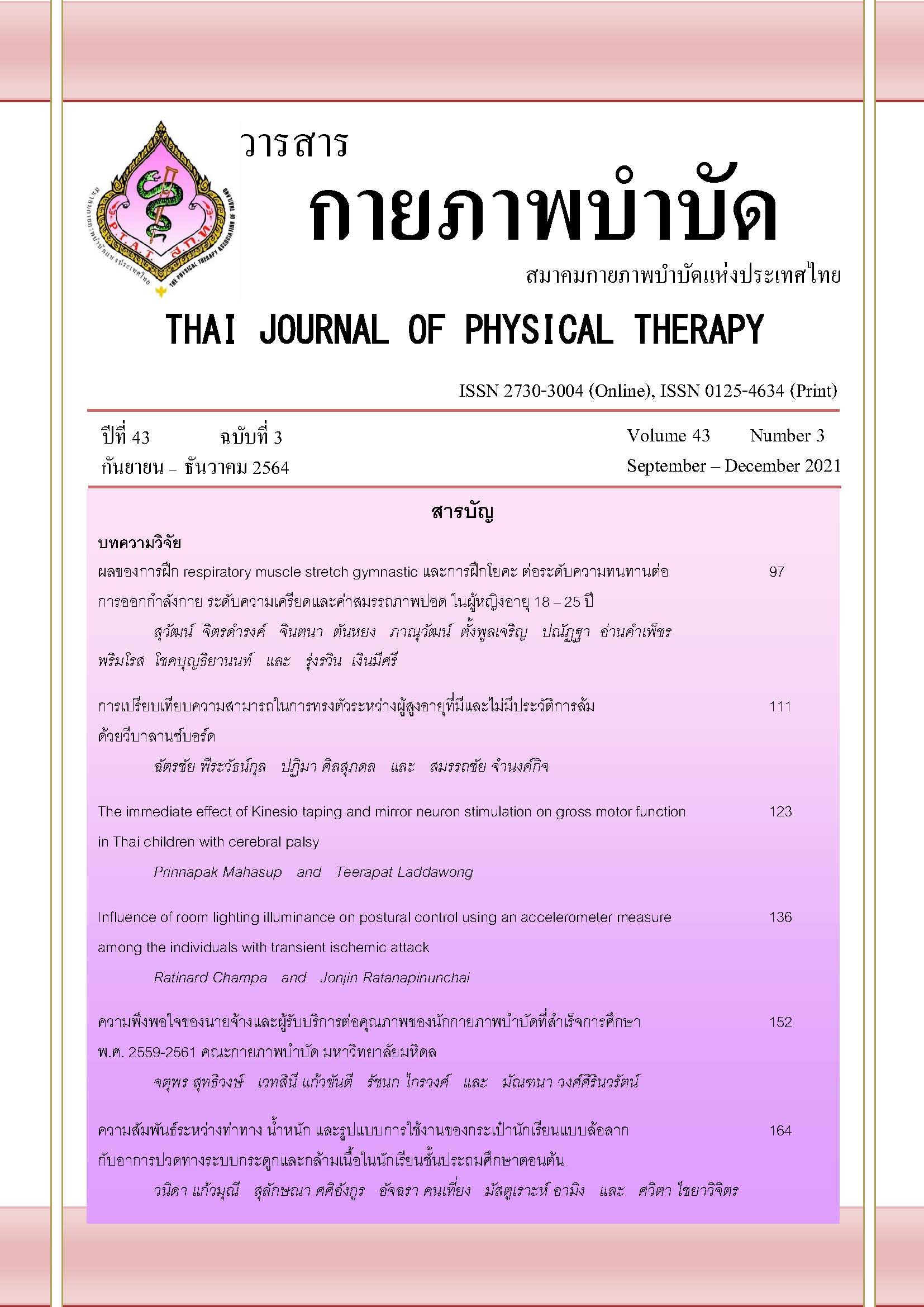
Comparison of Balance Ability in Elderly with and without History of Falls using Wii Balance Board
Article Sidebar
Main Article Content
Abstract
Background: Balance assessment under dynamic condition may differentiate the ability to control balance between the elderly with and without history of falls.
Objective: To compare the ability to control balance between elderly with and without history of falls using a quiet stance test, a forward reach test and an upward reach test.
Methods: Fifty community-dwelling older adults were classified into the faller group (n = 25) and the non-faller group (n = 25). All participants were tested on three balance conditions using the Wii Balance Board (WBB). Independent samples t-test was used to compare balance parameters between groups. The level of significant was set at p < 0.05.
Results: Center of pressure (COP) parameters in the faller group were significantly less than the non-faller group in the forward reach condition (COP total path length, COP displacement - AP, and COP velocity - AP) (p < 0.05) and the upward reach condition (COP total path length, COP displacement - AP, COP velocity - AP, and COP velocity - ML) (p < 0.05). No significant differences between groups were found in the quiet stance condition. The faller group had significantly less reaching distance than the non-faller group only for the upward reach condition (p = 0.002).
Conclusion: The reaching tests especially the upward reach test can detect some differences in dynamic balance performance between elderly fallers and non-fallers and may be used as fall-risk screening test.
Article Details
References
Bergen G, Stevens MR, Burns ER. Falls and Fall Injuries Among Adults Aged ≥ 65 Years - United States, 2014. MMWR Morb Mortal Wkly Rep. 2016; 65(37): 993-8.
Cuevas-Trisan R. Balance Problems and Fall Risks in the Elderly. Clin Geriatr Med. 2019; 35(2): 173-83.
Srichang N, Kawee L. Report on prediction of falls in elderly (aged over 60 years) in Thailand during the year 2017 - 2021. Nonthaburi: Division of Non-Communication Disease, Department of Disease Control, Ministry of Health; 2016.
Goble DJ, Cone BL, Fling BW. Using the Wii Fit as a tool for balance assessment and neurorehabilitation: the first half decade of "Wii-search". J Neuroeng Rehabil. 2014; 11: 12.
Clark RA, Bryant AL, Pua Y, McCrory P, Bennell K, Hunt M. Validity and reliability of the Nintendo Wii Balance Board for assessment of standing balance. Gait Posture. 2010; 31(3): 307-10.
Park DS, Lee G. Validity and reliability of balance assessment software using the Nintendo Wii balance board: usability and validation. J Neuroeng Rehabil. 2014; 11: 99.
Brauer SG, Burns YR, Galley P. A prospective study of laboratory and clinical measures of postural stability to predict community-dwelling fallers. J Gerontol A Biol Sci Med Sci. 2000; 55(8): M469-76.
Melzer I, Benjuya N, Kaplanski J. Postural stability in the elderly: a comparison between fallers and non-fallers. Age Ageing. 2004; 33(6): 602-7.
Park JW, Jung M, Kweon M. The Mediolateral CoP Parameters can differentiate the fallers among the community-dwelling elderly population. J Phys Ther Sci. 2014; 26(3): 381-4.
Howcroft J, Lemaire ED, Kofman J, McIlroy WE. Elderly fall risk prediction using static posturography. PLoS One. 2017; 12(2): e0172398.
Rubenstein LZ. Falls in older people: epidemiology, risk factors and strategies for prevention. Age Ageing. 2006; 35 Suppl 2: ii37-ii41.
Blake AJ, Morgan K, Bendall MJ, Dallosso H, Ebrahim SB, Arie TH, et al. Falls by elderly people at home: prevalence and associated factors. Age Ageing.1988; 17(6): 365-72.
Duncan PW, Weiner DK, Chandler J, Studenski S. Functional reach: a new clinical measure of balance. J Gerontol.1990; 45(6): M192-7.
Rosa MV, Perracini MR, Ricci NA. Usefulness, assessment and normative data of the Functional Reach Test in older adults: A systematic review and meta-analysis. Arch Gerontol Geriatr. 2019; 81: 149-70.
Row BS, Cavanagh PR. Reaching upward is more challenging to dynamic balance than reaching forward. Clin Biomech (Bristol, Avon). 2007; 22(2): 155-64.
Takeshima N, Islam MM, Rogers ME, Koizumi D, Tomiyama N, Narita M, et al. Pattern of age-associated decline of static and dynamic balance in community-dwelling older women. Geriatr Gerontol Int. 2014; 14(3): 556-60.
Kwok BC, Clark RA, Pua YH. Novel use of the Wii Balance Board to prospectively predict falls in community-dwelling older adults. Clin Biomech (Bristol, Avon). 2015;30(5): 481-4.
Zecevic AA, Salmoni AW, Speechley M, Vandervoort AA. Defining a fall and reasons for falling: comparisons among the views of seniors, health care providers, and the research literature. Gerontologist. 2006; 46(3): 367-76.
Yardley L, Beyer N, Hauer K, Kempen G, Piot-Ziegler C, Todd C. Development and initial validation of the Falls Efficacy Scale-International (FES-I). Age Ageing. 2005; 34(6): 614-9.
Thiamwong L. Psychometric testing of the Falls Efficacy Scale-International (FES-I) in Thai older adults. Songkla Med J. 2011; 29(6): 277-87.
Desai A, Goodman V, Kapadia N, Shay BL, Szturm T. Relationship between dynamic balance measures and functional performance in community-dwelling elderly people. Phys Ther. 2010; 90(5): 748-60.
Zakeri L, Jamebozorgi A, Kahlaee A. Correlation between center of pressure measures driven from Wii balance board and force platform. Asian J Sports Med. 2017; 8(3): 1-8.
Barozzi S, Socci M, Soi D, Di Berardino F, Fabio G, Forti S, et al. Reliability of postural control measures in children and young adolescents. Eur Arch Otorhinolaryngol. 2014; 271(7): 2069-77.
Jorgensen MG, Hansen NB, Perez ALR, Spaich EG. A standard low-cost worldwide accessible Nintendo Wii Balance test can differentiate older fallers from non-fallers. In: Jensen W, Andersen O, Akey M, editors. Replace, Repair, Restore, Relieve-Bridging Clinical and Engineering Solutions in Neurorehabilitation Biosystems & Biorobotics, Vol7. Cham: Springer, 2014. p 473-78
Maurer C, Mergner T, Bolha B, Hlavacka F. Vestibular, visual, and somatosensory contributions to human control of upright stance. Neurosci Lett. 2000; 281(2-3): 99-102.
Juras G, Stomka K, Fredyk A, Sobota G, Bacik B. Evaluation of limits of stability (LOS) balance test. J Human Kinetics. 2008; 19: 39-52.
Tinetti ME, Richman D, Powell L. Falls efficacy as a measure of fear of falling. J Gerontol. 1990; 45(6): 239-43.
Powell LE, Myers AM. The Activities-specific Balance Confidence (ABC) Scale. J Gerontol A Biol Sci Med Sci. 1995; 50A(1): M28-34.
de Waroquier-Leroy L, Bleuse S, Serafi R, Watelain E, Pardessus V, Tiffreau AV, et al. The Functional Reach Test: strategies, performance and the influence of age. Ann Phys Rehabil Med. 2014; 57(6-7): 452-64.
Morita M, Takamura N, Kusano Y, Abe Y, Moji K, Takemoto T, et al. Relationship between falls and physical performance measures among community-dwelling elderly women in Japan. Aging Clin Exp Res. 2005; 17(3): 211-6.
