
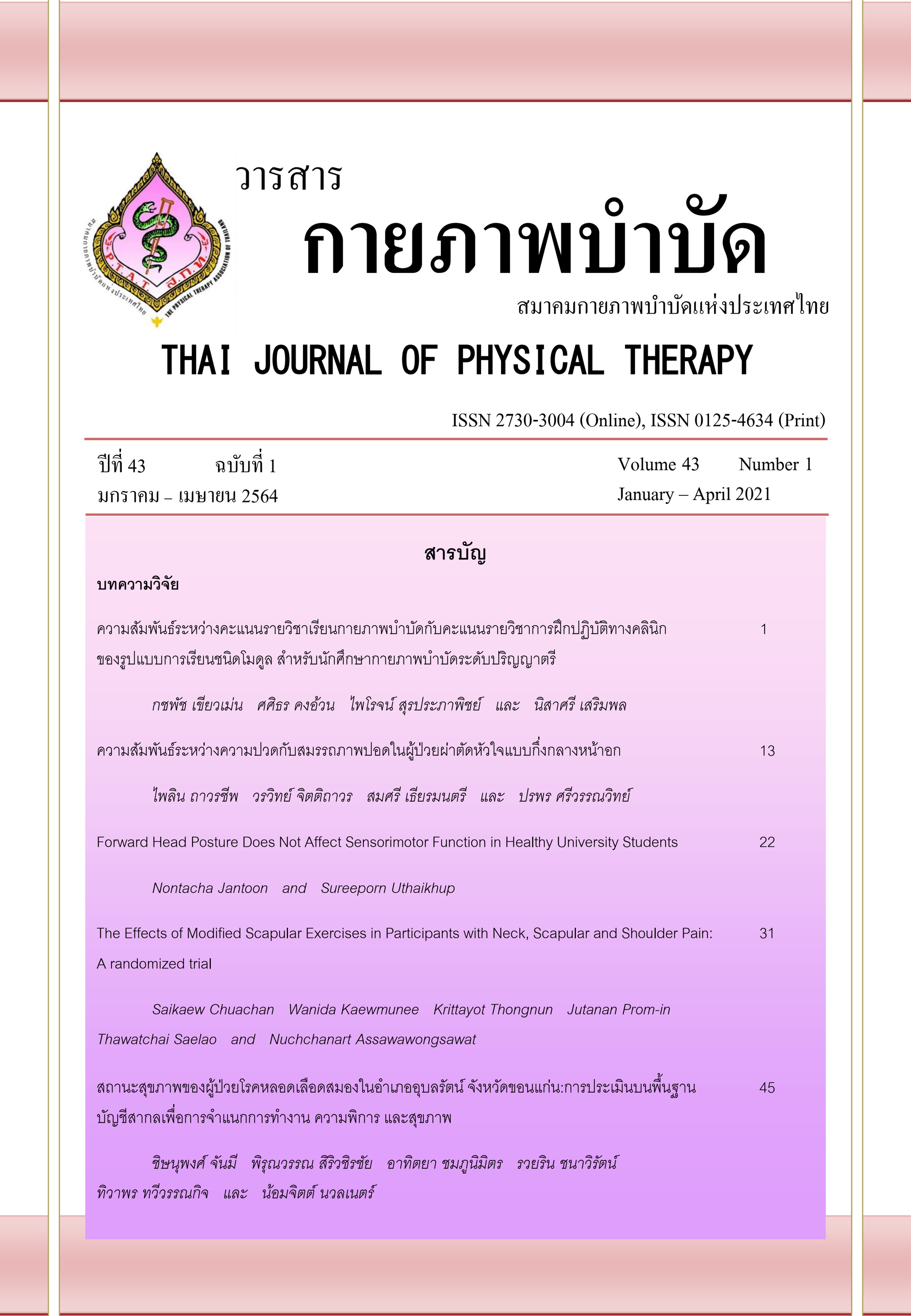
ความสัมพันธ์ระหว่างความปวดกับสมรรถภาพปอด ในผู้ป่วยผ่าตัดหัวใจแบบกึ่งกลางหน้าอก
Article Sidebar
Main Article Content
บทคัดย่อ
ที่มาและความสำคัญ: ปัญหาสำคัญที่เกิดขึ้นภายหลังการผ่าตัดหัวใจ คือค่าสมรรถภาพปอดลดลง ซึ่งเป็นผลมาจากปัจจัยต่าง ๆ เช่น ผลของยาสลบ การใช้เครื่องปอดและหัวใจเทียม เทคนิคการผ่าตัด และอาการปวดแผลผ่าตัด ทำให้ผู้ป่วยมีอัตราการหายใจเร็ว สั้นและตื้น โดยปัจจัยเหล่านี้ส่งผลทำให้เพิ่มความเสี่ยงในการเกิดภาวะแทรกซ้อนต่าง ๆ ตามมา เช่น ภาวะปอดแฟบ และการติดเชื้อที่ปอด เป็นต้น อย่างไรก็ตาม ยังไม่มีการศึกษาด้านความปวดที่เกิดขึ้นภายหลังการผ่าตัดนั้นส่งผลต่อสมรรถภาพปอดของผู้ป่วยอย่างไร และความสัมพันธ์กับค่าสมรรถภาพปอดไปในทิศทางใด
วัตถุประสงค์: เพื่อศึกษาความปวดและสมรรถภาพปอดที่เปลี่ยนแปลงภายหลังการผ่าตัด และความสัมพันธ์ระหว่างความปวดกับสมรรถภาพปอด ในผู้ป่วยผ่าตัดหัวใจแบบกึ่งกลางหน้าอก
วิธีการวิจัย: อาสาสมัครที่ผ่าตัดหัวใจแบบกึ่งกลางหน้าอก จำนวน 34 คน เพศชาย 19 คน และหญิง 15 คน อาสาสมัครทุกรายได้รับโปรแกรมการฟื้นฟูหัวใจ การประเมินระดับความเจ็บปวด (numeric rating scales, NRS) ปริมาตรการหายใจออกเต็มแรง (forced vital capacity, FVC) ปริมาตรของอากาศหายใจออกเต็มที่ หลังจากการหายใจเข้าเต็มที่ลดลง (vital capacity, VC) ปริมาตรอากาศที่ขับออกได้ในวินาทีแรกของการหายใจออกอย่างเร็วและแรงเต็มที่จากการหายใจเข้าเต็มที่ (forced expiratory volume in one second, FEV1) ความจุปอดรวม (total lung capacity, TLC) และค่าอัตราการไหลของอากาศที่เร็วที่สุด (peak expiratory flow rate, PEFR) ก่อนการผ่าตัดและในวันที่ 2, 3, 4 และ 5 หลังการผ่าตัด
ผลการวิจัย: มีความสัมพันธ์ในเชิงลบในระดับปานกลาง (moderate negative relationship) อย่างมีนัยสำคัญทางสถิติ ระหว่างความปวด (NRS) กับ VC (r=-0.468, p=0.005) และความปวด (NRS) กับ PEFR (r=-0.352, p=0.041) ของวันที่ 2 หลังการผ่าตัด
สรุปผล: ความปวดมีความสัมพันธ์ในระดับปานกลางกับ VC และ PEFR ในผู้ป่วยหลังผ่าตัดหัวใจ ดังนั้น นักกายภาพบำบัดควรคำนึงถึงการจัดการความปวด เมื่อต้องใช้เทคนิคที่กระตุ้นการไอผู้ป่วย เนื่องจากต้องอาศัยค่า VC และ PEFR เพื่อป้องกันภาวะแทรกซ้อน
Article Details
เอกสารอ้างอิง
Mazzeffi M, Khelemsky Y. Poststernotomy pain: a clinical review. J Cardiothorac Vasc Anesth. 2011; 25: 1163-78.
Lahtinen P, Kokki H, Hynynen M. Pain after cardiac surgery:prospective cohort study of 1-year incidence and intensity. Anesthesiology. 2006; 105: 794-800.
Milgrom LB, Brooks JA, Qi R. Pain levels experienced with activities after cardiac surgery. Am J Crit Care. 2004; 13: 116-25.
Ranucci M, Ballotta A, La Rovere MT, Castelvecchio S; Surgical and Clinical Outcome Research (SCORE) Group. Post-operative hypoxia and length of intensive care unit stay after cardiac surgery: the underweight paradox? PLoS One. 2014; 9(4): e93992.
Westerdahl E, Lindmark B, Bryngelsson I, Tenling A. Pulmonary function 4 months after coronary artery bypass graft surgery. Respir Med. 2003; 97(4): 317-22.
Arozullah AM, Daley J, Henderson WG, Khuri SF: Multifactorial risk index for predicting post-operative respiratory failure in men after major noncardiac surgery. The National Veterans Administration Surgical Quality Improvement Program. Ann Surg 2000; 232: 242–53
Wynne R, Botti M. Postoperative pulmonary dysfunction in adults after cardiac surgery with cardiopulmonary bypass: clinical significance and implications for practice. Amer J Resp Crit Care. 2004 Sep 1;13(5):384-93.
Guizilini S, Gomes WJ, Faresin SM, Carvalho AC, Jaramillo JI, Alves FA, et al. Effects of the pleural drain site on the pulmonary function after coronary artery bypass grafting. Braz J Cardiovasc Surg. 2004; 19(1): 47-54.
Mueller XM, Tinguely F, Tevaearai HT, Revelly JP, Chioléro R, Segesser LK. Pain location, distribution, and intensity after cardiac surgery. Chest. 2000; 118(2): 391-6.
Sasaki N, Meyer MJ, Eikermann M. Postoperative Respiratory Muscle Dysfunction Pathophysiology and Preventive Strategies. Anesthesiology. 2013; 118(4): 961-78.
Berrizbeitia LD, Tessler S, Jacobowitz IJ, Kaplan P, Cunningham JN. Effect of sternotomy and coronary bypass surgery on post-operative pulmonary mechanics: comparison of internal mammary and saphenous vein bypass grafts. Chest. 1989; 96(4): 873-6.
Baumgarten MC, Garcia GK, Frantzeski MH, Giacomazzi CM, Lagni VB, Dias AS, Monteiro MB. Pain and pulmonary function in patients submitted to heart surgery via sternotomy. Braz J Cardiovasc Surg. 2009; 24(4): 497-505.
Lichtenberg A, Hagl C, Harringer W, Klima U, Haverich A. Effects of minimal invasive coronary artery bypass on pulmonary function and post-operative pain. J Thorac Cardiovasc Surg. 2000;70(2): 461-5.
Ragnarsdottir M, Kristjansdottir A, Ingvarsdóttir I, Hannesson P, Torfason B, Cahalin LP. Short‐term changes in pulmonary function and respiratory movements after cardiac surgery via median sternotomy. Scand Cardiovasc J. 2004; 38(1): 46-52.
Locke TJ, Griffiths TL, Mould H, Gibson GJ. Rib cage mechanics after median sternotomy. Thorax. 1990; 45(6): 465-8.
Shenkman Z, Shir Y, Weiss YG, Bleiberg B, Gross D. The effects of cardiac surgery on early and late pulmonary functions. Acta Anaesthesiol Scand. 1997; 41: 1193–9.
Melzack, R., & Katz, J. Pain measurement in persons in pain, Textbook of pain (pp. 409-26). London: Harcourt Publisher; 1999
Morsch KT, Leguisamo CP, Camargo MD, Coronel CC, Mattos W, Ortiz LD, et al. Ventilatory profile of patients undergoing CABG surgery. Braz J Cardiovasc Surg. 2009; 24(2): 180-7.
Renault JA, Costa-Val R, Rossetti MB. Respiratory physiotherapy in the pulmonary dysfunction after cardiac surgery. Braz J Cardiovasc Surg. 2008; 23(4): 562-9.
Lancey RA, Gaca C, Salm TJV. The use of smaller, more flexible chest drains following open heart surgery. Chest. 2001; 119: 19-24.
Guizilini S, Gomes WJ, Faresin SM, Bolzan DW, Alves FA, Catani R, et al. Evaluation of pulmonary function in patients following on and off-pump coronary artery bypass grafting. Braz J Cardiovasc Surg. 2005; 20(3): 310-6.
Enright PL, Kronmal R A , Manolio TA , Schenker M B, Hyatt RE . Respiratory muscle strength in the elderly. Correlates and reference values. Cardiovascular Health Study Research Group . Am J Respir Crit Care Med. 1994 ;149 : 430 – 8.
Shoemaker MJ , Donker S , Lapoe A . Inspiratory muscle training in patients with chronic obstructive pulmonary disease:The state of the evidence . Cardiopulm Phys Ther J. 2009 ; 20 :5 – 15.
