
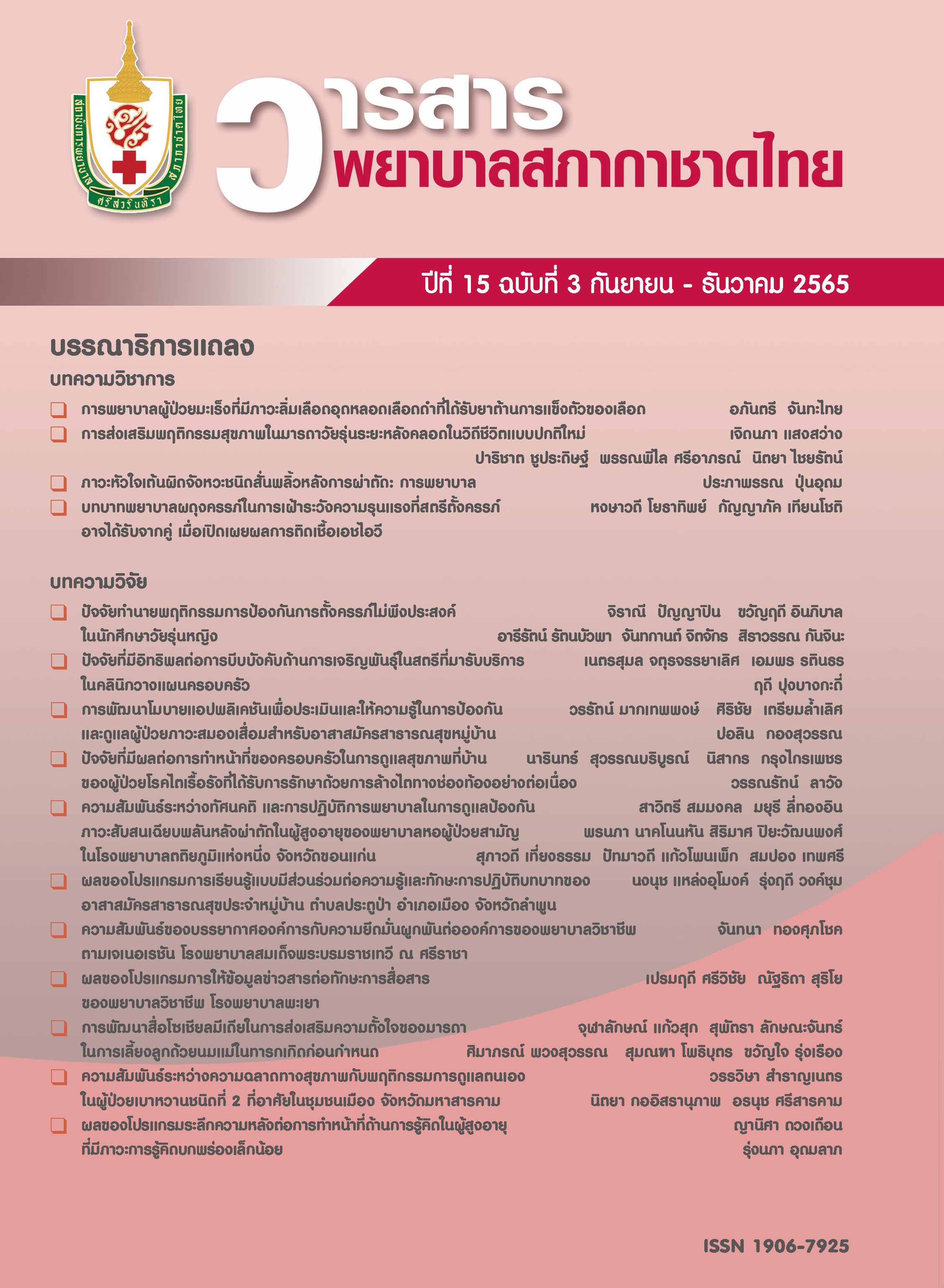
ความสัมพันธ์ระหว่างทัศนคติ และการปฏิบัติการพยาบาลในการดูแลป้องกัน ภาวะสับสนเฉียบพลันหลังผ่าตัดในผู้สูงอายุของพยาบาลในหอผู้ป่วยสามัญ โรงพยาบาลตติยภูมิแห่งหนึ่ง จังหวัดขอนแก่น
คำสำคัญ:
ภาวะสับสนเฉียบพลันหลังผ่าตัด , ผู้สูงอายุ, ทัศนคติ, การปฏิบัติพยาบาลบทคัดย่อ
การวิจัยเชิงสำรวจเพื่อหาความสัมพันธ์ระหว่างทัศนคติและการปฏิบัติการพยาบาลต่อภาวะสับสน เฉียบพลันหลังผ่าตัดในผู้สูงอายุของพยาบาล กลุ่มตัวอย่าง คือ พยาบาล หอผู้ป่วยสามัญ โรงพยาบาลตติยภูมิแห่งหนึ่ง จังหวัดขอนแก่น จำนวน 83 ราย เก็บรวบรวมข้อมูลโดยใช้แบบสอบถามทัศนคติ และแบบสอบถามการปฏิบัติการพยาบาลในการดูแลป้องกันภาวะสับสนเฉียบพลันหลังผ่าตัดในผู้สูงอายุ โดยได้รับการตอบกลับจากพยาบาล 80 ราย (ร้อยละ 96.38) วิเคราะห์ข้อมูลด้วยสถิติเชิงพรรณนา และ สัมประสิทธิ์สหสัมพันธ์ของเพียร์สัน
ผลการวิจัย พบว่า พยาบาลส่วนใหญ่มีทัศนคติและการปฏิบัติการพยาบาลในการดูแลป้องกันภาวะสับสนเฉียบพลันหลังผ่าตัดในผู้สูงอายุระดับปานกลาง (ร้อยละ 57.5 และ 56.3 ตามลำดับ) ซึ่งทัศนคติโดยรวมต่อภาวะสับสนเฉียบพลันมีความสัมพันธ์กับการปฏิบัติการพยาบาลในการดูแลป้องกันภาวะสับสนเฉียบพลันหลังผ่าตัดในผู้สูงอายุ (r = .309, p = .005) โดยทัศนคติโดยรวมมีความสัมพันธ์ กับการปฏิบัติการพยาบาลระยะก่อนผ่าตัดในการดูแลป้องกันภาวะสับสนเฉียบพลันหลังผ่าตัด (r = .402, p < .001) แต่ไม่มีความสัมพันธ์กับการปฏิบัติการพยาบาลระยะหลังผ่าตัด (r = .181, p > .05) ผลการวิจัยในครั้งนี้ แสดงให้เห็นว่าการส่งเสริมและพัฒนาการปฏิบัติการพยาบาลในการดูแลป้องกันภาวะสับสนเฉียบพลันหลังผ่าตัดในผู้สูงอายุควรคำนึงถึงทัศนคติของพยาบาลต่อภาวะสับสนเฉียบพลันร่วมด้วย
Downloads
เอกสารอ้างอิง
Huang C, Mårtensson J, Gögenur I, Asghar MS. exploring postoperative cognitive dysfunction and delirium in noncardiac surgery using MRI: a systematic review. Neural Plast 2018:1281657. doi: 10.1155/2018/1281657.
Iamrod N, Sindhu S, Danaidutsadeekul S, Tantiwongkosri K. Predictors of delirium in the elderly patients undergone open heart surgery in the first 72 hours after surgery. J Royal Thai Army Nurses 2016;17(2):34-42 (in Thai).
Chiwong P, Sucamvang K, Chintanawat R, Wongpakaran N. Predicting factors related to delirium among post-operative older persons. Nurs J 2015;42(2):116-25 (in Thai).
Inouye SK, Robinson T, Blaum C, Busby-Whitehead J, Boustani M, Chalian A, et al. Postoperative delirium in older adults: best practice statement from the American Geriatrics Society. J Am Coll Surg 2015;220(2):136-48.e1. doi: 10.1016/j.jamcollsurg. 2014.10.019.
Raats JW, Steunenberg SL, de Lange DC, van der Laan L. Risk factors of post-operative delirium after elective vascular surgery in the elderly: a systematic review. Int J Surg 2016;35:1-6. doi: 10.1016/j.ijsu.2016.09.001.
Hofman MR, van den Hanenberg F, Sierevelt IN, Tulner CR. Elderly patients with an atypical presentation of illness in the emergency department. Neth J Med 2017;75(6):241-46.
Inouye SK, Westendorp RG, Saczynski JS. Delirium in elderly people. Lancet 2014;383(9920):911-22. doi: 10.1016/S0140-6736(13)60688-1.
Mossie A, Regasa T, Neme D, Awoke Z, Zemedkun A, et al. Evidence-based guideline on management of postoperative delirium in older people for low resource setting: systematic review article. Int J Gen Med 2022;15:4053-65.
Janssen TL, Alberts AR, Hooft L, Mattace-Raso F, Mosk CA, van der Laan L. Prevention of postoperative delirium in elderly patients planned for elective surgery: systematic review and meta-analysis. Clin Interv Aging 2019;14:1095-117. doi: 10.2147/CIA. S201323.
Siddiqi N, Harrison JK, Clegg A, Teale EA, Young J, Taylor J, et al. Interventions for preventing delirium in hospitalised non-ICU patients. Cochrane Database Syst Rev 2016;3:CD005563. doi: 10.1002/14651858.CD005563.pub3.
Xing J, Sun Y, Jie Y, Yuan Z, Liu W. Perceptions, attitudes, and current practices regards delirium in China: a survey of 917 critical care nurses and physicians in China. Medicine (Baltimore) 2017;96(39):e8028. doi: 10.1097/MD.0000000000008028.
Papaioannou M, Papastavrou E, Kouta C, Tsangari H, Merkouris A. Investigating nurses’ knowledge and attitudes about delirium in older persons: a cross-sectional study. Research Square 2022. doi: 10.21203/rs.3.rs-1620060/v1
Mukaetova-Ladinska EB, Cosker G, Chan M, Coppock M, Scully A, Kim SY, et al. Delirium stigma among healthcare staff. Geriatrics (Basel) 2018;4(1):6. doi: 10.3390/ geriatrics4010006
Trogrlić Z, Ista E, Ponssen HH, Schoonderbeek JF, Schreiner F, Verbrugge SJ, et al. Attitudes, knowledge and practices concerning delirium: a survey among intensive care unit professionals. Nurs Crit Care 2017;22(3):133-40. doi: 10.1111/nicc.12239.
Schwartz NE. Nutrition knowledge, attitudes and practices of Canadian public health nurses. J Nutr Educ 1976;8(1):28-31.
Li Y, Sukonthasarn A, Wangsrikhun S. Nurses’ knowledge, attitudes, and practices regarding ICU delirium, Kunming Tertiary Hospitals, Yunnan Province, the People’s Republic of China. Nursing Journal 2021;48(4):41-53.
Lee KH, Park ML, Kim GY. A study of knowledge, recognition and practice about delirium in general hospital nurses. International Journal of Bio-Science and Bio-Technology 2016;8(3):219-30. doi.org/10.14257/ijbsbt.2016.8.3.22
Lee G, Roh YS. Knowledge, barriers, and training needs of nurses working in delirium care. Nurs Crit Care 2021. doi: 10.1111/nicc.12724
Arsavisate L, Leethong-in M, Piyawattanapong S. Nurse’s knowledge, attitude and pracrtice on post-operative delirium in elderly patient, a tertiary hospital, Ubon Ratchathani province. Journal of Nursing and Health Care 2019;37(4):235-43 (in Thai).
Piyawattanapong S, Leethong-in M, Thiengtham S, Sommongkol S, Kaewkot S. The relationship between knowledge, attitude, and practices of nursing staffs on post-operative delirium in the elderly. Srinagarind Med J 2019;34(3):281-86 (in Thai).
Naknonehun P, Jaipang C, Sanonoi N, Piyawattanapong S. The study of knowledge, attitude and behavior of nurses to caring for the elderly with delirium after cardiac surgery. J Royal Thai Army Nurses 2020;21(2):368-76 (in Thai).
Weder F, Yarnold J, Mertl S, Hübner R, Elmenreich W, Sposato R. Social learning of sustainability in a pandemic—changes to sustainability understandings, attitudes, and behaviors during the global pandemic in a higher education setting. Sustainability 2022;14(6):3416. https://doi.org/10.3390/su14063416
Bandura A. Social foundations of thought and action: a social cognitive theory. Englewood Cliffs, NJ: Prentice-Hall; 1986.
Ponto J. Understanding and evaluating survey research. J Adv Pract Oncol 2015;6(2):168-71.
Inouye SK, Foreman MD, Mion LC, Katz KH, Cooney LM Jr. Nurses’ recognition of delirium and its symptoms: comparison of nurse and researcher ratings. Arch Intern Med 2001;161(20):2467-73. doi: 10.1001/archinte.161.20.2467.
Grover S, Mehra A, Sharma N, Sahoo S, Dua D. Knowledge and attitude of nurses toward delirium. Annals of Indian Psychiatry 2022;6(1):73-81.
Poikajärvi S, Rauta S, Salanterä S, Junttila K. Delirium in a surgical context from a nursing perspective: a hybrid concept analysis. International Journal of Nursing Studies Advances 2022;4. https://doi.org/10.1016/j.ijnsa.2022.100103
ดาวน์โหลด
เผยแพร่แล้ว
รูปแบบการอ้างอิง
ฉบับ
ประเภทบทความ
สัญญาอนุญาต
ลิขสิทธิ์ (c) 2023 สถาบันการพยาบาลศรีสวรินทิรา สภากาชาดไทย

อนุญาตภายใต้เงื่อนไข Creative Commons Attribution-NonCommercial-NoDerivatives 4.0 International License.
เนื้อหาบทความหรือข้อคิดเห็นต่างๆ ในวารสารพยาบาลสภากาชาดไทยนี้ เป็นความคิดเห็นของผู้เขียนบทความ ไม่ใช่ความเห็นของกองบรรณาธิการ หรือสถาบันการพยาบาลศรีสวรินทิรา สภากาชาดไทย


