
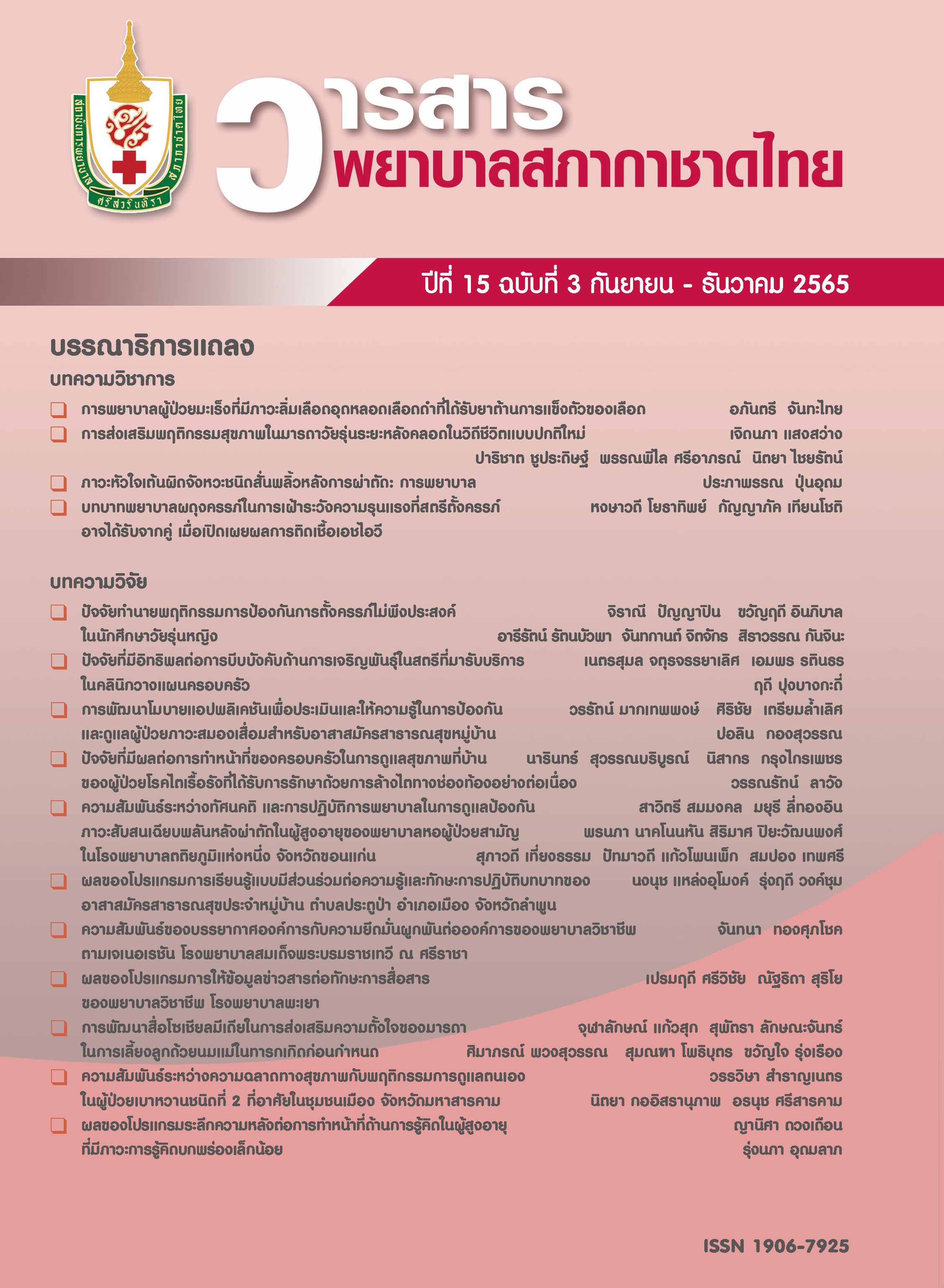
ผลของโปรแกรมระลึกความหลังต่อการทำหน้าที่ด้านการรู้คิดในผู้สูงอายุที่มีภาวะการรู้คิดบกพร่องเล็กน้อย
คำสำคัญ:
การระลึกความหลัง , การทำหน้าที่ด้านการรู้คิด , ภาวะการรู้คิดบกพร่องเล็กน้อย , ผู้สูงอายุบทคัดย่อ
การวิจัยกึ่งทดลองนี้มีวัตถุประสงค์เพื่อเปรียบเทียบผลของโปรแกรมระลึกความหลังต่อการทำหน้าที่ด้านการรู้คิดในผู้สูงอายุที่มีภาวะการรู้คิดบกพร่องเล็กน้อย กลุ่มตัวอย่าง คือ ผู้สูงอายุในชมรม ผู้สูงอายุแห่งหนึ่งในกรุงเทพมหานคร คัดเลือกแบบเฉพาะเจาะจงซึ่งมีคุณสมบัติตามเกณฑ์คัดเข้า หลังจากนั้นจับคู่กลุ่มทดลองและกลุ่มควบคุมให้มีลักษณะใกล้เคียงกัน (matched pair group) กลุ่มละ 20 คน เครื่องมือที่ใช้ในการวิจัย คือ โปรแกรมระลึกความหลัง โดยกลุ่มทดลองได้รับโปรแกรม 6 สัปดาห์ สัปดาห์ละ 1 ครั้ง และกลุ่มควบคุมได้รับการดูแลตามปกติ เก็บรวบรวมข้อมูลโดยใช้แบบประเมิน พุทธิปัญญา (MoCA) วัดผลก่อนได้รับโปรแกรม ระหว่างได้รับโปรแกรม 4 สัปดาห์ หลังสิ้นสุดโปรแกรมทันที ระยะติดตามหลังสิ้นสุดโปรแกรม 2 สัปดาห์ และ 4 สัปดาห์ วิเคราะห์ข้อมูลโดยใช้สถิติ Fisher’s Exact test, Wilcoxon Signed Rank test, Mann - Whitney U test และ Friedman test
ผลการวิจัยสรุปดังนี้ โปรแกรมระลึกความหลังส่งผลให้การทำหน้าที่ด้านการรู้คิดของผู้สูงอายุที่มีภาวะการรู้คิดบกพร่องเล็กน้อยเพิ่มขึ้นระหว่างและหลังได้รับโปรแกรมอย่างมีนัยสำคัญทางสถิติที่ระดับ.05 และระยะติดตามหลังสิ้นสุดโปรแกรม 2 สัปดาห์ และ 4 สัปดาห์พบว่าการทำ หน้าที่ด้านการรู้คิดของผู้สูงอายุ สูงกว่าก่อนได้รับโปรแกรมอย่างมีนัยสำคัญทางสถิติที่ระดับ .05 จากการเปรียบเทียบกลุ่มทดลองและกลุ่มควบคุม พบว่าระหว่างได้รับโปรแกรม หลังสิ้นสุดโปรแกรมทันที ระยะติดตามหลัง สิ้นสุดโปรแกรม 2 สัปดาห์ และ 4 สัปดาห์ กลุ่มทดลองมีคะแนนเฉลี่ยการทำหน้าที่ด้านการรู้คิดของ ผู้สูงอายุสูงกว่ากลุ่มควบคุม อย่างมีนัยสำคัญทางสถิติที่ระดับ .05
สรุป: โปรแกรมระลึกความหลังสามารถเพิ่มการรู้คิดในผู้สูงอายุที่มีภาวะการรู้คิดบกพร่องเล็กน้อยได้
Downloads
เอกสารอ้างอิง
Li M, Lyu JH, Zhang Y, Gao ML, Li R, Mao PX, et al. Efficacy of group reminiscence therapy on cognition, depression, neuropsychiatric symptoms, and activities of daily living for patients with Alzheimer Disease. J Geriatr Psychiatry Neurol 2020;33(5):272-81.
Griffiths J, Thaikruea L, Wongpakaran N, Munkhetvit P. Prevalence of mild cognitive impairment in rural Thai older people, associates risk factors and their cognitive characteristics. Dement Geriatr Cogn Dis Extra 2020;10(1):38-45.
Lenox-Smith A, Reed C, Lebrec J, Belger M, Jones RW. Potential cost saving to be made by slowing cognitive decline in mild Alzheimer’s disease dementia using a model derived from the UK GERAS observational study. BMC Geriatr 2018;18(1):57. doi: 10.1186/s12877-018-0748-9
Fogg D, Griffiths P, Meredith P, Bridges J. Hospital outcomes of older people with cognitive impairment: an integrative review. Int J Geriatr Psychiatry 2018;33(9):1177-97.
Zhu CW, Sano M, Ferris SH, Whitehouse PJ, Patterson MB, Aisen PS. Health-related resource use and costs in elderly adults with and without mild cognitive impairment. J AM Geriatr Soc 2013;61(3):396-402.
Connor MH, Seeher K, Teixeira-Pinto A, Woodward M, Ames A, Brodaty H. Mild cognitive impairment and caregiver burden: a 3-year-longitudinal study. Am J Geriatr Psychiatry 2019;27(11):1206-15.
Wang YQ, Jia RX, Liang JH, Li J, Qian S, Li JY, et al. Effects of non-pharmacological therapies for people with mild cognitive impairment. A Bayesian network meta-analysis. Int J Geriatr Psychiatry 2020;35(6):591-600.
Haight B, Gibson F. Burnside’s working with older adults group process and techniques. 4th ed. Sudbury, MA: Jones and Bartlett; 2005.
Duru Aşiret G, Kapucu S. The effect of reminiscence therapy on cognition, depression, and activities of daily living for patients with Alzheimer Disease. J Geriatr Psychiatry Neurol 2016;29(1):31-7.
Lin LJ, Yen HY. Efficacy of reminiscence therapy on cognitive functioning in older adults. Geriatr Rehabil 2018;34(2):112-7.
Bademil K, Lok N, Selcuk-Tosun A. The effect of reminiscence therapy on cognitive functions, depression, and quality of life in Alzheimer patients: randomized controlled trial. Int J Geriatr Psychiatry 2019;34(1):47-53.
Wongpakaran N, Wongpakaran T. Prevalence of major depressive disorder and suicide in long-term care facilities: a report from northern Thailand. Psychogeriatrics 2012;12(1):11-7.
Touhy TA. Communicating with older adults. In: Touhy TA, Jett K, editors. Ebersole & Hess’ toward health aging: human needs & nursing response. 10th ed. St. Louis, MO: Elsevier; 2020. p.68-76.
Synder M. Reminiscence. In: Synder M, Lindquist R, editors. Complementary/ Alternative therapies in nursing. 4th ed. New Yoke: Springer Publishing; 1998. p.143-51.
Spector A, Thorgrimsen L, Woods B, Orrell M. Making a difference: an evidence-based group programme to offer Cognitive Stimulation therapy (CST) to people with dementia. London: Hawker Publications; 2006.
Burnside I, Schmidt MG. Working with older adults: group process and technique. 3rd ed. Sudbury, MA: Jones and Bartlett Publishers; 1994.
Committee Conducted Mini-Mental State Examination (Thai-Version). The dementia project in Thai elderly 2000. Bangkok: Medical Department; 2000. (in Thai)
Jitapunkul S, Suriyawongpaisarn P. Health problems of the elderly in Thailand. Bangkok: Holistic Publishing; 1999. (in Thai)
Hemrungrojn S. MoCA cognitive assessment Thai Version [Internet]. 2007 [cited 2020 May 30]. Available from: https://www.mocatest.org/paper/
Wu LF, Koo M. Randomized controlled trial of a six-week spiritual reminiscence intervention on hope, life satisfaction, and spiritual well-being in elderly with mild and moderate dementia. Int J Geriatr Psychiatry 2016;31(2):120-7.
ดาวน์โหลด
เผยแพร่แล้ว
รูปแบบการอ้างอิง
ฉบับ
ประเภทบทความ
สัญญาอนุญาต
ลิขสิทธิ์ (c) 2023 สถาบันการพยาบาลศรีสวรินทิรา สภากาชาดไทย

อนุญาตภายใต้เงื่อนไข Creative Commons Attribution-NonCommercial-NoDerivatives 4.0 International License.
เนื้อหาบทความหรือข้อคิดเห็นต่างๆ ในวารสารพยาบาลสภากาชาดไทยนี้ เป็นความคิดเห็นของผู้เขียนบทความ ไม่ใช่ความเห็นของกองบรรณาธิการ หรือสถาบันการพยาบาลศรีสวรินทิรา สภากาชาดไทย


