ความรู้ ความเชื่อด้านสุขภาพและพฤติกรรมการตรวจเต้านมด้วยตนเองของนักศึกษาพยาบาลหลักสูตรพยาบาลศาสตรบัณฑิต วิทยาลัยพยาบาลบรมราชชนนี เชียงใหม่
คำสำคัญ:
ผู้ป่วยมะเร็งเต้านม, การตรวจเต้านมด้วยตนเอง, ความเชื่อด้านสุขภาพ, นักศึกษาพยาบาลบทคัดย่อ
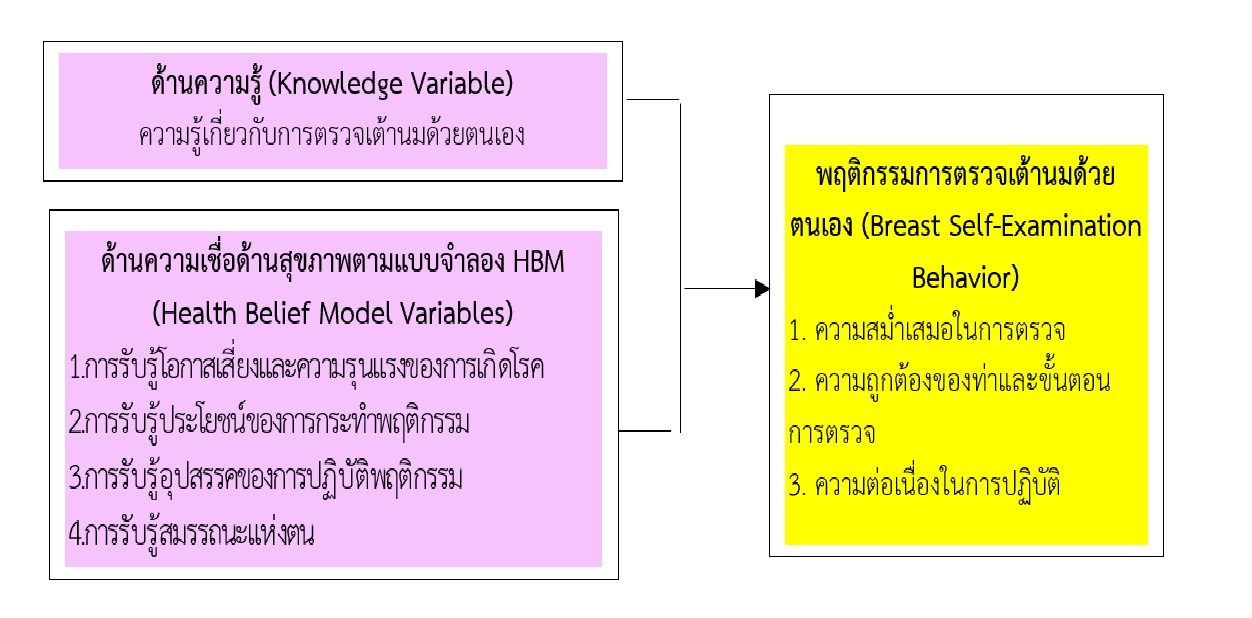
การศึกษานี้มีวัตถุประสงค์เพื่อประเมินระดับความรู้ ความเชื่อด้านสุขภาพ และพฤติกรรมการตรวจเต้านมด้วยตนเองของนักศึกษาพยาบาลหลักสูตรพยาบาลศาสตรบัณฑิต วิทยาลัยพยาบาลบรมราชชนนี เชียงใหม่ งานวิจัยเป็นการวิจัยเชิงพรรณนา โดยกลุ่มตัวอย่างคัดเลือกด้วยการสุ่มแบบชั้นภูมิและสุ่มแบบง่าย จำนวน 240 คน เครื่องมือประกอบด้วย 4 ส่วน ได้แก่ ข้อมูลส่วนบุคคล (13 ข้อ) แบบวัดความรู้เกี่ยวกับมะเร็งเต้านมและการตรวจเต้านมด้วยตนเอง (20 ข้อ โดยให้คะแนนแบบอิงเกณฑ์ 0-20) แบบสอบถามความเชื่อด้านสุขภาพ (41 ข้อ จำนวน 4 ระดับ) และแบบวัดพฤติกรรมการตรวจเต้านมด้วยตนเอง (12 ข้อ; ปฏิบัติ/ไม่ปฏิบัติ) เครื่องมือผ่านการตรวจสอบความตรงโดยผู้เชี่ยวชาญ (0.80-0.84) และมีความเชื่อมั่นภายในที่ยอมรับได้ (KR-20 = 0.80-0.82; Cronbach’s α = 0.88) ข้อมูลวิเคราะห์ด้วยสถิติเชิงพรรณนาและสหสัมพันธ์เพียร์สัน ผลพบว่านักศึกษาส่วนใหญ่มีอายุ 18-20 ปี (57.5%) และส่วนใหญ่ปฏิบัติการตรวจเต้านมด้วยตนเองร้อยละ 77.36 โดยท่ายืนหน้ากระจกเป็นที่นิยมที่สุด (84.10%) ระดับความรู้โดยรวมอยู่ในระดับปานกลาง (ความถูกต้องเฉลี่ยร้อยละ 49.17) ขณะที่ความเชื่อด้านสุขภาพอยู่ในระดับต่ำถึงปานกลางในทุกมิติ การวิเคราะห์ความสัมพันธ์พบความสัมพันธ์เชิงบวกและมีนัยสำคัญระหว่างความรู้กับพฤติกรรม (r = 0.462, p < 0.01) และระหว่างความเชื่อด้านสุขภาพกับพฤติกรรม (r = 0.389, p < 0.01) ดังนั้นการพัฒนาและส่งเสริมความรู้ควบคู่กับการเสริมสร้างความเชื่อด้านสุขภาพจึงเป็นกลยุทธ์สำคัญในการยกระดับพฤติกรรมการตรวจเต้านมด้วยตนเองของนักศึกษาพยาบาลหลักสูตรพยาบาลศาสตรบัณฑิตเพื่อการป้องกันและการค้นพบมะเร็งเต้านมในระยะเริ่มต้นอย่างมีประสิทธิภาพ
เอกสารอ้างอิง
Alkhasawneh, E., Suleiman, K., Akhu-Zaheya, L., & Haymour, Z. (2022). Effect of educational intervention on knowledge, attitude, and practice of breast self-examination among nursing students: A quasi-experimental study. Nurse Education Today, 119, 105552. https://doi.org/10.1016/j.nedt.2022.105552
Arnold, M., Morgan, E., Rumgay, H., Mafra, A., Singh, D., Laversanne, M., et al. (2022). Current and future burden of breast cancer: Global statistics for 2020 and 2040. The Breast, 66, 15-23. https://doi.org/10.1016/j.breast.2022.08.010
Becker, M. H. (1974). The Health Belief Model and personal health behavior. Health Education Monographs, 2, 324–473.
Bloom, B. S. (1971). Handbook on formative and summative evaluation of student learning. McGraw-Hill.
Cathcart-Rake, E. J., Ruddy, K. J., Bleyer, A., & Johnson, R. H. (2021). Breast cancer in adolescent and young adult women under the age of 40 years. JCO Oncology Practice, 17(6), 305-313. https://doi.org/10.1200/OP.20.00793
Demirkiran, F., Balkaya, N. A., Memis, S., Turk, G., Ozvurmaz, S., & Tuncyurek, P. (2007). How do nurses and teachers perform breast self-examination: Are they reliable sources of information? BMC Public Health, 7, 96. https://doi.org/10.1186/1471-2458-7-96
Department of health. (2022). The Department of Health reveals breast cancer as the most prevalent cancer among Thai women, recommending monthly breast self-examinations. Retrieved June 2, 2024 from https://multimedia.anamai.moph.go.th/news/140366/
Genctürk, N., Demirezen, E., & Ay, F. (2015). Health beliefs of nursing faculty students about breast cancer and self breast examination. Journal of Breast Health, 11(4), 190-196. https://doi.org/10.5152/tjbh.2015.2547
Giaquinto, A. N., Sung, H., Miller, K. D., Kramer, J. L., Newman, L. A., Minihan, A., et al. (2022). Breast Cancer Statistics, 2022. CA: A Cancer Journal for Clinicians, 72(6), 524-541. https://doi.org/10.3322/caac.21754
Jitchan, P. & Jitchan, N. (2025). Effects of a self-efficacy promotion program on knowledge of breast cancer and breast self-examination behavior among women in Ubon Ratchathani Province. Journal of Health Promotion and Environmental Health, 19(2), 415-426. https://he02.tci-thaijo.org/index.php/RHPC9Journal/article/view/272429
Khempech, U., Suanpan, N., & Mano, A. (2023). Health Belief Model: Promote breast self-examination in students in higher education. Journal of Nursing and Health Science Research, 15(1), 278-289. https://he01.tci-thaijo.org/index.php/unc/article/view/258786
Kim, J., Harper, A., McCormack, V., Sung, H., Houssami, N., Morgan, E., et al. (2025). Global patterns and trends in breast cancer incidence and mortality across 185 countries. Nature Medicine, 31(4), 1154-1162. https://doi.org/10.1038/s41591-025-03502-3
Komonwipast, N. & Pakdevong, N.-O. (2018). Comparison of Knowledge, Health Belief, and Perceived Self Efficacy Between Female Students Who Performed and Did Not Perform Breast Self Examination. Journal of Research in Nursing Midwifery and Health Sciences, 38(4), 68–78. https://he02.tci-thaijo.org/index.php/nur-psu/article/view/163899
Krejcie, R. V. & Morgan, D. W. (1970). Determining sample size for research activities. Educational and Psychological Measurement, 30(3), 607-610.
Lera, T., Beyene, A., Bekele, B., & Abreha, S. (2020). Breast self-examination and associated factors among women in Wolaita Sodo, Ethiopia: A community-based cross-sectional study. BMC Women’s Health, 20, 167. https://doi.org/10.1186/s12905-020-01042-1
Likert, R. (1932). A technique for the measurement of attitudes. Archives of Psychology, 140, 1-55.
Mano, A., Khempech, U., & Suanpan, N. (2022). Factors Related to Breast Self-Examination Behaviors of Nursing Students. Journal of Nursing and Health Science Research, 14(2), 129-142. (in Thai)
Marzo, R. R., Awisan, J., Bawang, M., & Stewart, H. (2015). Factors associated with breast self-examination practices among junior and senior nursing students in Baguio City. International Journal of Allied Medical Sciences and Clinical Research, 3(2), 100-114. https://doi.org/10.61096/ijamscr.v3.iss2.2015.100-114
Noitung, S., Lapvongwatana, P., & Chansatitporn, N. (2018). Effects of the Health Belief Model Program for Breast Cancer Prevention among Female High School Students in the Bangkok Metropolitan Area. Thai Red Cross Nursing Journal, 11(2),78-94. (in Thai)
Nunnally, J. C. & Bernstein, I. H. (1994). Psychometric theory (3rd ed.). McGraw-Hill.
Pender, N. J., Murdaugh, C. L., & Parsons, M. A. (2015). Health promotion in nursing practice (7th ed.). Pearson Education.
Phimsen, S., Chutima, S., Sormunen, T., & Nagata, T. (2022). Pathum Raksa Project: Addressing disparity in breast cancer care through national innovation in Thailand. Cancer Management and Research, 14, 1-12. https://doi.org/10.2147/CMAR.S335386
Polit, D. F. & Beck, C. T. (2017). Nursing research: Generating and assessing evidence for nursing practice (10th ed.). Wolters Kluwer.
Rosenstock, I. M. (1974). Historical origins of the Health Belief Model. Health Education Monographs, 2, 328–335.
Virani, S., Bilheem, S., Chansaard, W., Chitapanarux, I., Daoprasert, K., Khuanchana, S., et al. (2017). National and Subnational Population-Based Incidence of Cancer in Thailand: Assessing Cancers with the Highest Burdens. Cancers, 9(8), 108. https://doi.org/10.3390/cancers9080108
Sun, Y., Ding, Q., Liu, L., Chen, Y., Chen, W., & Lin, H. (2024). Breast cancer incidence among US women aged 20 to 49 years by race, stage, and hormone receptor status. JAMA Network Open, 7(1), e2350071. https://doi.org/10.1001/jamanetworkopen.2023.50071
Virani, S., Chindaprasirt, J., Wirasorn, K., Sookprasert, A., Somintara, O., Vachirodom, D., et al. (2018). Breast cancer incidence trends and projections in northeastern Thailand. Journal of Epidemiology, 28(7), 323-330. https://doi.org/10.2188/jea.JE20170045
Young Survival Coalition. (2024). Breast cancer statistics. Retrieved from https://youngsurvival.org/breast-cancer-statistics
ดาวน์โหลด
เผยแพร่แล้ว
รูปแบบการอ้างอิง
ฉบับ
ประเภทบทความ
สัญญาอนุญาต
ลิขสิทธิ์ (c) 2026 วิทยาลัยพยาบาลบรมราชชนนี นครศรีธรรมราช

อนุญาตภายใต้เงื่อนไข Creative Commons Attribution-NonCommercial-NoDerivatives 4.0 International License.
บทความที่ได้รับการตีพิมพ์เป็นลิขสิทธิ์ของ วิทยาลัยพยาบาลบรมราชชนนี นครศรีธรรมราช
ข้อความที่ปรากฏในบทความแต่ละเรื่องในวารสารวิชาการเล่มนี้เป็นความคิดเห็นส่วนตัวของผู้เขียนแต่ละท่านไม่เกี่ยวข้องกับวิทยาลัยพยาบาลบรมราชชนนี นครศรีธรรมราช และบุคคลากรท่านอื่น ๆ ในวิทยาลัยฯ แต่อย่างใด ความรับผิดชอบองค์ประกอบทั้งหมดของบทความแต่ละเรื่องเป็นของผู้เขียนแต่ละท่าน หากมีความผิดพลาดใดๆ ผู้เขียนแต่ละท่านจะรับผิดชอบบทความของตนเองแต่ผู้เดียว