Knowledge, Health Beliefs, and Breast Self-Examination behaviors among Undergraduate Nursing Students at Boromarajonani College of Nursing, Chiang Mai: A Descriptive Study
Keywords:
Breast Cancer, Breast Self-Examination, Health Belief Model, Nursing StudentsAbstract
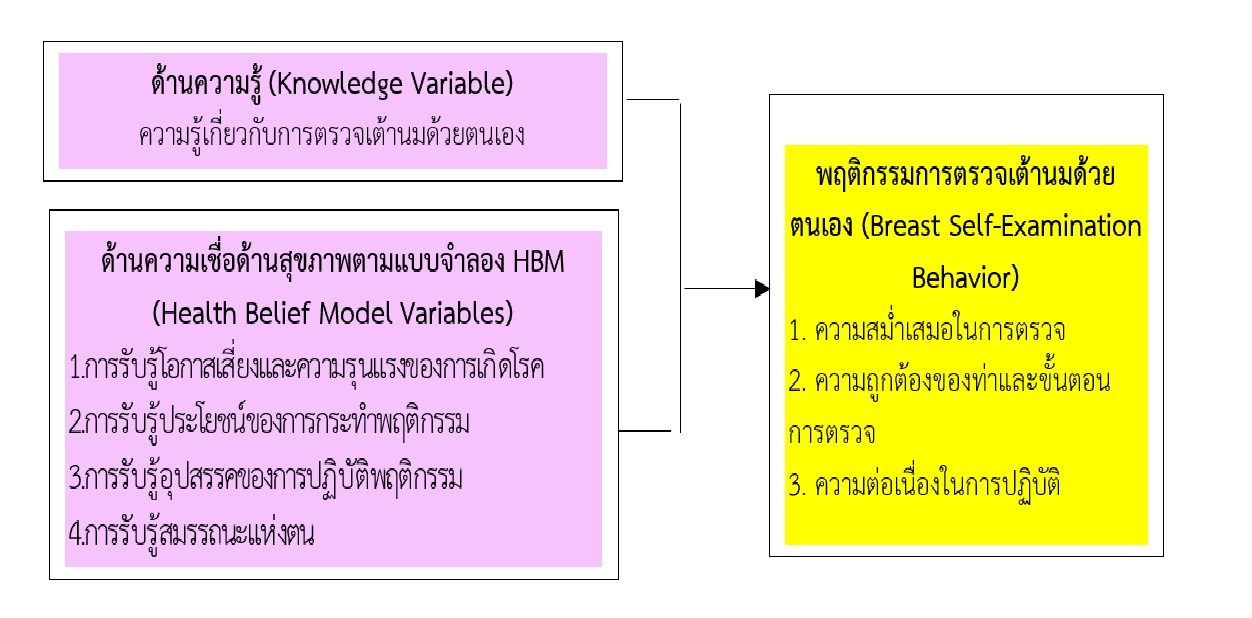
Breast cancer is the most common cancer among women globally. Early screening and detection are crucial for treatment outcomes. Breast Self-Examination (BSE) is a simple, cost-effective screening method. For nursing students, who are future healthcare professionals, possessing appropriate knowledge, health beliefs, and BSE practice is essential. The objectives of this study were to investigate: (1) the level of knowledge regarding BSE, (2) the level of health beliefs about BSE, and (3) the BSE practice behavior among Bachelor of Nursing Science students at Boromarajonani College of Nursing, Chiang Mai. Methods: This was a descriptive research study utilizing the Health Belief Model (HBM) as the conceptual framework. The population consisted of 593 nursing students enrolled in the academic year 2023. A total of 240 samples were selected using stratified and simple random sampling techniques based on the Krejcie & Morgan formula. The research instrument was a 4-part online questionnaire covering: personal data, BSE knowledge (20 items), health beliefs (41 items), and BSE practice behavior (12 items). The content validity index (CVI) for the knowledge and health belief questionnaires was 0.80 and 0.84, respectively, with Cronbach’s Alpha reliability coefficients of 0.82 and 0.88, respectively. Data analysis employed frequency, percentage, mean, and standard deviation. Results: the majority of the samples were aged 18-20 years (57.5%), had regular menstruation (67.5%), and had no history of breast cancer in direct relatives (95.8%). The primary source of knowledge was high school education (25.8%). The mean knowledge level of BSE was at a moderate level (49.17%). The findings indicated that 49.17% of the participants had a correct level of knowledge regarding breast self-examination (BSE). However, all subscales of the Health Belief Model (HBM) were rated at a low level 1) perceived Susceptibility and Severity of Breast Cancer (x̄ = 2.00, S.D.=0.41) 2) perceived benefits of breast self-examination (x̄ = 2.14, S.D.=0.44 3) perceived Barriers to Breast self-examination (x̄ = 1.42, S.D.=0.59 4) self-efficacy for breast self-examination (x̄ = 1.99, S.D.=0.57). Regarding behavior, the majority of students reported performing BSE (77.36%), with the most frequently practiced technique being the standing in front of a mirror position (84.10%). The research results provide baseline data for developing appropriate health promotion programs to effectively enhance breast cancer prevention and early detection. Future research should focus on investigating the relationship between variables of the Health Belief Model and the breast self-examination behavior of nursing students. This is particularly important concerning the monthly regularity and the procedural accuracy of the examination
References
Alkhasawneh, E., Suleiman, K., Akhu-Zaheya, L., & Haymour, Z. (2022). Effect of educational intervention on knowledge, attitude, and practice of breast self-examination among nursing students: A quasi-experimental study. Nurse Education Today, 119, 105552. https://doi.org/10.1016/j.nedt.2022.105552
Arnold, M., Morgan, E., Rumgay, H., Mafra, A., Singh, D., Laversanne, M., et al. (2022). Current and future burden of breast cancer: Global statistics for 2020 and 2040. The Breast, 66, 15-23. https://doi.org/10.1016/j.breast.2022.08.010
Becker, M. H. (1974). The Health Belief Model and personal health behavior. Health Education Monographs, 2, 324–473.
Bloom, B. S. (1971). Handbook on formative and summative evaluation of student learning. McGraw-Hill.
Cathcart-Rake, E. J., Ruddy, K. J., Bleyer, A., & Johnson, R. H. (2021). Breast cancer in adolescent and young adult women under the age of 40 years. JCO Oncology Practice, 17(6), 305-313. https://doi.org/10.1200/OP.20.00793
Demirkiran, F., Balkaya, N. A., Memis, S., Turk, G., Ozvurmaz, S., & Tuncyurek, P. (2007). How do nurses and teachers perform breast self-examination: Are they reliable sources of information? BMC Public Health, 7, 96. https://doi.org/10.1186/1471-2458-7-96
Department of health. (2022). The Department of Health reveals breast cancer as the most prevalent cancer among Thai women, recommending monthly breast self-examinations. Retrieved June 2, 2024 from https://multimedia.anamai.moph.go.th/news/140366/
Genctürk, N., Demirezen, E., & Ay, F. (2015). Health beliefs of nursing faculty students about breast cancer and self breast examination. Journal of Breast Health, 11(4), 190-196. https://doi.org/10.5152/tjbh.2015.2547
Giaquinto, A. N., Sung, H., Miller, K. D., Kramer, J. L., Newman, L. A., Minihan, A., et al. (2022). Breast Cancer Statistics, 2022. CA: A Cancer Journal for Clinicians, 72(6), 524-541. https://doi.org/10.3322/caac.21754
Jitchan, P. & Jitchan, N. (2025). Effects of a self-efficacy promotion program on knowledge of breast cancer and breast self-examination behavior among women in Ubon Ratchathani Province. Journal of Health Promotion and Environmental Health, 19(2), 415-426. https://he02.tci-thaijo.org/index.php/RHPC9Journal/article/view/272429
Khempech, U., Suanpan, N., & Mano, A. (2023). Health Belief Model: Promote breast self-examination in students in higher education. Journal of Nursing and Health Science Research, 15(1), 278-289. https://he01.tci-thaijo.org/index.php/unc/article/view/258786
Kim, J., Harper, A., McCormack, V., Sung, H., Houssami, N., Morgan, E., et al. (2025). Global patterns and trends in breast cancer incidence and mortality across 185 countries. Nature Medicine, 31(4), 1154-1162. https://doi.org/10.1038/s41591-025-03502-3
Komonwipast, N. & Pakdevong, N.-O. (2018). Comparison of Knowledge, Health Belief, and Perceived Self Efficacy Between Female Students Who Performed and Did Not Perform Breast Self Examination. Journal of Research in Nursing Midwifery and Health Sciences, 38(4), 68–78. https://he02.tci-thaijo.org/index.php/nur-psu/article/view/163899
Krejcie, R. V. & Morgan, D. W. (1970). Determining sample size for research activities. Educational and Psychological Measurement, 30(3), 607-610.
Lera, T., Beyene, A., Bekele, B., & Abreha, S. (2020). Breast self-examination and associated factors among women in Wolaita Sodo, Ethiopia: A community-based cross-sectional study. BMC Women’s Health, 20, 167. https://doi.org/10.1186/s12905-020-01042-1
Likert, R. (1932). A technique for the measurement of attitudes. Archives of Psychology, 140, 1-55.
Mano, A., Khempech, U., & Suanpan, N. (2022). Factors Related to Breast Self-Examination Behaviors of Nursing Students. Journal of Nursing and Health Science Research, 14(2), 129-142. (in Thai)
Marzo, R. R., Awisan, J., Bawang, M., & Stewart, H. (2015). Factors associated with breast self-examination practices among junior and senior nursing students in Baguio City. International Journal of Allied Medical Sciences and Clinical Research, 3(2), 100-114. https://doi.org/10.61096/ijamscr.v3.iss2.2015.100-114
Noitung, S., Lapvongwatana, P., & Chansatitporn, N. (2018). Effects of the Health Belief Model Program for Breast Cancer Prevention among Female High School Students in the Bangkok Metropolitan Area. Thai Red Cross Nursing Journal, 11(2),78-94. (in Thai)
Nunnally, J. C. & Bernstein, I. H. (1994). Psychometric theory (3rd ed.). McGraw-Hill.
Pender, N. J., Murdaugh, C. L., & Parsons, M. A. (2015). Health promotion in nursing practice (7th ed.). Pearson Education.
Phimsen, S., Chutima, S., Sormunen, T., & Nagata, T. (2022). Pathum Raksa Project: Addressing disparity in breast cancer care through national innovation in Thailand. Cancer Management and Research, 14, 1-12. https://doi.org/10.2147/CMAR.S335386
Polit, D. F. & Beck, C. T. (2017). Nursing research: Generating and assessing evidence for nursing practice (10th ed.). Wolters Kluwer.
Rosenstock, I. M. (1974). Historical origins of the Health Belief Model. Health Education Monographs, 2, 328–335.
Virani, S., Bilheem, S., Chansaard, W., Chitapanarux, I., Daoprasert, K., Khuanchana, S., et al. (2017). National and Subnational Population-Based Incidence of Cancer in Thailand: Assessing Cancers with the Highest Burdens. Cancers, 9(8), 108. https://doi.org/10.3390/cancers9080108
Sun, Y., Ding, Q., Liu, L., Chen, Y., Chen, W., & Lin, H. (2024). Breast cancer incidence among US women aged 20 to 49 years by race, stage, and hormone receptor status. JAMA Network Open, 7(1), e2350071. https://doi.org/10.1001/jamanetworkopen.2023.50071
Virani, S., Chindaprasirt, J., Wirasorn, K., Sookprasert, A., Somintara, O., Vachirodom, D., et al. (2018). Breast cancer incidence trends and projections in northeastern Thailand. Journal of Epidemiology, 28(7), 323-330. https://doi.org/10.2188/jea.JE20170045
Young Survival Coalition. (2024). Breast cancer statistics. Retrieved from https://youngsurvival.org/breast-cancer-statistics
Downloads
Published
How to Cite
Issue
Section
License
Copyright (c) 2026 Boromarajonani College of Nursing, Nakhon Si Thammarat

This work is licensed under a Creative Commons Attribution-NonCommercial-NoDerivatives 4.0 International License.
บทความที่ได้รับการตีพิมพ์เป็นลิขสิทธิ์ของ วิทยาลัยพยาบาลบรมราชชนนี นครศรีธรรมราช
ข้อความที่ปรากฏในบทความแต่ละเรื่องในวารสารวิชาการเล่มนี้เป็นความคิดเห็นส่วนตัวของผู้เขียนแต่ละท่านไม่เกี่ยวข้องกับวิทยาลัยพยาบาลบรมราชชนนี นครศรีธรรมราช และบุคคลากรท่านอื่น ๆ ในวิทยาลัยฯ แต่อย่างใด ความรับผิดชอบองค์ประกอบทั้งหมดของบทความแต่ละเรื่องเป็นของผู้เขียนแต่ละท่าน หากมีความผิดพลาดใดๆ ผู้เขียนแต่ละท่านจะรับผิดชอบบทความของตนเองแต่ผู้เดียว