Feasibility and Technology Acceptance of a LINE-Based Breastfeeding Support Application Among Mothers of Sick Neonates: A Pilot Study
Keywords:
Feasibility, Technology Acceptance, LINE Official Account Application, Mothers of Sick Newborns, Pilot StudyAbstract
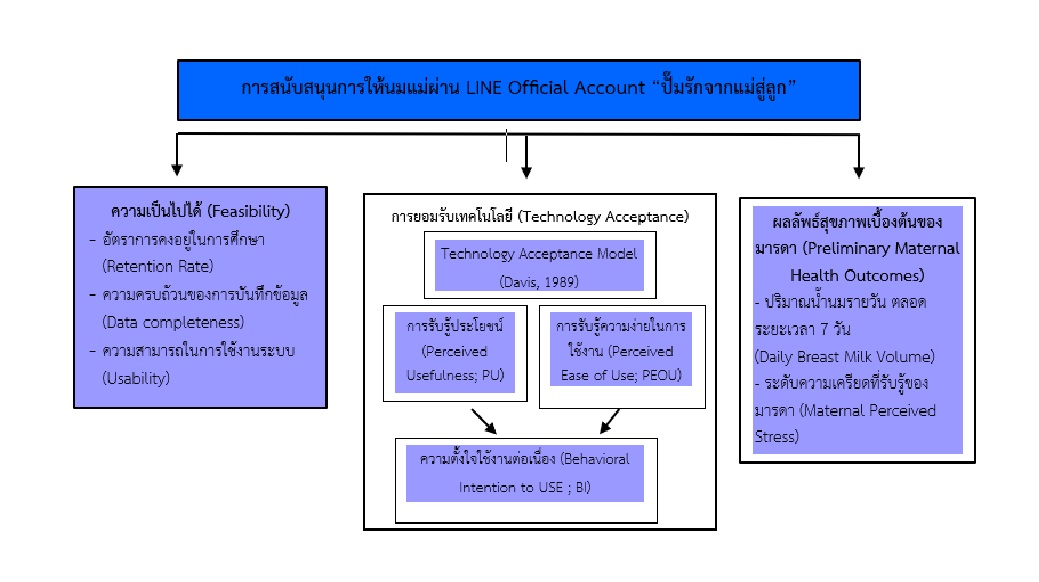
Mothers of sick neonates admitted to neonatal intensive care units often experience stress, maternal–infant separation, and barriers to breastfeeding. This study aimed to develop a breastfeeding support application and to evaluate its feasibility, technology acceptance, and preliminary outcomes regarding breast milk volume and maternal stress. This one-group pretest–posttest pilot study was conducted among 15 mothers of hospitalized neonates at Saraburi Hospital, Thailand, with 14 participants completing the 7-day follow-up period. The “Pump Love from Mother to Baby” breastfeeding support application was developed on the LINE Official Account platform. The application included educational videos on breast milk stimulation and maintenance, breast milk recording functions, and online consultation support. Research instruments included the Technology Acceptance Model (TAM) questionnaire and the Thai Perceived Stress Scale-10 (T-PSS-10). Data were analyzed using descriptive statistics and a paired t-test. The results showed that the retention rate was 93.3%, and the engagement rate was 86.7%, indicating good feasibility of the intervention. Overall, technology acceptance was high (Mean = 3.91, SD = 1.14; n = 14). Exploratory findings showed an increasing trend in breast milk volume during the first 7 postpartum days; however, milk volume data were incomplete at some time points and were therefore presented descriptively to explore preliminary trends only. In addition, maternal stress scores significantly decreased after the intervention (p = .017). These findings suggest that the “Pump Love from Mother to Baby” application is feasible and well-accepted among mothers of sick neonates and may serve as a digital support approach for breastfeeding promotion in this population. Further studies with larger sample sizes and controlled study designs are recommended.
References
ชุติมณฑน์ นวลศรี, อรุณรัตน์ ศรีจันทรนิตย์, และสมสิริ รุ่งอมรรัตน์. (2568). ผลของโปรแกรมการให้ข้อมูลและการสนับสนุนด้านจิตใจผ่านสื่อดิจิทัลต่อความวิตกกังวลของมารดาทารกเกิดก่อนกำหนดในภาวะวิกฤต. วารสารพยาบาลศาสตร์, 43(2), 111–125. https://he02.tci-thaijo.org/index.php/ns/article/view/273104
Almohanna, A. A., Win, K. T., & Meedya, S. (2020). Effectiveness of internet-based electronic technology interventions on breastfeeding outcomes: Systematic review. Journal of Medical Internet Research, 22(5), e17361. https://doi.org/10.2196/17361
Chuektong, C., Nirattharadorn, M., & Buaboon, N. (2023). Breastfeeding self-efficacy enhancement program with LINE application among mothers with cesarean section: A quasi-experimental study. Pacific Rim International Journal of Nursing Research, 27(4), 711–721. https://doi.org/10.60099/prijnr.2023.262349
Davis, F. D. (1989). Perceived usefulness, perceived ease of use, and user acceptance of information technology. MIS Quarterly, 13(3), 319–340. https://doi.org/10.2307/249008
Holditch-Davis, D., & Miles, M. S. (2000). Mothers' stories about their experiences in the neonatal intensive care unit. Neonatal Network, 19(3), 13–21. https://doi.org/10.1891/0730-0832.19.3.13
Kent, J. C., Prime, D. K., & Garbin, C. P. (2012). Principles for maintaining or increasing breastmilk production. Journal of Obstetric, Gynecologic & Neonatal Nursing, 41(1), 114–121. https://doi.org/10.1111/j.1552-6909.2011.01313.x
Kleebpan, S., Apartsakun, P., Chaiyanusak, P., & Kitson-Reynolds, E. (2025). The effect of parental enhancing program with mobile application on parental stress and competence among Thai adolescent postpartum women: A quasi-experimental matched control design. PLOS ONE, 20(10), e0324318. https://doi.org/10.1371/journal.pone.0324318
Lau, Y., Htun, T. P., Tam, W. S. W., & Klainin-Yobas, P. (2016). Efficacy of e-technologies in improving breastfeeding outcomes among perinatal women: A meta-analysis. Maternal & Child Nutrition, 12(3), 381–401. https://doi.org/10.1111/mcn.12202
Medina Poeliniz, C., Hoban, R., Janes, J., & Meier, P. P. (2025). Pumping behaviors of breast pump-dependent mothers of preterm infants in the neonatal intensive care unit (NICU): Importance of the first five postpartum days. Breastfeeding Medicine, 20(7),
–501. https://doi.org/10.1089/bfm.2024.0396
Meek, J. Y., Noble, L., & Section on Breastfeeding. (2022). Policy statement: Breastfeeding and the use of human milk. Pediatrics, 150(1), e2022057988. https://doi.org/10.1542/peds.2022-057988
Neville, M. C., Demerath, E. W., Hahn-Holbrook, J., Hovey, R. C., Martin-Carli, J., McGuire, M. A., & Rudolph, M. C. (2023). Parental factors that impact the ecology of human mammary development, milk secretion, and milk composition. American Journal of Clinical
Nutrition, 117(Suppl 1), S11–S27. https://doi.org/10.1016/j.ajcnut.2022.11.026
Rai, S., da Silva, O., Angelini, M., Christmas, M., & Geoghegan-Morphet, N. (2018). Maternal Virtual Infant Nutrition Support Clinic for the Neonatal Intensive Care Unit (MAVINS-NICU): A qualitative study. Pediatrics & Child Health, 23(Suppl 1), e28. https://doi.org/10.1093/pch/pxy054.072
Schwab, I., Ohnhaeuser, T., Rothe, R. L., Dresbach, T., Schmitz, K., Tutzer, N., Dymek, N. G., Köberlein-Neu, J., & Scholten, N. (2025). The Neo-MILK web app as a health technology to support mothers of preterm and sick neonates during lactation: Usability study. JMIR Pediatrics and Parenting, 8, e69079. https://doi.org/10.2196/69079
Srichalerm, T., Jacelon, C. S., Sibeko, L., Granger, J., & Briere, C. E. (2024). Thai novice nurses' lived experiences and perspectives of breastfeeding and human milk in the Neonatal Intensive Care Unit (NICU). International Breastfeeding Journal, 19, 20. https://doi.org/10.1186/s13006-024-00620-5
Thabane, L., Ma, J., Chu, R., Cheng, J., Ismaila, A., Rios, L. P., Robbins, L., Gafni, A., Kaczorowski,
J., & Goldsmith, C. H. (2010). A tutorial on pilot studies: The what, why and how. BMC Medical Research Methodology, 10, 1. https://doi.org/10.1186/1471-2288-10-1
UNICEF Thailand. (2023). UNICEF finds 1 in 3 mothers in Thailand exclusively breastfeed their babies, far below target. https://www.unicef.org/thailand/press-releases/unicef-finds-1-3-mothers-thailand-exclusively-breastfeed-their-babies-far-below
Vermont Oxford Network. (2019). Infants receiving human milk at discharge varies internationally.
Victora, C. G., Bahl, R., Barros, A. J. D., França, G. V. A., Horton, S., Krasevec, J., Murch, S., Sankar, M. J., Walker, N., & Rollins, N. C. (2016). Breastfeeding in the 21st century: Epidemiology, mechanisms, and lifelong effect. Lancet, 387(10017), 475–490.
https://doi.org/10.1016/S0140-6736(15)01024-7
World Health Organization. (2023). Infant and young child feeding. Retrieved January 10, 2025, from
https://www.who.int/news-room/fact-sheets/detail/infant-and-young-child-feeding
Wongpakaran, N., & Wongpakaran, T. (2010). The Thai version of the PSS-10: An investigation of its psychometric properties. Biopsychosocial Medicine, 4, 6. https://doi.org/10.1186/1751-0759-4-6
Yang, Y., Brandon, D., Lu, H., & Cong, X. (2019). Breastfeeding experiences and perspectives on support among Chinese mothers separated from their hospitalized preterm infants: A qualitative study. International Breastfeeding Journal, 14, 45. https://doi.org/10.1186/s13006-019-0242-9
Downloads
Published
How to Cite
Issue
Section
License
Copyright (c) 2026 Boromarajonani College of Nursing, Nakhon Si Thammarat

This work is licensed under a Creative Commons Attribution-NonCommercial-NoDerivatives 4.0 International License.
บทความที่ได้รับการตีพิมพ์เป็นลิขสิทธิ์ของ วิทยาลัยพยาบาลบรมราชชนนี นครศรีธรรมราช
ข้อความที่ปรากฏในบทความแต่ละเรื่องในวารสารวิชาการเล่มนี้เป็นความคิดเห็นส่วนตัวของผู้เขียนแต่ละท่านไม่เกี่ยวข้องกับวิทยาลัยพยาบาลบรมราชชนนี นครศรีธรรมราช และบุคคลากรท่านอื่น ๆ ในวิทยาลัยฯ แต่อย่างใด ความรับผิดชอบองค์ประกอบทั้งหมดของบทความแต่ละเรื่องเป็นของผู้เขียนแต่ละท่าน หากมีความผิดพลาดใดๆ ผู้เขียนแต่ละท่านจะรับผิดชอบบทความของตนเองแต่ผู้เดียว