ความเป็นไปได้และการยอมรับเทคโนโลยีของการสนับสนุนการให้นมแม่ผ่าน LINE Official Account ในมารดาที่มีทารกแรกเกิดป่วยที่เข้ารับการรักษาในหออภิบาลทารกแรกเกิด: การศึกษานำร่อง
คำสำคัญ:
ความเป็นไปได้ในการใช้งาน, การยอมรับเทคโนโลยี, แอปพลิเคชันไลน์ออฟฟิเชียล, มารดาทารกแรกเกิดป่วย, การศึกษานำร่องบทคัดย่อ
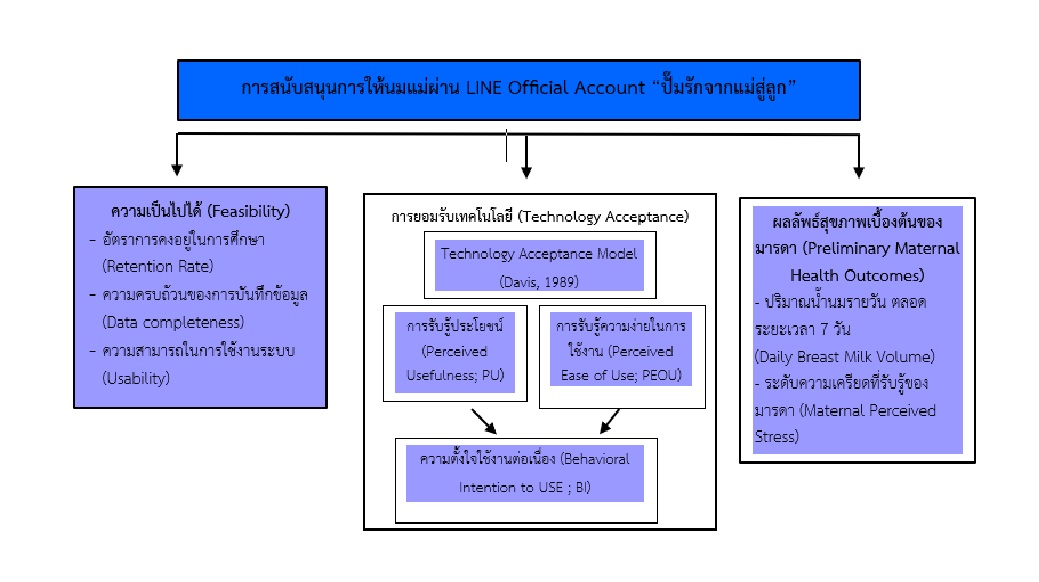
นมแม่มีความสำคัญอย่างยิ่งต่อทารกป่วย โดยช่วยเสริมสร้างภูมิคุ้มกัน ลดความเสี่ยงต่อการติดเชื้อและภาวะลำไส้เน่า รวมทั้งส่งเสริมการเจริญเติบโตและพัฒนาการทางระบบประสาท อย่างไรก็ตาม มารดาที่มีทารกแรกเกิดป่วยซึ่งเข้ารับการรักษาในหออภิบาลทารกแรกเกิดมักเผชิญกับความเครียด การแยกจากบุตร และข้อจำกัดในการให้นมแม่ การศึกษานำร่องแบบกลุ่มเดียววัดก่อนและหลังนี้มีวัตถุประสงค์เพื่อประเมินความเป็นไปได้และการยอมรับเทคโนโลยีของการสนับสนุนการให้นมแม่ผ่าน LINE Official Account “ปั๊มรักจากแม่สู่ลูก” รวมทั้งสำรวจผลลัพธ์เบื้องต้นด้านปริมาณน้ำนมและความเครียดของมารดา เพื่อใช้ในการพัฒนานวัตกรรมก่อนวิจัยฉบับเต็ม ดำเนินการในมารดาที่มีทารกแรกเกิดป่วยในหออภิบาลทารกแรกเกิด โรงพยาบาลสระบุรี จำนวน 15 ราย เครื่องมือวิจัย ได้แก่ แอปพลิเคชัน LINE Official Account “ปั๊มรักจากแม่สู่ลูก” ประกอบด้วยวีดิทัศน์ให้ความรู้เกี่ยวกับการกระตุ้นและการคงไว้ซึ่งน้ำนม ระบบบันทึกปริมาณน้ำนม และระบบให้คำปรึกษาออนไลน์ แบบสอบถามการยอมรับเทคโนโลยีตามแนวคิด Technology Acceptance Model และแบบประเมินความเครียดฉบับภาษาไทย (Thai Perceived Stress Scale-10: T-PSS-10) วิเคราะห์ข้อมูลด้วยสถิติเชิงพรรณนาและสถิติทีคู่ ผลการศึกษาพบว่าความเป็นไปได้ในการใช้งานของแอปพลิเคชันอยู่ในระดับดี โดยมีอัตราการคงอยู่ในการศึกษาร้อยละ 93.3 และมารดาร้อยละ 57.1 บันทึกข้อมูลปริมาณน้ำนมผ่านระบบแอปพลิเคชันอย่างน้อย 1 ครั้ง โดยไม่นับรวมข้อมูลการนำส่งน้ำนมที่ผู้วิจัยบันทึกแยกต่างหาก ณ หออภิบาลทารกแรกเกิด การยอมรับเทคโนโลยีโดยรวมอยู่ในระดับมาก (Mean = 3.91, SD = 1.14) ปริมาณน้ำนมมีแนวโน้มเพิ่มขึ้นในช่วง 7 วันหลังคลอด และความเครียดหลังการทดลองลดลงอย่างมีนัยสำคัญทางสถิติ (p = .017)
ผลการศึกษาสะท้อนว่าแอปพลิเคชัน "ปั๊มรักจากแม่สู่ลูก" มีความเป็นไปได้ในการใช้งานและได้รับการยอมรับทางเทคโนโลยีในระดับดีในมารดาที่มีทารกแรกเกิดป่วย อย่างไรก็ตาม ยังพบข้อจำกัดด้านความครบถ้วนของการบันทึกข้อมูล ซึ่งควรนำไปปรับปรุงนวัตกรรมก่อนการศึกษาประสิทธิผลในระยะต่อไป แอปพลิเคชันนี้อาจเป็นแนวทางหนึ่งในการพัฒนาระบบสนับสนุนการให้นมแม่สำหรับมารดาที่มีทารกแรกเกิดป่วยในอนาคต โดยควรมีการศึกษาต่อยอดในกลุ่มตัวอย่างขนาดใหญ่และมีกลุ่มควบคุมต่อไป
เอกสารอ้างอิง
ชุติมณฑน์ นวลศรี, อรุณรัตน์ ศรีจันทรนิตย์, และสมสิริ รุ่งอมรรัตน์. (2568). ผลของโปรแกรมการให้ข้อมูลและการสนับสนุนด้านจิตใจผ่านสื่อดิจิทัลต่อความวิตกกังวลของมารดาทารกเกิดก่อนกำหนดในภาวะวิกฤต. วารสารพยาบาลศาสตร์, 43(2), 111–125. https://he02.tci-thaijo.org/index.php/ns/article/view/273104
Almohanna, A. A., Win, K. T., & Meedya, S. (2020). Effectiveness of internet-based electronic technology interventions on breastfeeding outcomes: Systematic review. Journal of Medical Internet Research, 22(5), e17361. https://doi.org/10.2196/17361
Chuektong, C., Nirattharadorn, M., & Buaboon, N. (2023). Breastfeeding self-efficacy enhancement program with LINE application among mothers with cesarean section: A quasi-experimental study. Pacific Rim International Journal of Nursing Research, 27(4), 711–721. https://doi.org/10.60099/prijnr.2023.262349
Davis, F. D. (1989). Perceived usefulness, perceived ease of use, and user acceptance of information technology. MIS Quarterly, 13(3), 319–340. https://doi.org/10.2307/249008
Holditch-Davis, D., & Miles, M. S. (2000). Mothers' stories about their experiences in the neonatal intensive care unit. Neonatal Network, 19(3), 13–21. https://doi.org/10.1891/0730-0832.19.3.13
Kent, J. C., Prime, D. K., & Garbin, C. P. (2012). Principles for maintaining or increasing breastmilk production. Journal of Obstetric, Gynecologic & Neonatal Nursing, 41(1), 114–121. https://doi.org/10.1111/j.1552-6909.2011.01313.x
Kleebpan, S., Apartsakun, P., Chaiyanusak, P., & Kitson-Reynolds, E. (2025). The effect of parental enhancing program with mobile application on parental stress and competence among Thai adolescent postpartum women: A quasi-experimental matched control design. PLOS ONE, 20(10), e0324318. https://doi.org/10.1371/journal.pone.0324318
Lau, Y., Htun, T. P., Tam, W. S. W., & Klainin-Yobas, P. (2016). Efficacy of e-technologies in improving breastfeeding outcomes among perinatal women: A meta-analysis. Maternal & Child Nutrition, 12(3), 381–401. https://doi.org/10.1111/mcn.12202
Medina Poeliniz, C., Hoban, R., Janes, J., & Meier, P. P. (2025). Pumping behaviors of breast pump-dependent mothers of preterm infants in the neonatal intensive care unit (NICU): Importance of the first five postpartum days. Breastfeeding Medicine, 20(7),
–501. https://doi.org/10.1089/bfm.2024.0396
Meek, J. Y., Noble, L., & Section on Breastfeeding. (2022). Policy statement: Breastfeeding and the use of human milk. Pediatrics, 150(1), e2022057988. https://doi.org/10.1542/peds.2022-057988
Neville, M. C., Demerath, E. W., Hahn-Holbrook, J., Hovey, R. C., Martin-Carli, J., McGuire, M. A., & Rudolph, M. C. (2023). Parental factors that impact the ecology of human mammary development, milk secretion, and milk composition. American Journal of Clinical
Nutrition, 117(Suppl 1), S11–S27. https://doi.org/10.1016/j.ajcnut.2022.11.026
Rai, S., da Silva, O., Angelini, M., Christmas, M., & Geoghegan-Morphet, N. (2018). Maternal Virtual Infant Nutrition Support Clinic for the Neonatal Intensive Care Unit (MAVINS-NICU): A qualitative study. Pediatrics & Child Health, 23(Suppl 1), e28. https://doi.org/10.1093/pch/pxy054.072
Schwab, I., Ohnhaeuser, T., Rothe, R. L., Dresbach, T., Schmitz, K., Tutzer, N., Dymek, N. G., Köberlein-Neu, J., & Scholten, N. (2025). The Neo-MILK web app as a health technology to support mothers of preterm and sick neonates during lactation: Usability study. JMIR Pediatrics and Parenting, 8, e69079. https://doi.org/10.2196/69079
Srichalerm, T., Jacelon, C. S., Sibeko, L., Granger, J., & Briere, C. E. (2024). Thai novice nurses' lived experiences and perspectives of breastfeeding and human milk in the Neonatal Intensive Care Unit (NICU). International Breastfeeding Journal, 19, 20. https://doi.org/10.1186/s13006-024-00620-5
Thabane, L., Ma, J., Chu, R., Cheng, J., Ismaila, A., Rios, L. P., Robbins, L., Gafni, A., Kaczorowski,
J., & Goldsmith, C. H. (2010). A tutorial on pilot studies: The what, why and how. BMC Medical Research Methodology, 10, 1. https://doi.org/10.1186/1471-2288-10-1
UNICEF Thailand. (2023). UNICEF finds 1 in 3 mothers in Thailand exclusively breastfeed their babies, far below target. https://www.unicef.org/thailand/press-releases/unicef-finds-1-3-mothers-thailand-exclusively-breastfeed-their-babies-far-below
Vermont Oxford Network. (2019). Infants receiving human milk at discharge varies internationally.
Victora, C. G., Bahl, R., Barros, A. J. D., França, G. V. A., Horton, S., Krasevec, J., Murch, S., Sankar, M. J., Walker, N., & Rollins, N. C. (2016). Breastfeeding in the 21st century: Epidemiology, mechanisms, and lifelong effect. Lancet, 387(10017), 475–490.
https://doi.org/10.1016/S0140-6736(15)01024-7
World Health Organization. (2023). Infant and young child feeding. Retrieved January 10, 2025, from
https://www.who.int/news-room/fact-sheets/detail/infant-and-young-child-feeding
Wongpakaran, N., & Wongpakaran, T. (2010). The Thai version of the PSS-10: An investigation of its psychometric properties. Biopsychosocial Medicine, 4, 6. https://doi.org/10.1186/1751-0759-4-6
Yang, Y., Brandon, D., Lu, H., & Cong, X. (2019). Breastfeeding experiences and perspectives on support among Chinese mothers separated from their hospitalized preterm infants: A qualitative study. International Breastfeeding Journal, 14, 45. https://doi.org/10.1186/s13006-019-0242-9
ดาวน์โหลด
เผยแพร่แล้ว
รูปแบบการอ้างอิง
ฉบับ
ประเภทบทความ
สัญญาอนุญาต
ลิขสิทธิ์ (c) 2026 วิทยาลัยพยาบาลบรมราชชนนี นครศรีธรรมราช

อนุญาตภายใต้เงื่อนไข Creative Commons Attribution-NonCommercial-NoDerivatives 4.0 International License.
บทความที่ได้รับการตีพิมพ์เป็นลิขสิทธิ์ของ วิทยาลัยพยาบาลบรมราชชนนี นครศรีธรรมราช
ข้อความที่ปรากฏในบทความแต่ละเรื่องในวารสารวิชาการเล่มนี้เป็นความคิดเห็นส่วนตัวของผู้เขียนแต่ละท่านไม่เกี่ยวข้องกับวิทยาลัยพยาบาลบรมราชชนนี นครศรีธรรมราช และบุคคลากรท่านอื่น ๆ ในวิทยาลัยฯ แต่อย่างใด ความรับผิดชอบองค์ประกอบทั้งหมดของบทความแต่ละเรื่องเป็นของผู้เขียนแต่ละท่าน หากมีความผิดพลาดใดๆ ผู้เขียนแต่ละท่านจะรับผิดชอบบทความของตนเองแต่ผู้เดียว