
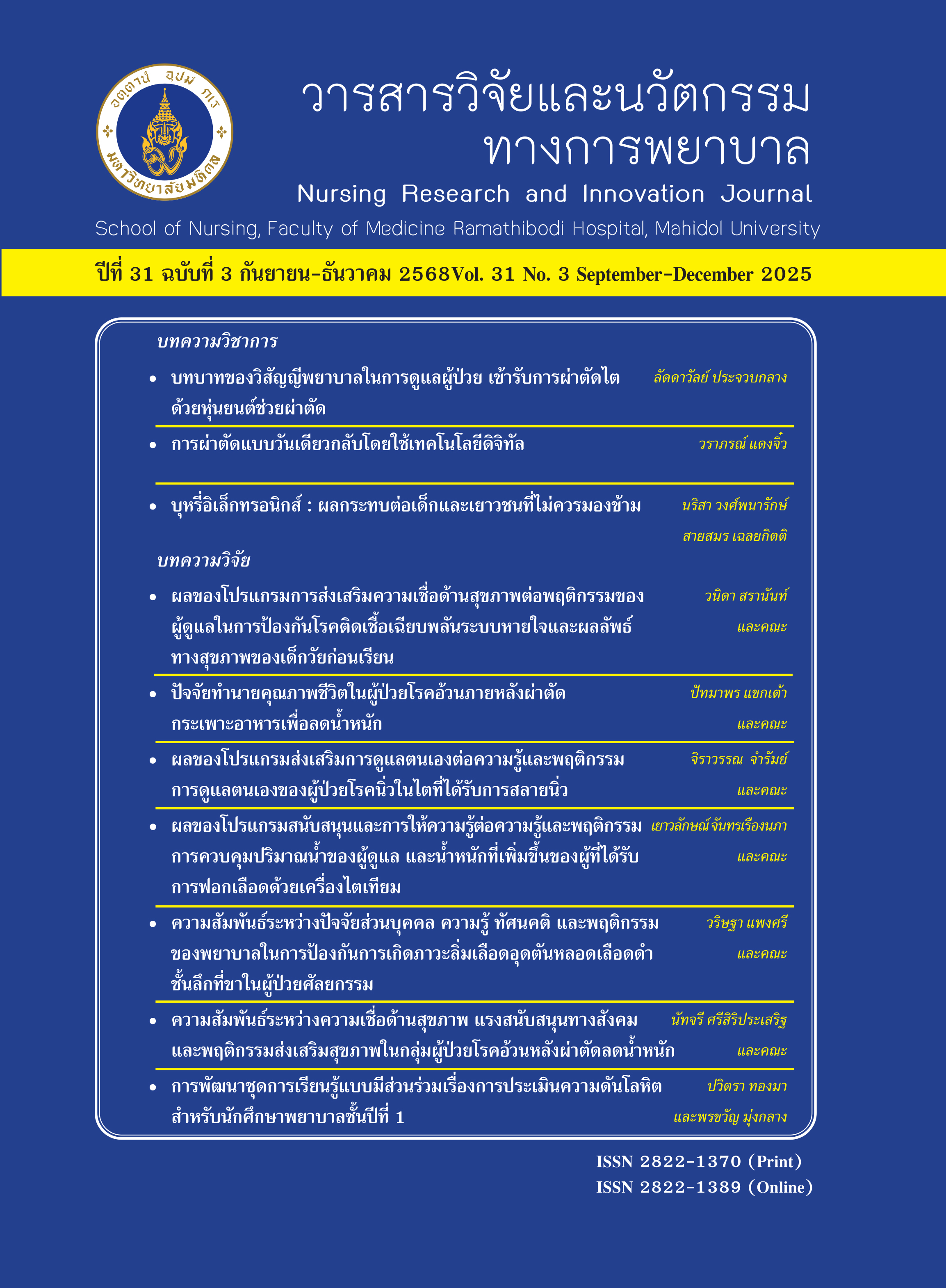
ผลของโปรแกรมการส่งเสริมความเชื่อด้านสุขภาพต่อพฤติกรรมของผู้ดูแลในการป้องกันโรคติดเชื้อเฉียบพลันระบบหายใจและผลลัพธ์ทางสุขภาพของเด็กวัยก่อนเรียน
Article Sidebar
Main Article Content
บทคัดย่อ
โรคติดเชื้อเฉียบพลันระบบหายใจถือเป็นปัญหาด้านสาธาณสุขที่สำคัญ โดยเฉพาะในเด็กวัยก่อนเรียน ซึ่งยังมีภูมิคุ้มกันต่ำและระบบทางเดินหายใจที่ยังพัฒนาไม่สมบูรณ์ ทำให้เสี่ยงต่อการติดเชื้อได้เฉลี่ยปีละ 6-8 ครั้ง หากไม่ได้การดูแลอย่างเหมาะสม อาจเกิดภาวะแทรกซ้อนหรือรุนแรงถึงขั้นเสียชีวิต แม้ว่าความก้าวหน้าทางการแพทย์จะช่วยเพิ่มอัตรการรวดชีวิต แต่อัตราการป่วยยังคงอยู่ในระดับสูง ปัจจัยที่มีผลต่อการเกิดโรคสามารถจำแนกได้เป็น 3 ด้านหลัก ได้แก่ ปัจจัยด้านเด็ก ปัจจัยด้านผู้ดูแล และปัจจัยด้านสิ่งแวดล้อม โดยเฉพาะบทบาทของผู้ดูแลมีความสำคัญอย่างยิ่งต่อการเผ้าระวัง การป้องกัน และการตัดสินใจเข้ารับบริการทางการแพทย์ได้อย่างทันท่วงทีแบบแผนความเชื่อด้านสุขภาพ (Health Belief Model) เป็นกรอบแนวคิดที่ใช้ในการส่งเสริมพฤติกรรมสุขภาพ โดยเน้นการรับรู้ความเสี่ยง ความรุนแรงของโรค ประโยชน์ของพฤติกรรม และการลดอุปสรรค เพื่อกระตุ้นให้เกิดพฤติกรรมที่เหมาะสม งานวิจัยที่ผ่านมาได้นำแนวคิดนี้ไปใช้ในกลุ่มผู้ป่วยโรคเรื้อรังเป็นหลัก แต่ยังไม่มีการศึกษาที่ประยุกต์ใช้กับผู้ดูแลเด็กวัยก่อนเรียนในการป้องกันโรคติดเชื้อเฉียบพลันระบบหายใจ อีกทั้งยังขาดการประเมินผลลัพธ์ในระยะยาว การวิจัยครั้งนี้เป็นการวิจัยกึ่งทดลอง เพื่อศึกษาผลของโปรแกรมการส่งเสริมความเชื่อด้านสุขภาพต่อพฤติกรรมของผู้ดูแลในการป้องกันโรคติดเชื้อเฉียบพลันระบบหายใจและผลลัพธ์ทางสุขภาพของเด็กวัยก่อนเรียนโดยมีวัตถุประสงค์ 1) เพื่อเปรียบเทียบพฤติกรรมการป้องกันโรคติดเชื้อเฉียบพลันระบบหายใจของผู้ดูแลหลังสิ้นสุดการทดลอง ระหว่างกลุ่มทดลองและกลุ่มควบคุม 2) เพื่อเปรียบเทียบพฤติกรรมการป้องกันโรคติดเชื้อเฉียบพลันระบบหายใจของผู้ดูแลเด็กกุล่มทดลอง ก่อนและหลังการทดลอง 3) เพื่อเปรียบเทียบผลลัพธ์ด้านสุขภาพเด็กในกลุ่มควบคุมและกลุ่มทดลอง กลุ่มตัวอย่างเป็นผู้ดูแลเด็กระหว่างอายุ 2-6 ปี แบ่งเป็นกลุ่มควบคุมและกลุ่มทดลอง กลุ่มละ 34 ราย โดยกลุ่มทดลองได้รับโปรแกรมการส่งเสริมความเชื่อด้านสุขภาพ เป็นการให้ข้อมูลเกี่ยวกับสาเหตุและความเสี่ยงของโรค พร้อมกระตุ้นความตระหนัก เน้นความรุนแรงของโรคโดยชี้ให้เห็นประโยชน์ของการป้องกันโรค และลดอุปสรรคในการปฏิบัติ ฝึกทักษะที่เกี่ยวข้องกับการป้องกันโรค ได้แก่ การล้างมือ การสวมหน้ากากอนามัย การเช็ดตัวลดไข้ และการล้างจมูก และติดตามกระตุ้นอย่างต่อเนื่องทางโทรศัพท์เป็นระยะเวลา 8 สัปดาห์ ขณะที่กลุ่มควบคุมได้รับการพยาบาลและดูแลเด็กตามแนวทางปฏิบัติปกติของตนเองที่บ้าน เก็บรวบรวมข้อมูลโดยใช้แบบสอบถามข้อมูลส่วนบุคคลแบบสอบถามพฤติกรรมการป้องกันโรคติดเชื้อเฉียบพลันระบบหายใจ และแบบวัดผลลัพธ์ด้านสุขภาพของเด็ก วิเคราะห์ข้อมูลด้วยสถิติการแจกแจงความถี่ ร้อยละ ค่าเฉลี่ย ส่วนเบี่ยงเบนมาตรฐานและสถิติ ANCOVA
ผลการวิจัยพบว่า กลุ่มตัวอย่างในการศึกษาครั้งนี้ เป็นผู้ดูแลเด็กจำนวน 68 คน ประกอบด้วย เพศหญิงร้อยละ 31.18 และเพศชายร้อยละ 8.82 มีอายุระหว่าง 20-65 ปี ส่วนใหญ่อายุ 30-39 ปี จบการศึกษาระดับต่ำกว่ามัธยมศึกษาตอนปลาย ร้อยละ 33.82 ส่วนใหญ่มีสถานภาพสมรส ร้อยละ 67.65 มีบุตร 1-2 คน ร้อยละ 73.53 รายได้ต่อเดือนระหว่าง 10,001-20,000 บาท ร้อยละ 47.06 เมื่อเปรียบเทียบข้อมูลทั่วไปของกลุ่มตัวอย่างระหว่างกลุ่มทดลองและกลุ่มควบคุมพบว่าไม่มีความแตกต่างอย่างมีนัยสำคัญทางสถิติที่ระดับ .05 แสดงให้เห็นว่ากลุ่มตัวอย่างทั้งสองกลุ่มมีคุณลักษณะทั่วไปใกล้เคียงกัน ผู้ดูแลเด็กกลุ่มทดลอง มีค่าเฉลี่ยคะแนนพฤติกรรมในการป้องกันโรคติดเชื้อเฉียบพลันระบบหายใจหลังการเข้าร่วมกิจกรรมสูงกว่าผู้ดูแลเด็กกลุ่มควบคุม (F1,65 = 25.46, p = < .001).และสูงกว่าก่อนเข้าร่วมอย่างมีนัยสำคัญทางสถิติ (t = -5.13, p < .001))แสดงว่าโปรแกรมนี้ส่งผลให้พฤติกรรมการป้องกันโรคในกลุ่มผู้ดูแลเด็กเพิ่มขึ้น จากโปรแกรมการส่งเสริมความเชื่อด้านสุขภาพที่ผู้วิจัยดำเนินการ สามารถสรุปได้ว่าพฤติกรรมการดูแลเด็กเกี่ยวกับโรคติดเชื้อเฉียบพลันระบบหายใจเพิ่มขึ้นหลังการทดลอง อย่างไรก็ตาม ผลลัพธ์ดังกล่าวอาจไม่ได้เกิดจากแนวคิดความเชื่อด้านสุขภาพเพียงอย่างเดียว แต่เกิดจากแนวคิดและกิจกรรมเพิ่มเติม เช่น การจัดการฝึกทักษะ การสนับสนุนทางสังคม และการให้ข้อมูลข่าวสารร่วมด้วย การให้ความรู้ตามแบบแผนความเชื่อด้านสุขภาพถือมีความจำเป็นอย่างยิ่ง เพราะช่วยส่งเสริมให้ผู้ดูแลมีพฤติกรรมที่เหมาะสมต่อการป้องกันโรคติดเชื้อเฉียบพลันระบบหายใจที่เหมาะสม การศึกษาผลลัพธ์ทางสุขภาพของเด็กในงานวิจัยนี้พบว่าไม่มีความแตกต่างกันอย่างมีนัยสำคัญทางสถิติ อาจเป็นผลมาจากปัจจัยภายนอกเช่น การระบาดของโควิด-19 ที่เพิ่มการตื่นตัวในการดูแลสุขภาพของประชาชน และระยะเวลาในการติดตามผลลัพธ์ซึ่งอาจยังไม่เพียงพอ ผลการวิจัยครั้งนี้เสนอแนะว่า บุคลากรสุขภาพควรใช้โปรแกรมการส่งเสริมความเชื่อด้านสุขภาพไปประยุกต์ใช้ในการให้ความรู้ส่งเสริมพฤติกรรมของผู้ดูแลเด็กวัยก่อนเรียนในการป้องกันโรคติดเชื้อเฉียบพลันระบบหายใจ เพื่อส่งเสริมพฤติกรรมการป้องกันโรคติดเชื้อเฉียบพลันระบบหายใจได้อย่างมีประสิทธิภาพ โดยการออกแบบโปรแกรมให้เหมาะสมกับบริบทของสถานบริการสุขภาพและติดตามผลอย่างต่อเนื่อง การศึกษาครั้งต่อไปควรขยายระยะเวลาเป็น 6-12 เดือน เพื่อประเมินความคงอยู่ของพฤติกรรมการป้องกันโรคติดเชื้อเฉียบพลันระบบหายใจและผลกระทบต่อสุขภาพเด็กอย่างชัดเจน นอกจากนี้ ควรออกแบบการศึกษาที่สามารถควบคุมตัวแปรแทรกซ้อนให้รัดกุมยิ่งขึ้น เช่น การขยายระยะเวลาติดตามผล การใช้ตัวชี้วัดที่ครอบคลุมทั้งเชิงพฤติกรรมและผลลัพธ์ทางสุขภาพ และศึกษาปัจจัยที่มีผลต่อการนำโปรแกรมไปใช้จริงในบริบทต่าง ๆ เพื่อให้สามารถขยายผลและประยุกต์ใช้ได้อย่างมีประสิทธิภาพในระดับชุมชนและสถานพยาบาล
คำสำคัญ : พฤติกรรมของผู้ดูแล โปรแกรมส่งเสริมความเชื่อด้านสุขภาพ ผลลัพธ์ทางสุขภาพเด็กวัยก่อนเรียน การป้องกันโรคติดเชื้อเฉียบพลันระบบหายใจ
Article Details

อนุญาตภายใต้เงื่อนไข Creative Commons Attribution-NonCommercial-NoDerivatives 4.0 International License.
บทความ ข้อมูล เนื้อหา รูปภาพ ฯลฯ ที่ได้รับการตีพิมพ์ในรามาธิบดีพยาบาลสาร ถือเป็นลิขสิทธิ์ของวารสาร หากบุคคลหรือหน่วยงานใดต้องการนำทั้งหมดหรือส่วนหนึ่งส่วนใดไปเผยแพร่หรือเพื่อกระทำการใด ใด จะต้องได้รับอนุญาตเป็นลายลักษณ์อักษรจากรามาธิบดีพยาบาลสารก่อนเท่านั้น
เอกสารอ้างอิง
Thai Pediatric Respiratory and Critical Care Society. Guideline for the management of acute respiratory infections in children [Internet]. Nonthaburi: Beyond and Type. 2019. [cited 2020 Jul 9]. Available from: https://www.pidst.or.th/A750.mobile?action=download&file= 859_FILE_49233e526c05cec19b6cb7e1a4391654_DOWNLOAD.pdf
World Health Organization. Levels and trends in child under-5 mortality in 2020 [Internet]. Geneva: World Health Organization; 2020. [cited 2022 Mar 23]. Available from: https://www.who.int/news-room/fact-sheets/detail/levels-and-trends-in-child-under-5-mortality-in-2020
Department of Epidemiology, Ministry of Public Health. Disease surveillance report 506 [Internet]. Nonthaburi: Ministry of Public Health; 2022. [cited 2022 Mar 25]. Available from: http://doe.moph.go.th/surdata/506wk/y63/d15_5263.pdf. (in Thai)
ThaiHealth. Acute respiratory infections. ThaiHealth [Internet]. Bangkok: ThaiHealth; 2018. [cited 2023 Mar 8]. Available from: https://www.thaihealth.or.th. (in Thai)
Kantahong K. Children with acute illness admitted to the hospital. Nursing Journal of the Faculty of Nursing, Chiang Mai University [Internet]. 2015;42(3):1–12. [cited 2023 Mar 19]. Available from: https://he02.tcithaijo.org/index.php/cmunursing/article/view/43418. (in Thai)
Phuphaibul R. Nursing care planning for healthy and ill children. Bangkok: Thammasat University; 2015. (in Thai)
Monroe RA. Health promotion of the preschooler and family. In: Hockenberry MJ, Wilson D, editors. Wong’s nursing care of infants and children. St. Louis: Mosby; 2015. p. 572-650.
Kaewsuk C, Pongjaturawit Y, Chaimongkol N. Factors associated with maternal behaviors in preventing acute respiratory infections in preschool children. Journal of Faculty of Nursing, Burapha University. 2016;24(4):54-64. (in Thai)
Janie BB, Karen LR, editors. Philosophies and theories for advanced nursing practice. Boston: Jones & Bartlett Learning; 2015.
Srikotr A, Jintrawe U, Mesukko J. Factors predicting care behaviors of caregivers to prevent respiratory tract infection in children with congenital heart disease. Nursing Journal of Chiang Mai University. 2018;45(4):14-25. [cited 2022 Dec 25]. Available from: https://he02.tci-thaijo.org/index.php/cmunursing/article/view/162574. (in Thai)
Moss P, Khandekar N. The impact of education on caregivers’ knowledge and behavior regarding respiratory infection prevention in children. J Pediatr Nurs. 2016;31(5):421-9. doi: 10.1016/j.pedn.2016. 03.004.
Alosaimi FD, Alzahrani SH, Alblowi SA, et al. Knowledge, attitudes, and practices regarding respiratory infections in children: a cross-sectional study. J Family Med Prim Care. 2020;9(1):373-8. doi: 10.4103/jfmpc.jfmpc_1382_19.
Lamchang S, Niyomkar S, Junpunyaskoo O, Lamchang P, Chontawan R. Factors related to perceived severity of illness among caregivers of children with respiratory infection. Nursing Journal of Chiang Mai University. 2015;42(3):13-22. [cited 2022 May 5]. Available from: https://he02.tci-thaijo.org/index.php/cmunursing/article/view/43418. (in Thai)
Laemthaisong J. Factors predicting preventive behaviors of respiratory infected diseases among caregivers of preschool children in child care centers, Bangkok [thesis].Chonburi: Burapha University; 2016. (in Thai)
Zarei N, Vahidi R, Tabrizi JS, et al. The effect of Health Belief Model-based education on prevention of respiratory infections in children. J Pediatr Nurs. 2020;53:84-90. doi: 10.1016/j.pedn.2020.04.014.
Gibson EG, Gage JC, Castle PE, Scarinci IC. Perceived susceptibility to cervical cancer among African American women in the Mississippi Delta: does adherence to screening matter? Womens Health Issues. 2019;29(1):38-47. doi: 10.1016/j.whi.2018. 09.006.
Zampetakis LA, Melas C. The health belief model predicts vaccination intentions against COVID-19: a survey experiment approach. Appl Psychol Health Well Being. 2021;13(2):469-84. doi: 10.1111/aphw.12262.
Bazargani Z, Sarikhani F, Darenjani SK, et al. Effect of educational intervention based on the health belief model on promoting preventive behaviours of urinary tract infections in mothers with children under 6 years of age. BMC Womens Health. 2022;22(1):409. doi: 10.1186/s12905-022-01981-x.
Danpradit P, Prasitsary N. Effects of the health belief model educational program on perceptions and preventive behaviors of COVID-19 in secondary school students. Vajira Medical Journal. 2023;67(3):575-582. doi: 10.14456/vmj.2023.19. (in Thai)
Jetnipit S, Auiwattanakul P. Effects of health education program using health belief model for AIDS prevention among junior high school students in Khon Kaen Province. Ratchaphruek Journal. 2016;14(2):17-26. (in Thai)
Waehayi H. Severity perception and preventive behavior on the coronavirus disease-2019 among youth at Sateng-Nok Subdistrict, Muang District, Yala Province. Academic Journal of Community Public Health. 2020;6(4):158-68. (in Thai)
Sukeri S, Zahiruddin WM, Shafei MN, et al. Perceived severity and susceptibility towards leptospirosis infection in Malaysia. Int J Environ Res Public Health. 2020; 17(17):6362. doi: 10.3390/ijerph17176362.
Pacharapakornsin P, Srichai A, Wijit W, Singkaeo D. The effects of a telephone intervention program on medical adherence among people with mental health problems. Journal of Faculty of Nursing, Burapha University. 2021;29(2):95-104. [cited 2023 Mar 9]. Available from: https://he02.tci-thaijo.org/index.php/Nubuu/article/view/251848. (in Thai)
Faul F, Erdfelder E, Lang AG, Buchner A. G*Power 3: a flexible statistical power analysis program for the social, behavioral, and biomedical sciences. Behav Res Methods. 2007;39(2):175-91.
Lerdngammongkolkul S, Wichiencharoen K, Nookong A. The effect of a supportive-educative nursing program on maternal behavior in care for children with acute respiratory infection [thesis on the Internet]. Bangkok: Mahidol University; 2011. [cited 2022 May 25]. Available from: https://he02.tci-thaijo.org/index.php/ns/article/view/2849/2232. (in Thai)
Lemeshow S, Hosmer DW Jr, Klar J, Lwanga SK. Adequacy of sample size in health studies. Chichester: John Wiley & Sons; 1990.
Jaide C, Santat S, Kongsaktrakul C. Factors related to child care workers’ behavior in prevention of acute respiratory infection in child care centers. Rama Nursing Journal. 2011;18(3):389-403. [cited 2022 May 25]. Available from: https://www.rama.mahidol.ac.th /nursing/ sites/default/files/public/research/Nation/2555/2555_27.pdf. (in Thai)
Thangthong S. Factors related to preventive and caring behaviors during acute illness with acute respiratory tract infection in rural children [thesis]. Khon Kaen: Khon Kaen University; 1998. doi:10.14457/KKU. the.1998.86. (in Thai)
Janie BB, Karen LR, editors. Philosophies and theories for advanced nursing practice. 1st ed. Boston: Jones & Bartlett Learning; 2015.
Jakraphan P. Health behaviors: concepts, theories, and applications. 3rd ed. Phitsanulok: Naresuan University; 2023. (in Thai)
Kesakaew S. The theory and techniques of health behavior development and application in public health. 2nd ed. Bangkok: Chulalongkorn University; 2022. (in Thai)
Koonwiang E. Effectiveness of health education program for prevention of respiratory infection among children with acyanosis congenital heart disease. Journal of Royal Thai Army Nurses. 2018;18(12):56-67. [cited 2023 May 23]. Available from: https://lib.pnru.ac.th/cgi-bin/koha/opac-detail.pl?biblionumber=105133. (in Thai)
O’Leary ST, Schroeder R, Farris K, et al. Impact of caregivers’ education regarding respiratory infections on the health status of day-care children: a randomized trial. Fam Pract. 2016;33(5):cmw029. doi: 10.1093/fampra/cmw029.
Siripaiibo C, Duangchinda A, Srimaksook K, Kahanak S, Bunkhong A. Health belief towards health promotion behaviors among Thai elderly in Mueang District, Samut Songkhram Province. KKU Journal of Public Health Research. 2021;14(2):94-107. [cited 2023 Jul 18]. Available from: https://he01.tci-thaijo.org/index.php/kkujphr/article/download/245490/169650/. (in Thai)
Ruankham P, Prasartkul P, Saengprachatanarug K, et al. Factors associated with preventive behaviors against COVID-19 SARS-CoV-2 among the adult population: a case study of Chom Thong District, Bangkok Metropolitan. Journal of Health Science. 2022;31(Suppl 2):123-30. (in Thai)
Panyasai K, Phucharoen P, Piayoo N. Evaluation of health promotion for people at risk of diabetes mellitus and hypertension. Journal of Phrapokklao Nursing College. 2017;28(1):51-62. [cited 2022 Mar 18]. Available from: https://he01.tci-thaijo.org/index.php/pnc/article/download/117853/90412. (in Thai)
Limmun W. Research and evaluate healthy kitchen utilizing Dhamma medicine project to caring for chronic illness: a case study of Thanud Subdistrict Health Promotion Hospital, Damnoen Saduak District, Ratchaburi: initial stage. Hua Hin Sook Jai Klai Kangwon Journal. 2018;3(2):102-15. [cited 2023 May 18]. Available from: https://he01.tci-thaijo.org/index.php/hhsk/article / download/ 175266/ 125380. (in Thai)
