
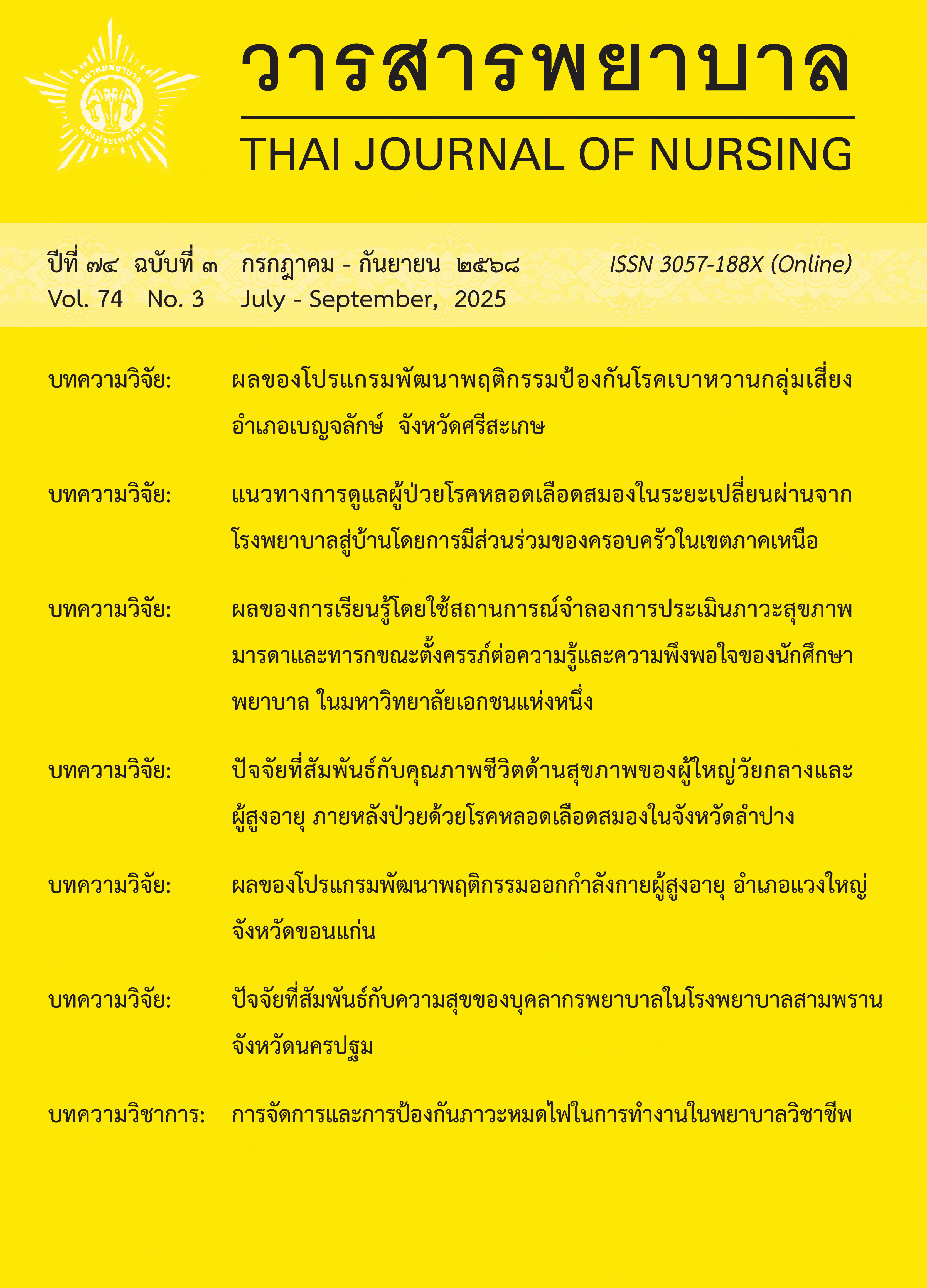
Guidelines for caring stroke patient during the transition from hospital to home with family participation in the Northern Region
Article Sidebar
Main Article Content
Abstract
This research and development aimed to explore the problems and needs of care, and to develop guidelines for caring stroke patient during the transition from hospital to home with family participation. The study was carried out in three stages. Stage 1 involved exploring patient care problems and needs. Stage 2 was the development of patient care guidelines for caregivers. Stage 3 examined the effectiveness of patient care guideline implementation using a quasi-experimental study with one group pretest posttest design. The sample included 27 pairs of caregivers and patients. Data were analyzed using descriptive statistics and paired t-test. The results showed that caregivers lacked confidence and were not involved in care planning. Patients had readmissions and inconsistent follow-up, with insufficient resources. The developed patient care guidelines consisted of two parts: for professional nurses and for caregivers. It covered identifying issues and needs in care, preparing knowledge, and training skills in caregivers. The study of the effectiveness of the care guidelines showed that the overall readiness score of the caregivers was at a good level. The ability to perform daily activities of the patients was significantly better after using the care guidelines than before (p < .05) and the patients’ quality of life significantly improved to a good level (p < .05).
Article Details

This work is licensed under a Creative Commons Attribution-NonCommercial-NoDerivatives 4.0 International License.
References
กระทรวงสาธารณสุข กองยุทธศาสตร์และแผนงาน. (2566). สถิติสาธารณสุข 2565. https://spd.moph.go.th/wp-content/uploads/2023/
/Hstatistic65.pdf
จารวี คณิตาภิลักษณ์, ทศพร คำผลศิริ, และลินจง โปธิบาล. (2563). ผลของโปรแกรมการสร้างเสริมพลังอำนาจ ต่อคุณภาพชีวิตของผู้สูงอายุที่เป็นโรคหลอดเลือดสมอง. พยาบาลสาร, 47(1), 220-230.
ณีรนุช วงค์เจริญ, ทัศนมินทร์ รัชตาธนรัชต์, และพิสิษฐ์ สมงาม. (2563). การพัฒนารูปแบบการดูแลต่อเนื่องที่บ้านของผู้ป่วยโรคหลอดเลือดสมอง. วารสารวิชาการสาธารณสุขชุมชน, 6(4), 61- 71.
ธัญพิมล เกณสาคู, เตือนใจ สินอำไพสิทธิ์, และวีรยุทธ ศรีทุมสุข. (2563). ประสิทธิผลของแนวปฏิบัติการพยาบาลการวางแผนจำหน่ายต่อความสามารถในการปฏิบัติกิจวัตรประจำวัน การกลับเข้ารักษาซ้ำในโรงพยาบาลและคุณภาพชีวิตของผู้ป่วยโรคหลอดเลือดสมองชนิดตีบอุดตัน. วารสารพยาบาลทหารบก, 21(3), 215-224.
นาฏยา เอื้องไพโรจน์, ชนกพร อุตตะมะ, จรรยา กาวีเมือง, และปริชาติ ขันทรักษ์. (2564). การพัฒนาระบบการดูแลผู้ป่วยโรคหลอดเลือดสมองเครือข่ายจังหวัดเชียงใหม่. พยาบาลสาร, 48(1), 1-14.
ปราโมทย์ ถ่างกระโทก, วชิรา โพธิ์ใส, เพลินตา พิพัฒน์สมบัติ, วินัย ไตรนาถถวัลย์, และวานิช สุขสถาน. (2562). ความตรงและความเที่ยงของแบบวัดคุณภาพชีวิตเฉพาะผู้ป่วยโรคหลอดเลือดสมอง ฉบับภาษาไทย. วารสารการแพทย์และวิทยาศาสตร์สุขภาพ, 26(3), 33-43.
วิรารัตน์ นิลสวัสดิ์. (2565). ผลของโปรแกรมการดูแลผู้ป่วยโรคหลอดเลือดสมองและผู้ดูแลในระยะเปลี่ยนผ่านจากโรงพยาบาลสู่บ้านต่อความสามารถการใช้ชีวิตประจำวัน ภาวะแทรกซ้อนของผู้ดูแล และความสามารถการจัดการตนเองของผู้ดูแล. วารสารวิจัยการพยาบาลและการสาธารณสุข, 2(3), 57-70.
ศรารินทร์ พิทธยะพงษ์. (2561). สถานการณ์ ปัญหา และอุปสรรคการดูแลผู้ป่วยหลังการเกิดโรคหลอดเลือดสมองระยะเปลี่ยนผ่านจากโรงพยาบาลสู่บ้าน. วารสารพยาบาลสภากาชาดไทย, 11(2), 26-39.
สมศักดิ์ เทียมเก่า. (2564). สถานการณ์โรคหลอดเลือดสมอง. วารสารประสาทวิทยาแห่งประเทศไทย, 37(4), 54-60.
สุกัญญา ตรุสานันท์. (2567). การพยาบาลผู้ป่วยโรคหลอดเลือดสมองจากภาวะหลอดเลือดสมองแตก. วารสารสาธารณสุขมูลฐานภาคเหนือ, 34 (1), 38-44.
อรพรรณ นันตาดี, ศิริภรณ์ ทองคำ, และวิชุดา ศรียุทนา. (2560). ปัญหาและความต้องการของผู้ดูแลผู้ป่วยโรคหลอดเลือดสมอง เขตพื้นที่อำเภอเถิน จังหวัดลำปาง. วารสารวิชาการสุขภาพภาคเหนือ, 4(1), 29- 41.
อุไรวรรณ ทองอร่าม และนิภาวรรณ สามารถกิจ. (2562). อิทธิพลของความพร้อมในการดูแล ภาระในการดูแล และรางวัลจากการดูแลต่อการปรับตัวของญาติผู้ดูแลผู้ป่วยโรคหลอดเลือดสมอง. วารสารกองการพยาบาล, 46(3), 88-102.
Braun, V., & Clarke, V. (2006). Using thematic analysis in psychology. Qualitative Research in Psychology, 3(2), 77-101. https://doi.org/10.1191/1478088706qp063oa
Civelek, G. M., Atalay, A., & Turhan, N. (2016). Medical complications experienced by first-time ischemic stroke patients during inpatient, tertiary level stroke rehabilitation. Journal of Physical Therapy Science, 28(2), 382-391.
Cohen, J. (1988). Statistical power for the behavioural sciences (2nd.ed.). Lawrence Erlbaum.
Faul, F., Erdfelder, E., Lang, A. G., & Buchner, A. (2007). G* Power 3: A flexible statistical power analysis program for the social, behavioral, and biomedical sciences. Behavior Research Methods, 39(2), 175-191.
Naylor, M. D., Brooten, D. A., Campbell, R. L., Maislin, G., McCauley, K. M., & Schwartz, J. S. (2004). Transitional care of older adults hospitalized with heart failure: A randomized, controlled trial.
Journal of the American Geriatrics Society, 52(5), 675-684. https://doi.org/10.1111/j.1532-5415.2004.52202.x
Pucciarelli, G., Lee, C. S., Lyons, K. S., Simeone, S., Alvaro, R., & Vellone, E. (2019). Quality of life trajectories among stroke survivors and the related changes in caregiver outcomes: A growth mixture study. Archives of Physical Medicine and Rehabilitation, 100(3), 433-440. Article e431. https://doi.org/10.1016/j.apmr.2018.07.428
Sewell, K., Tse, T., Harris, E., Matyas, T., Churilov, L., Ma, H., Davis, S. M., Donnan, G. A., & Carey, L. M. (2021). Pre-existing comorbidity burden and patient perceived stroke impact. International Journal
of Stroke, 16(3), 273-279. https://doi.org/10.1177/17474930209208
Wulansari, Y. P., Nurmala, I., & Hargono, R. (2020). Needs of family caregiver education for caring stroke patients at home. Indian Journal of Public Health Research & Development, 11(3), 1362-1368.
Zhao, J., Zeng, Z., Yu, J., Xu, J., Chen, P., Chen, Y., Li, J., & Ma, Y. (2021). Effect of main family caregiver’s anxiety and depression on mortality of patients with moderate-severe stroke. Scientific Reports, 11(1), 2747. https://doi.org/10.1038/s41598-021-81596-8
