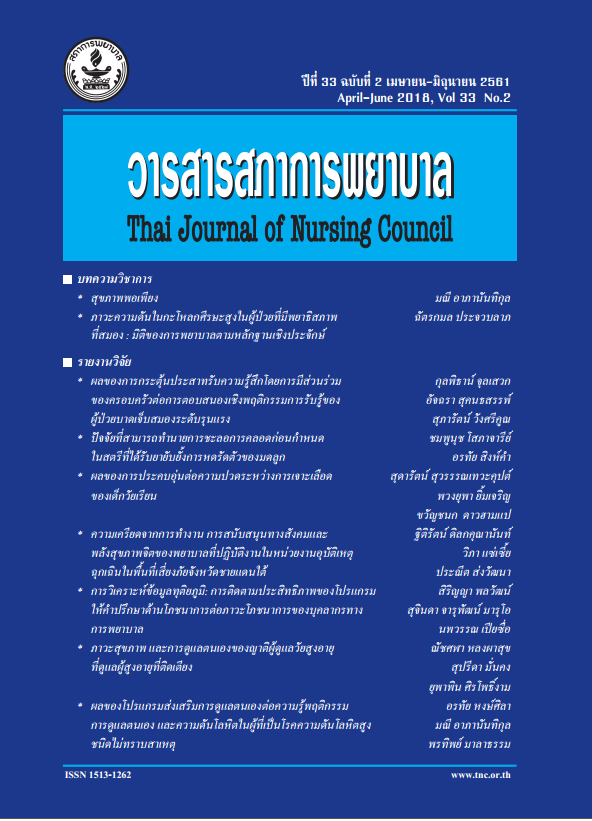
ปัจจัยที่สามารถทำนายการชะลอการคลอดก่อนกำหนดในสตรีที่ได้รับ ยายับยั้งการหดรัดตัวของมดลูก
คำสำคัญ:
ยายับยั้งการหดรัดตัวของมดลูก, ชะลอการคลอดก่อนกำหนด, ตั้งครรภบทคัดย่อ
บทคัดย่อ:
วัตถุประสงค์การวิจัย: เพื่อศึกษาปัจจัยที่สามารถทำนายการชะลอการคลอดก่อนกำหนด
ในสตรีที่ได้รับยายับยั้งการหดรัดตัวของมดลูก
การออกแบบการวิจัย: การวิจัยแบบบรรยายเชิงทำนาย (descriptive predictive research)
การดำเนินการวิจัย: กลุ่มตัวอย่างจำนวน 153 ราย เป็นสตรีเจ็บครรภ์คลอดก่อนกำหนด
ที่เกิดขึ้นเอง (spontaneous preterm labour) ที่เข้ารับการรักษาในห้องคลอดและได้รับยายับยั้ง
การหดรัดตัวของมดลูกเพื่อชะลอการคลอดก่อนกำหนด ใช้วิธีการคัดเลือกกลุ่มตัวอย่างตามสะดวก
(convenience sampling) ทำการเก็บรวบรวมข้อมูลโดยใช้แบบสอบถามข้อมูลสตรีตั้งครรภ์ ข้อมูล
การตั้งครรภ์และการรักษา และแบบสอบถามความวิตกกังวล แบบสอบถามทั้งหมดผ่านการตรวจสอบ
คุณภาพเครื่องมือจากผู้ทรงคุณวุฒิแล้ว และมีค่าความตรงเชิงเนื้อหาเท่ากับ 1.00 ค่าความเชื่อมั่น
ของแบบสอบถามความวิตกกังวลเท่ากับ 0.82 (Cronbach’s alpha = 0.82) วิเคราะห์ข้อมูลใช้
วิธีการวิเคราะห์ถดถอยพหุคูณแบบเชิงชั้น (hierarchical multiple regression)
ผลการวิจัย: ปัจจัยทั้งหมด ประกอบด้วย ปัจจัยด้านการคลอด (ระยะเวลาที่เจ็บครรภ์ก่อน
มาโรงพยาบาล ความบางของปากมดลูกเมื่อแรกรับ ระยะเวลาที่มีน้ำเดินก่อนมาโรงพยาบาล และ
ระยะห่างของการเจ็บครรภ์) ปัจจัยด้านจิตสังคม (ความวิตกกังวล) และปัจจัยส่วนบุคคล (อายุของ
สตรีตั้งครรภ์ ดัชนีมวลกายก่อนการตั้งครรภ์) สามารถร่วมกันทำนายการชะลอการคลอดก่อนกำหนด
ได้ร้อยละ 78.30 (F=26.80, p<.001) โดยปัจจัยที่สามารถทำนายการชะลอการคลอดก่อนกำหนด
ได้ดีที่สุด คือ ความบางของปากมดลูกเมื่อแรกรับ (Beta=-0.94, t=-13.24, p<.001) รองลง
มาได้แก่ ระยะเวลาที่มีน้ำเดินก่อนมาโรงพยาบาล (Beta=-0.30, t=-4.26, p<.001) ระยะห่าง
ของการเจ็บครรภ์ (Beta=0.22, t=3.17, p<.01) และความวิตกกังวล (Beta=-0.23, t=-3.21,
p<.01) ปัจจัยที่ไม่สามารถร่วมทำนายได้อย่างมีนัยสำคัญทางสถิติ ได้แก่ ระยะเวลาที่เจ็บครรภ์
ก่อนมาโรงพยาบาล อายุของสตรีตั้งครรภ์ และดัชนีมวลกายก่อนการตั้งครรภ์ (p>0.05)
ข้อเสนอแนะ: พยาบาลและสตรีตั้งครรภ์มีบทบาทสำคัญในการชะลอการคลอดก่อนกำหนด
โดยการแนะนำสตรีตั้งครรภ์ในการประเมินระยะห่างของการหดรัดตัวของมดลูกและตัดสินใจมา
โรงพยาบาลได้อย่างทันเวลาก่อนที่มดลูกจะหดรัดตัวถี่ขึ้นจนเกิดการบางของปากมดลูกและถุงน้ำคร่ำ
แตก นอกจากนี้ ระหว่างการเข้ารับการรักษาในโรงพยาบาล พยาบาลควรประเมินและวางแผน
ลดความวิตกกังวล ทั้งนี้เพื่อให้สามารถชะลอการคลอดก่อนกำหนดออกไปได
Downloads
เอกสารอ้างอิง
1. Urairoekkun C. Appropriate risk factors for preterm labour screening. Journal of Health Science 2017; 26(supp1): s64-9. (In Thai)
2. Strategy and Planning Division, Minisry of Public Health. Public healh statistics A.D.2016. Nonthaburi: Strategy and Planning Division, Ministry of Public Health; 2016. (In Thai)
3. Matthews TJ, MacDorman MF, Thoma ME. Infant mortality statistics from the 2013 period linked birth/ infant death data set. Natl Vital Stat Rep 2015; 64(9):1-30.
4. Watkins WJ, Kotecha SJ, Kotecha S. All-cause mortality of low birthweight infants in infancy, childhood, and adolescence: population study of England and Wales. PLoS Med 2016; 13(5): e1002018.
5. World Health Organization. WHO recommendations on interventions to improve preterm birth outcomes. Geneva: WHO press; 2015.
6. Carlo WA, McDonald SA, Fanaroff AA, Vohr BR, Stoll BJ, Ehrenkranz RA. Association of antenatal corticosteroids with mortality and neurodevelopmental outcomes among infants born at 22 to 25 weeks’ gestation. JAMA 2011; 306 (21): 2348-58.
7. Kiatsuda D, Thinkhamrop J, Prasertcharoensuk W. Success rate in preterm uterine contraction inhibition with tocolytic agents in a tertiary care center. Int J Womens Health 2016; 8: 663–7.
8. Althabe F, Belizán JM, McClure EM, HemingwayFoday J, Berrueta M, Mazzoni A, et al. A populationbased, multifaceted strategy to implement antenatal corticosteroid treatment versus standard care for the reduction of neonatal mortality due to preterm birth in low-income and middle-income countries: the ACT cluster-randomised trial. Lancet 2015; 385(9968):629-39.
9. Cunningham FG, Leveno KJ, Bloom SL, Hauth JC, Rouse DJ, Spong CY. Williams Obstetrics. 23rd ed.New York: McGraw-Hill; 2010.
10. Staneva A, Bogossian F, Pritchard M, Withowski A. The effect of maternal anxiety, depression, and perceived stress during pregnancy on preterm birth: a systematic review. Women Birth 2015; 28(3):179-93.
11. Kane HS, Schetter CD, Glynn LM, Hobel CJ, Sandman CA. Pregnancy anxiety and prenatal trajectories. Biol Psychol 2014; 100: 13-9.58
12. Stewart CP, Oaks BM, Laugero KD, Ashorn U, Harjunmaa U, Kumwenda C. et al. Maternal cortisol and stress are associated with birth outcomes, but are not affected by lipid-based nutrient supplements during pregnancy: an analysis
of data from a randomized controlled trial in rural Malawi. BMC Pregnancy Childbirth 2015; 15(1): 346.
13. Reinl EL, England SK. Fetal-to-maternal signaling to initiate parturition. J Clin Invest 2015; 125(7): 2569-71.
14. Laopaiboon M, Lumbiganon P, Intarut N, Mori R,Ganchimeg T, Vogel JP, et al. Advanced maternal age and pregnancy outcomes: a multicountry assessment. BJOG 2014; 121(suppl1): 49-56.
15. Di Renzo GC, Giardina I, Rosati A, Clerici G, Torricelli M, Petraglia F. Maternal risk factors for preterm
birth: a country-based population analysis. Eur J Obstet Gynecol Reprod Biol 2011; 159(2):342-6.
16. Hendler I, Goldenberg RL, Mercer BM, Iams JD, Meis PJ, Moawad AH, et al. The preterm prediction study: association between maternal body mass index and spontaneous and indicated preterm birth.Am J Obstet Gynecol 2005; 192(3): 882–6.
17. Torloni MR, Betrán AP, Daher S, Widmer M, Dolan SM, Menon R, et al. Maternal BMI and preterm birth: a systematic review of the literature with meta-analysis. J Matern Fetal Neonatal Med 2009;22(11): 957-70.
18. Romero R, Espinoza J, Goncalves, LF, Kusanovic JP, Friel LA, Nien JK. Inflammation in preterm and term
labour and delivery. Semin Fetal Neonatal Med 2006; 11(5): 317-26.
19. Ramsay JE, Ferrell WR, Crawford L, Wallace AM, Greer IA, Sattar N. Maternal obesity is associated with dysregulation of metabolic, vascular, and inflammatory pathways. J Clin Endocrinol Metab 2002; 87(9): 4231-37.
20. Soltani H, Fraser RB. A longitudinal study of maternal anthropometric changes in normal weight, overweight and obese women during pregnancy and postpartum. Br J Nutr 2000; 84(1): 95-101.
21. Fontana L, Eagon JC, Trujillo ME, Scherer PE, Klein S. Visceral fat adipokine secretion is associated with systemic inflammation in obese humans. Diabetes 2007; 56(4):1010-13.
22. Faul F, Erdfelder E, Buchner A, Lang A. G*Power version 3.1.2 [computer software]. Universität Kiel, Germany; 2008. Retrieved from http://www.psycho.uni-duesseldorf.de/abteilungen/aap/gpower3/download-and-register
23. Faul F, Erdfelder E, Buchner A, Lang A. Statistical power analyses using G*Power 3.1: Tests for correlation and regression analyses. Behavior Research Methods 2009; 41: 1149-60.
24. Cohen J. Statistical power analysis for the behavioral Sciences. 2nd ed. New Jersey: Lawrence Erlbaum Associates; 1988.
25. Sopajaree C, Ratchukul S. Anxiety of frst-time expectant parents in high-risk pregnancy: A phenomenological
study. Journal of Nursing Science, Chulalongkorn University 2002; 14(3): 1-11. (In Thai)
26. Schmidt AF, Finan C. Linear regression and the normality assumption. J Clin Epidemiol 2018; 98:146-51.
27. Gaillard R, Arends LR, Steegers EAP, Hoffman A, Jaddoe VWV. Second and third trimester placental
hemodynamics and the risks of pregnancy complications:The generation R study. Am J Epidemiol 2013;177(8): 743-54.