
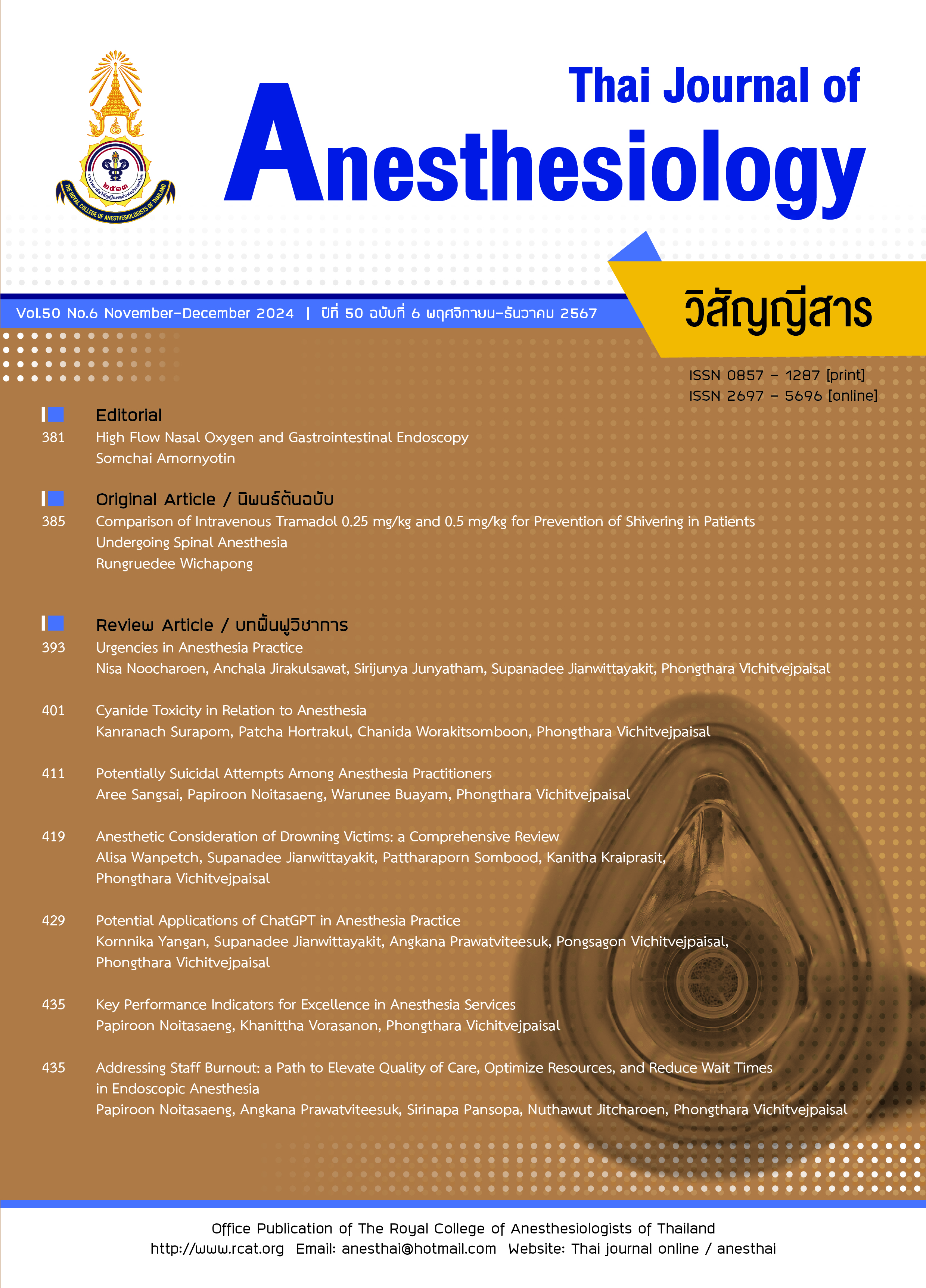
High Flow Nasal Oxygen and Gastrointestinal Endoscopy
Keywords:
high-flow nasal oxygen, gastrointestinal endoscopy, sedation, oxygen therapyAbstract
High-flow nasal oxygen (HFNO) is an innovative modality increasingly used in various medical settings, including during gastrointestinal endoscopy (GIE) procedures. This technique provides oxygen at high flow rates, delivering humidified and heated oxygen that offers significant advantages over traditional oxygen delivery systems. In high-risk patients or during prolonged procedures, HFNO has emerged as a promising tool to enhance patient safety, maintain oxygenation, and reduce complications associated with GIE sedation.
References
Amornyotin S. Sedation-related complications in gastrointestinal endoscopy. World J Gastrointest Endosc. 2013;5:527-33.
Amornyotin S. Intravenous sedation techniques for gastrointestinal endoscopy. J Gastroenterol Hepatol Res. 2016;5:2050-7.
Amornyotin S, Pranootnarabhal T, Chalayonnavin W, Kongphlay S. Anesthesia for gastrointestinal endoscopy from 2005-2006 in Siriraj Hospital: a prospective study. Thai J Anesthesiol. 2007;33:93-101.
Amornyotin S. Sedation and monitoring for gastrointestinal endoscopy. World J Gastrointest Endosc. 2013;5:47-55.
Amornyotin S, Chalayonnawin W, Kongphlay S. Oxygen supplementation for propofol-based deep sedation in colonoscopic procedure: a comparison between nasal cannula and face mask. J Clin Res Anesthesiol. 2020;3:1-5.
Wyatt KD, Goel NN, Whittle JS. Recent advances in the use of high flow nasal oxygen therapies. Front Med. 2022;9:1017965.
Kim SH, Bang S, Lee KY, et al. Comparison of high flow nasal oxygen and conventional nasal cannula during gastrointestinal endoscopic sedation in the prone position: a randomized trial. Can J Anesth. 2021;68:460-6.
Khanna P, Haritha D, Das A, Sarkar S, Roy A. Utility of high‑fow nasal oxygen in comparison to conventional oxygen therapy during upper gastrointestinal endoscopic procedures under sedation: a systematic review and meta‑analyses. Indian J Gastroenterol. 2023;42:53-63.
Nay MA, Fromont L, Eugene A, et al. High-flow nasal oxygenation or standard oxygenation for gastrointestinal endoscopy with sedation in patients at risk of hypoxaemia: a multicentre randomised controlled trial (ODEPHI trial). Brit J Anaesth. 2021;127:133-42.
Zhang YX, He XX, Chen YP, Yang S. The efectiveness of high-fow nasal cannula during sedated digestive endoscopy: a systematic review and meta-analysis. Eur J Med Res. 2022;27:30.
Lin Y, Zhang X, Li L, et al. High-flow nasal cannula oxygen therapy and hypoxia during gastroscopy with propofol sedation: a randomized multicenter clinical trial. Gastrointest Endosc. 2019;90:591-601.
Ng J, Pu LZCT, Be KH, et al. High-flow nasal cannula oxygen therapy versus conventional oxygen therapy in prolonged upper GI endoscopy: a randomized controlled trial. iGIE. 2023;2:131-8.
Yin X, Xu W, Zhang J, et al. High-flow nasal oxygen versus conventional nasal cannula in preventing hypoxemia in elderly patients undergoing gastroscopy with sedation: a randomized controlled trial. Int J Med Sci. 2024;21:914-20.
Wei C, Ma S, Jiang L, Wang J, Yuan L, Wang Y. A meta-analysis of the effects of transnasal high-flow oxygen therapy in gastrointestinal endoscopy. Front Med. 2024;11:1419635.
Gu WJ, Wang HT, Huang J, et al. High flow nasal oxygen versus conventional oxygen therapy in gastrointestinal endoscopy with conscious sedation: systematic review and meta-analysis with trial sequential analysis. Dig Endosc. 2022;34:1136-46.
Carron M, Tamburini E, Fakhr BS, De Cassai A, Linassi F, Navalesi P. High-flow nasal oxygenation during gastrointestinal endoscopy. Systematic review and meta-analysis. BJA Open. 2022;4:100098. Open. 2022;4:100098.
Downloads
Published
How to Cite
Issue
Section
License

This work is licensed under a Creative Commons Attribution-NonCommercial-NoDerivatives 4.0 International License.
Copyright
Copyright of all articles published in the Thai Journal of Anesthesiology is held by the Thai Journal of Anesthesiology, the Royal College of Anesthesiologists of Thailand. Submission of a manuscript constitutes the authors' agreement that, upon acceptance for publication, copyright of the work is transferred to the Journal. The content and any opinions expressed in published articles are the sole responsibility of the authors and do not necessarily reflect the views of the editorial board or the Royal College of Anesthesiologists of Thailand.
Licensing
All articles are published open access under the Creative Commons Attribution-NonCommercial-NoDerivatives 4.0 International License (CC BY-NC-ND 4.0). Under this license, anyone may copy and redistribute published articles in any medium or format for non-commercial purposes, provided that appropriate credit is given to the authors and to the Thai Journal of Anesthesiology as the original source of publication, a link to the license is included, and the material is not modified in any way. Requests for commercial use or for adaptation of published material should be directed to the editorial office.
Authors' Rights
Although copyright is held by the Journal, authors retain the right to reuse their own published material in their future scholarly works, theses and dissertations, teaching, and academic presentations, and to deposit the final published version (PDF) in institutional or subject repositories or on personal and institutional websites, without embargo, provided that the Thai Journal of Anesthesiology is clearly acknowledged as the original place of publication.