
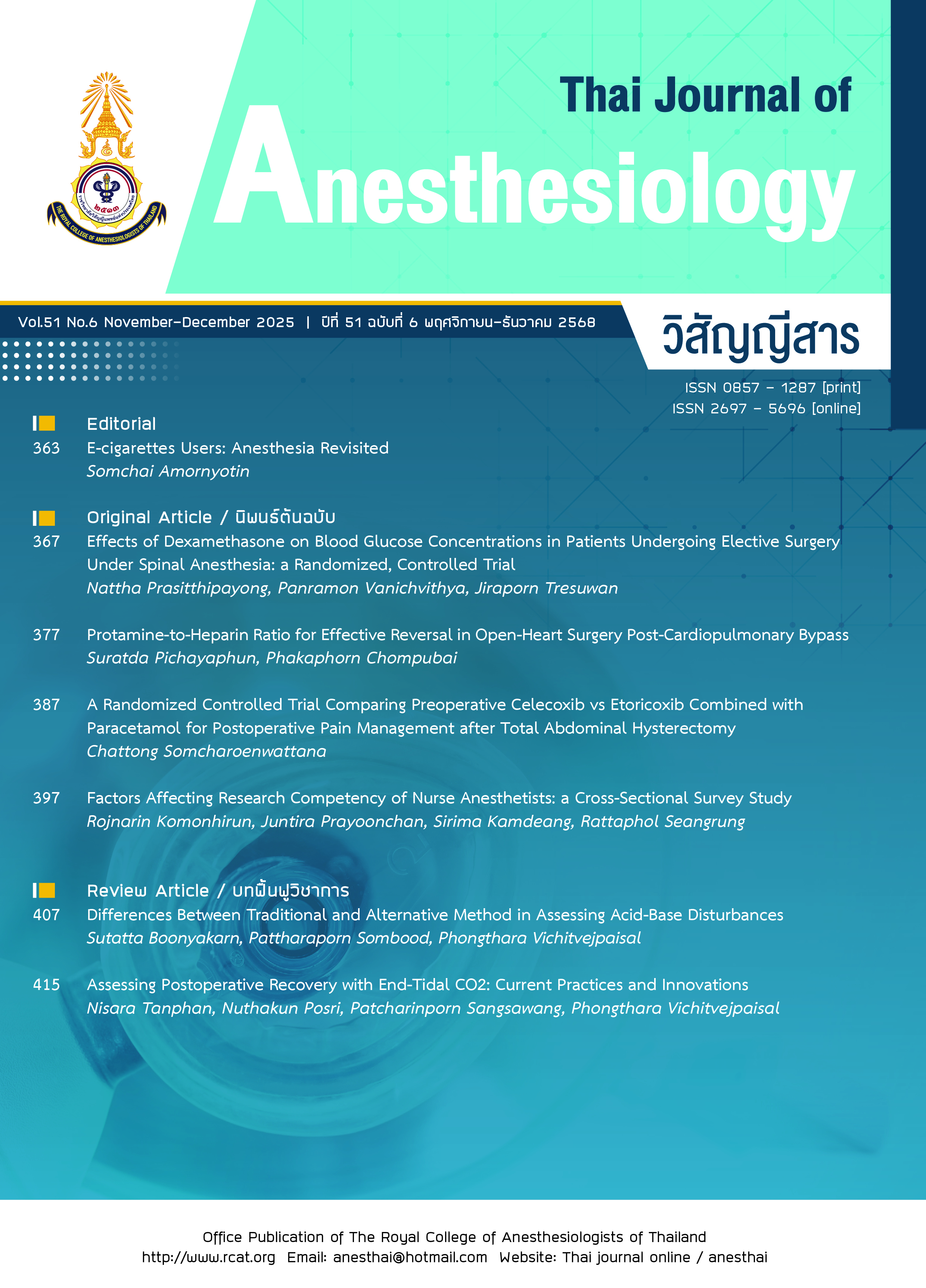
E-cigarettes Users: Anesthesia Revisited
Keywords:
anesthesia, E-cigarettes, perioperative period, vapingAbstract
E-cigarettes, also known as electronic nicotine delivery systems, have gained widespread popularity as an alternative to combustible tobacco. While often perceived as safer, emerging evidence demonstrates significant respiratory, cardiovascular, and systemic effects relevant to anesthesia. These include airway inflammation, bronchial hyperreactivity, cardiovascular stimulation, and an association with acute lung injury known as E-cigarette or vaping-associated lung injury (EVALI). For anesthetic personnel, E-cigarette use introduces unique perioperative challenges, particularly in airway management, ventilation strategies, hemodynamic stability, and postoperative recovery. This review summarizes current evidence on the physiological impact of E-cigarette use, outlines anesthetic considerations across the perioperative continuum, and provides a practical summary table to guide clinical decision-making
References
Amaro EJ, Shepard N, Moss L, Karamitopoulos M, Lajam C. Vaping and orthopedic surgery: a review of current knowledge. JBJS Rev. 2019;7:e5.
Cutts TG, O’Donnell AM. The implications of vaping for the anaesthetist. BJA Educ. 2021;21:243-9.
Krishna A, Mathieu W, Mull E, Tobias JD. Perioperative implications of vaping. J Med Cases. 2020;11:129-34.
Tarran R, Barr RG, Benowitz NL, et al. E-cigarettes and cardiopulmonary health. Function. 2021;2:zqab004.
Amornyotin S. E-cigarettes: what anesthetic personnel need to know? Thai J Anesthesiol. 2025;51:1-4.
Morris PB, Ference BA, Jahangir E, et al. Cardiovascular effects of exposure to cigarette smoke and electronic cigarettes: clinical perspectives from the Prevention of Cardiovascular Disease Section Leadership Council and Early Career Councils of the American College of Cardiology. J Am Coll Cardiol. 2015;66:1378-91.
Qasim H, Karim ZA, Rivera JO, Khasawneh FT, Alshbool FZ. Impact of electronic cigarettes on the cardiovascular system. J Am Heart Assoc. 2017;6:e006353.
Fracol M, Dorfman R, Janes L, et al. The surgical impact of e-cigarettes: a case report and review of the current literature. Arch Plast Surg. 2017;44:477-81.
Goniewicz ML, Knysak J, Gawron M, et al. Levels of selected carcinogens and toxicants in vapour from electronic cigarettes. Tob Control. 2014;23:133-9.
Sweeney BP, Grayling M. Smoking and anaesthesia: the pharmacological implications. Anaesthesia. 2009;64:179-86.
Myers K, Hajek P, Hinds C, McRobbie H. Stopping smoking shortly before surgery and postoperative complications: a systematic review and meta-analysis. Arch Intern Med. 2011;171:983-9.
Oyston J. What do anesthesiologists need to know about vaping? Can J Anesth. 2020;67:1124-9.
Melroy-Greif WE, Stitzel JA, Ehringer MA. Nicotinic acetylcholine receptors: upregulation, age-related effects, and associations with drug use. Genes Brain Behav. 2016;15:89-107.
Plesner K, Jensen HI, Hojsted J. Smoking history, nicotine dependence and opioid use in patients with chronic non-malignant pain. Acta Anaesthesiol Scand. 2016;60:988-94.
Amornyotin S. Role of an anesthesiologist in smoking patients undergoing endoscopic procedures. J Addict Med Ther Sci. 2017;3:030-1.
Amornyotin S, Prakanrattana U, Chalayonnawin W, Kongphlay S. Brief advice offered by anesthetic personnel to encourage smoking cessation in ambulatory gastrointestinal endoscopic patients in a developing country. Int J Life Sci Med Res. 2012;2:37-42.
Downloads
Published
How to Cite
Issue
Section
License

This work is licensed under a Creative Commons Attribution-NonCommercial-NoDerivatives 4.0 International License.
Copyright
Copyright of all articles published in the Thai Journal of Anesthesiology is held by the Thai Journal of Anesthesiology, the Royal College of Anesthesiologists of Thailand. Submission of a manuscript constitutes the authors' agreement that, upon acceptance for publication, copyright of the work is transferred to the Journal. The content and any opinions expressed in published articles are the sole responsibility of the authors and do not necessarily reflect the views of the editorial board or the Royal College of Anesthesiologists of Thailand.
Licensing
All articles are published open access under the Creative Commons Attribution-NonCommercial-NoDerivatives 4.0 International License (CC BY-NC-ND 4.0). Under this license, anyone may copy and redistribute published articles in any medium or format for non-commercial purposes, provided that appropriate credit is given to the authors and to the Thai Journal of Anesthesiology as the original source of publication, a link to the license is included, and the material is not modified in any way. Requests for commercial use or for adaptation of published material should be directed to the editorial office.
Authors' Rights
Although copyright is held by the Journal, authors retain the right to reuse their own published material in their future scholarly works, theses and dissertations, teaching, and academic presentations, and to deposit the final published version (PDF) in institutional or subject repositories or on personal and institutional websites, without embargo, provided that the Thai Journal of Anesthesiology is clearly acknowledged as the original place of publication.