
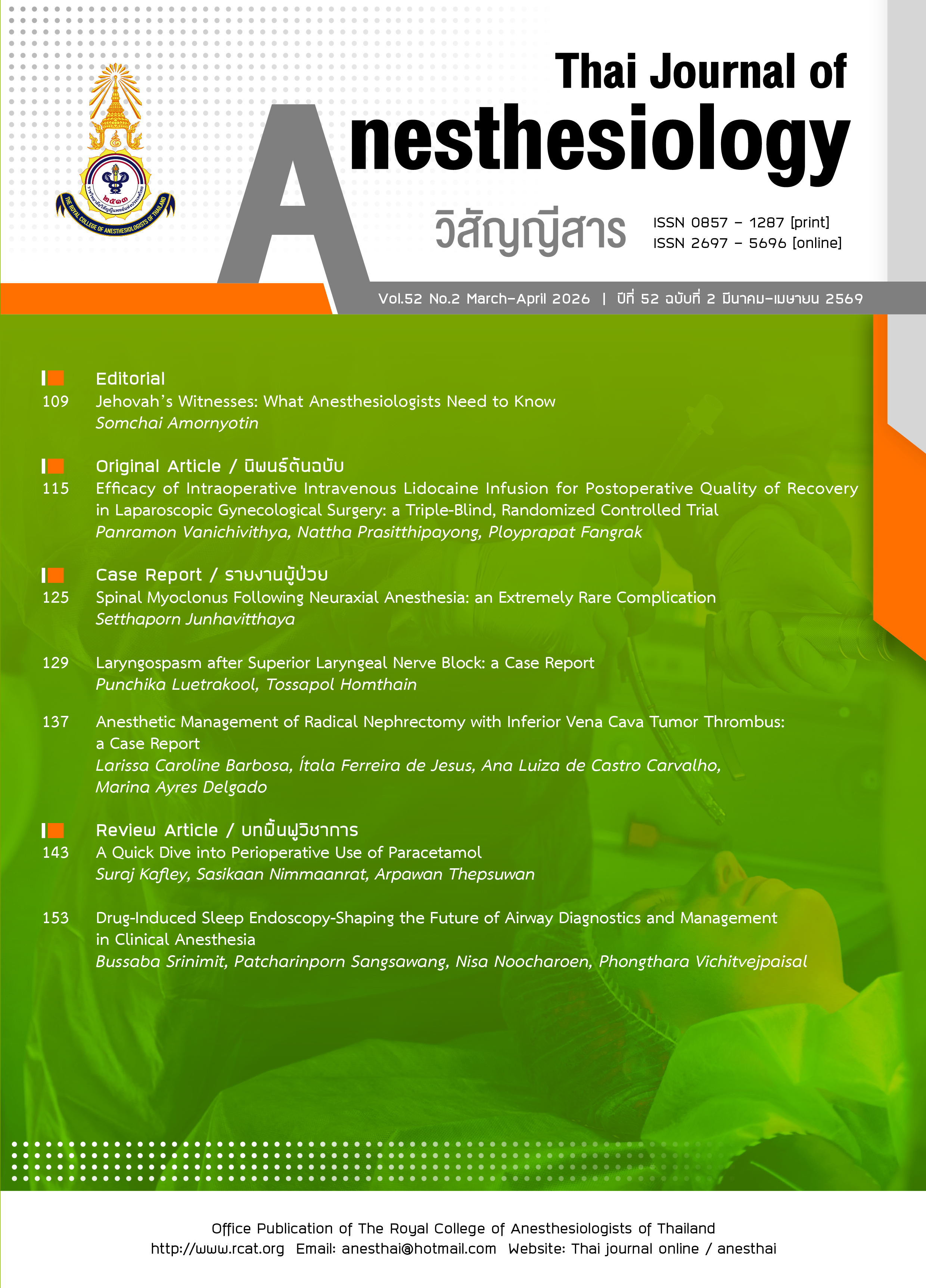
Drug-Induced Sleep Endoscopy: Shaping the Future of Airway Diagnostics and Management in Clinical Anesthesia
Keywords:
airway management, drug-induced sleep endoscopy, obstructive sleep apnea, personalized anesthesia careAbstract
Drug-induced sleep endoscopy (DISE) has emerged as a transformative tool in airway diagnostics and management, offering significant advantages over traditional methods. By inducing sleep through pharmacologic agents, DISE enables real-time visualization of dynamic airway obstructions, providing valuable insights into the site, type, and pattern of airway collapse. This review explores DISE’s role in clinical anesthesia, emphasizing its importance in perioperative airway assessment, especially in patients at risk for difficult intubation or those with obstructive sleep apnea (OSA). DISE’s clinical applications include guiding surgical planning, tailoring airway management strategies, and informing non-surgical interventions, such as continuous positive airway pressure or mandibular advancement devices. The review highlights the evidence supporting DISE’s efficacy, reviewing case studies, clinical trials, and outcomes. As DISE continues to evolve, its integration into routine clinical practice holds the potential to revolutionize personalized anesthesia care, ensuring optimal airway management and enhancing patient safety during surgical procedures.
References
Disma N, Asai T, Cools E, et al. Airway management in neonates and infants: European society of anaesthesiology and intensive care and british journal of anaesthesia joint guidelines. Eur J Anaesthesiol. 2024;41:3-23.
Kornas RL, Owyang CG, Sakles JC, Foley LJ, Mosier JM. Evaluation and management of the physiologically difficult airway: consensus recommendations from society for airway management. Anesth Analg. 2021;132:395-405.
Cozowicz C, Memtsoudis SG. Perioperative management of the patient with obstructive sleep apnea: a narrative review. Anesth Analg. 2021;132:1231-43.
Yeghiazarians Y, Jneid H, Tietjens JR, et al. Obstructive sleep apnea and cardiovascular disease: a scientific statement from the American Heart Association. Circulation. 2021;144:e56-67.
Viana A, Estevão D, Zhao C. The clinical application progress and potential of drug-induced sleep endoscopy in obstructive sleep apnea. Ann Med. 2022;54:2909-20.
Garcia GJM, Woodson BT. The collapsing anatomical structure is not always the primary site of flow limitation in obstructive sleep apnea. J Clin Sleep Med. 2020; 16: 345-6.
Vito A, Cammaroto G, Chong KB, Carrasco-Llatas M, Vicini C. Drug-induced sleep endoscopy: clinical application and surgical outcomes. Healthcare. 2019;7:100.
Eggerstedt M, Urban MJ, Chi E, Ritz EM, Losavio P. The anesthesia airway evaluation: correlation with sleep endoscopy findings. Am J Otolaryngol. 2020;41:102362.
Wang Z, Jin Y, Zheng Y, Chen H, Feng J, Sun J. Evaluation of preoperative difficult airway prediction methods for adult patients without obvious airway abnormalities: a systematic review and meta-analysis. BMC Anesthesiol. 2024;24:242.
Kuo YH, Liu TJ, Chiu FH, et al. Novel intraoral negative airway pressure in drug-induced sleep endoscopy with target-controlled infusion. Nat Sci Sleep. 2021;13:2087-99.
Ha JG, Lee Y, Nam JS, et al. Can drug-induced sleep endoscopy improve the success rates of tongue base surgery. J Otolaryngol Head Neck Surg. 2020;49:8.
Campos A, Cebola P, Dias SS, et al. Upper airway assessment in obstructive sleep apnea patients: can computed tomography with lateral cephalometry replace drug-induced sleep endoscopy (DISE). Acta Otorrinolaringol. 2023;74:290-7.
Schwartz D, Schall C, Harders M, et al. Anesthesia for drug induced sleep endoscopy (DISE). Curr Anesthesiol Rep. 2024;14:469-74.
Ordones AB, Grad GF, Cahali MB, Lorenzi-Filho G, Sennes LU, Genta PR. Comparison of upper airway obstruction during zolpidem-induced sleep and propofol-induced sleep in patients with obstructive sleep apnea: a pilot study. J Clin Sleep Med. 2020;16:725-32.
Darie AM, Schumann DM, Laures M, et al. Oxygen desaturation during flexible bronchoscopy with propofol sedation is associated with sleep apnea: the PROSA-study. Respir Res. 2020;21:306.
Pang KP, Baptista PM, Olszewska E, et al. Does drug-induced sleep endoscopy affect surgical outcome. a multicenter study of 326 obstructive sleep apnea patients. Laryngoscope. 2020;130:551-5.
Rodríguez-Alcalá L, Reina COC, Gil BR, Plaza G, Morente JCC. Epileptic crisis in a patient with obstructive sleep apnea during drug-induced endoscopy. Sleep Sci. 2021;14:189-92.
Amornyotin S. Anesthesia and drug induced sleep endoscopy (DISE). Thai J Anesthesiol. 2024;50:217-20.
Van den Bossche K, Van de Perck E, Kazemeini E, et al. Natural sleep endoscopy in obstructive sleep apnea: a systematic review. Sleep Med Rev. 2021;60:101534.
Fernández-Sanjuán P, Alcaraz M, Bosco G, et al. Modifications in upper airway collapsibility during sleep endoscopy with a mandibular positioner: study in snorers and obstructive sleep apnea patients. J Clin Med. 2024;13:1184.
Lin HC, Wang CH, Kuo TBJ, et al. Upper airway surgery or weight control modified drug-induced sleep endoscopy for obstructive sleep apnea. Otolaryngol Head Neck Surg. 2023;169:1345-55.
Cheong CS, Loke W, Thong MKT, Toh ST, Lee CH. The emerging role of drug-induced sleep endoscopy in the management of obstructive sleep apnea. Clin Exp Otorhinolaryngol. 2021;14:149-58.
Öner Ö, Ecevit MC, Gökmen AN. The relationship between bi-spectral index and VOTE score in evaluation of drug-induced sleep endoscopy: a systematic meta-analysis. Baltimore. 2023;102:e35209.
Bergeron M, Lee DR, DeMarcantonio MA, et al. Safety and cost of drug-induced sleep endoscopy outside the operating room. Laryngoscope. 2020;130:2076-80.
Kim JY, Han SC, Lim HJ, Kim HJ, Kim JW, Rhee CS. Drug-induced sleep endoscopy: a guide for treatment selection. Sleep Med Res. 2020;11:1-6.
Ghazizadeh S, Moore K, Kiai K, Mendelsohn AH. Drug-induced sleep endoscopy performed in the endoscopy suite: a resource utilization analysis. Otolaryngol Head Neck Surg. 2020;162:386-91.
Dmowska J, Larson SR, Gillespie MB, Sheyn A. Effect of drug induced sleep endoscopy on intraoperative decision making in pediatric sleep surgery. Int J Pediatr Otorhinolaryngol. 2020;130:109810.
Gao EY, Tan BKJ, Tan NKW, et al. Artificial intelligence facial recognition of obstructive sleep apnea: a Bayesian meta-analysis. Sleep Breath. 2024;29:36.
Valderrama-Penagos JX, Rodríguez Alcalá L, Plaza G, et al. Ankyloglossia in children, a cause of obstructive sleep apnoea: case report of paediatric ankyloglossia and sleep apnoea: DISE resolves the mystery. Children. 2024;11:218.
Downloads
Published
How to Cite
Issue
Section
License

This work is licensed under a Creative Commons Attribution-NonCommercial-NoDerivatives 4.0 International License.
Copyright
Copyright of all articles published in the Thai Journal of Anesthesiology is held by the Thai Journal of Anesthesiology, the Royal College of Anesthesiologists of Thailand. Submission of a manuscript constitutes the authors' agreement that, upon acceptance for publication, copyright of the work is transferred to the Journal. The content and any opinions expressed in published articles are the sole responsibility of the authors and do not necessarily reflect the views of the editorial board or the Royal College of Anesthesiologists of Thailand.
Licensing
All articles are published open access under the Creative Commons Attribution-NonCommercial-NoDerivatives 4.0 International License (CC BY-NC-ND 4.0). Under this license, anyone may copy and redistribute published articles in any medium or format for non-commercial purposes, provided that appropriate credit is given to the authors and to the Thai Journal of Anesthesiology as the original source of publication, a link to the license is included, and the material is not modified in any way. Requests for commercial use or for adaptation of published material should be directed to the editorial office.
Authors' Rights
Although copyright is held by the Journal, authors retain the right to reuse their own published material in their future scholarly works, theses and dissertations, teaching, and academic presentations, and to deposit the final published version (PDF) in institutional or subject repositories or on personal and institutional websites, without embargo, provided that the Thai Journal of Anesthesiology is clearly acknowledged as the original place of publication.