
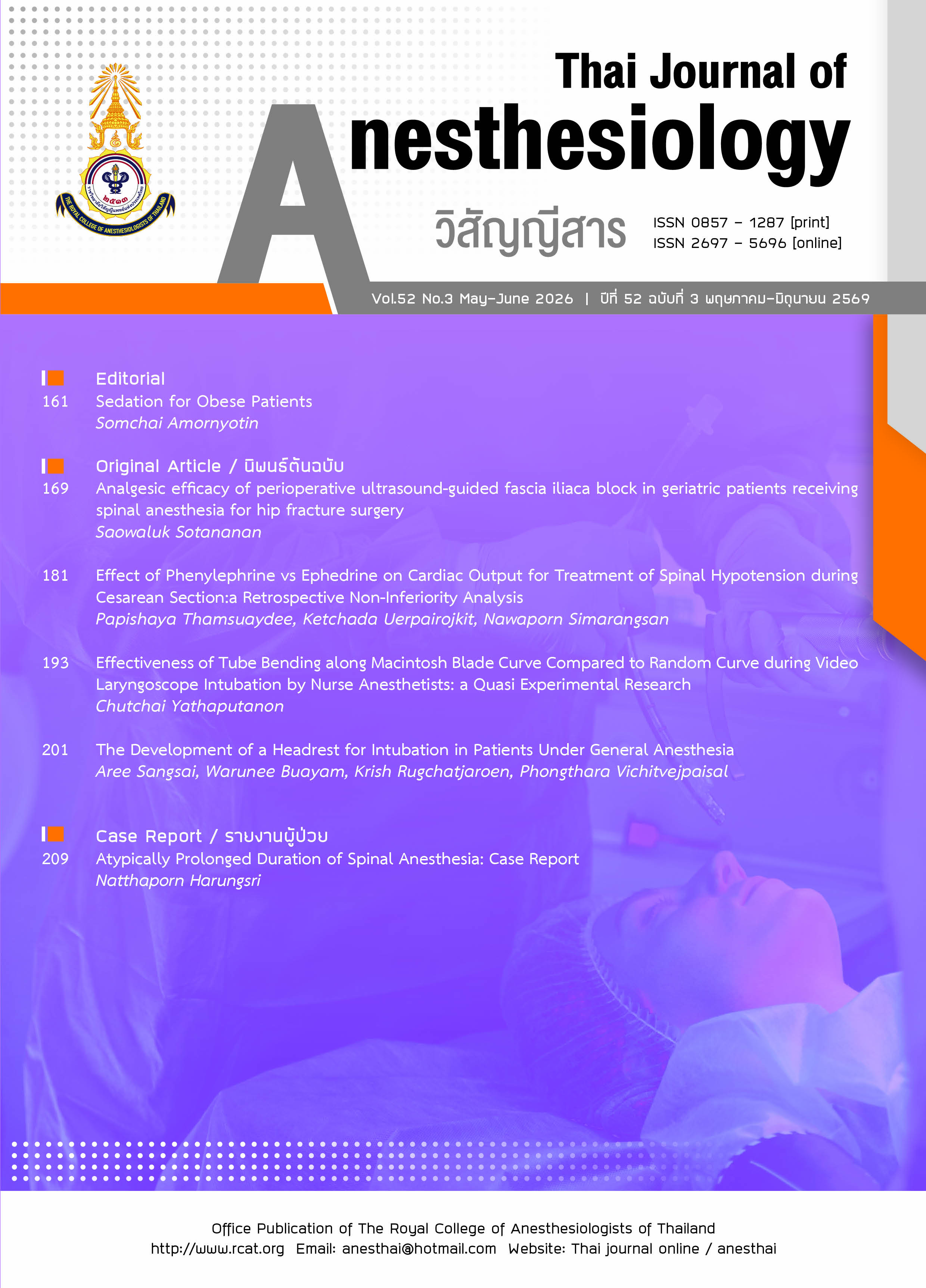
Sedation for Obese Patients
Keywords:
airway management, capnography, obesity, obstructive sleep apnea, procedural sedationAbstract
Obesity has become a global health concern, with an increasing number of obese patients requiring procedural sedation in operating rooms, endoscopy suites, interventional radiology units, and ambulatory surgical centers. Sedation in obese individuals presents unique challenges due to altered respiratory physiology, difficult airway management, pharmacokinetic and pharmacodynamic changes, and a high prevalence of obesity-related comorbidities such as obstructive sleep apnea, obesity hypoventilation syndrome, cardiovascular disease, and diabetes mellitus. Sedation-related adverse events, particularly hypoxemia, airway obstruction, hypercapnia, and cardiovascular instability, occur more frequently in obese patients than in normal-weight individuals. Contemporary advances including capnography, high-flow nasal oxygen, continuous positive airway pressure, and dexmedetomidine-based sedation techniques have improved safety in high-risk populations. Appropriate preprocedural assessment, careful drug selection, optimized dosing strategies, vigilant monitoring, and advanced airway management techniques are essential to improve patient safety. This review summarizes the pathophysiological changes associated with obesity, discusses sedation-related risks, evaluates commonly used sedative agents, and provides evidence-based recommendations for peri-procedural management of obese patients undergoing sedation.
References
Bautista A, Hrushka L, Lenhardt R. Procedural sedation in the morbidly obese: implica-tions, complications, and management. Int Anesthesiol Clin. 2020;58:41-6.
Hardt K, Wappler F. Anesthesia for morbidly obese patients. Dtsch Arztebl Int. 2023;120:779-85.
Brodsky JB. Recent advances in anesthesia of the obese patient. 2018;7:1195.
Lukosiute A, Karmali A, Cousins JM. Anaesthetic preparation of obese patients: current status on optimal work-up. Curr Obes Rep. 2017;6:229-37.
Nightingale CE, Margarson MP, Shearer E, et al. Peri-operative management of the obese surgical patient 2015. Association of Anaesthetists of Great Britain and Ireland Society for Obesity and Bariatric Anaesthesia. Anaesthesia. 2015;70:859-76.
Martins EF, Martinez D, Cortes AL, Nascimento N, Brendler J. Exploring the STOP-BANG questionnaire for obstructive sleep apnea screening in seniors. J Clin Sleep Med. 2020;16:199-206.
Amornyotin S. Sedative and analgesic drugs for gastrointestinal endoscopic procedure. J Gastroenterol Hepatol Res. 2014;3:1133-44.
Amornyotin S. Dexmedetomidine. Thai J Anesthesiol. 2009;35:296-302.
Patrick R, Birmingham A, Allen P, Karelsky S. Novel combination dexmedetomidine and propofol anesthetic regimen for DISE improves procedural efficiency compared to single-agent regimens. Laryngosc Invest Otolaryngol. 2025;10:e70329.
Amornyotin S. Ketamine: pharmacology revisited. Intern J Anesthesiol Res. 2014;2:42-4.
Amornyotin S. Ketofol: a combination of ketamine and propofol. J Anesth Crit Care Open Access. 2014;1:00031.
Amornyotin S. High flow nasal oxygen and gastrointestinal endoscopy. Thai J Anesthesiol. 2024;50:381-4.
Amornyotin S. Sedation and monitoring for gastrointestinal endoscopy. World J Gastroin-test Endosc. 2013;5:47-55.
Amornyotin S. Role of capnography for gastrointestinal endoscopy. Thai J Anesthesiol. 2025;51:293-8.
Amornyotin S, Kongphlay S. Complication rate of propofol-based deep sedation for co-lonoscopy in marked obesity patients. J Gastroenterol Hepatol Res. 2015;4:1734-8.
Martin ML, Lennox PH. Sedation and analgesia in the interventional radiology department. J Vasc Interv Radiol. 2003;14:1119-28.
Uppot RN. Technical challenges of imaging & image-guided interventions in obese pa-tients. Br J Radiol. 2018;91:20170931.
Khan I, Chatterjee AB, Bellinger CR, Haponik E. Sedation for bronchoscopy and compli-cations in obese patients. Respiration. 2016;92:158-65.
Amornyotin S. When to call anesthesiologists for sedation. Thai J Anesthesiol. 2024;50:301-4.
Amornyotin S. Sedation-related complications in gastrointestinal endoscopy. World J Gas-trointest Endosc. 2013;5:527-33.
Published
Versions
- 2026-08-24 (2)
- 2026-06-29 (1)
How to Cite
Issue
Section
License

This work is licensed under a Creative Commons Attribution-NonCommercial-NoDerivatives 4.0 International License.
Copyright
Copyright of all articles published in the Thai Journal of Anesthesiology is held by the Thai Journal of Anesthesiology, the Royal College of Anesthesiologists of Thailand. Submission of a manuscript constitutes the authors' agreement that, upon acceptance for publication, copyright of the work is transferred to the Journal. The content and any opinions expressed in published articles are the sole responsibility of the authors and do not necessarily reflect the views of the editorial board or the Royal College of Anesthesiologists of Thailand.
Licensing
All articles are published open access under the Creative Commons Attribution-NonCommercial-NoDerivatives 4.0 International License (CC BY-NC-ND 4.0). Under this license, anyone may copy and redistribute published articles in any medium or format for non-commercial purposes, provided that appropriate credit is given to the authors and to the Thai Journal of Anesthesiology as the original source of publication, a link to the license is included, and the material is not modified in any way. Requests for commercial use or for adaptation of published material should be directed to the editorial office.
Authors' Rights
Although copyright is held by the Journal, authors retain the right to reuse their own published material in their future scholarly works, theses and dissertations, teaching, and academic presentations, and to deposit the final published version (PDF) in institutional or subject repositories or on personal and institutional websites, without embargo, provided that the Thai Journal of Anesthesiology is clearly acknowledged as the original place of publication.