
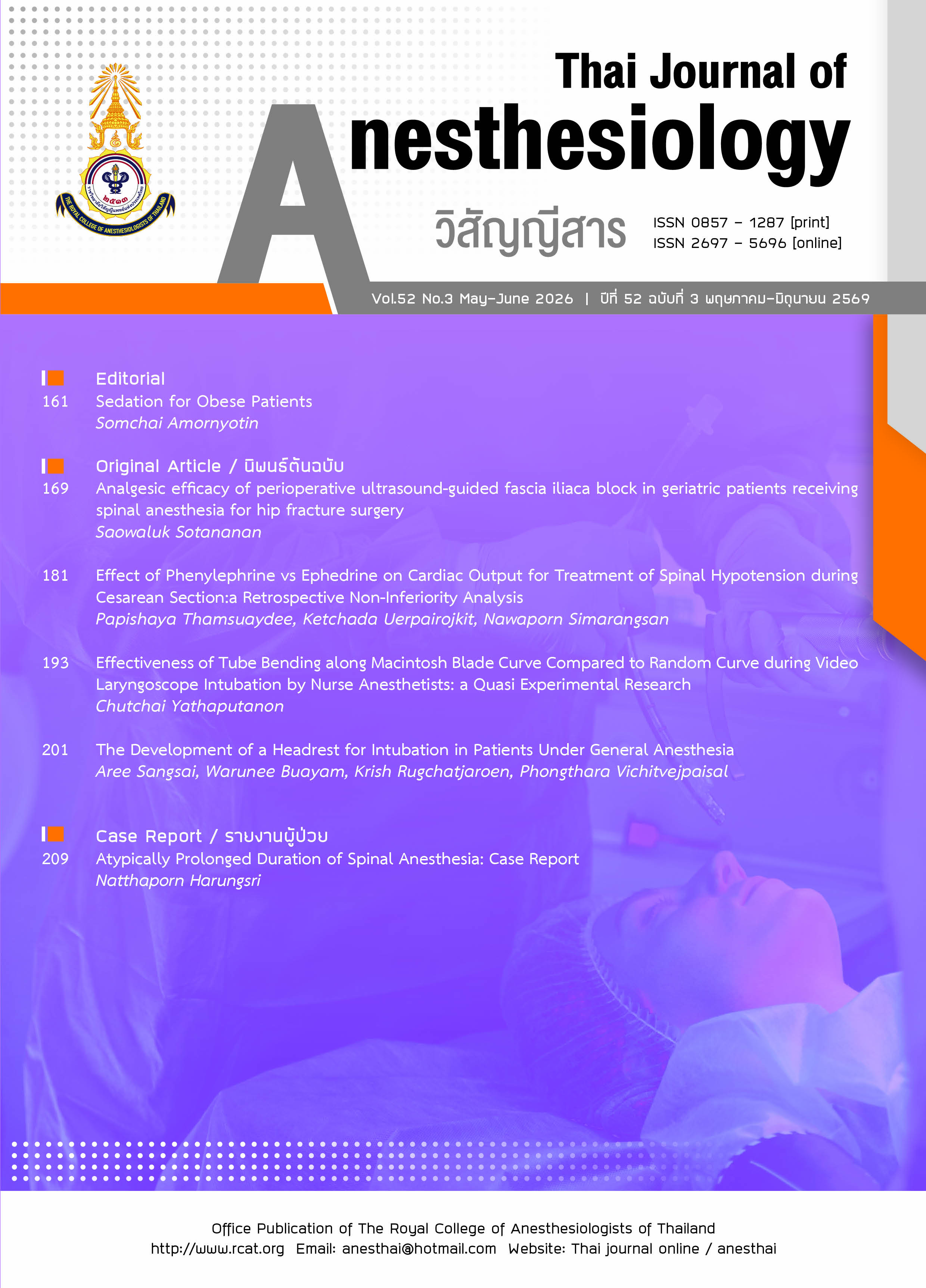
Analgesic efficacy of perioperative ultrasound-guided fascia iliaca block in geriatric patients receiving spinal anesthesia for hip fracture surgery
Keywords:
ageing, hip fracture, nerve block, pain management, perioperative careAbstract
Introduction: Effective perioperative pain management in elderly patients undergoing hip fracture surgery remains challenging. Inadequate pain control not only increases the patient’s distress but may also lead to postoperative complications. The fascia iliaca compartment block (FICB) has been shown to enhance analgesia and improve patient comfort. This study aims to compare the analgesic efficacy of FICB when performed prior to spinal anesthesia in patients undergoing hip fracture surgery. Methods: A prospective randomized study was conducted in 54 elderly patients undergoing hip fracture surgery under spinal anesthesia. Patients were randomly assigned to receive either an ultrasound-guided FICB with 0.25% bupivacaine 40 mL (block group) or sham ultrasound without injection (control group). The prespecified primary outcome was total postoperative morphine consumption at 24 and 48 h. Secondary outcomes included pain during positioning for spinal anesthesia, postoperative pain, patient satisfaction, and adverse events. Longitudinal pain outcomes were analyzed using a linear mixed-effects model. Results: Total morphine consumption at 24 and 48 h was not significantly different between the groups. However, patients in the block group had significantly lower postoperative pain during ambulation. Mixed-effects modelling confirmed a significant overall group effect for postoperative pain on movement (P = 0.009). Pain during positioning for spinal anesthesia was significantly lower in the block group (P < 0.001). Correspondingly, the time required to perform spinal anesthesia was significantly shorter in the block group (P < 0.001). The incidence of complications was similar between groups. Conclusions: Although postoperative opioid consumption did not differ between groups, FICB improved pain during positioning for spinal anesthesia and decreased pain during ambulation without increasing complications.
References
Johansen A, Tsang C, Boulton C, Wakeman R, Moppett I. Understanding mortality rates after hip fracture repair using ASA physical status in the National Hip Fracture Database. Anaesthesia. 2017;72:961-6.
Kim BS, Kim TH, Oh JH, et al. Association between preoperative high sensitive troponin I levels and cardiovascular events after hip fracture surgery in the elderly. J Geriatr Cardiol. 2018;15:215-21.
Danford NC, Logue TC, Boddapati V, Anderson MJJ, Anderson FL, Rosenwasser MP. Surgery after 48 hours of admission for geriatric hip fracture patients is associated with increased mortality and complication rate: a study of 27,058 patients using the National Trauma Data Bank. J Orthop Trauma. 2021;35:535-41.
Borsheski R, Johnson QL. Pain management in the geriatric population. Mo Med. 2014;111:508-11.
Griffiths R, Babu S, Dixon P, et al. Guideline for the management of hip fractures 2020. Anaesthesia. 2021;76:225-37.
Pinson S. Fascia iliaca (FICB) block in the emergency department for adults with neck of femur fractures: a review of the literature. Int Emerg Nurs. 2015;23:323-8.
Jiang M, Liu S, Deng H, Liang X, Bo Z. The efficacy and safety of fast track surgery (FTS) in patients after hip fracture surgery: a meta-analysis. J Orthop Surg Res. 2021;16:1-24.
Leewatchararoongjaroen C, Tangwiwat S, Rungmongkolsab P, Sutthaso P. Analgesic efficacy of ultrasound-guided fascia iliaca compartment block (FICB) and outcomes in preoperative fast-track geriatric patients with hip fracture: a single-center retrospective study. Siriraj Med J. 2024;76:436-43.
Hebbard P, Ivanusic J, Sha S. Ultrasound-guided supra-inguinal fascia iliaca block: a cadaveric evaluation of a novel approach. Anaesthesia. 2011;66:300-5.
Luckanachanthachote C, Pangthipampai P, Iamaroon A, Luansritisakul C, Rungmongkolsab P, Tangwiwat S. Pain management in geriatric hip fracture patients with ultrasound-guided continuous fascia iliaca compartment block: a pilot study. Thai J Anesthesiol. 2022;48:209-22.
Schulte SS, Fernandez I, Van Tienderen R, Reich MS, Adler A, Nguyen MP. Impact of the fascia iliaca block on pain, opioid consumption, and ambulation for patients with hip fractures: a prospective randomized study. J Orthop Trauma. 2020;34:533-8.
Wheeler M, Oderda GM, Ashburn MA, Lipman AG. Adverse events associated with postoperative opioid analgesia: a systematic review. J Pain. 2002;3:159-80.
Sanzone AG. Use of nonopioid analgesics and the impact on patient outcomes. J Orthop Trauma. 2016;30:12-5.
Ftouh S, Morga A, Swift C. Management of hip fracture in adults: summary of NICE guidance. BMJ. 2011;342:d3304.
Høgh A, Dremstrup L, Jensen SS, Lindholt J. Fascia iliaca compartment block performed by junior registrars as a supplement to pre-operative analgesia for patients with hip fracture. Strategies Trauma Limb Reconstr. 2008;3:65-70.
Dochez E, van Geffen GJ, Bruhn J, Hoogerwerf N, van de Pas H, Scheffer G. Prehospital administered fascia iliaca compartment block by emergency medical service nurses: a feasibility study. Scand J Trauma Resusc Emerg Med. 2014;22:38.
Roberts KC, Brox WT. AAOS Clinical practice guideline: management of hip fractures in the elderly. J Am Acad Orthop Surg. 2015;23:138-40.
Thompson J, Long M, Rogers E, et al. Fascia iliaca block decreases hip fracture postoperative opioid consumption: a prospective randomized controlled trial. J Orthop Trauma. 2020;34:49-54.
Guay J, Kopp S. Peripheral nerve blocks for hip fractures in adults. Cochrane Database Syst Rev. 2020;11:1159.
Foss NB, Kristensen BB, Bundgaard M, et al. Fascia iliaca compartment blockade for acute pain control in hip fracture patients: a randomized, placebo-controlled trial. Anesthesiology. 2007;106:773-8.
Hao C, Li C, Cao R, et al. Effects of perioperative fascia iliaca compartment block on postoperative pain and hip function in elderly patients with hip fracture. Geriatr Orthop Surg Rehabil. 2022;13:21514593221092883.
Downloads
Published
How to Cite
Issue
Section
License

This work is licensed under a Creative Commons Attribution-NonCommercial-NoDerivatives 4.0 International License.
Copyright
Copyright of all articles published in the Thai Journal of Anesthesiology is held by the Thai Journal of Anesthesiology, the Royal College of Anesthesiologists of Thailand. Submission of a manuscript constitutes the authors' agreement that, upon acceptance for publication, copyright of the work is transferred to the Journal. The content and any opinions expressed in published articles are the sole responsibility of the authors and do not necessarily reflect the views of the editorial board or the Royal College of Anesthesiologists of Thailand.
Licensing
All articles are published open access under the Creative Commons Attribution-NonCommercial-NoDerivatives 4.0 International License (CC BY-NC-ND 4.0). Under this license, anyone may copy and redistribute published articles in any medium or format for non-commercial purposes, provided that appropriate credit is given to the authors and to the Thai Journal of Anesthesiology as the original source of publication, a link to the license is included, and the material is not modified in any way. Requests for commercial use or for adaptation of published material should be directed to the editorial office.
Authors' Rights
Although copyright is held by the Journal, authors retain the right to reuse their own published material in their future scholarly works, theses and dissertations, teaching, and academic presentations, and to deposit the final published version (PDF) in institutional or subject repositories or on personal and institutional websites, without embargo, provided that the Thai Journal of Anesthesiology is clearly acknowledged as the original place of publication.