
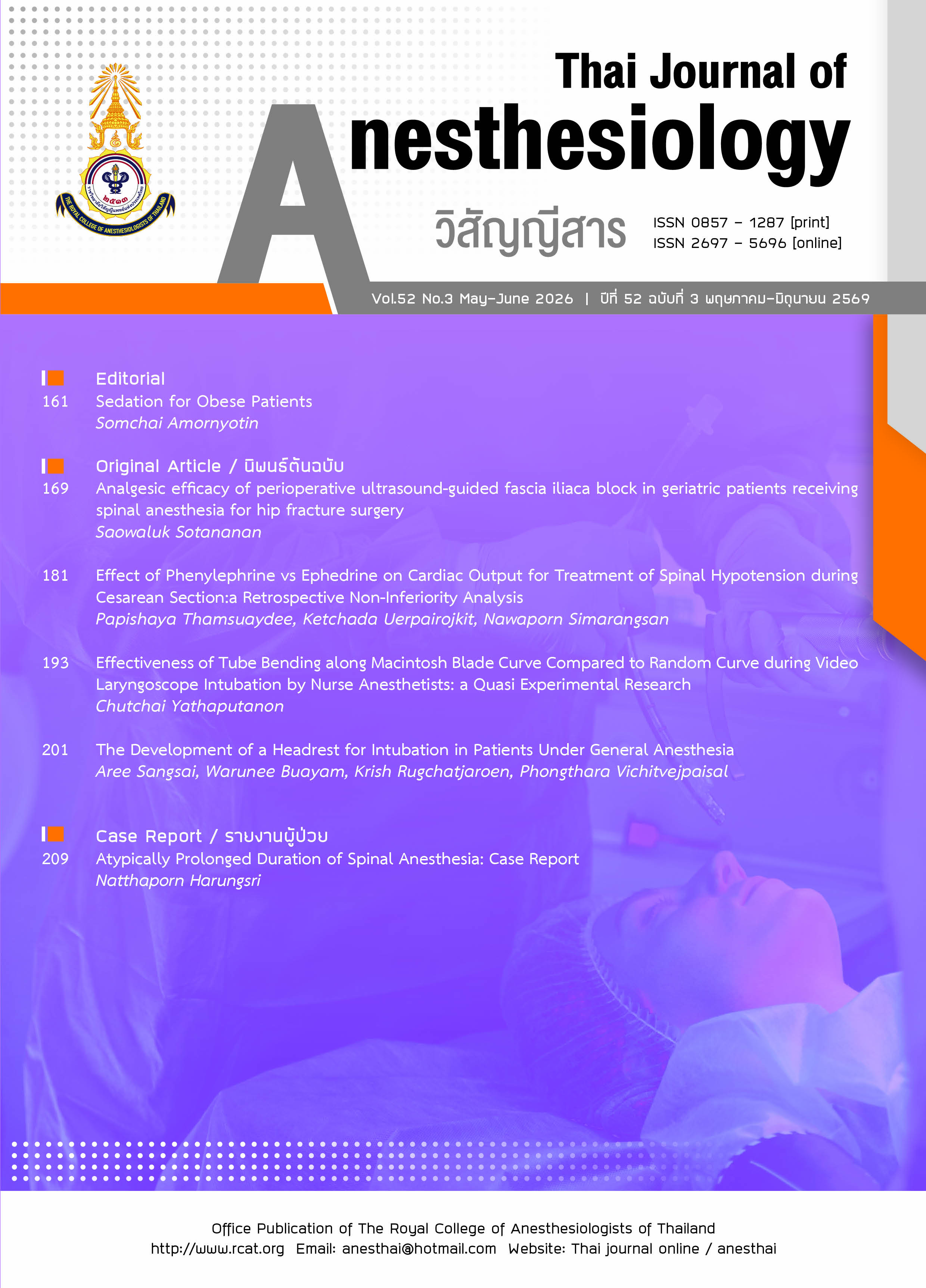
Effect of Phenylephrine vs Ephedrine on Cardiac Output for Treatment of Spinal Hypotension during Cesarean Section: a Retrospective Non-Inferiority Analysis
Keywords:
cesarean section, cardiac output, ephedrine, hypotension, phenylephrine, spinal anesthesiaAbstract
Objective: As the first study to evaluate maternal cardiac output in Thai parturients, we compared the hemodynamic effects of phenylephrine and ephedrine during the management of spinal-induced hypotension for elective cesarean delivery. Materials and methods: This study was a secondary analysis of a previously published randomized controlled multi-centered trial. Data from 33 parturients experiencing spinal hypotension during cesarean section wasanalyzed retrospectively; 19 received phenylephrine (group P) and 14 received ephedrine (group E). Case enrollment was done from December 2019 to September 2020. The primary aim was to compare alterations in maternal cardiac output between before and after vasopressor administration of phenylephrine and ephedrine treatment group, in healthy parturients undergoing an elective cesarean section. The secondary outcomes were to assess the changes in maternal cardiac output and systolic blood pressure, as well as to determine correlation between cardiac output and heart rate after vasopressor administration. Results: The maternal cardiac output change between pre- and post-vasopressor treatment in group P, -0.08 l/min (95%CI -0.44, 0.28), is non-inferior to group E, -0.01 l/min (95%CI -0.44, 0.41). The change in cardiac output in the phenylephrine group did not cross the pre- specified non-inferior margin of -1.17 l/min. There were no significant differences in changes of heart rate and cardiac output before after vasopressor administration between and two groups. In addition, it is found that cardiac output is positively correlated with heart rate (Pearson correlation = 0.512) after vasopressor administration. Conclusion: Cardiac output difference after vasopressor administration in the phenylephrine was non-inferior to ephedrine. Heart rate, rather than choice of vasopressor, might have a role on maternal cardiac output. Additional research focusing on high-risk pregnancies is necessary to gain insights into specific patient populations.
References
Practice guidelines for obstetric anesthesia: an updated report by the American Society of Anesthesiologists Task Force on Obstetric Anesthesia and the Society for Obstetric Anesthesia and Perinatology. Anesthesiology. 2016;124:270-300.
Cooper DW, Carpenter M, Mowbray P, Desira WR, Ryall DM, Kokri MS. Fetal and maternal effects of phenylephrine and ephedrine during spinal anesthesia for cesarean delivery. Anesthesiology. 2002;97:1582-90.
Dyer RA, Reed AR, van Dyk D, et al. Hemodynamic effects of ephedrine, phenylephrine, and the coadministration of phenylephrine with oxytocin during spinal anesthesia for elective cesarean delivery. Anesthesiology. 2009;111:753-65.
Nguyen LP, Gerstein NS. Cardiovascular pharmacology in noncardiac surgery. In: Kaplan JA, Cronin B, Maus T, editors. Essentials of cardiac anesthesia for noncardiac surgery, 1st ed., Philadelphia: Elsevier. 2019;p247-88.
Robson SC, Boys RJ, Rodeck C, Morgan B. Maternal and fetal haemodynamic effects of spinal and extradural anesthesia for elective caesarean section. Br J Anaesth. 1992;68:54-9.
Skjoldebrand A, Eklund J, Johansson H, et al. Uteroplacental blood flow measured by placental scintigraphy during epidural anaesthesia for caesarean section. Acta Anasethesiol Scand. 1990;34;79-84.
Zoremba N, Bickenbach J, Krauss B, Rossaint R, Kuhlen R, Schalte G. Comparison of electrical velocimetry and thermodilution techniques for the measurement of cardiac output. Acta Anaesthesiol Scand. 2007;51:1314-9.
Schmidt C, Theilmeier G, Van Aken H, et al. Comparison of electrical velocimetry and transoesophageal doppler echocardiography for measuring stroke volume and cardiac output. Br J Anaesth. 2005;95:603-10.
Norozi K, Beck C, Osthaus WA, Wille I, Wessel A, Bertram H. Electrical velocimetry for measuring cardiac output in children with congenital heart disease. Br J Anaesth. 2008;100:88-94.
Feng S, Liu J. Electrical velocimetry has limited accuracy and precision and moderate trending ability compared with transthoracic echocardiography for cardiac output measurement during cesarean delivery: a prospective observational study. Medicine. 2020;99:e21914.
Martin E, Anyikam A, Ballas J, et al. A validation study of electrical cardiometry in pregnant patients using transthoracic echocardiography as the reference standard. J Clin Monit Comput. 2016;30:679-86.
Uerpairojkit K, Thongthaweeporn N, Anusorntanawat R, et al. A randomized comparison of hemodynamic changes in response to a heart rate-dependent phenylephrine/ephedrine protocol versus ephedrine-only for spinal hypotension during elective cesarean section. J Obstet Gynaecol Res. 2022;48:1750-9.
Ngamjarus C, Pattanittum P. n4Studies: application for sample size calculation in health science research. Version 2.2. App store; 2023.
Phenylephrine hydrochloride injection package insert. Lake Forest, IL: Hospira, Inc.; 2005 Nov.
Downloads
Published
How to Cite
Issue
Section
License

This work is licensed under a Creative Commons Attribution-NonCommercial-NoDerivatives 4.0 International License.
Copyright
Copyright of all articles published in the Thai Journal of Anesthesiology is held by the Thai Journal of Anesthesiology, the Royal College of Anesthesiologists of Thailand. Submission of a manuscript constitutes the authors' agreement that, upon acceptance for publication, copyright of the work is transferred to the Journal. The content and any opinions expressed in published articles are the sole responsibility of the authors and do not necessarily reflect the views of the editorial board or the Royal College of Anesthesiologists of Thailand.
Licensing
All articles are published open access under the Creative Commons Attribution-NonCommercial-NoDerivatives 4.0 International License (CC BY-NC-ND 4.0). Under this license, anyone may copy and redistribute published articles in any medium or format for non-commercial purposes, provided that appropriate credit is given to the authors and to the Thai Journal of Anesthesiology as the original source of publication, a link to the license is included, and the material is not modified in any way. Requests for commercial use or for adaptation of published material should be directed to the editorial office.
Authors' Rights
Although copyright is held by the Journal, authors retain the right to reuse their own published material in their future scholarly works, theses and dissertations, teaching, and academic presentations, and to deposit the final published version (PDF) in institutional or subject repositories or on personal and institutional websites, without embargo, provided that the Thai Journal of Anesthesiology is clearly acknowledged as the original place of publication.